Deciphering the Pathways - Differences Between O-1, EB-1, and EB-2 Visas
The O-1, EB-1, and EB-2 all reward excellence, but they serve different purposes. A clear look at how the three categories differ and who each one fits.
Vera Kenahan
February 2, 2026 · 5 min read

Navigating the U.S. immigration system for employment can feel like solving a puzzle with many pieces. Among the options for professionals with exceptional skills or achievements, the O-1, EB-1, and EB-2 visas stand out. Although these categories share a focus on excellence, they serve different purposes, involve distinct application processes, and offer varying benefits. Here's a comprehensive look at what sets them apart:
O-1 Visa: Non-Immigrant Status for Extraordinary Individuals
Purpose:
The O-1 visa is a non-immigrant visa (temporary) for those with extraordinary ability or achievement in their field, whether in sciences, arts, education, business, or athletics, or for those with a distinguished record in television or motion pictures.
Key Characteristics:
- Temporary Nature: It's not a direct path to permanent residency but can be extended indefinitely in one to three-year increments.
- Eligibility: Requires proof of sustained acclaim, often through awards, significant contributions, or expert endorsements.
- Employer Flexibility: O-1 holders can work for multiple employers, each needing to file an O-1 petition.
- No Permanent Residency: The O-1 is strictly nonimmigrant; holders must maintain ties to their home country or seek another visa category if they wish to adjust status.
- No Cap: There's no annual limit on O-1 visas, making it potentially quicker to obtain than capped visas.
Ideal For:
- Freelancers, consultants, or professionals with short-term contracts.
- Individuals with notable achievements seeking to work temporarily in the U.S.
- Those who might later consider transitioning to an immigrant visa if they plan to stay permanently.
EB-1 Visa: The Employment-Based First Preference
Purpose:
The EB-1 visa is an immigrant visa (green card) for individuals with extraordinary ability who are at the very top of their field, outstanding professors or researchers, or multinational executives or managers. It's designed for those who wish to live permanently in the U.S.
Subcategories:
- EB-1A (Extraordinary Ability): For those who excel in their field without the need for a job offer or labor certification – individuals with extraordinary ability in the sciences, arts, education, business, or athletics.
- EB-1B (Outstanding Professors/Researchers): For those with international acclaim in academia.
- EB-1C (Multinational Managers/Executives): For intracompany transfers of high-level employees.
Key Characteristics:
- Permanent Residency: Leads directly to a green card, offering a path to U.S. citizenship.
- High Standards: Requires more rigorous proof of achievements – substantial evidence compared to O-1, given it's for permanent residency.
- No Labor Certification: EB-1A doesn't require a job offer or PERM labor certification, unlike many other employment-based visas.
Ideal For:
- Professionals who have already achieved a high level of recognition in their field.
- Academics and researchers with significant contributions to their discipline.
- Multinational executives or managers looking to transition to permanent residency in the U.S.
EB-2 Visa: The Employment-Based Second Preference
Purpose:
The EB-2 visa is for professionals with advanced degrees or exceptional ability in sciences, arts, or business. It's another route to permanent residency but with different criteria from EB-1.
Subcategories:
- EB-2A (Advanced Degree): For those with a master's degree or higher or a bachelor's degree with five years of progressive work experience.
- EB-2B (Exceptional Ability): For those with exceptional skills in their field.
- National Interest Waiver (NIW): A special provision allowing self-petition without a job offer if the work is in the U.S. national interest.
Key Characteristics:
- Advanced Degree Requirement: Generally, requires a master’s degree or higher, or a bachelor’s degree with at least five years of progressive work experience in the field.
- Eligibility: While not as stringent as EB-1, still requires significant proof of qualifications or contributions.
- Labor Certification: Typically requires a PERM labor certification unless NIW is pursued.
- Visa Backlog: Depending on the country of origin, there can be long waiting times due to annual visa quotas.
Ideal For:
- Professionals with advanced academic credentials and significant work experience.
- Individuals whose contributions can be argued to have national significance, especially under the NIW provision.
- Applicants who are strong in their field but may not meet the ultra-high standards of the EB-1 category.
Key Differences at a Glance:
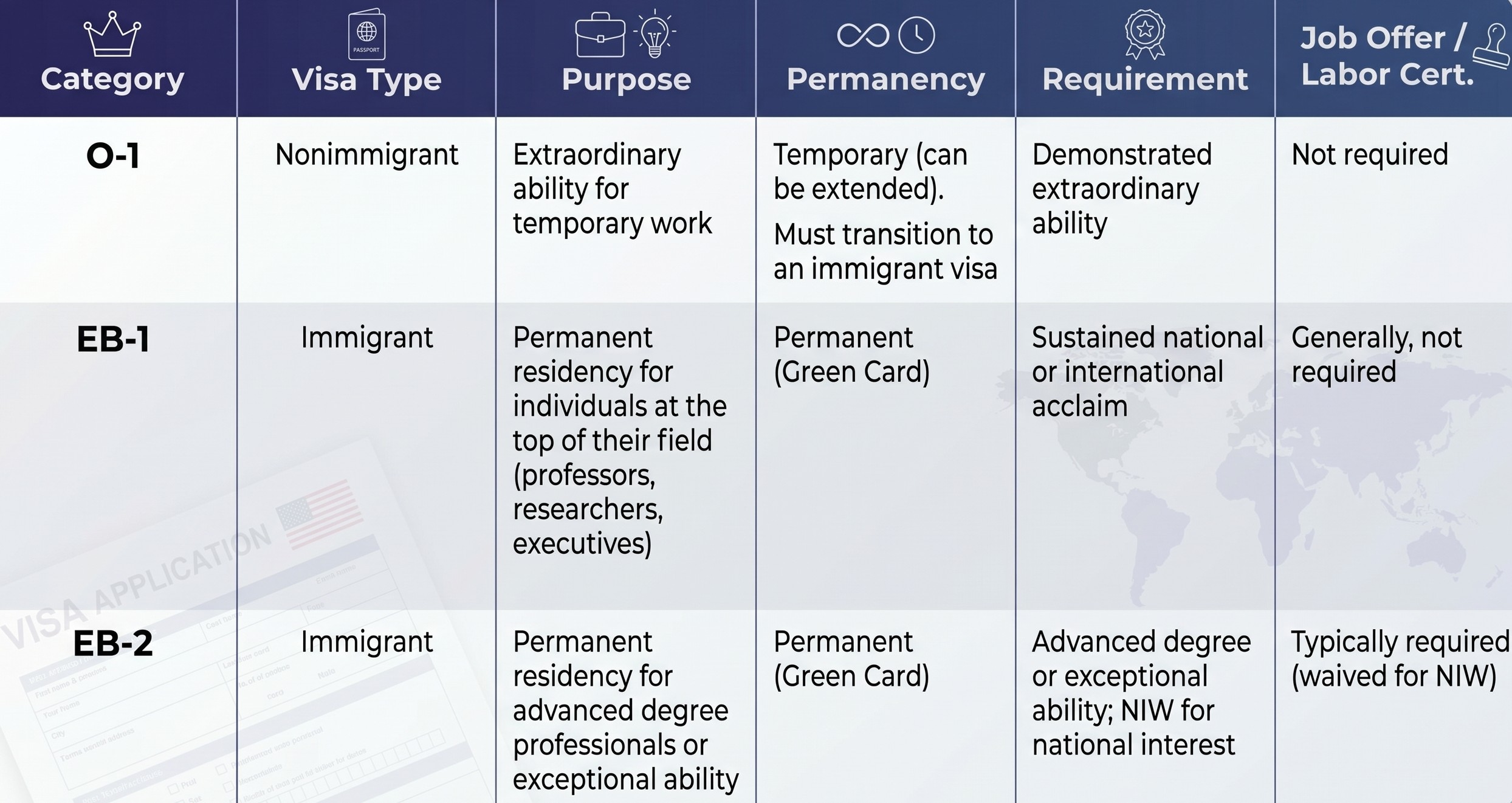
Conclusion
Choosing between these visas depends on your career stage, long-term goals, the nature of your achievements, and your immediate needs. The O-1 is excellent for those who want to work in the U.S. without committing to permanent residency initially. In contrast, EB-1 and EB-2 are for those looking to settle permanently. Each visa has its nuances, and consulting with an immigration attorney can provide personalized guidance tailored to your situation. Remember, the journey to working or living in the U.S. involves understanding these intricate pathways, each with its own set of rewards and challenges.