EB-1A in 2026: Why More Petitions Get RFEs — and How to Build a Case That Actually Gets Approved
EB-1A requirements for 2026: the 10 criteria, how USCIS’s two-step review works, and what evidence gets your green card approved without an RFE.
Vera Kenahan
October 5, 2026 · 20 min read

This guide is for informational purposes only and is not legal advice. EB-1A eligibility is highly fact-specific. Sporadic policy updates and case laws constantly change USCIS adjudication standards. Whether you qualify as having "extraordinary ability" depends on your field, the strength of your evidence, and how your case is presented. Always verify current guidance at uscis.gov/policy-manual and consult a licensed immigration attorney before making any decisions.
What Is EB-1A and Who It Is Actually For
EB-1A, which stands for Employment-Based First Preference, is a green card category for individuals at the pinnacle of their field. Its main advantage is that you can apply on your own, without requiring employer sponsorship or a job offer.
It requires proof of "sustained national or international acclaim" in sciences, arts, education, business, or athletics and is governed by 8 CFR § 204.5(h).
How it differs from other employment-based green cards:
• No employer sponsorship needed.
• No PERM labour certification (the long process where an employer tests the U.S. job market).
• No specific job offers. You do, however, have to show that you plan to keep working in your field after you arrive. That is a legal requirement, covered later under “The Plan-to-Keep-Working Requirement.”
• A much higher bar than EB-2 or EB-3. This is “extraordinary ability,” not “strong candidate.”
One thing to keep in mind: It is important to note that EB-1A is a legal standard that requires proof, not just a career reward. It signifies that you are among the minute percentage at the top of your field. It is very prestigious hence many highly accomplished professionals don't qualify.
These approval rates vary from year to year, and those that are self-filed usually receive more attention than those that were sponsored by an employer. USCIS does not provide specific figures on the EB-1A approval rate. However, they provide statistics on the total number of I-140s filed, approved, and denied, broken down by type, in their public immigration data database, which is the best place to see these trends in general terms. There are also trends that differ between various fields, e.g., sports vs. software developers/researchers.
Self-nominated petitions usually have higher standards because there are incentives: a petition filed by the employer implies that the employer is responsible for endorsing and supporting the candidate, while a self-nominated applicant stands to gain by exaggerating their qualifications. The officers realize that fact, which is why third-party evidence is much more crucial compared to assertions made either by yourself or by your employer about yourself. Your self-nomination is evaluated depending on whether the field acknowledges you.
RFE and denial rates have increased as officers enforce the standards more rigorously. It's important to remember that the review climate reflects policy decisions, not just bureaucratic attitudes. Enforcement priorities change depending on leadership, so a case that passes easily one year might encounter more scrutiny the next. The best safeguard is a well-prepared petition that can withstand the strictest interpretation of the rules.
The Legal Standard: What USCIS Actually Evaluates
The USCIS framework stems from only one court ruling. The ruling comes from the case Kazarian v. USCIS, in which the court held that it would be inappropriate to impose excessive requirements when considering criteria. Instead, it provided an approach for evaluating such cases that consisted of two stages (Kazarian v. USCIS, 596 F.3d 1115 [9th Cir. 2010]).
This is not just a hypothetical. The name of Officer Kazarian is included in the RFEs and Denials, lawyers construct arguments based on it, and all of the steps discussed below have come about because of this. This is the case one needs to remember when doing any research or discussion regarding the Standard.
The burden is on you. In order to substantiate your case, the “preponderance of the evidence” standard requires that every assertion made has more than a fifty percent chance of being correct according to the evidence presented. As such, every piece of evidence needs to have its own proof, and it is your duty to ensure that every item ties in directly with the corresponding point.
With that in mind, USCIS applies a two-step analysis to every EB-1A petition:
Step 1: Count the Criteria
You must meet at least 3 of the 10 criteria outlined in 8 CFR § 204.5(h)(3).Meeting 3 criteria is the minimum threshold. Meeting more of the criteria won’t guarantee your approval if the final merits determination fails.
The 10 criteria are:
• Lesser nationally or internationally recognized prizes or awards for excellence.
• Membership in associations that require outstanding achievement to join.
• Published material about you in professional or major trade publications.
• Judging the work of others in your field.
• Original contributions of major significance (scientific, scholarly, artistic, athletic, or business).
• Authorship of scholarly articles in professional journals or major media.
• Display of your work at artistic exhibitions or showcases.
• A leading or critical role in distinguished organizations.
• A high salary compared with others in your field.
• Commercial success in the performing arts.
Comparable Evidence: A Path for Non-Traditional Fields
In the case where the above mentioned ten characteristics are not applicable to your field, the regulation allows you to use evidence that can be considered equivalent. This is a real alternative; it is not a mere footnote to the statute but is present due to the fact that the characteristics in question are mainly geared toward scientists, artists, and athletes.
Two things are absolutely necessary in this context. Firstly, one needs to show that the standard requirements do not apply to one’s own field, as opposed to showing preference for using a different kind of proof. Secondly, everything one submits has to be considered equal to the requirement stated in the checklist. For instance, instead of submitting articles published in peer-reviewed journals, one could submit information about fundraising rounds, acquisitions or recognition from the industry. USCIS has a very narrow definition of what qualifies as an equivalent of the required proof.
Step 2: The Final Merits Review
Even after you meet three criteria, USCIS steps back and looks at everything together:
• Are you at the very top of your field, not just above average?
• Is the recognition sustained, rather than a single moment?
• Does the whole record really support a claim of extraordinary ability?
In practice, checking boxes is not enough. Petitions with thin evidence spread across many criteria often fail here, while tighter cases with clear, well-documented evidence tend to get approved.
What “Sustained” Really Means
“Sustained” in “sustained national or international acclaim” is an essential term, and its meaning frequently creates misunderstanding. One important accomplishment achieved some years ago is normally not enough by itself. USCIS usually requires proof of sustained acclaim. For instance, sustained activity in publishing, judging, media appearances, or positions of leadership in one’s field. For example, if you obtained recognition two or three years ago but have now taken up managerial work or moved on to another area of practice, the clock keeps ticking. Your application needs to show that your recognition is relatively new.
Example: How the Two-Step Analysis Plays Out
Take a software engineer with this profile:
• Senior Staff Engineer at a well-known tech company, $280,000 total compensation.
• 2 published papers, 47 citations combined.
• Reviewed 3 manuscripts for one conference over two years.
• Active member of ACM and IEEE.
• Led an internal platform used across the company.
Step 1 analysis:
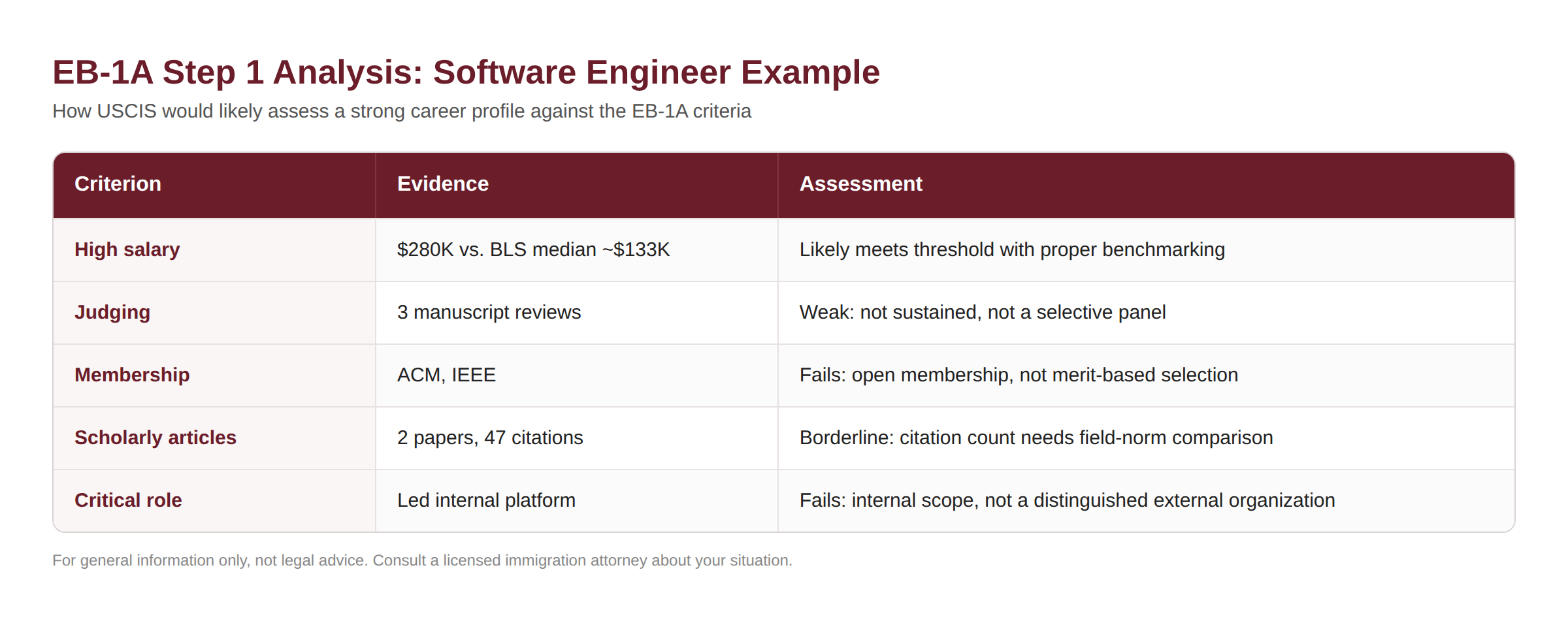
Result at Step 1: maybe 1 to 2 criteria, not the 3 required.
Step 2 (only if Step 1 were met): even if this person scraped together 3 criteria, the final review would likely find too little outside recognition:
• The citations are not top 5% by field norms.
• The judging is below what officers expect.
• The platform work stayed inside one company.
USCIS would probably issue an RFE, or deny, on the basis that the record does not show sustained national or international acclaim.
What would change the outcome: Examples of evidence that clearly indicate the professional status of the individual in the relevant industry include having a significant impact factor within his/her field, regular peer reviews for highly selected journals, awards confirmed through a selection process, and recognition in reliable trade journals.
A note on the salary criterion: The question about high salaries needs to be answered in regard to your local labour market rather than considering national averages. According to the Bureau of Labor Statistics, there are figures concerning wages that can be used metro by metro, meaning that $280,000 in San Francisco means something else when compared to $280,000 earned in Omaha. This means that the officer may find it wrong to compare the income of the worker in San Francisco with the national average.
Why RFEs Get Issued: The Real Reasons
RFEs follow predictable patterns, especially when the evidence does not clearly connect to the legal standard.
1. Evidence is submitted but never analyzed
Too many poor petitions simply list documents without explaining how they apply to any one criterion or the overall case. USCIS will not make your case for you. Each document should be tied to a criterion or the overall case, with its relevance clearly explained.
2. A criterion is claimed without actually meeting it
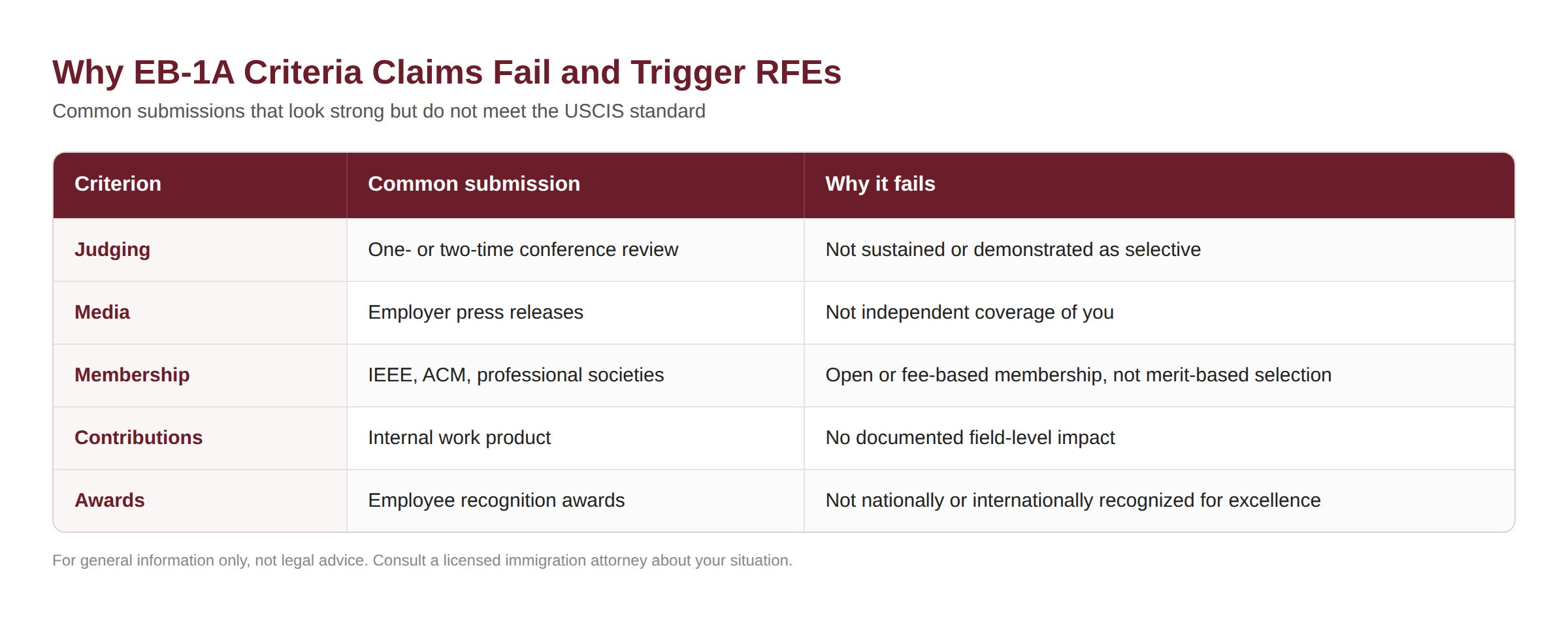
3. Recommendation letters are generic
Weak letters: praise without proof, written by your own managers or colleagues, with no metrics and no comparison to your peers.
Strong letters:
• Come from independent experts outside your employer, and put numbers on your impact.
• Compare your work directly to others in the field.
• Explain why your contributions matter at a national or international level.
A letter from your PhD advisor saying you are talented is weaker than a letter from an independent expert in your subfield showing how your specific paper changed the way the field approaches a problem, backed by citations that prove others adopted it.
4. There is no final-merits story
The typical problem is that the petition sometimes appears to qualify under various categories in Step 1, yet doesn’t explain how the combined information supports this person's being considered a top expert in their field. The officers just want a clear answer to a simple question: “Is this person recognized as a top expert in his/her field?
5. Confusing career success with extraordinary ability
This is the most common mistake of all:
• A high salary does not equal extraordinary ability.
• A senior title does not equal extraordinary ability.
• Working at a big company does not equal extraordinary ability.
• Patents do not equal extraordinary ability on their own, unless they were licensed or adopted at scale.
USCIS is looking for recognition by the field, not internal career progress.
What Strong Evidence Actually Looks Like
The best evidence combines three things: outside validation, specific detail, and, where possible, hard numbers showing your impact.
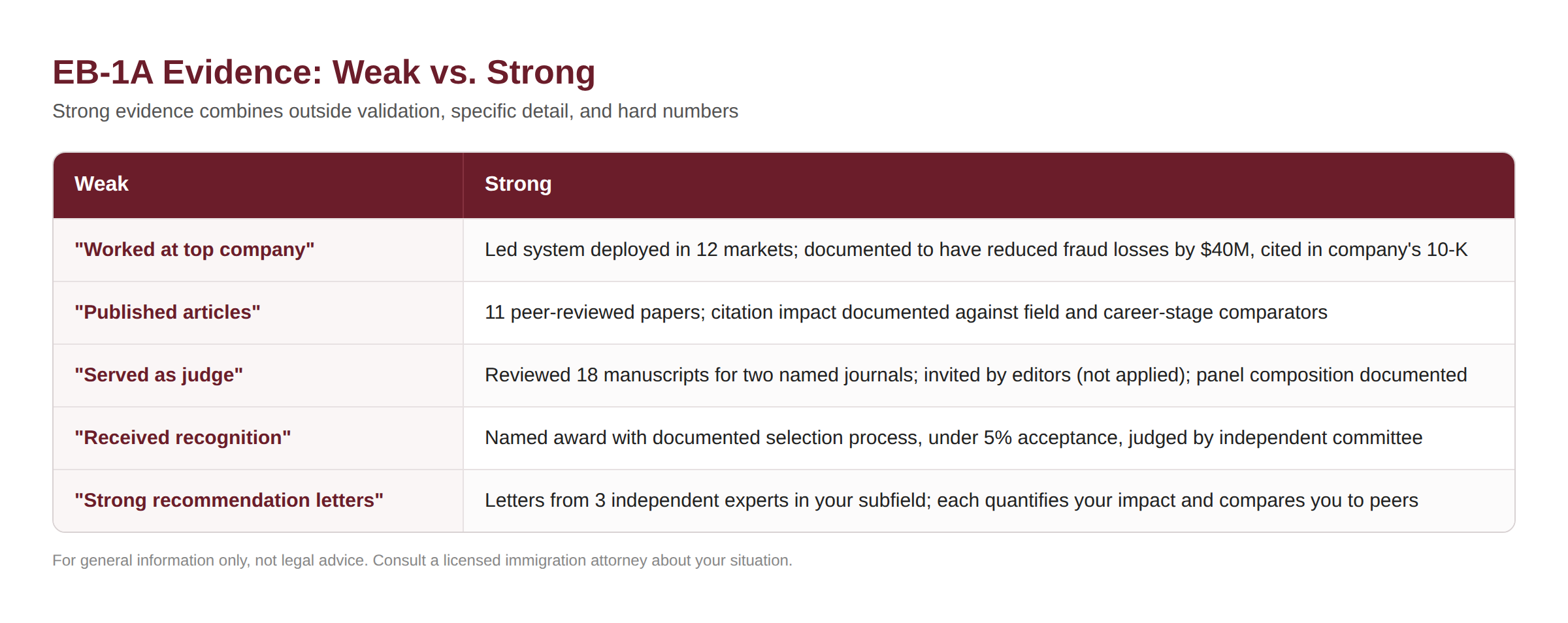
On citation counts: Citations alone are insufficient. You need to demonstrate what is typical for your field and career stage, then show how you surpass that standard. A researcher with 340 citations in physics, for example, is making a different claim than someone with 340 citations in a niche humanities subfield. Use Google Scholar field norms, h-index comparisons, or other field-specific benchmarks, and explicitly include the comparison. Do not assume the reviewer will do this analysis for you.
How to Structure the Petition Brief
Strong evidence still has to be laid out the way an officer expects to read it. Experienced practitioners follow a predictable structure, and a messy brief, no matter how good the underlying evidence, creates friction that can trigger an RFE on its own.
A well-organized EB-1A brief usually does three things:
• Takes each claimed criterion in turn. Give each of the three (or more) criteria its own labeled section.
• Breaks each criterion down by evidence. Within each section, give each piece of evidence its own subsection, and make the explicit legal argument for why it satisfies that criterion under the regulation and the Policy Manual.
• Closes with a separate final-merits section. After the criteria, add a distinct section that pulls the whole record together and argues, as a whole, that you have sustained acclaim and sit at the top of your field. This is the Step 2 argument, and it should never be left implied.
An officer reading a brief built this way can check compliance quickly. That is the goal: make the approval easy to write.
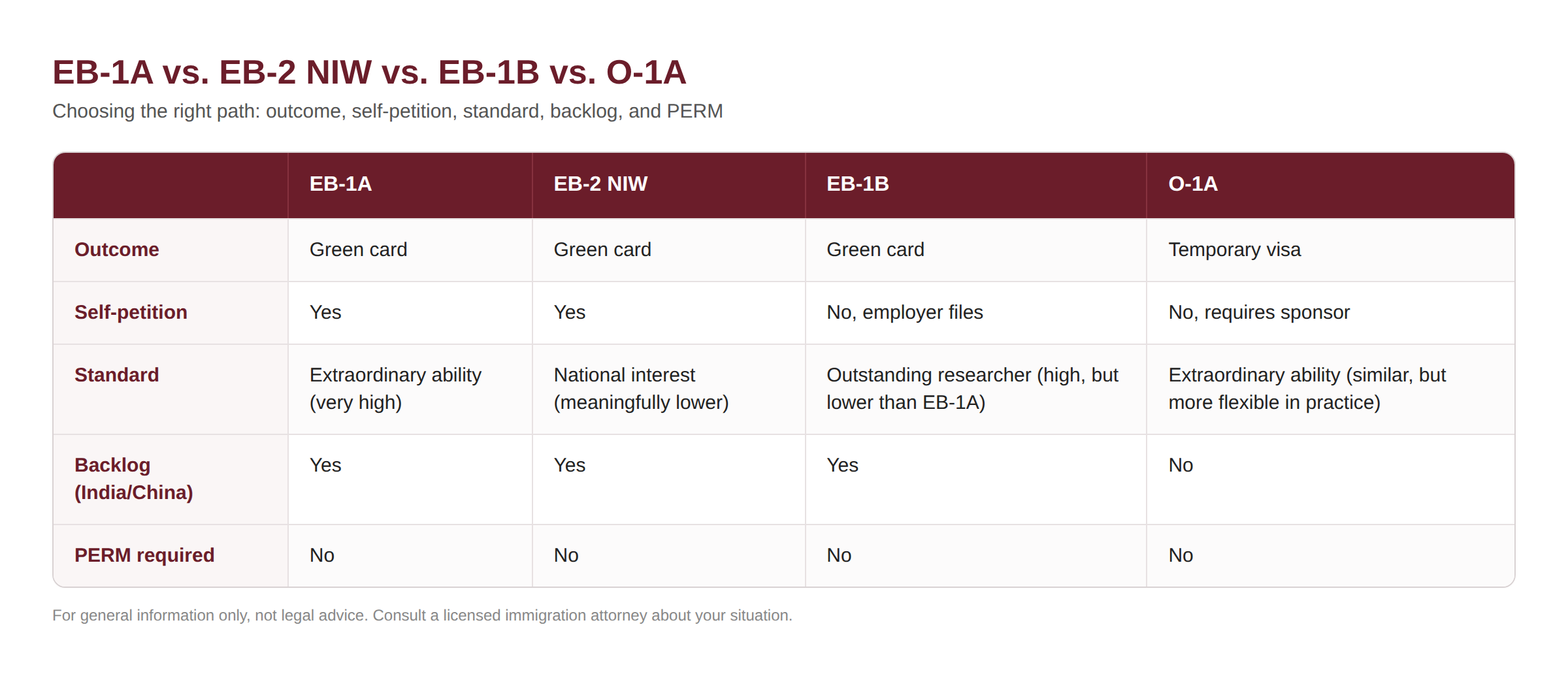
EB-1A vs. EB-2 NIW vs. O-1A: Choosing the Right Path
Before you commit to EB-1A, it helps to see how it compares with the related options.
EB-1B (Outstanding Researcher or Professor)
The most widely used category for academics and scientists, however, seems to be EB-1B, which, despite its advantages, is overlooked by most guides. Just like EB-1A, EB-1B belongs to the same preference category and thus shares the same priority dates and does not require a PERM labor certification. There are two notable distinctions.
For one, EB-1B needs an employer. An employer needs to provide a permanent research position or a tenured/tenure-track teaching position and serve as a petitioner; thus, the petition cannot be filed by oneself. Two, more importantly, there is a reduced requirement for EB-1B. You have to prove that you are internationally recognized as outstanding in your field, not an individual of extraordinary ability, through fulfilling two of six standards and having a minimum of three years of experience as either a researcher or teacher. For a researcher who publishes papers well and can prove a good peer-review history, he can be approved for EB-1B even if he does not qualify for EB-1A.
EB-2 National Interest Waiver (NIW)
EB-2 NIW is a self-petition that waives the usual job-offer and PERM requirements, on the basis that your work serves the national interest of the United States.
When NIW may be the better first move:
• Your profile is strong but does not clearly scream top-of-field.
• You work in STEM, healthcare, or another field with a documented national interest.
• You cannot yet show 3 EB-1A criteria convincingly.
• You want a workable filing now while you keep building toward EB-1A (which also preserves a priority date for later).
Important: an approved EB-2 NIW locks in your priority date. If your EB-1A case gets stronger later, you can file EB-1A then, while the NIW petition holds your place in line.
O-1A
O-1A is a temporary nonimmigrant visa and therefore It is not itself a green card category. It uses similar extraordinary ability concepts, but approval of O-1A does not mean that the EB-1A analysis will have the same outcome.Do not assume O-1A approval reduces the risk of your
When O-1A makes sense first:
• You need U.S. work authorization now, and your green card case needs more time.
• Your profile is borderline and you want to build more evidence (judging, media, awards) before filing EB-1A.
• You are heading toward EB-1A but need another year or two to gather evidence.
If You Are on H-1B: How EB-1A Fits With Your Status
Most people reading an EB-1A guide are on H-1B, so it is worth spelling out how the two interact.
• An approved I-140 unlocks H-1B extensions past the six-year cap. With the help of American Competitiveness in the 21st Century Act (AC21), after your EB-1A I-140 petition is approved, you can stay in the country as an H-1B on an extension for up to three years even after reaching the standard duration of six years. This is perhaps the biggest reason for getting your I-140 approved now.
• A self-filed I-140 moves with you. Because EB-1A is self-petitioned, the approved I-140 belongs to you, not an employer. If you change jobs, it goes with you, unlike an employer-sponsored petition the employer could withdraw.
• A pending I-485 gives you flexibility. Once you have filed for adjustment of status and hold a pending I-485 with work authorization, you have options you did not have on H-1B alone, including job portability.
• Cap-gap does not apply here. Cap-gap protection bridges F-1 students into H-1B. It is not part of the EB-1A path, so do not plan around it in this context.
Timing Reality: Approval Does Not Mean a Green Card
Getting your I-140 approved does not make you a permanent resident. It only establishes that you are eligible. When you can actually get the green card depends on the Visa Bulletin.
Your country of birth, not your passport, sets your wait time.
From the June 2026 Visa Bulletin (Final Action Dates, EB-1):
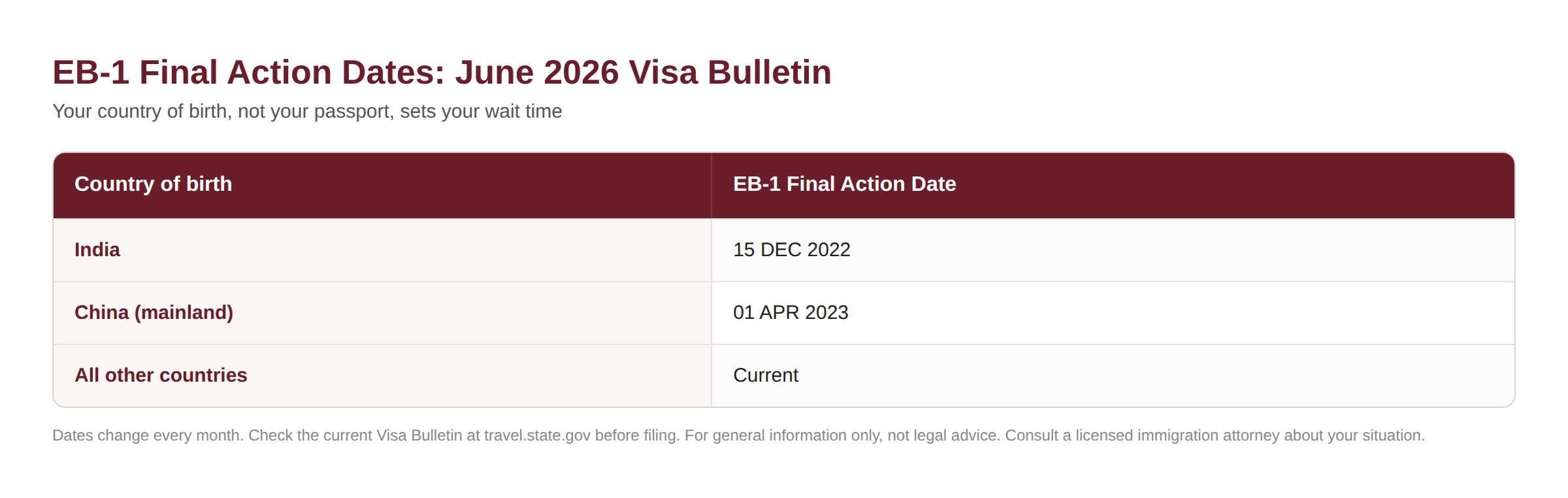
These dates are examples and change every month. Always check the current dates at travel.state.gov before you make any filing decisions. They can move without warning.
How to read the table: “Current” means you can move ahead right away. A date (say, 15 DEC 2022) means only people whose priority date falls before that date can proceed. Your priority date is usually the day USCIS received your I-140.
Why these backlogs exist: The maximum number of visas available to individuals from any one nation is capped each year by U.S. law. Given the huge volume of applicants from both India and China, long delays are expected, spanning years or even decades. Current wait times for EB-1 applications from India and China are several years out of date, while EB-2 applications from India may take decades.
Retrogression is a real risk, even in EB-1. The Final Action Dates are not just going to increase forward. In cases where demand exceeds the per-country cap, the State Department could push the cut-off date back, meaning that the date that was current last month will no longer be the case next month. This has occurred in previous years regarding EB-1 India/China, and this is currently taking place as well because the June 2026 bulletin moved the dates back to December 15, 2022, and a warning was given by the State Department for more retrogression and making categories “unavailable” before the September 30 fiscal year-end deadline.
Cross-chargeability: if you and your spouse were born in different countries and your birth country has a severe backlog, you may be able to “charge” your green card to your spouse’s less-backlogged country, as long as you file together as co-applicants.
Premium processing: this only speeds up USCIS action on the I-140 itself, and it guarantees the agency will act within the set timeframe. It does nothing for I-485 processing, Visa Bulletin waits, or consular scheduling. It does not get you a green card faster.
The EB-1A Process, Start to Finish
Here is a realistic view of the full sequence, including steps a lot of guides leave out.
Phase 1: Build Your Petition
• Evidence audit: figure out honestly which criteria you meet, and how strongly.
• Gather documentation: letters, citations, award records, media, salary data.
• Collect recommendation letters from independent experts.
• Draft a legal brief connecting each piece of evidence to specific criteria and to the final-merits standard (see “How to Structure the Petition Brief” above).
• File Form I-140 with USCIS, plus the premium processing fee if you want it.
Phase 2: USCIS Adjudication
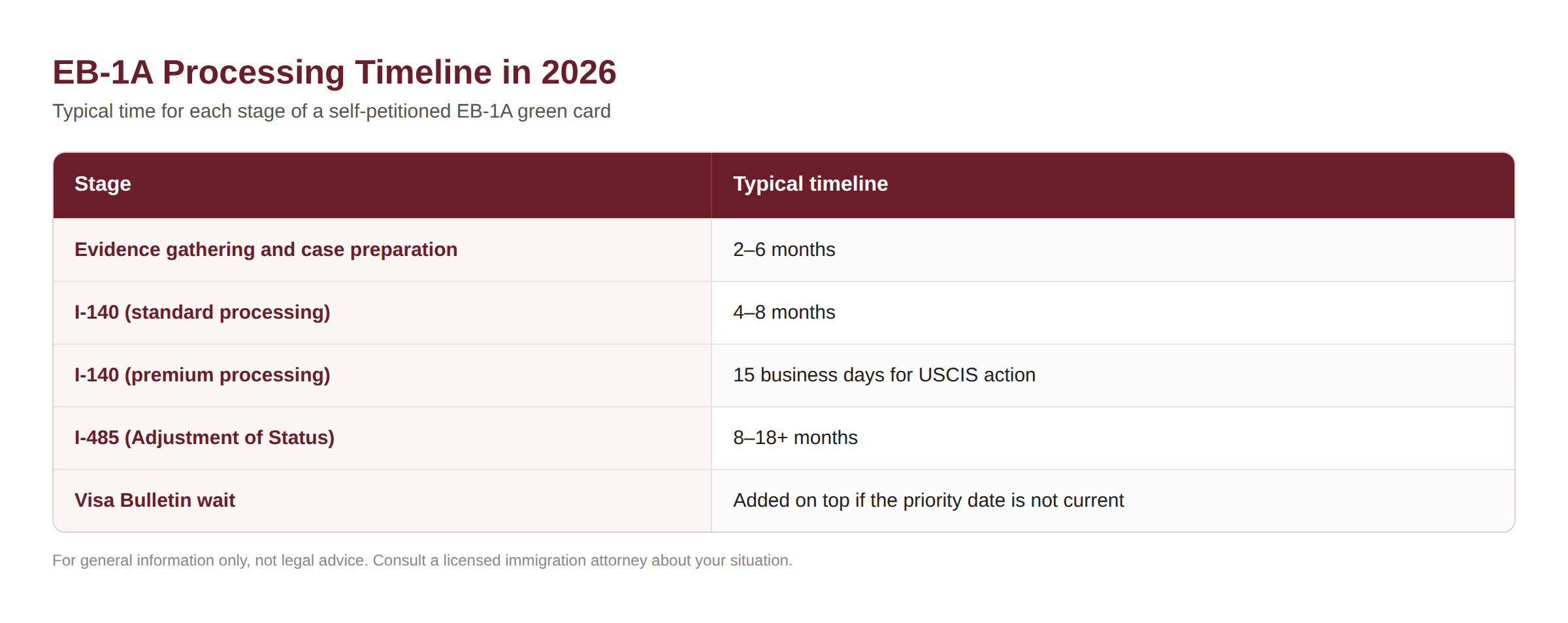
If your priority date is current, a well-planned out self-petition process using premium processing could take you from the beginning of the process to filing an I-485 in less than one year. In most cases, when applicants are from India or China, the Visa Bulletin slows the process.
Phase 3: After I-140 approval
If your priority date is current (or becomes current):
Path A: Adjustment of Status (if in the U.S.):
- File Form I-485 (adjustment of status), simultaneously with Form I-765 (work authorization) and Form I-131 (advance parole/travel document)
- Attend a biometrics appointment — you will receive a Form I-797C notice with your scheduled time; this step is mandatory and cannot be skipped (although USCIS may sometimes reuse prior biometrics)
- Receive your EAD card and, separately your AP document (typically within a few months of filing)
- Potentially attend an interview (not always required for employment based cases; varies by field office)
- Receive green card decision
Path B: Consular Processing (if outside the U.S. or if preferred):
- USCIS forwards approved I-140 to the National Visa Center (NVC)
- NVC collects fees, civil documents, and supporting materials ( this stage alone can take months depending on embassy backlogs- timelines which vary significantly by consulate and case)
- NVC schedules a consular interview at the relevant U.S. embassy or consulate
- Attend interview; receive immigrant visa
- Enter the U.S. on immigrant visa; green card issued after entry
Important: Renewing your EAD during a long wait. If you have filed I-485 and your EAD expires while your case is still pending (including during retrogression), you can and should file Form I-765 for renewal. Do not assume your EAD auto renews. File proactively.
The Plan-to-Keep-Working Requirement
EB-1A does not require a specific job offer, but it does require that you intend to keep working in your area of extraordinary ability after you arrive in the United States.
This is not a formality. If there is no link between your future goals and your proposed field of exceptional ability, it becomes an obstacle to your case, and you risk being denied eligibility. For instance, suppose you are a performer planning on retiring. Your application might be turned down or revoked.
How to document your plans. USCIS accepts a range of evidence, and a combination is strongest:
• A personal statement describing the work you plan to do in your field.
• Letters from prospective employers, collaborators, or clients.
• Evidence you are already working in the field (current projects, engagements, or commitments).
• Offers of future employment, or a concrete description of planned business activities.
As a rule of thumb, a personal statement about your planned work, backed up by evidence that you are already active in the field, is usually enough. The right documentation depends on how you work. A self-employed consultant should show a documented client pipeline; a researcher should show ongoing research plans; and an entrepreneur should describe the venture and demonstrate that it is real and running. The point is the same in every field: make the future work concrete and tie it to the area where you claim acclaim.
Family Members: What to Know
Your spouse and unmarried children under 21 can come along as derivative beneficiaries on an EB-1A petition.
The Child Status Protection Act (CSPA), a time-sensitive trap: If a child who is a derivative beneficiary turns 21 before acquiring the green card, they will no longer qualify for citizenship under the initial application. Under the Child Status Protection Act, there is a mathematical computation for the “CSPA age” which can help the applicant become eligible, but the method is quite complicated, and once the deadline expires, nothing can be done about it. An attorney should be consulted when the beneficiary is two or three years old from becoming 21 years old.
Compelling Circumstances EAD
If you have an approved I-140 in EB-1, EB-2, or EB-3 but your priority date is not current, and you face job loss or another serious hardship, such as:
• Being forced to sell your home,
• Having to pull your children out of school,
• Or other severe hardship,
you may qualify for a Compelling Circumstances Employment Authorization Document. Document the hardship carefully. This is discretionary relief, which means it is not guaranteed.
Realistic Costs in 2026
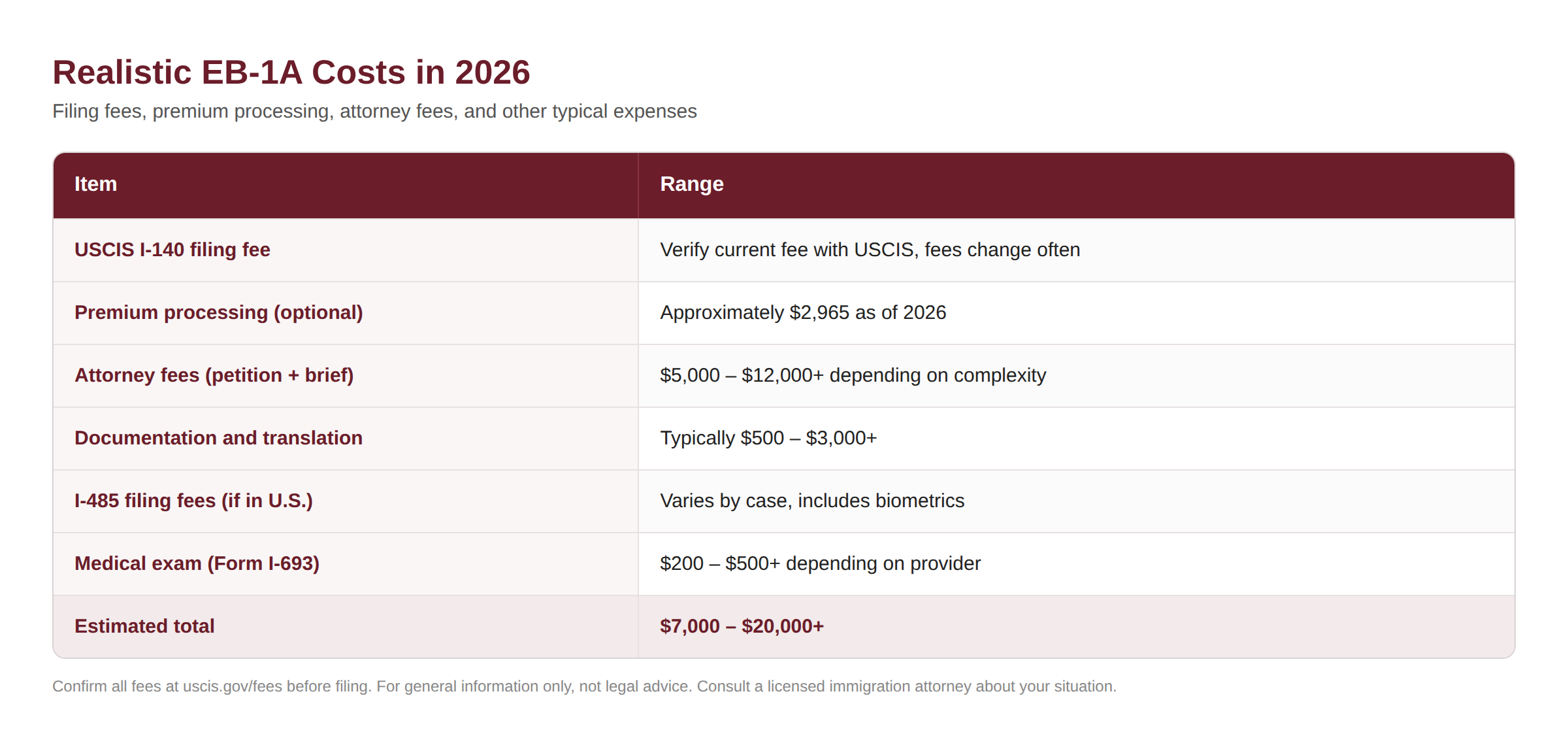
A note on fees: the same caution applies to every number above. Fees change, so confirm all of them at uscis.gov/fees before filing. One detail specific to EB-1A: under USCIS fee guidance, an individual self-petitioner pays a $300 Asylum Program Fee on top of the $715 Form I-140 filing fee, for a total of $1,015. Employers with more than 25 full-time employees pay $600, and nonprofits pay $0. The two amounts must be paid as separate payments, or USCIS may reject the filing.
During the medical exam, the clock on Form I-693 starts on the date the civil surgeon signs it, which may differ from the date of your physical. As of mid-2026, the usual procedure is for the civil surgeon to hand you the completed, signed report in a sealed envelope (do not open it). Check the current I-693 submission instructions at uscis.gov/i-693 before your exam.
RFEs cost more: responding to an RFE often incurs significant attorney fees, sometimes several thousand dollars, depending on the scope. A stronger petition up front is cheaper than answering an RFE later.
Common Profile Gaps, and How to Fix Them
If You Get an RFE or a Denial
RFE: a Request for Evidence usually arrives as a paper notice rather than online. For I-140 petitions, the standard response window is 87 days from the date on the notice (the regulatory 84-day period plus 3 days for mailing, per the USCIS Policy Manual, Volume 1, Part E, Chapter 6). The notice states your exact deadline, and that printed date is what counts, so go by your specific notice rather than a general figure. Read the whole RFE, answer every point completely, and meet the deadline. Getting an attorney involved is strongly advised, especially when the issues are complex.
Denial: a denial does not necessarily end your options. You can refile a stronger petition, and there are three post-denial routes (the first two go on Form I-290B). They are easy to mix up but do different jobs:
• Motion to reconsider. Argues USCIS made a legal or policy error on the record you already filed. You are not adding evidence; you are saying the decision misapplied the law.
• Motion to reopen. Brings in new facts and evidence that were not available before. If you were denied for thin evidence and now have more, this is usually the right path, not a motion to reconsider.
• Appeal to the Administrative Appeals Office (AAO). A formal appeal asking a higher authority to review the decision. AAO timelines vary and add attorney fees.
Each route has its own timeline, cost, and proper use. Picking the wrong one (for example, arguing legal error when your real problem was missing evidence) wastes time and money. Talk to an attorney about which path fits your specific denial before you decide.
Last reviewed: June 2026. Not legal advice. Verify all information at uscis.gov before acting on your case.