O-1 Visa Cost 2026: Complete Fee Breakdown
How much does an O-1 visa cost in 2026? USCIS fees ($830–$1,655), premium processing, attorney fees, dependents, and realistic total budgets.
Vera Kenahan
October 25, 2026 · 15 min read

An O-1 visa costs about $1,200 to $22,000 in 2026. Mandatory USCIS fees are $830 for small employers and $1,655 for larger ones (the I-129 fee plus the Asylum Program Fee). Premium processing adds $2,965, and attorney fees usually run $5,000 to $15,000. There is no $500 fraud fee for O-1 petitions.
This information is provided for informational purposes only and should not be considered legal advice. Fees, processing times, and USCIS policy change frequently and sometimes without notice. Unless stated otherwise, amounts are current as of mid-2026. Verify current fees at uscis.gov before filing, and consult an immigration attorney about your individual situation.
The Quick Answer: What an O-1 Visa Costs in 2026
The total cost of an O-1 visa in 2026 is roughly $1,200 to $22,000. Where you land depends on your employer's size, whether you use premium processing, whether you hire an attorney, and the specifics of your case.
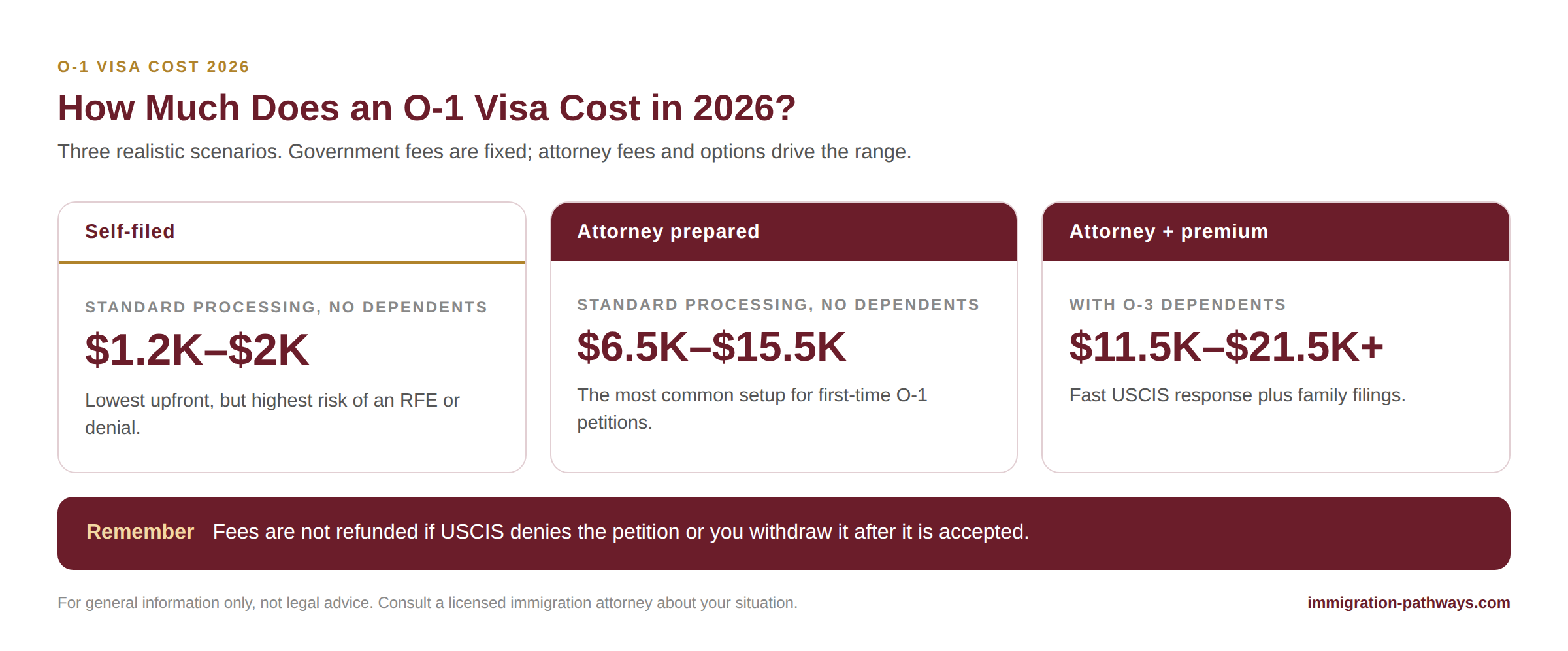
- Self-filed, standard processing, no dependents: $1,200 to $2,000
- Attorney prepared, standard processing, no dependents: $6,500 to $15,500
- Attorney prepared, premium processing, with dependents: $11,500 to $21,500 or more
Government fees are fixed. Attorney fees vary, and that choice affects your risk as much as your budget. This guide explains what each fee is for.
Fees are not refunded after a denial. If USCIS denies your petition after accepting it, or you withdraw it while it is pending, the government fees are not refunded. This is the single most important point for financial planning.
A rejection at intake is different. If USCIS rejects a package before accepting it, most often because the fee does not match the current fee schedule, the package and payment are usually returned unprocessed. You refile with the correct fee and generally get the original payment back. Not every rejection works this way, though: if a correct fee was already collected and the petition is later rejected for another defect, such as a missing signature, USCIS guidance is that fees are generally non-refundable. Filing correctly the first time is the only guaranteed way to avoid the question.
Part 1: Government Filing Fees (Mandatory)
Verify all amounts at uscis.gov/forms before filing. Fee schedules change with published notice.
Form I-129 Base Filing Fee
This is the main fee for the O-1 petition. It depends on employer size:
- Larger employer (26 or more full-time equivalent employees): $1,055
- Small employer (25 or fewer FTE): $530
- Nonprofits and certain tax-exempt organizations: may qualify for the small employer rate; verify at uscis.gov
How employer size is counted. Size is the total number of full-time equivalent (FTE) employees across all U.S. locations, not just the worksite. Part-time employees count proportionally. Under the April 2024 fee rule, FTE equals full-time employees plus part-time hours converted to full-time equivalents: someone working 20 hours a week against a 40-hour week counts as 0.5 FTE. An employer with 15 full-time staff and 25 part-time staff at 20 hours each is at about 27.5 FTE, above the 25 FTE small employer threshold. Submitting the $530 fee when the employer is actually above 25 FTE will get the petition rejected for an incorrect fee.
Online filing. Online filing does not lower the O-1 base fee. CHECK: confirm at uscis.gov/i-129 whether online filing is currently available for O petitions
Asylum Program Fee
Introduced with the USCIS fee rule effective April 1, 2024:
- Larger employer (26 or more FTE): $600
- Small employer (25 or fewer FTE): $300
- Nonprofit or certain tax-exempt organization: waived
It applies to initial petitions and most extensions.
Who qualifies for the nonprofit waiver. The waiver applies to organizations recognized under Internal Revenue Code Section 501(c)(3) and certain government research organizations. It is the petitioner, the organization filing the I-129, that must hold this status, not the beneficiary or the venue. A for-profit agency sponsoring an O-1B artist who will perform at nonprofit venues does not qualify.
The Fraud Prevention and Detection Fee Does Not Apply to O-1
This $500 fee is often wrongly included in O-1 estimates. It was created by the L-1 Visa and H-1B Visa Reform Act of 2004 (INA 214(c)(12)) and, under the Form I-129 instructions and fee schedule, applies only to H-1B, H-2B, and L petitions. O-1A and O-1B petitions are not on that list. Any O-1 estimate that includes it is $500 too high.
Premium Processing (Optional)
Premium processing for O-1 petitions (Form I-907) costs $2,965 as of March 1, 2026. USCIS must respond within 15 business days with an approval, denial, RFE, or NOID.
Premium processing does not:
- Guarantee approval
- Change the evidentiary standard
- Cover dependents: O-3 dependents file Form I-539, which premium processing on the I-129 does not cover
If USCIS issues an RFE, a new 15-business-day clock starts when it receives your response. Even with an RFE, premium processing is usually much faster than standard processing.
Biometrics: No Separate Fee for Most O-1 Filings
Older guides list an $85 biometrics fee. Since April 1, 2024, USCIS has folded biometrics into the base fee for most forms, including Form I-129. The separate $30 fee now applies only to a few categories, such as Temporary Protected Status, and O-1 is not one of them.
Visa Application Fee (DS-160), If You Need a Visa Stamp
If you are outside the U.S., or need a new visa stamp to re-enter, you pay a $205 visa application fee per person to the Department of State. This is the fee for petition-based visas such as O-1. It is paid when you schedule your consular appointment, not to USCIS.
If you are already in the U.S. in lawful status and change status to O-1, you do not pay this fee.
Government Fee Summary
Because the fraud fee does not apply and biometrics are included, O-1 government fees come down to two items: the I-129 base fee and the Asylum Program Fee. The amounts are the same for initial petitions, extensions with the same employer, and employer transfers.
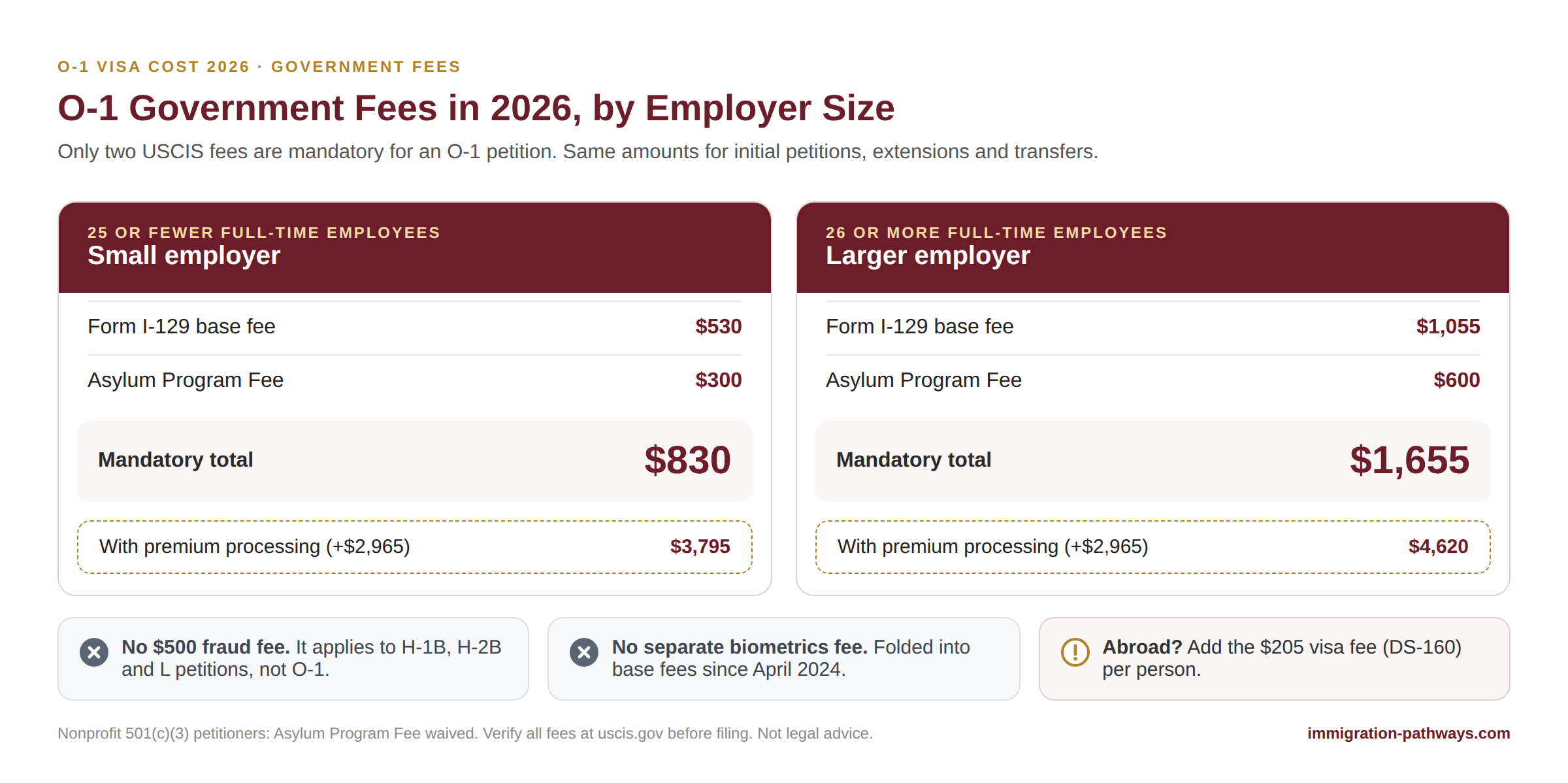
- Larger employer (26+ FTE): $1,655 mandatory; $4,620 with premium processing
- Small employer (25 or fewer FTE): $830 mandatory; $3,795 with premium processing
- Consular processing from abroad: add the $205 visa application fee per person
Part 2: Attorney Fees
Attorney fees are the largest variable cost and the one that most affects your outcome.
Typical Attorney Fees in 2026
- Straightforward O-1A, strong profile, complete documents: $5,000 to $8,000
- Moderate O-1A, some gaps, evidence building needed: $7,000 to $12,000
- Complex O-1A (founder, agent structure, cross-disciplinary): $10,000 to $15,000 or more
- O-1B (arts, film, entertainment): $5,000 to $10,000
- Extension with the same employer, little new evidence: $2,500 to $5,000
- RFE response, on top of the initial fee: $2,000 to $6,000 or more
These ranges come from practitioner reports; USCIS does not publish attorney fee data. They cover full-service representation: case assessment, evidence review, the legal brief, recommendation letter guidance, assembly, and filing. Some firms charge separately for consultations, translation review, or expedite letters.
What Attorney Fees Actually Pay For
Form I-129 itself is short and factual. Attorneys charge for the work around it:
- The legal brief. The most important part of the petition. It connects your evidence to the regulations and the final merits determination, and shows an officer outside your field that you are at the top of it. It can run 20 to 60 pages for a difficult case, and it often decides whether a case is approved or gets an RFE.
- Evidence strategy. Choosing which criteria your profile can prove, spotting gaps early, and presenting each criterion in the strongest way.
- Recommendation letter guidance. Who to ask, what the letters should cover, and how to keep independent experts from sounding like one author.
- RFE prevention. An attorney who knows the RFEs common in your field can address them before filing.
Who Pays: Employer or Employee?
Unlike H-1B, there is no rule that certain O-1 fees cannot be charged to the employee. In practice:
- Employer-sponsored O-1: the employer usually pays government and legal fees, sometimes sharing premium processing with the employee.
- Agent-sponsored O-1: common for founders and freelancers, who usually pay everything themselves.
- Shared costs: common with small employers that cover basic fees but not premium processing.
Agree on who pays before you accept an O-1 sponsorship offer.
Part 3: Premium Processing, When It's Worth $2,965
Use premium processing if
- You have a start date, contract, or funding deadline that standard processing will miss
- You are in a grace period, such as the 60 days after an H-1B layoff, and need a decision before it ends
- Your visa stamp expires soon and you need status confirmed before travel
- You are filing during a high-volume period when standard times run long
- The cost of waiting (lost income, delayed projects) is more than $2,965
Standard processing may be enough if
- Your start date is flexible
- You are extending an existing O-1 with the same employer and have time
- Your case is complex and likely to get an RFE anyway; premium processing guarantees a fast response, not a fast approval
- Budget is tight and your employer will not cover the fee
Current Standard Processing Times
Reports of O-1 standard processing times in 2026 vary, from about 2 to 6 months in most practitioner sources to as long as 12 months in some cases. The only reliable figure is the one shown at egov.uscis.gov/processing-times when you file.
If your I-129 is past the posted time, use the Processing Times tool with your receipt date to find your case inquiry date. It uses a higher completion threshold than the headline figure, so your eligible date usually comes later than it looks. Only after that date passes should you submit an e-Request.
Part 4: Costs People Often Miss
O-3 Dependents
Spouses and unmarried children under 21 can join as O-3 dependents, using Form I-539 inside the U.S. or consular processing abroad.
- Form I-539 filing fee: $470 on paper or $420 online CHECK: confirm whether one fee covers the whole family or each co-applicant pays
- Biometrics: generally included in the I-539 fee since April 2024; confirm in the current I-539 instructions
- Visa application fee for consular processing: $205 per person
O-3 status does not allow work. A dependent who needs to work must qualify for work authorization separately. This is often overlooked.
Plan for the timing gap. Premium processing on the I-129 does not cover the I-539. The O-1 holder may be approved in a few weeks while dependents wait through standard processing. If travel, school, or a job start depends on a date, treat the O-3 timeline as its own clock.
Document Translation
Documents not in English need certified English translations, typically $200 to $1,500 for an O-1 petition depending on language and volume.
Credential Evaluation
If you studied outside the U.S., you may need an evaluation from a NACES-member organization, typically $150 to $400.
Advisory Opinion (Consultation Letter)
O-1A petitions need an advisory opinion from a peer group or expert in your field, usually arranged by your attorney without a separate fee. For O-1B (arts, film, television), the relevant labor organization may charge a small fee.
Expert Letters
Independent expert letters are central to almost every O-1 petition. Experts usually write them as a professional courtesy, but some document preparers charge to help draft them. Ask whether your attorney's fee includes sourcing letters.
Working for More Than One Employer
For O-1 concurrent employment, each direct employer generally files its own Form I-129, with its own full government fees and usually its own attorney work. A freelance O-1B performer with several bookings, or a researcher with multiple appointments, can end up with several petitions in one year. A single U.S. agent representing multiple engagements can sometimes file one consolidated petition with one set of fees. Ask an attorney which structure fits your situation.
Travel and Consular Costs
If you need a visa stamp abroad, budget for appointment wait times (which vary widely by country), travel to the nearest consulate with availability, and accommodation if you travel. Confirm appointment availability before booking travel.
RFE Response Costs
- Narrow, document-based RFE: $1,500 to $3,000
- Substantive RFE requiring new evidence and brief revisions: $3,000 to $6,000 or more
- Complex RFE on the final merits determination: $4,000 to $8,000 or more
This is why a strong petition up front usually costs less. Paying $10,000 for a well-prepared petition is cheaper than paying $7,000 and then $5,000 for an RFE response.
Part 5: Self-Filing vs. Attorney, the Real Comparison
You can file an O-1 petition yourself; USCIS does not require an attorney. The question is whether it saves money.
What the Data Shows
Practitioner sources consistently report that self-filed O-1 petitions are denied more often than attorney-prepared ones, though the size of the gap varies. One 2026 source reports about 18% denials for all O-1A petitions versus more than 34% for self-filed ones, roughly 1.9 times higher. Another states that reliable comparative data is not publicly available. Treat the exact multiplier as an estimate; the overall direction is well supported.
Either way, a self-filed petition that gets an RFE or denial usually ends up needing an attorney anyway, often at an urgent-response rate, plus refiling fees.
When Self-Filing Could Work
Only if all of these are true:
- Your evidence is strong, detailed, and clearly matches the criteria
- You can write a persuasive 30 to 60 page legal brief
- You have time to study the regulations, the USCIS Policy Manual, and current adjudication trends
- You understand the final merits determination and can argue it
- You have no deadline pressure
Self-filing is likely to cost more if any of these are true:
- Your evidence needs strategic framing
- You are a founder with an unusual or cross-disciplinary profile
- You face a deadline, such as a grace period, contract date, or visa expiration
- You have never prepared an immigration brief
- You work in a high-RFE field such as technology, business, or entertainment
The Honest Cost Comparison
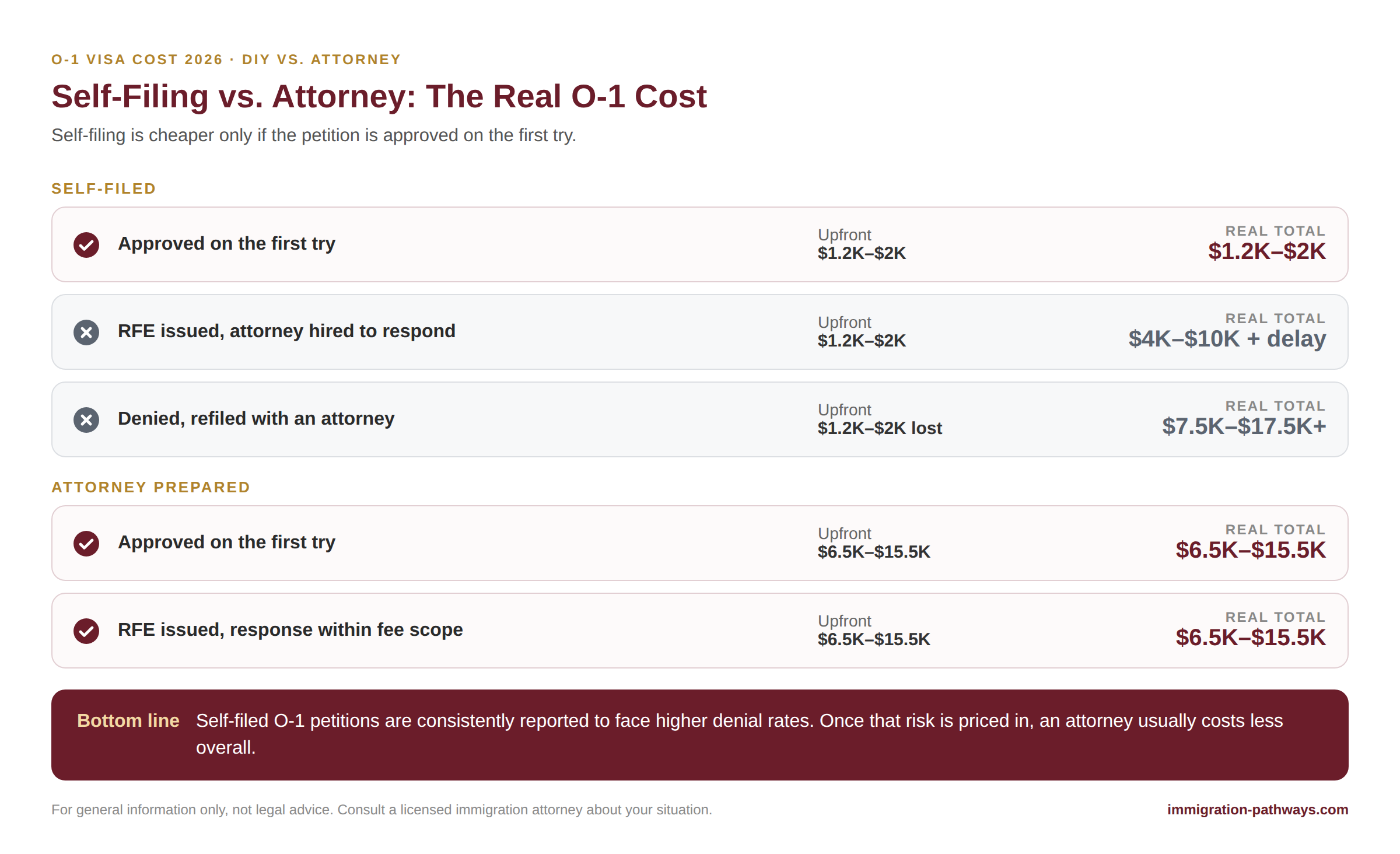
- Self-filed, approved first time: about $1,200 to $2,000
- Self-filed, RFE, attorney hired to respond: $4,000 to $10,000 total, plus months of delay
- Self-filed, denied, refiled with an attorney: $7,500 to $17,500 or more total
- Attorney prepared, approved first time: about $6,500 to $15,500
- Attorney prepared, RFE response included in scope: about $6,500 to $15,500
Self-filing is cheaper only if the petition is approved on the first try. Once the higher RFE and denial risk is priced in, the expected cost of self-filing is generally higher than hiring an attorney.
When the Math Favors Self-Filing
For an extension with the same employer, where your evidence has not changed much and an attorney prepared the original petition, some attorneys offer reduced flat fees because the risk is much lower. Ask whether you qualify.
Part 6: Lifecycle Costs Beyond the First Petition
An O-1 is granted for up to 3 years and can then be extended in one-year increments with no limit. Each extension is a new I-129 with the same fees. If you stay in O-1 status for years while working toward EB-1A or waiting for a Visa Bulletin date, those costs add up.
Five-Year Cost Projection
- Year 0, initial petition (larger employer, attorney, premium processing): $13,500 to $17,500
- Year 3, first extension: $8,000 to $12,000
- Year 4, second extension: $8,000 to $12,000
- Year 5, third extension: $8,000 to $12,000
- Five-year total: $37,500 to $53,500 or more
This assumes no employer changes, no RFEs, and no fee changes.
What this means for planning. O-1 is flexible, but it is not a cheap substitute for H-1B. Compared with $37,500 to $53,500 over five years of renewals, an EB-1A green card starts to look less like an extra expense and more like an alternative. EB-1A has its own costs, but for a profile that qualifies, approval ends the yearly renewal cycle instead of adding $8,000 to $12,000 every year.
Part 7: Fee Mistakes That Cost Applicants Money
Paying the wrong fee amount
USCIS fees changed significantly in April 2024, and premium processing rose to $2,965 in March 2026. A petition filed with the wrong amount after a change is usually rejected at intake and returned unprocessed. You generally get the payment back, but lose time refiling. Check current fees at uscis.gov/forms right before filing.
Adding the fraud fee, which O-1 does not have
The most common estimating error. The $500 Fraud Prevention and Detection Fee applies to H-1B, H-2B, and L petitions only. Any quote or calculator that adds it to an O-1 is $500 too high.
Budgeting a separate biometrics fee
Since April 1, 2024, biometrics are included in the base fee for most forms, including Form I-129. The old $85 fee does not apply to O-1 petitions.
Disputing the card payment after filing
USCIS accepts credit cards, but under its fee rules card payments cannot be disputed, charged back, or refunded except by USCIS decision. Resolve any payment issue with USCIS, not your card issuer; a chargeback can seriously harm your petition.
Forgetting dependents
O-3 costs are often left out. Budget for the Form I-539 fee ($470 paper or $420 online), any visa fees for consular processing, and attorney time for the I-539 if you use one.
Assuming the RFE response is included
Most flat-fee O-1 packages cover preparation and filing but not an RFE response. Confirm exactly what is included before you sign.
Total Budget: Three Realistic Scenarios
Scenario 1: Straightforward O-1A, small employer, attorney, no premium processing
- I-129 base fee (small employer): $530
- Asylum Program Fee (small employer): $300
- Attorney fee: $6,000
- Translation (moderate): $400
- Total: about $7,230
Scenario 2: Complex O-1A, founder or agent structure, larger employer, attorney, premium processing
- I-129 base fee (larger employer): $1,055
- Asylum Program Fee (larger employer): $600
- Premium processing: $2,965
- Attorney fee (complex case): $12,000
- Translation and credential evaluation: $700
- Total: about $17,320
Scenario 3: O-1 extension, same employer, larger employer, attorney, standard processing
- I-129 base fee (larger employer): $1,055
- Asylum Program Fee (larger employer): $600
- Attorney fee (extension): $3,500
- Total: about $5,155
FAQ
Who pays the O-1 fees, employer or employee?
No law decides this for O-1, unlike H-1B where some fees cannot be shifted to the employee. Employers usually pay for sponsored employees, while founders and agent-structure filers often pay everything themselves. Agree on it before accepting sponsorship.
Are O-1 government fees refundable if denied?
No. If USCIS denies a petition after accepting it, or you withdraw it while pending, fees are not refunded. A rejection at intake, most often for a wrong fee amount, is different: USCIS usually returns the payment with the package.
Does the O-1 petition require a Fraud Prevention and Detection Fee?
No. The $500 fee applies to H-1B, H-2B, and L petitions only. Any O-1 estimate that includes it is $500 too high.
Can I file an O-1 without an attorney to save money?
Yes, but self-filed petitions are consistently reported to face higher denial risk, though the exact gap is not well documented. Self-filing only saves money if you are approved on the first try, so weigh the cost of a possible RFE or denial.
How much does it cost to respond to an RFE?
Usually $1,500 to $8,000 or more in extra attorney fees, depending on whether the RFE is narrow or requires new evidence and revised arguments. It is almost always billed separately.
What does premium processing actually guarantee?
A USCIS response (approval, denial, RFE, or NOID) within 15 business days, not approval. If you get an RFE, a new 15-business-day clock starts after your response.
What does an O-1 extension cost?
The same government fees as an initial petition: the I-129 fee and the Asylum Program Fee. Attorney fees for straightforward renewals are usually lower, about $2,500 to $5,000.
Do O-3 dependents need their own petitions?
O-3 dependents in the U.S. file Form I-539 ($470 paper or $420 online); those abroad apply at a consulate. O-3 status does not allow work. The I-539 has its own, usually slower, timeline that premium processing on the I-129 does not speed up.
Does working for multiple employers cost more?
Usually, yes. Each direct employer generally files its own I-129 with full government fees. A single U.S. agent representing several engagements can sometimes file one petition instead.
Official Resources
- USCIS Form I-129, Petition for a Nonimmigrant Worker
- USCIS Form I-907, Premium Processing
- USCIS Form I-539, Extend or Change Nonimmigrant Status
- USCIS fee schedule (Form G-1055)
- USCIS processing times
- DS-160 online visa application
All fee amounts reflect USCIS schedules as of mid-2026 and change with published notice. Verify current amounts at uscis.gov before paying. This article is not legal advice.