H-1B Visa 2026. Complete Guide, Lottery, Fees, Timeline, and Requirements
H-1B visa 2026 guide: eligibility requirements, every USCIS fee, the weighted lottery, filing steps, the $100K fee, and the path to a green card.
Vera Kenahan
October 24, 2026 · 23 min read

Short answer: The H-1B is an employer-sponsored U.S. work visa for jobs that require at least a bachelor's degree in a specific field. Most new applicants must be selected in the annual lottery (85,000 visas), which in 2026 favors higher wage levels. Employers pay about $2,225–$3,545 in required government fees. Status lasts up to six years.
This information is provided for informational purposes only and should not be considered legal advice. Fees, processing times, and USCIS policy change frequently and sometimes without notice. Unless stated otherwise, the information here is current as of August 2026. Please check up-to-date information at uscis.gov and travel.state.gov before filing anything, and consult an immigration attorney about your individual situation.
What Is the H-1B Visa? The Short Answer
The H-1B visa is the main nonimmigrant work visa for professionals in specialty occupations. It is authorized by Section 101(a)(15)(H) of the INA and lets U.S. employers hire foreign workers for jobs that require at least a bachelor's degree in a relevant field.
The H-1B is employer-sponsored: your employer files the petition, not you. It is limited by annual quotas, so most people must be selected in a lottery. And it is a temporary work status with a maximum stay, not a green card.
What the H-1B is not. It is not a green card. It is not a self-petition. You cannot switch employers without a new petition. And although it is the standard route for skilled professionals, in 2026 it is no longer the only realistic option, and for many people it may not be the best one.
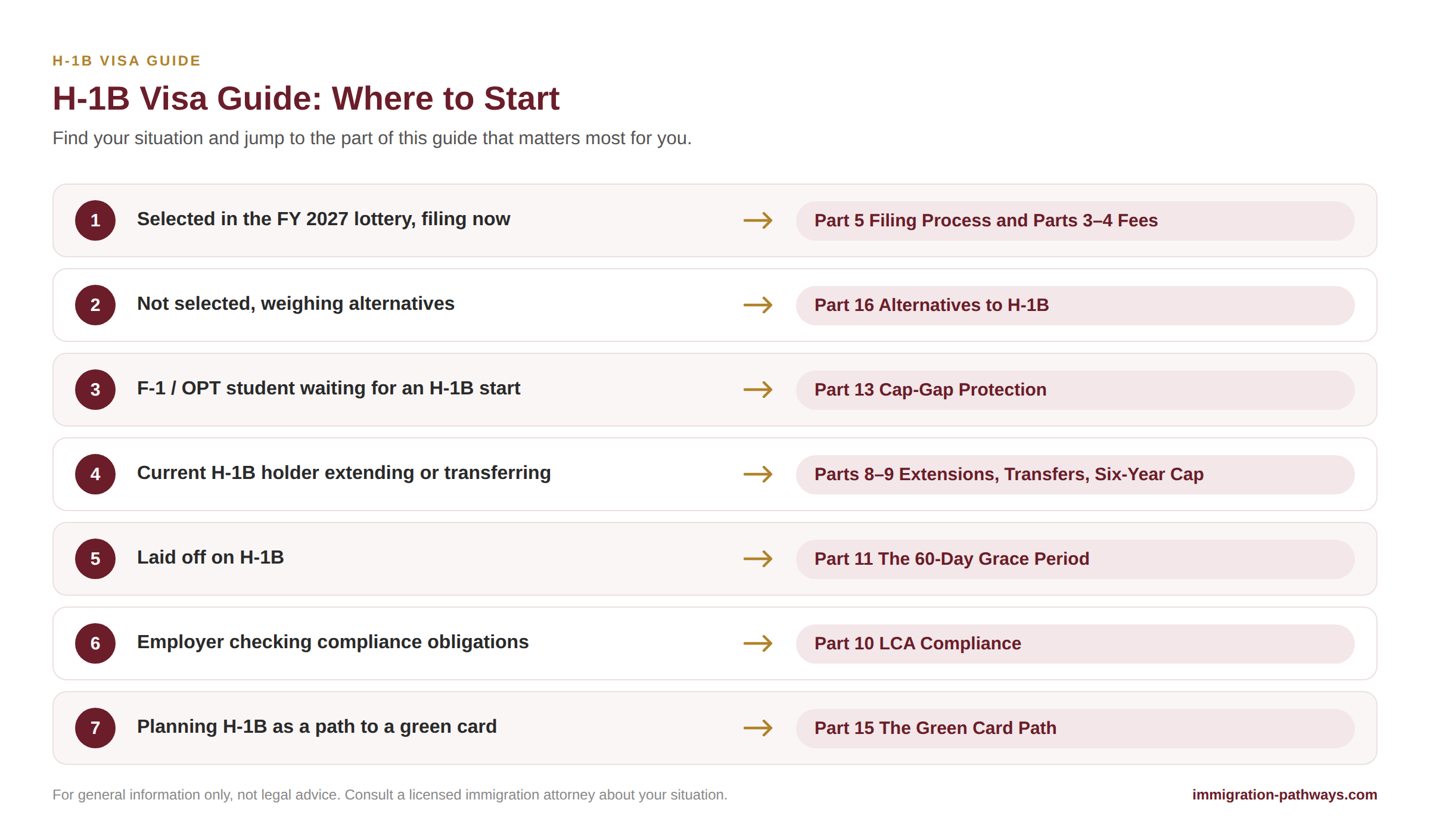
Start Here: Which Situation Are You In?
Part 1: The H-1B Cap and Lottery
Annual Numerical Limits
The 65,000 regular cap and the 20,000 advanced-degree exemption have been in place since the 2004 H-1B Visa Reform Act.
- Regular cap: 65,000 visas
- Advanced degree exemption (U.S. master's or higher): 20,000 visas
- Total: 85,000 visas
The advanced degree exemption works in two steps. People with a U.S. master's degree or higher are entered into the master's pool first. Those not selected there move into the regular cap pool, which gives them two chances at selection.
Cap-Exempt Employers
Some employers are not subject to the annual cap and can file H-1B petitions at any time, regardless of the lottery:
- Institutions of higher education, such as universities and colleges
- Nonprofits affiliated with institutions of higher education
- Nonprofit or governmental research organizations
Once you have been counted against the H-1B cap and have maintained H-1B status (or departed and re-entered within the timeframes USCIS allows), you generally remain cap-exempt for future petitions with any employer, cap-subject or cap-exempt, for as long as time remains on your six-year H-1B clock. You do not re-enter the lottery just because you change employers. The situation that does require the lottery is different: someone who has only ever held cap-exempt H-1B status and has never been counted against the cap must be selected before moving to a cap-subject employer. Confirm your cap-counting history with an attorney, because the exemption belongs to your immigration history, not to your current employer type.
Working for a cap-exempt employer is one of the most dependable ways to avoid lottery uncertainty. If you could work in H-1B status at a university or affiliated nonprofit, consider this option alongside the cap-subject lottery.
FY 2027 Lottery: Key Dates and Results
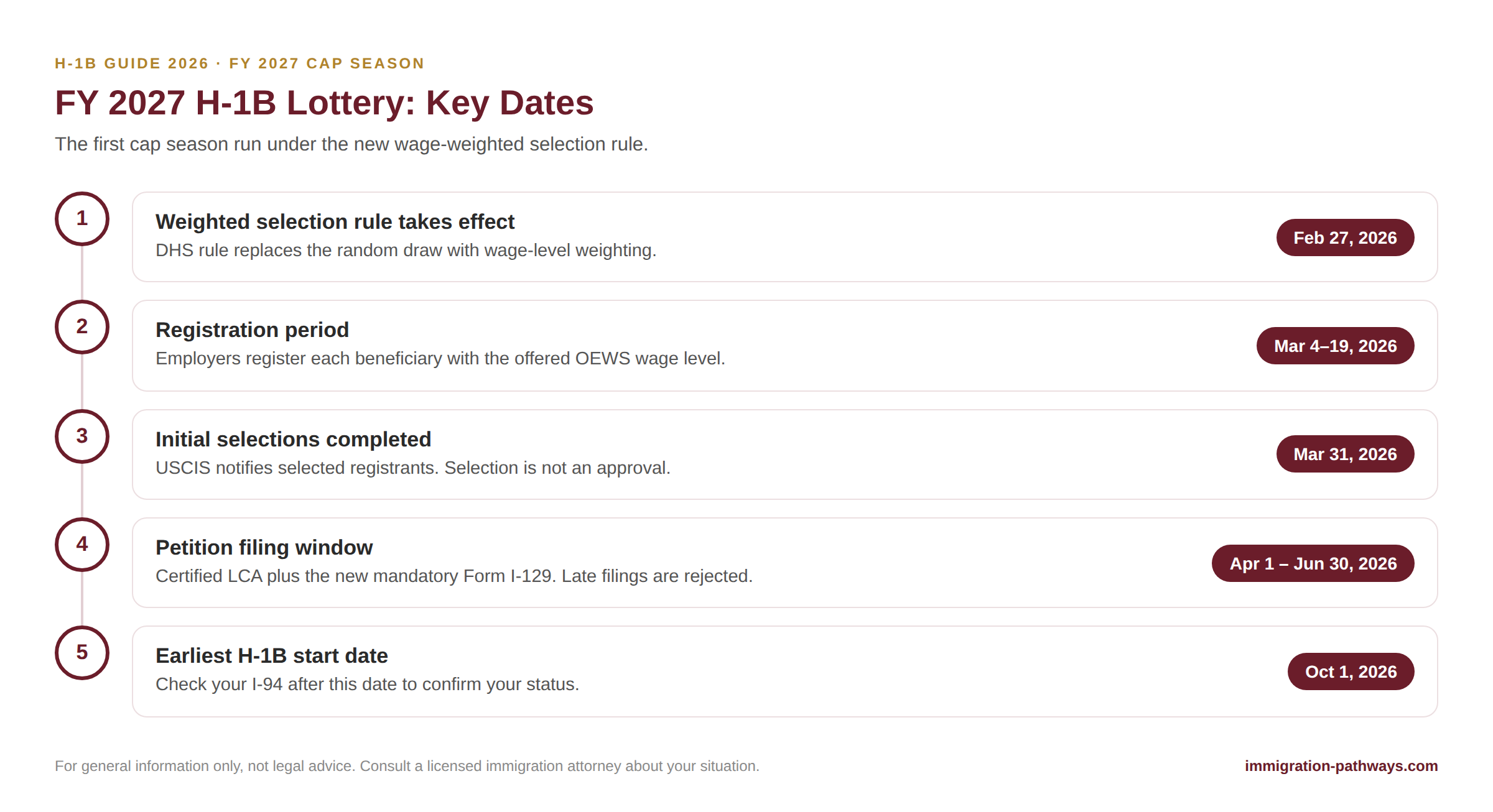
- Weighted selection rule effective: February 27, 2026
- Registration period: March 4–19, 2026
- Initial selections completed: March 31, 2026
- Petition filing window: April 1 – June 30, 2026
- Earliest employment start date: October 1, 2026
The 85,000 cap for FY 2027 was met during registration. USCIS ran a second lottery for FY 2024 and FY 2025 when extra visa numbers were available, but not for FY 2026. USCIS will announce whether there is a second round for FY 2027.
If a second round happens. Registrations not selected in the first round are automatically reconsidered from the same pool, so there is nothing extra to file. A second-round selection triggers the same I-129 filing process as an initial selection, but the 90-day filing deadline runs from the date of that later selection, not from the original April 1 – June 30 window. Second-round selections have historically come weeks or months after the first round, sometimes in July or August.
Historical Selection Rates
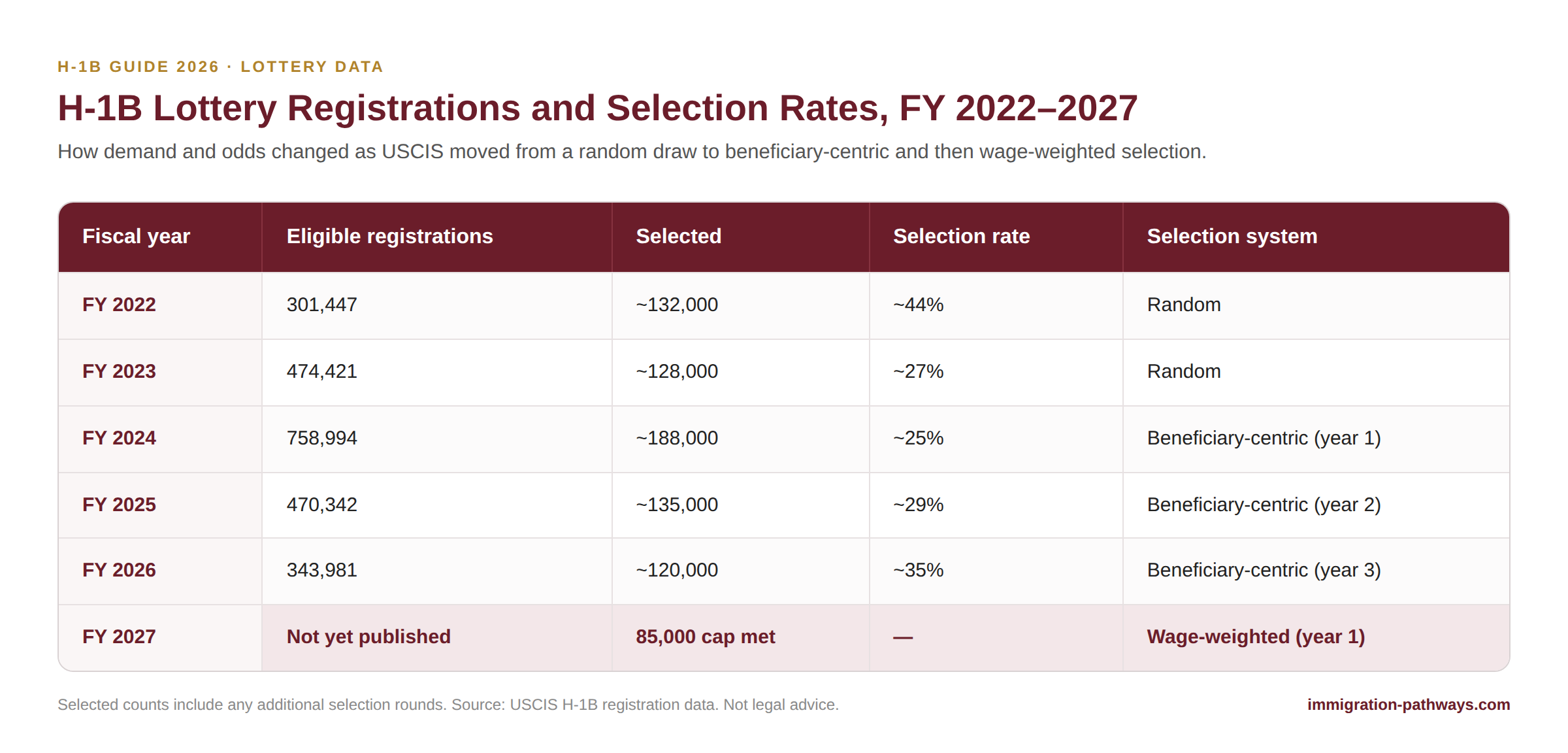
- FY 2022: 301,447 registrations, ~132,000 selected (~44%). Random draw, multiple registrations allowed.
- FY 2023: 474,421 registrations, ~128,000 selected (~27%). Random draw, multiple registrations allowed.
- FY 2024: 758,994 registrations, ~188,000 selected (~25%). Random draw, last year with multiple registrations.
- FY 2025: 470,342 registrations, ~135,000 selected (~29%). Beneficiary-centric, year 1.
- FY 2026: 343,981 registrations, ~120,000 selected (~35%). Beneficiary-centric, year 2.
- FY 2027: registrations not yet published; 85,000 cap met. Wage-weighted, year 1.
The beneficiary-centric system, under which each person enters the lottery only once no matter how many employers register them, started with FY 2025. FY 2024 was the last season that allowed duplicate registrations, which is part of why it set the record for registrations.
The New Weighted Lottery: How It Changes Your Odds
Starting with FY 2027, USCIS replaced the random draw with a wage-weighted lottery. Each beneficiary is entered into the selection pool a number of times based on the OEWS wage level of the offered job, not the salary itself.
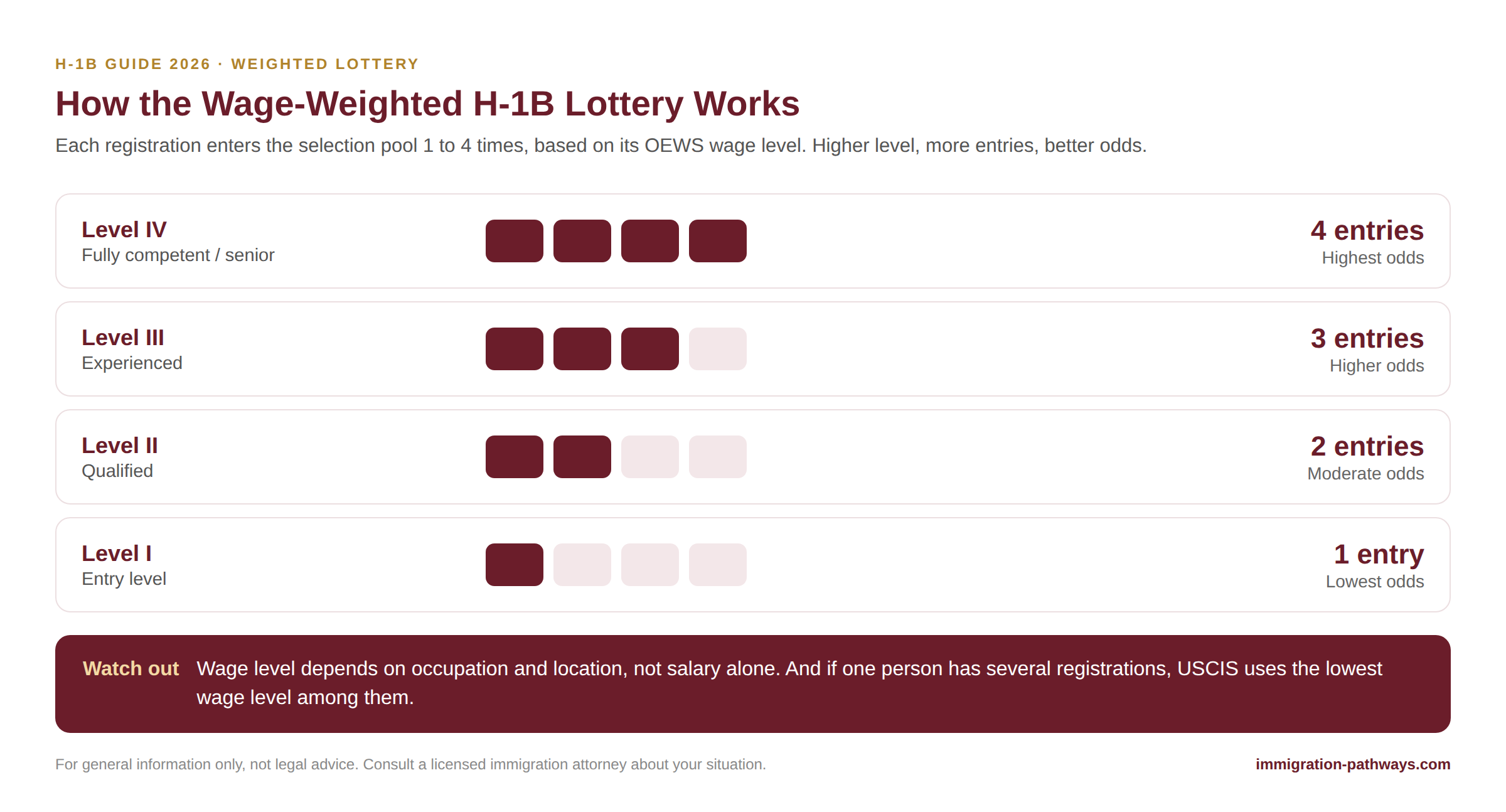
- Level IV (fully competent / senior): 4 entries, highest odds
- Level III (experienced): 3 entries
- Level II (qualified): 2 entries
- Level I (entry level): 1 entry, lowest odds
Wage level depends on occupation and location, not salary alone. The same $120,000 salary can be Level II in San Francisco and Level IV in a lower-cost metro area. USCIS has not published how FY 2027 registrations were spread across wage levels.
The integrity protection. If several employers register the same person, USCIS uses the lowest wage level among those registrations. This stops anyone from improving odds with multiple registrations at different levels.
Who is affected most. F-1/OPT graduates with entry-level offers. Under the old random system, every registration had the same chance. Under the weighted system, a Level I registration has one entry while a Level IV registration has four. If you recently graduated with an entry-level offer, treat your odds as meaningfully worse than before and build a backup plan.
Part 2: Eligibility Requirements
Specialty Occupation
The offered job must qualify as a specialty occupation under INA 214(i), meeting at least one of these four criteria:
- A bachelor's or higher degree in a specific specialty, or its equivalent, is normally the minimum requirement for the position.
- The degree requirement is common in the industry for parallel positions among similar employers.
- The employer normally requires the degree, or its equivalent, for the position.
- The duties are so specialized and complex that they require knowledge usually gained through a bachelor's or higher degree.
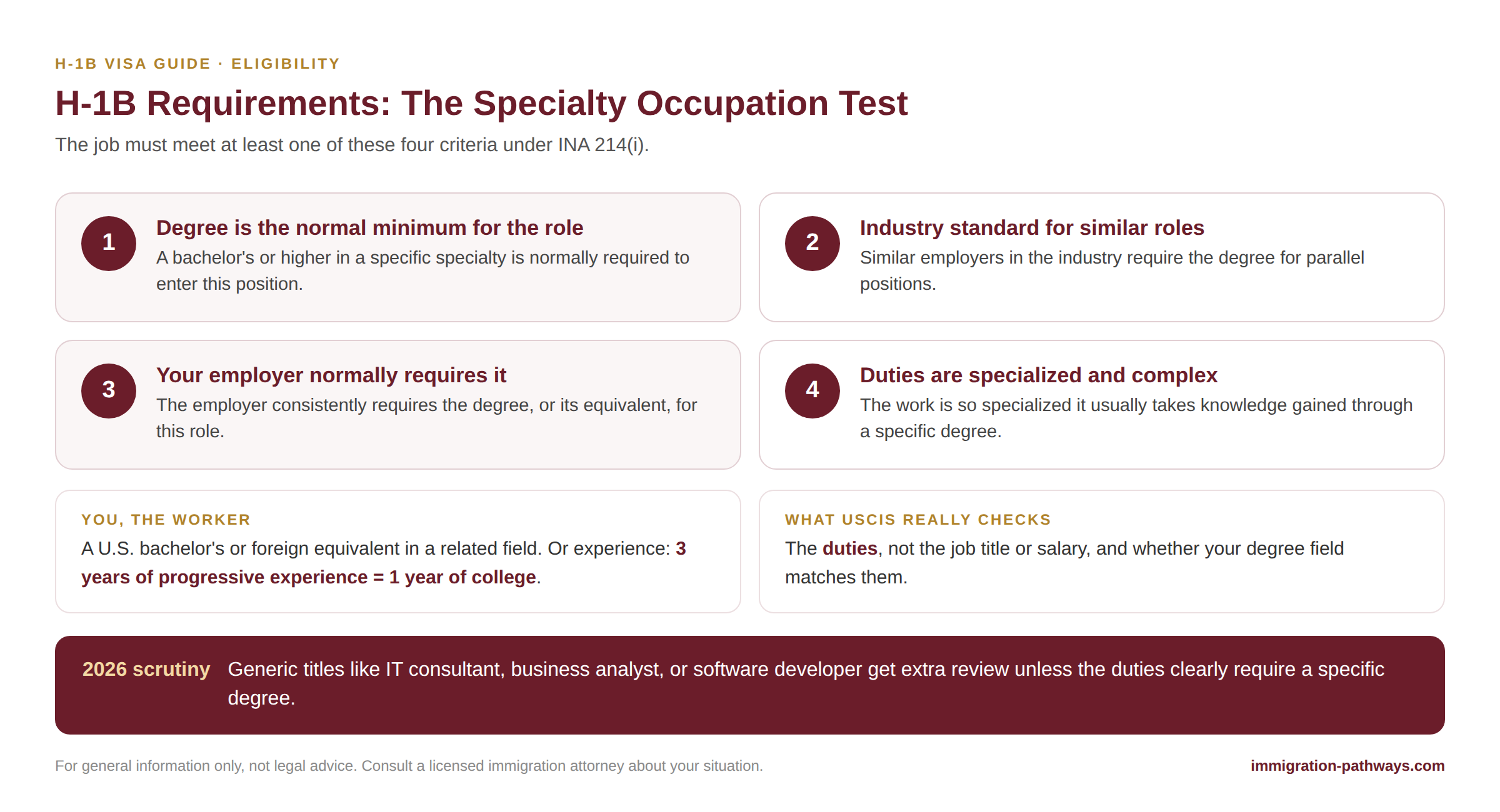
What USCIS actually looks at. Job title and salary are not the test. USCIS looks at whether the duties, as described, require specialized knowledge typically gained through a specific course of study. A vague description such as "technical support and assistance with engineering projects" raises more concerns than a clearly written one.
Current scrutiny. Generic roles such as IT consultant, business analyst, and software developer get extra review when the petition does not show that the duties require a specific degree. A clear link between the degree field and the actual duties is the most important part of a successful 2026 petition.
Fields that typically qualify. Software engineering, data science, electrical and mechanical engineering, architecture, accounting (especially CPA-track roles), medicine and healthcare (with licensing), finance and investment analysis, and university-level teaching.
The Worker's Qualifications
You need at least a U.S. bachelor's degree or foreign equivalent in a related specialty, or a combination of education, training, and progressively responsible experience equal to that degree.
Degree equivalency through experience. Generally, three years of progressive experience in the specialty count as one year of college. A three-year foreign bachelor's degree combined with a master's degree or enough professional experience may meet the requirement, but documentation is critical, and a credential evaluation from a reputable organization is often needed.
The degree must relate to the job. A computer science degree fits a software engineering role. A business degree for a data science role may need extra documentation. An unrelated degree cannot meet the specialty requirement, no matter how much experience you have.
Employer Requirements
- A legitimate need for the position
- The ability to pay at least the prevailing wage, as set out in the LCA
- A real employer-employee relationship with the H-1B worker
- For third-party placements, an itinerary of work assignments, which USCIS reviews closely
There is no minimum company size. Startups can sponsor H-1B workers, but must show they can pay the prevailing wage for the length of the petition.
Part 3: The $100,000 Supplemental Fee
Presidential Proclamation 10973, effective 12:01 a.m. Eastern on September 21, 2025, requires a $100,000 payment for new H-1B petitions for workers who are outside the United States or need consular processing.
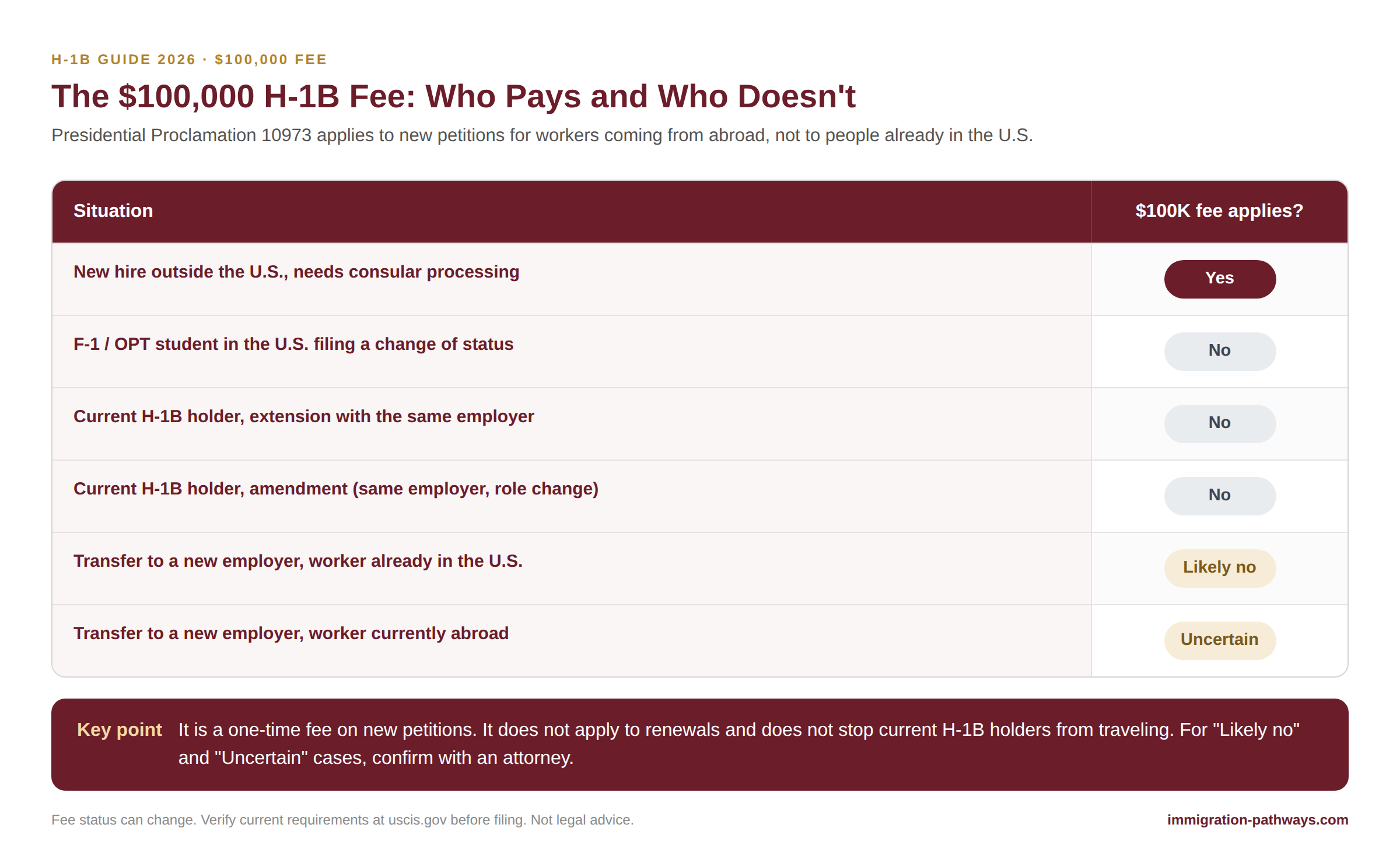
Who pays: new H-1B petitions for workers outside the U.S. who need an H-1B visa to enter and do not already hold a valid one.
Who is exempt:
- F-1 / OPT students in the U.S. changing status to H-1B
- Extensions of stay with the same employer
- Amendments with the same employer
- Petitions filed before the effective date, and current holders of valid H-1B visas
- H-1B holders already in the U.S. changing employers (generally not subject to the fee, but confirm with an attorney)
Legal status. The proclamation was set to expire on September 21, 2026, unless extended. CHECK: state whether it was extended or ended Legal challenges were filed by groups including the U.S. Chamber of Commerce and the Association of American Universities, but as of early August 2026 the fee remained in effect.
Policy context. The fee targets the offshore hiring model used by large IT services and outsourcing firms: sponsoring candidates abroad and placing them at U.S. client sites. It does not affect employers whose candidates are already in the U.S., for example on F-1/OPT.
Part 4: Government Fees, Full Breakdown
H-1B filing fees depend on employer size, petition type, and options chosen. The I-129 base fee is only one part.
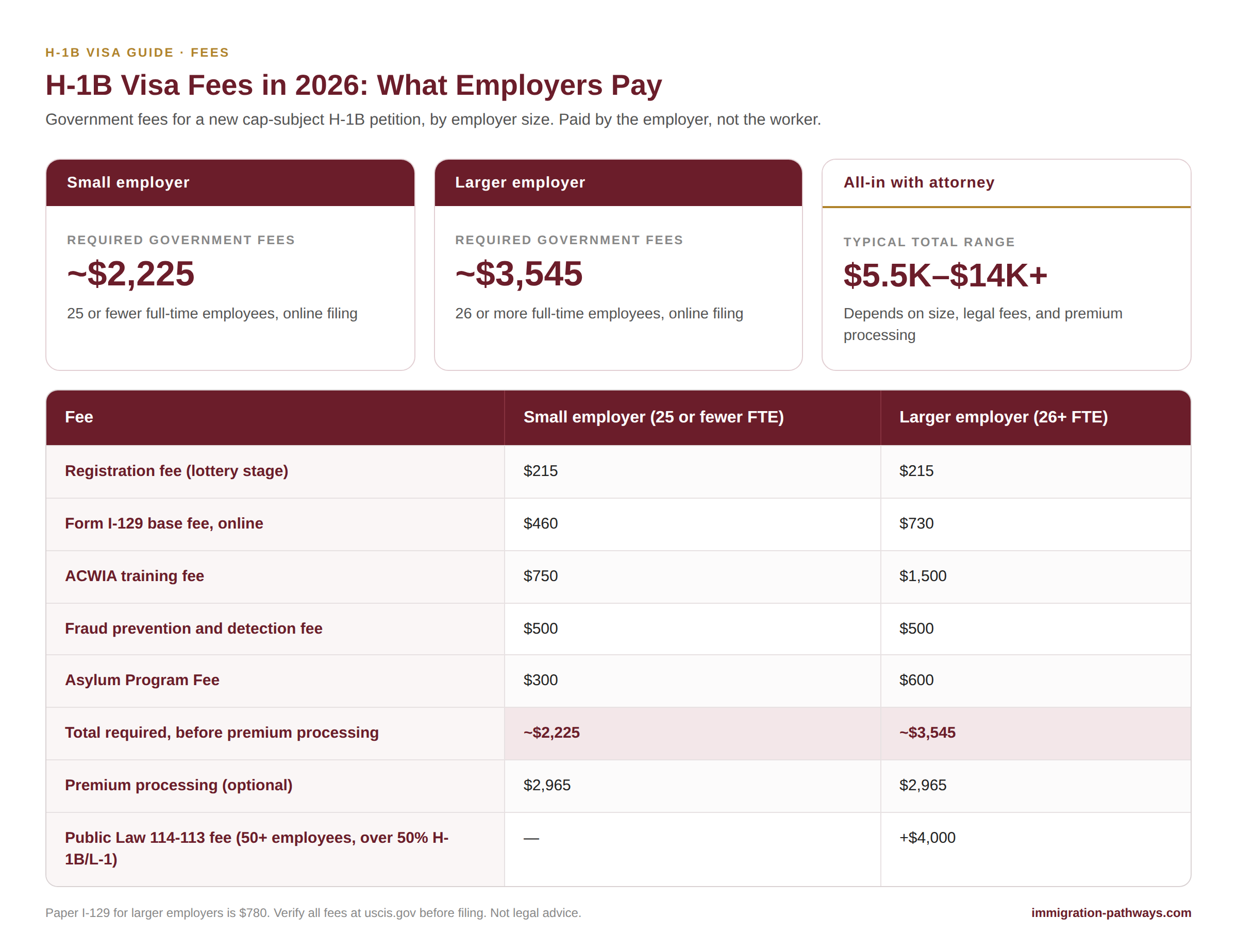
- Registration fee: $215 for all employers, per beneficiary, paid at the lottery stage
- Form I-129 base fee (online): $460 for small employers, $730 for larger employers (paper: $460 / $780)
- ACWIA training fee: $750 for small employers, $1,500 for larger employers; cannot be passed to the employee
- Fraud prevention and detection fee: $500 for all employers; initial petitions and employer changes, not extensions
- Asylum Program Fee: $300 for small employers, $600 for larger employers, $0 for nonprofits
- Total required, before premium processing: about $2,225 for small employers (25 or fewer full-time employees) and about $3,545 for larger employers (26 or more)
Public Law 114-113 fee. An extra $4,000 applies to employers with 50 or more U.S. employees when more than half hold H-1B or L-1 status.
Premium processing (optional). $2,965 since March 1, 2026. USCIS must act within 15 business days (approval, denial, RFE, or NOID). It does not guarantee approval. If USCIS misses the deadline, the premium fee is refunded.
Realistic all-in costs, including attorney fees:
- Small employer, no premium processing: about $5,500–$7,500
- Larger employer, no premium processing: about $7,500–$10,000
- Larger employer, with premium processing: about $10,000–$14,000 or more
What employers should know. Most government fees cannot be charged to the employee. Premium processing can be paid by an employee who requests it for personal reasons, but many attorneys recommend employers cover all fees to reduce compliance risk. USCIS fees are not refunded if a petition is rejected or withdrawn. Verify all fees at uscis.gov before filing.
Part 5: The Petition Filing Process, Step by Step
Step 1. Get a Labor Condition Application (LCA)
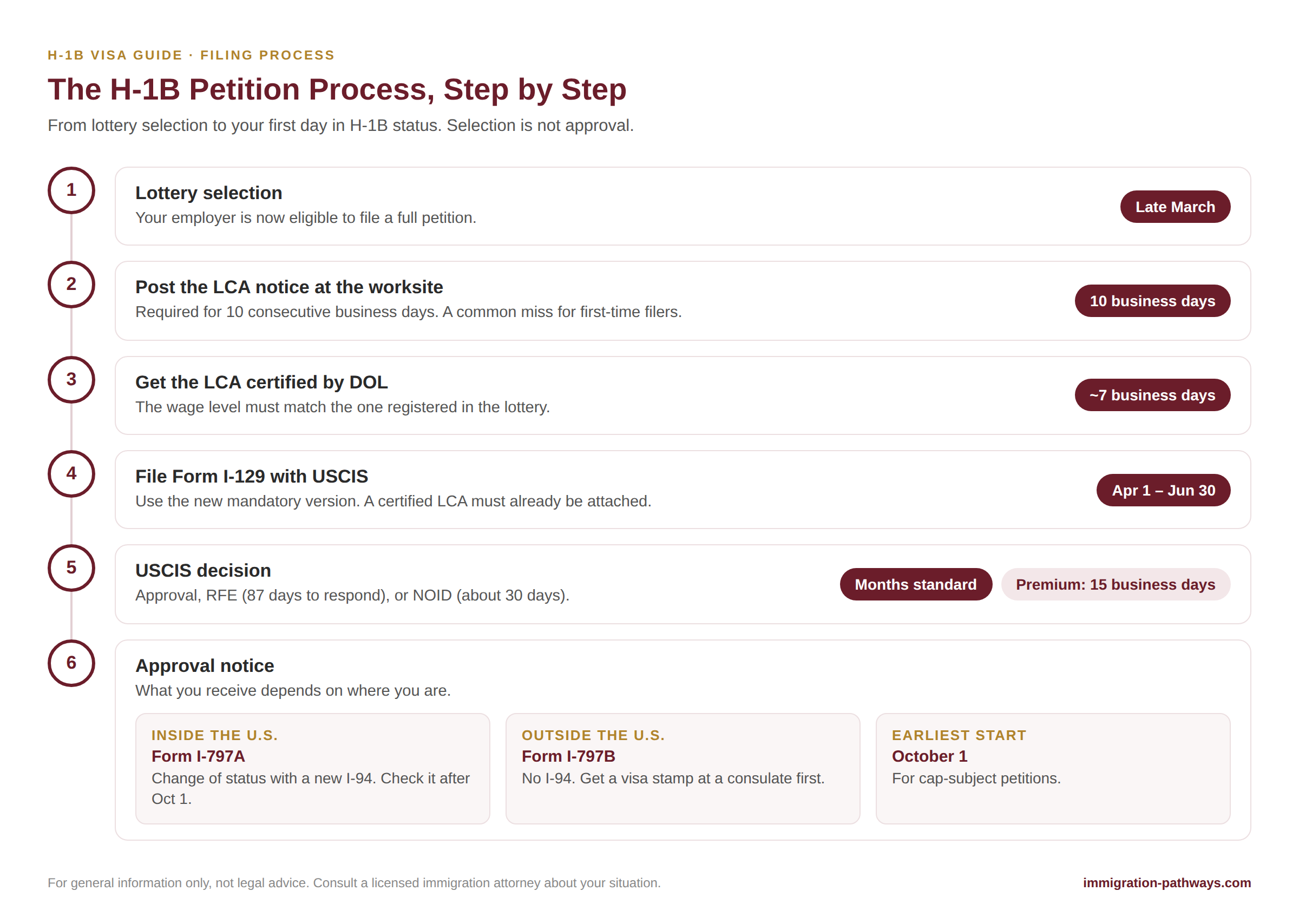
Before filing Form I-129, the employer must get a certified LCA from the Department of Labor through the FLAG system. The LCA confirms the employer will pay at least the prevailing wage, that working conditions will not harm U.S. workers, and that there is no strike or lockout at the worksite.
Posting requirement. Before filing the LCA, the employer must post a notice at the worksite for 10 consecutive business days. First-time filers often miss this.
The LCA wage level must match the lottery registration. Since April 1, 2026, cap petitions must include the source material used to determine the OEWS wage level at registration. A mismatch is one of the most common RFE triggers, and it can be more serious than an ordinary RFE. If the petition's wage level is lower than the one registered, USCIS can question whether the registration was made in good faith. In Matter of TEXPERTS, Inc., 29 I&N Dec. 491 (AAO 2026), the Administrative Appeals Office confirmed that registration conduct can support a finding of fraud or willful misrepresentation, and that withdrawing the petition afterward does not protect the employer.
Timing. DOL usually certifies an LCA in about 7 business days. The certified LCA must be in hand before Form I-129 is filed; USCIS will not accept an I-129 without it.
Step 2. File Form I-129
The employer files Form I-129, Petition for a Nonimmigrant Worker, with USCIS during the filing window. For FY 2027 cap petitions, the window was April 1 to June 30, 2026.
A new version of Form I-129 has been mandatory since April 1, 2026. It asks for more detail about the minimum requirements of the job, to test whether the degree requirement is genuine. Explain clearly why the specific degree is needed to perform the duties.
If you get an RFE. An RFE is not a denial. You usually have 87 days from the date on the notice, not the date you receive it. Answer the specific concern raised; a targeted response works better than adding more general evidence.
If you get a NOID. A Notice of Intent to Deny is more serious. USCIS has reached a tentative decision to deny, and you usually have about 30 days to rebut the officer's findings. Contact an attorney right away.
Step 3. Approval, Status, and the I-94
The approval notice depends on where you are. If you are in the U.S. and approved for a change of status, USCIS issues Form I-797A, which includes a new I-94 showing your H-1B status. If you are outside the U.S., or in the U.S. without a change of status, USCIS issues Form I-797B, which has no I-94; you take it to a consulate for a visa stamp before you can enter or start work. If you expected a change of status and received an I-797B, your status did not change.
Inside the U.S. (change of status). H-1B status starts on the approval date or the requested start date, whichever is later, but not before October 1 for cap-subject petitions. Check your I-94 at i94.cbp.dhs.gov after October 1. Errors are common, so check it after every entry or status change.
Outside the U.S. (consular processing). You need a visa interview at a U.S. consulate to get a visa stamp before entering. This currently carries real risk; see Part 7.
Part 6: H-1B Status vs. H-1B Visa Stamp
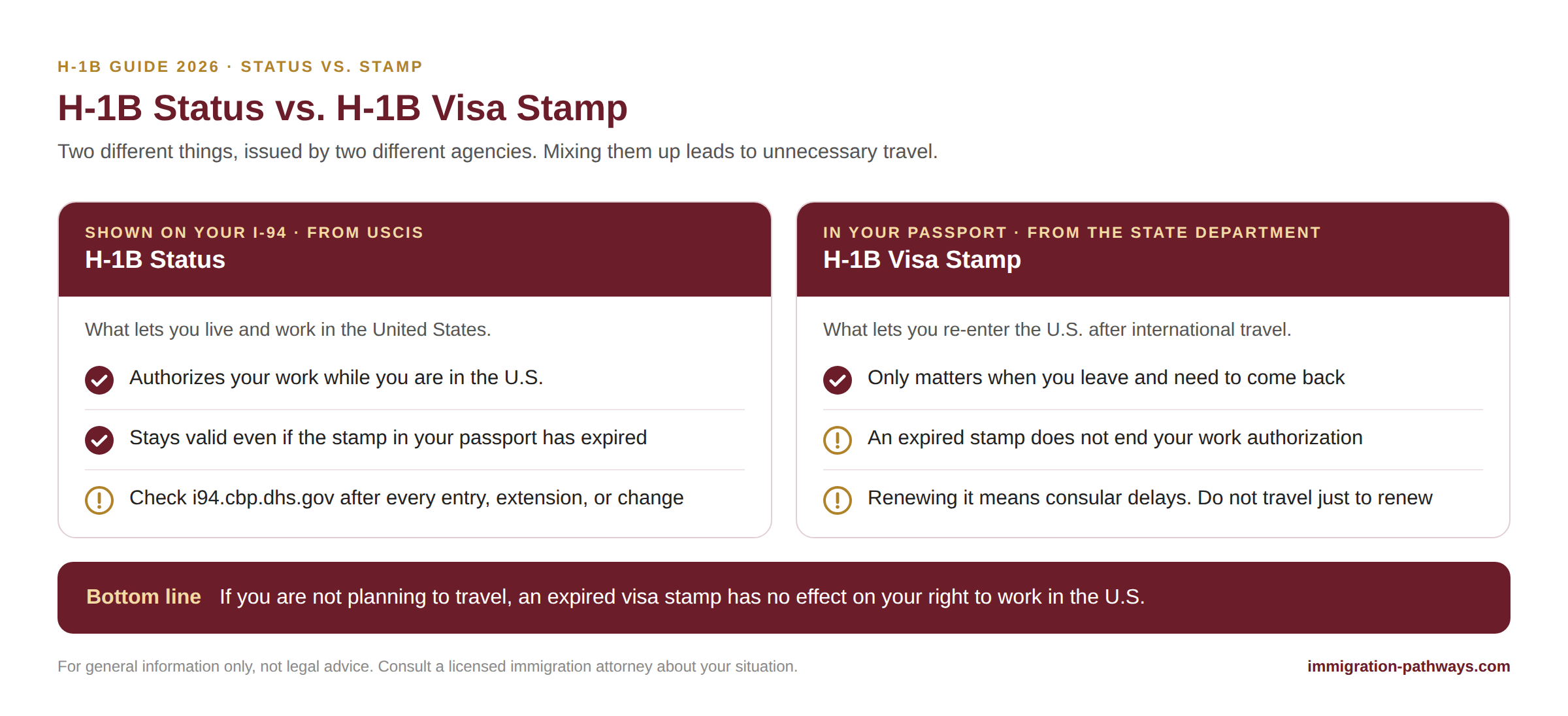
These are two different things from two different agencies, and confusing them causes unnecessary stress and travel.
H-1B status lets you live and work in the U.S. It is granted by USCIS and shown on your I-94.
The H-1B visa stamp lets you request entry to the U.S. after travel abroad. It is issued by a U.S. consulate and placed in your passport.
An expired stamp does not affect your right to work while you are in the U.S. You can hold valid H-1B status for years with an expired stamp; this is legal and common. The stamp only matters when you leave and want to come back.
Part 7: Visa Stamping in 2026
An approved petition does not mean you can travel freely if your stamp has expired or you need one for the first time. Getting a consular appointment is currently a serious bottleneck for many H-1B workers.
The current situation. CHECK: update current appointment availability As of mid-2026, immigration law firms tracking appointment data reported no H-1B stamping appointments at any of the five U.S. consulates in India through the end of 2026, with the earliest in May 2027. Since September 2025, third-country stamping has been very limited, so Indian passport holders can no longer easily book in Canada, Mexico, or Singapore. The interview waiver ("Dropbox") window was cut from 48 months to 12 months after the prior stamp expired.
Avoid international travel without a valid stamp: under current conditions you may be unable to return for 12 to 18 months or more.
Part 8: Duration, Extensions, and the Six-Year Cap
Initial Duration
H-1B status is normally granted for up to three years, with one extension of up to three more, for a total of six years for most cap-subject workers.
Extension Beyond Six Years
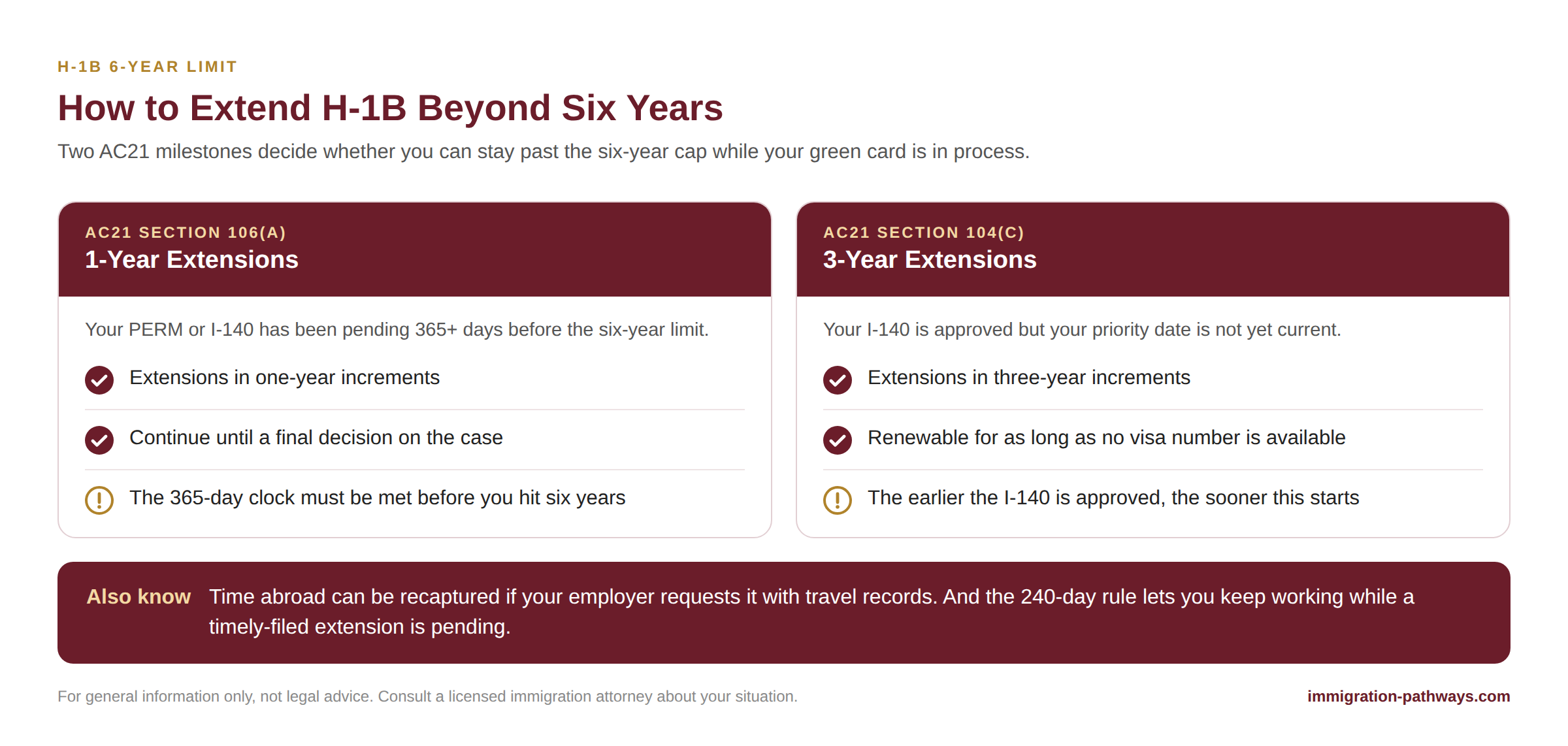
- One-year extensions: when a PERM or I-140 has been pending for 365 days or more.
- Three-year extensions: when an I-140 is approved and your priority date is not yet current in the Visa Bulletin.
These extensions are conditional, and your employer must file the right extension petition. Start planning your six-year path no later than year five.
Time Recapture
Time spent outside the U.S. during your H-1B validity can be recaptured, extending your total time. Keep records of international travel from day one: passport stamps, tickets, and I-94 departure records. They are much harder to gather years later.
The 240-Day Rule
If an extension petition is filed before your current I-94 expires, you can keep working for up to 240 days past the I-94 date while it is pending. The extension must be filed before the I-94 expires.
Part 9: Transfers, Amendments, and Multiple Employers
H-1B Transfers (Portability)
You can start working for a new employer on the day it files an I-129 transfer petition, without waiting for approval. This is H-1B portability under INA Section 214(n).
- You must be in H-1B status, or within the 60-day grace period, when the new petition is filed.
- You must have been counted against the H-1B cap before.
- The new petition must be genuine, not a placeholder.
H-1B Amendments
A material change in duties, location, or employment terms usually requires an amended petition. Common triggers:
- A move to a worksite in a different metropolitan statistical area (MSA)
- A significant change in job duties (not just a promotion with the same core duties)
- A change in the employing entity through a merger, acquisition, or reorganization
- A move to a new client site for third-party placements
For an MSA change, a new certified LCA is the first step but not enough on its own. Under Matter of Simeio Solutions, LLC, 26 I&N Dec. 542 (AAO 2015), the amendment itself must be filed before you start work at the new location. Once it is filed, you can start without waiting for approval. Starting work at the new site before filing, even with a certified LCA, is an LCA violation from the first day. If your situation has changed since your last petition, ask an attorney whether an amendment is needed before the change happens.
Concurrent H-1B Employment
You can work for more than one employer at the same time if each employer files its own H-1B petition. This suits academic appointments, consulting, or research alongside a main job.
Part 10: LCA Compliance and Wage Enforcement
The LCA is not a formality. The Department of Labor audits compliance, and penalties are serious.
- Wages: pay at least the higher of the prevailing wage or the actual wage paid to similarly qualified employees. This is a legal minimum.
- Working conditions: no less favorable than for comparable U.S. employees.
- Strike or lockout: the employer attests there is none at the worksite.
- Public access file: the employer keeps a file documenting LCA compliance, available on request.
Third-party placement. Each client worksite may need its own LCA. Moving H-1B workers between client sites without updating LCAs is one of the most common DOL enforcement targets.
Penalties include back wages, civil penalties from about $1,000 per procedural violation up to $35,000 per willful violation involving worker displacement, debarment from the H-1B program for one to three years, and criminal referral in egregious cases. DOL publishes lists of H-1B violators.
Part 11: The 60-Day Grace Period
If you are laid off or lose your H-1B job, you have a grace period of up to 60 days, or until your I-94 expires if sooner.
- It starts the day after the last day you were paid for actual work. Severance does not delay it. If you stay on payroll during an active notice period (such as a WARN Act period), the grace period has not started yet. Confirm your last paid day of work with HR in writing.
- It can be used once per authorized validity period.
- It does not allow you to work unless a new employer files a transfer petition.
- It applies only if you are in the U.S. when your employment ends.
Steps right after a layoff:
- Confirm your last day paid for actual work, in writing from HR.
- Check your I-94 end date at i94.cbp.dhs.gov.
- Find out whether a new employer can file a transfer petition right away.
- Talk to an immigration attorney in the first week, not at day 55.
Your green card case. If your I-140 was approved, you generally keep its priority date for a future employer's petition. If it had been approved for 180+ days before any withdrawal, it also stays usable for H-1B extensions. AC21 job portability applies once your I-485 has been pending 180+ days.
Part 12: H-4 Spouses, Work Authorization Rules
Spouses of H-1B workers enter in H-4 status, which does not include work authorization.
H-4 EAD eligibility. The H-4 spouse can apply for an EAD (Form I-765) if the H-1B holder has an approved I-140, or has an H-1B extension beyond six years under AC21 because a PERM or I-140 was filed at least 365 days earlier.
- The H-4 EAD is not automatic; it requires a separate application.
- Processing can take 6 to 12 months or more.
- Renewals must be filed before the current EAD expires; there is no automatic extension.
- H-4 EAD rules have faced repeated rescission attempts. If your household depends on it, track changes with an attorney.
Part 13: Cap-Gap Protection for F-1/OPT Students
F-1 students with valid OPT whose H-1B petitions are filed on time automatically get cap-gap protection, which extends F-1 status and work authorization from OPT expiration to the October 1 H-1B start date.
- It applies automatically when the petition is filed on time; no separate application is needed.
- It lasts until September 30, or until the petition is denied, withdrawn, or revoked, whichever comes first.
- It does not apply if your OPT expired before the petition was filed.
- The $100,000 fee does not apply to F-1 students changing status inside the U.S.
If you were not selected, you cannot keep working on OPT past its expiration unless you have a STEM OPT extension. Look at alternatives right away.
Part 14: Processing Times and Premium Processing
Standard processing for I-129 varies from a few months to 6+ months depending on petition type and workload. Check egov.uscis.gov/processing-times.
Premium processing costs $2,965 (since March 1, 2026) and guarantees USCIS action within 15 business days. It is also available for extensions and transfers outside the cap season. If USCIS issues an RFE, a new 15-business-day clock starts when it receives your response.
Site visits. USCIS's Fraud Detection and National Security directorate makes unannounced visits to confirm that the worker performs the duties described, at the stated worksite. For third-party placements, officers may visit both the employer and the client site.
Part 15: The Green Card Path
Dual intent. H-1B holders can pursue permanent residence without the immigrant-intent problem other nonimmigrant visas face.
The common employer-sponsored route: PERM, then I-140, then I-485. PERM labor certification takes about 16 to 17 months for DOL review alone, with no premium option. Then comes the I-140 (about 6 to 12 months, or 15 business days with premium processing), the Visa Bulletin wait, and the I-485, which often takes about a year but varies widely.
For EB-2 and EB-3 applicants born outside India and China, the process usually takes about 3 to 5+ years from PERM filing to green card. For India-born EB-2 applicants, the wait is measured in well over a decade. CHECK: update EB-2 India and EB-1 India dates from the current Visa Bulletin
Self-petition routes.
- EB-1A (extraordinary ability): no employer, no PERM, and a high evidence bar. Priority dates are current for most countries outside India and China, and the EB-1 India date is far ahead of EB-2 India.
- EB-2 NIW (national interest waiver): no employer, no PERM, and an easier standard than EB-1A. India-born applicants face the same Visa Bulletin wait as PERM-based EB-2, but NIW locks in a priority date immediately.
Lock in a priority date early. Filing NIW, or having your employer file an I-140, as early as possible starts your priority date. Approval of an I-140 also makes you eligible for one-year and three-year H-1B extensions beyond six years.
Keeping your priority date when changing employers. A new employer can capture your priority date only if your prior I-140 was actually approved, not just filed. It is not automatic: the new employer's attorney must request it, usually with a copy of the prior approval notice. If a new employer says your priority date cannot carry over, get a second legal opinion.
Part 16: Alternatives to H-1B
H-1B in 2026 is more complex, expensive, and uncertain than ever. These routes are worth considering instead of, or alongside, H-1B.
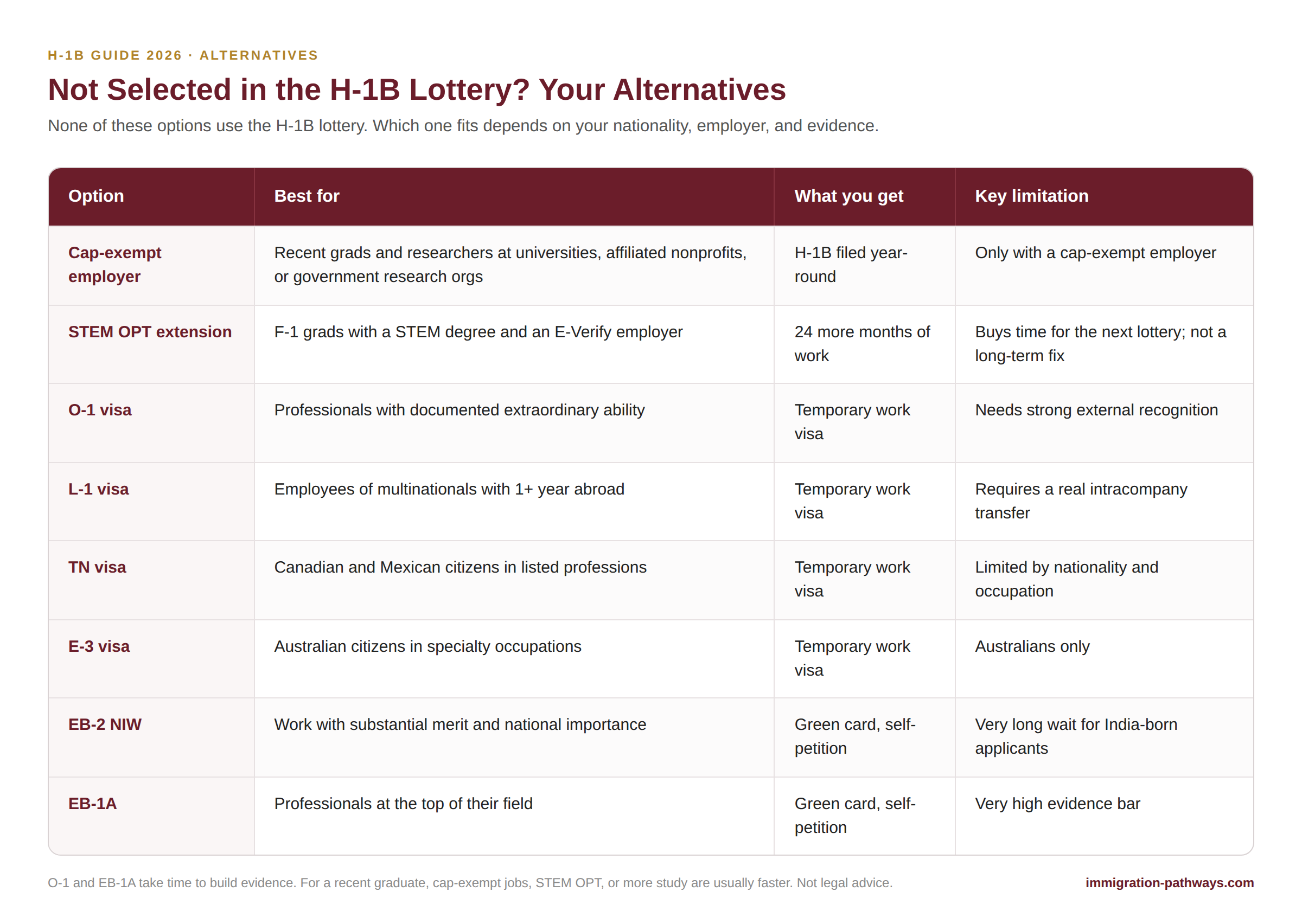
- O-1 visa: for extraordinary ability in sciences, business, arts, technology, or athletics. No lottery, no annual cap, renewable in one-year increments. Requires an employer or agent and strong evidence of sustained recognition.
- EB-2 NIW: a green card with no lottery, no employer, and no PERM, based on national interest. India-born applicants face the same Visa Bulletin wait as PERM-based EB-2.
- EB-1A: a self-petition green card with a higher evidence bar than NIW. Current for most applicants outside India and China.
- L-1: for employees of multinational companies with at least one year of qualifying work abroad. No lottery. Managers and executives may move to the EB-1C green card without PERM.
- TN: for Canadian and Mexican citizens in listed professions. No lottery, no cap. Canadians can apply at the border; Mexicans go through a consulate.
- E-3: for Australians in specialty occupations. 10,500 per year, rarely if ever filled. No lottery; requires an LCA.
- Cap-exempt H-1B: universities, affiliated nonprofits, and research institutions can file any time of year, with no lottery.
Summary Checklist
If your registration was selected (FY 2027)
- The wage level registered in the lottery matches the planned petition.
- LCA posted for 10 business days, then certified by DOL (about 7 business days) before I-129 filing.
- I-129 filed on the current mandatory form version between April 1 and June 30, 2026.
- Whether the $100,000 fee applies confirmed with an attorney before filing.
- OEWS wage level source material included and consistent with the registration.
- Premium processing decided ($2,965; verify at uscis.gov).
- I-94 checked at i94.cbp.dhs.gov after October 1.
- Travel plans checked against visa stamp validity.
If your registration was not selected
- Alternatives reviewed: O-1, L-1, TN, E-3, EB-2 NIW, EB-1A, and cap-exempt employment.
- STEM OPT extension eligibility checked, if on F-1/OPT.
- Cap-exempt job options explored.
- Planning for the FY 2028 registration, usually in March.
- If still in the pool, employer ready to file quickly if a second-round selection comes.
For current H-1B holders
- I-94 end date tracked separately from the petition end date.
- Six-year limit and extension eligibility confirmed with an attorney.
- Within two years of the six-year limit: green card process confirmed on track.
- If laid off: last paid day of work confirmed in writing, 60-day clock counted from it, and an attorney contacted.
- If changing employers: transfer petition filed before starting the new job, and cap-counting history confirmed if moving to a cap-subject employer.
- If job duties or worksite changed: amendment need confirmed and filed before any move to a new MSA.
- Valid visa stamp confirmed before any international travel.
Official Resources
- USCIS H-1B overview
- USCIS processing times
- USCIS H-1B FAQ, Presidential Proclamation
- DOL FLAG system (LCA filing)
- DOL prevailing wage data
- I-94 record
- Visa Bulletin (travel.state.gov)
- U.S. visa appointment scheduling
Final Takeaway
The H-1B remains one of the most important U.S. work visas, and in 2026 it has changed more than at any point in two decades. The weighted lottery, the $100,000 fee, the stamping backlog, and PERM delays are not temporary disruptions; they are the new normal for the foreseeable future.
For the right combination of employer and employee (a genuine specialty occupation, a well-documented petition, a competitive wage level, and a candidate already in the U.S.), H-1B remains a strong pathway. For everyone else, 2026 is the year to take alternatives seriously: O-1 for accomplished professionals, NIW for long-term independence, EB-1A for those whose record can meet the standard, and cap-exempt employment for those who can build a career around academic or nonprofit work.
Getting this decision right the first time matters. RFEs, denials, and missed priority dates have costs that compound over years. If your situation is complex, with a changing job, an approaching six-year limit, a pending green card case, or an uncertain stamping timeline, that is exactly when an immigration attorney is most valuable.
All information reflects H-1B regulations, fees, and policies as of early August 2026. Verify fees at uscis.gov, processing times at egov.uscis.gov/processing-times, and appointment availability at ustraveldocs.com before any filing or travel decision. This article is not legal advice.