PERM Labor Certification 2026: The 17-Month Reality and What to Do While You Wait
PERM labor certification takes about 17 months at DOL in 2026. Full timeline, audit triggers, H-1B extension rules, and what to do while you wait.
Vera Kenahan
October 27, 2026 · 15 min read

PERM labor certification currently takes about 16.5 to 17 months for Department of Labor review, and about 18 to 24 months end to end once you add the prevailing wage and recruitment steps. Audited cases can take 30 months or more. There is no premium processing for PERM; it becomes available only later, for Form I-140.
This information is provided for informational purposes only and should not be considered legal advice. PERM processing times and DOL queue positions change monthly. Information is current as of August 2026. Verify current figures at flag.dol.gov/processingtimes before planning, and consult an immigration attorney about your situation.
Start Here: Which Situation Are You In?
- Your employer just filed, or is about to file, PERM: read The Complete PERM Timeline
- PERM filed and waiting in the DOL queue: read 5 Things to Do While You Wait
- Close to the H-1B six-year limit with PERM pending: read The H-1B Clock (time-sensitive)
- Your case was selected for audit: read PERM Audits
- Considering EB-1A or NIW instead: see step 1 of 5 Things to Do While You Wait
- Employer or HR managing a filing: read Audit Prevention
The Short Answer
DOL review of PERM applications currently averages about 16.5 to 17 months, roughly 501 to 512 days depending on the month DOL reports. As of DOL's May 31, 2026 update, analysts were reviewing applications filed around April 2025.
If your case is selected for audit, it moves to a separate, slower queue. Recent DOL figures put average audit review at about 290 to 345 days, with the audit queue running three to four months behind the regular one. In the latest data, DOL was reviewing audited cases filed around November to December 2025.
Add the prevailing wage determination (about 2.5 to 3 months for most cases) and at least 60 days of recruitment, and a standard non-audited case takes about 18 to 24 months. An audited case can take 30 months or more.
There is no premium processing for any stage of PERM, and the Department of Labor does not offer expedites.
That is the 17-month reality. The rest of this guide is about how to use that time well.
What PERM Is, and Why It Takes So Long
PERM (Program Electronic Review Management) is the labor market test required before most EB-2 and EB-3 employment-based green cards. It is not a visa or an immigrant petition. It is a Department of Labor certification that the employer tested the U.S. job market in good faith, found no qualified U.S. workers, and can sponsor a foreign worker.
The employer files Form ETA-9089 through DOL's FLAG system. The filing establishes two things: your priority date, which sets your place in the Visa Bulletin line, and the employer's commitment to the job offer.
Why 17 months? Mostly volume. DOL's Office of Foreign Labor Certification receives far more applications than it can process quickly and handles them in the order received. There is no premium lane, no industry priority, and no faster time of year.
The Complete PERM Timeline
Most sources quote only the DOL review time. Here is the full process an employer-sponsored green card goes through before reaching USCIS.
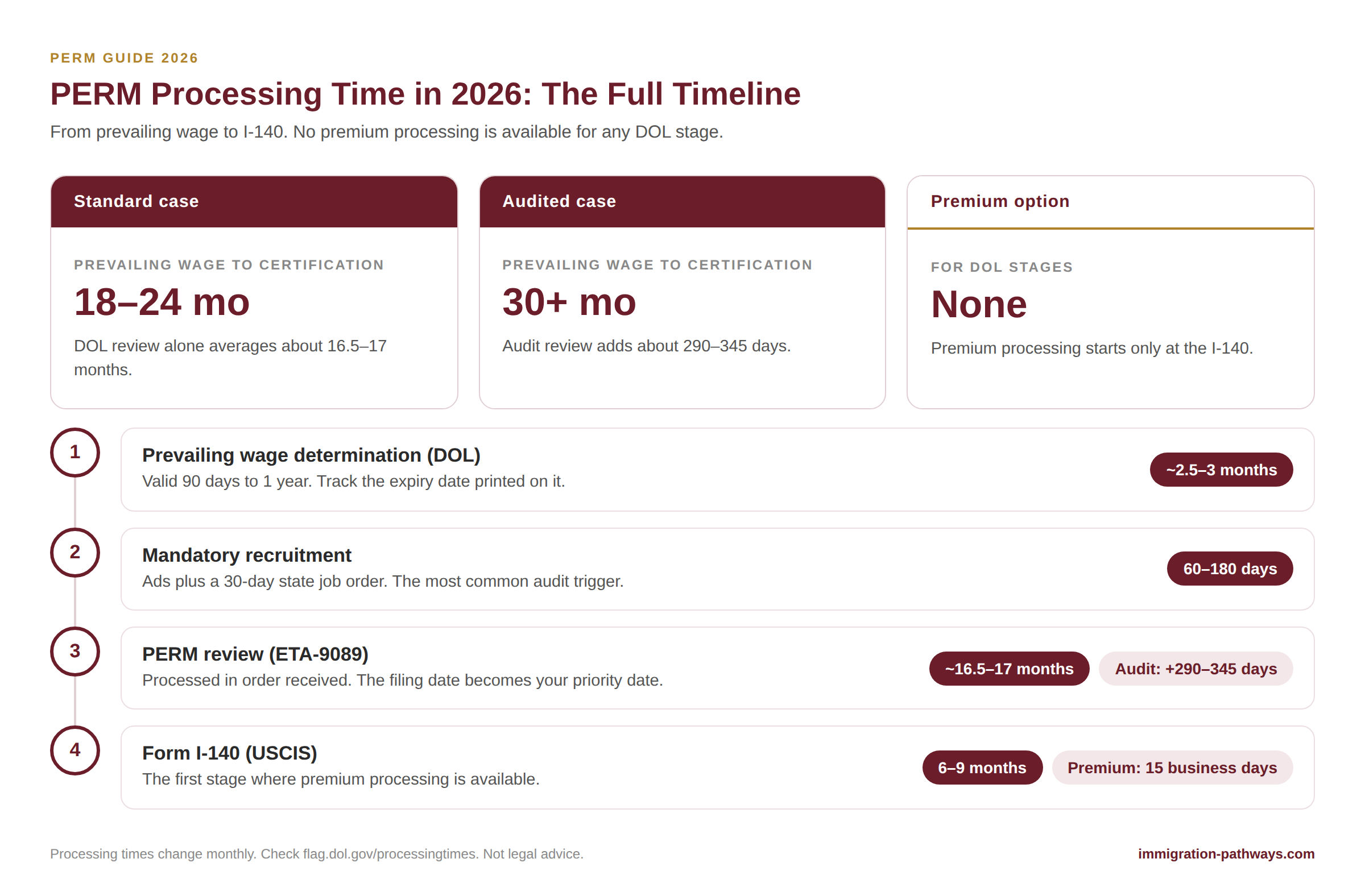
Stage 1: Prevailing Wage Determination (PWD)
- Who: DOL's National Prevailing Wage Center
- Time: about 2.5 to 3 months for OEWS-based occupations; non-OEWS cases may take longer
- Premium processing: not available
The employer asks DOL to set the minimum wage for the occupation, location, and skill level. The PWD must be issued before recruitment, and the ads must match the approved wage and occupation.
The PWD expires. Under 20 CFR 656.40(c), a PWD is valid for at least 90 days and at most one year from issue, with the exact window printed on it. Recruitment or the ETA-9089 filing must happen within that window, or a new PWD is needed. Note the expiration date as soon as the PWD arrives.
Stage 2: Mandatory Recruitment
- Who: the employer
- Time: at least 60 days, at most 180 days
The employer runs DOL-required job advertising to show no qualified U.S. worker applied. Recruitment is tightly regulated, with specific ad types, timing, and documentation. Gaps here are the main cause of audits.
Stage 3: PERM Filing and DOL Review
- Who: DOL Office of Foreign Labor Certification
- Time: about 501 to 512 days (16.5 to 17 months) for standard cases in 2026
- Queue: as of May 31, 2026, analysts were reviewing cases filed around April 2025
- Premium processing: not available
The employer files Form ETA-9089 with the PWD, recruitment results, and the worker's qualifications. The filing date becomes the worker's priority date. Always check the live figure at flag.dol.gov/processingtimes, since the queue position changes every month.
Stage 3a: Audit, If Selected
- Who: DOL audit review team
- Time: about 290 to 345 days in recent reports
- Queue: recently reviewing audited cases filed around November to December 2025
Practitioners estimate that about a quarter of PERM cases are audited each year, either at random or because of specific red flags described below.
Stage 4: Form I-140 (USCIS)
- Who: USCIS
- Time: about 6 to 9 months standard, or 15 business days with premium processing ($2,965 as of March 2026)
After PERM is certified, the employer files the I-140 immigrant petition. This is the first stage where premium processing is available, which is especially valuable for H-1B workers near the six-year limit.
Stage 5: Visa Bulletin Wait
- Who: Department of State, based on country of birth and category
- Time: from none to well over a decade
After I-140 approval, you cannot file Form I-485 until your priority date is current in the Visa Bulletin. For most applicants born outside India and China, EB-2 and EB-3 dates are current or close to it. India-born EB-2 applicants face a wait of well over a decade.
Stage 6: Form I-485 Adjustment of Status (USCIS)
- Time: about 12.5 months on average, ranging from about 7 to 8 months to more than a year depending on the office
- Premium processing: not available
Total Realistic Timeline
- Standard case, no audit, born outside India or China: about 3 to 5 years from PERM filing to green card, assuming no RFEs and favorable Visa Bulletin movement
- Standard case, India-born EB-2: well over a decade; the Visa Bulletin wait dominates
- Audited case: add roughly 10 to 18 months or more
- Denied and refiled: start over with new recruitment, a new ETA-9089, and a new priority date, unless an appeal preserves the original date (see PERM Audits)
The H-1B Clock: Why Timing Matters
For H-1B workers, PERM timing directly affects the six-year limit, and poor planning can lead to a real status gap.
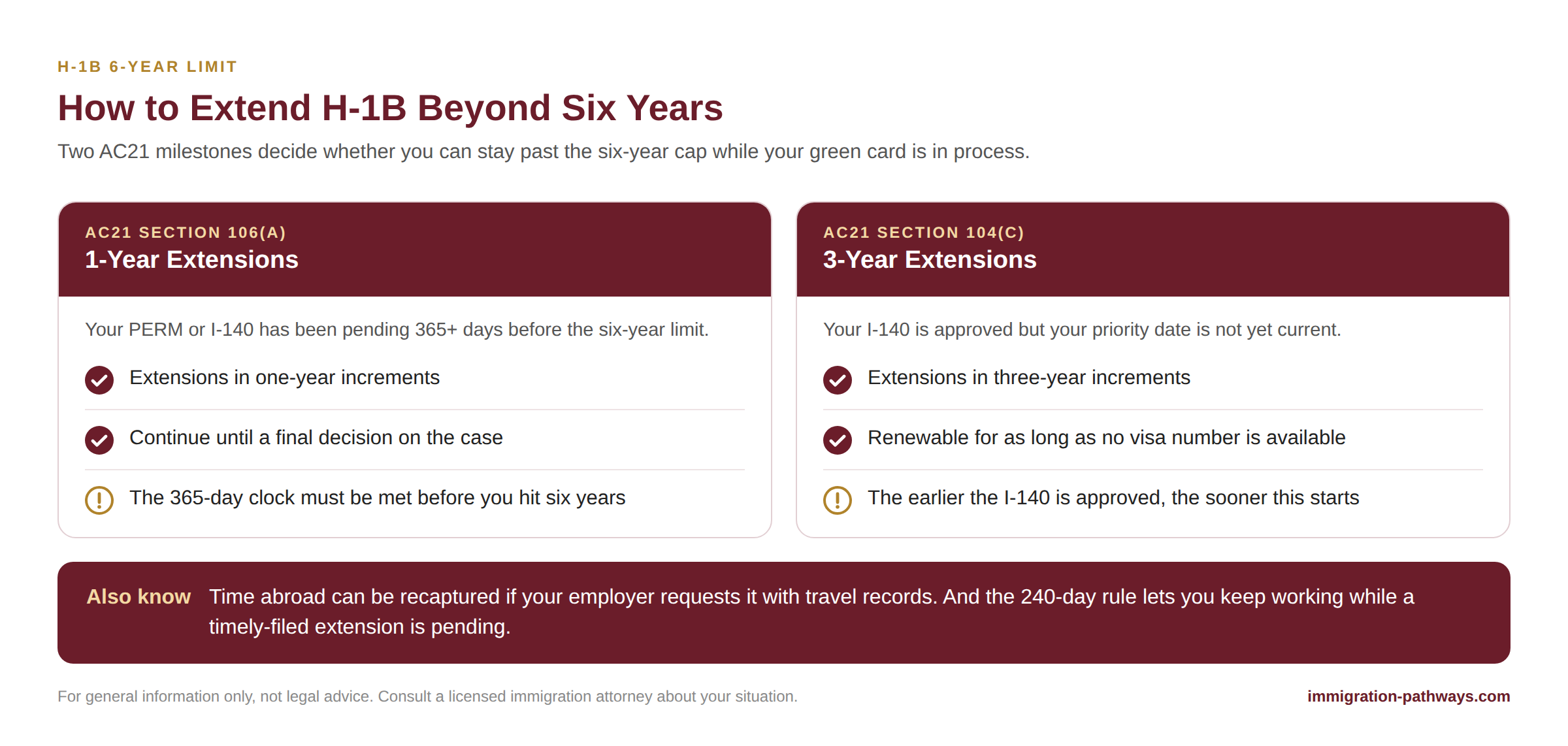
- The general rule: H-1B status lasts up to six years, three years initially plus a three-year extension.
- One-year extensions: available beyond six years if a PERM was filed at least 365 days earlier, even if it is still pending.
- Three-year extensions: available once an I-140 is approved and your priority date is not yet current, for as long as the Visa Bulletin wait lasts.
What this means for planning. If you are in year four of six and PERM has not been filed, starting it is urgent. Filing PERM at least 365 days before your six-year limit may be what allows you to stay in the U.S.
Use premium processing for the I-140. PERM cannot be expedited, but once it is certified, premium processing cuts the I-140 from 6 to 9 months to 15 business days.
PERM Audits: What Triggers Them and What Happens
An audit means DOL wants more documentation before certifying the case. Audits can be random, so being audited does not mean something is wrong; your case is simply in a different queue.
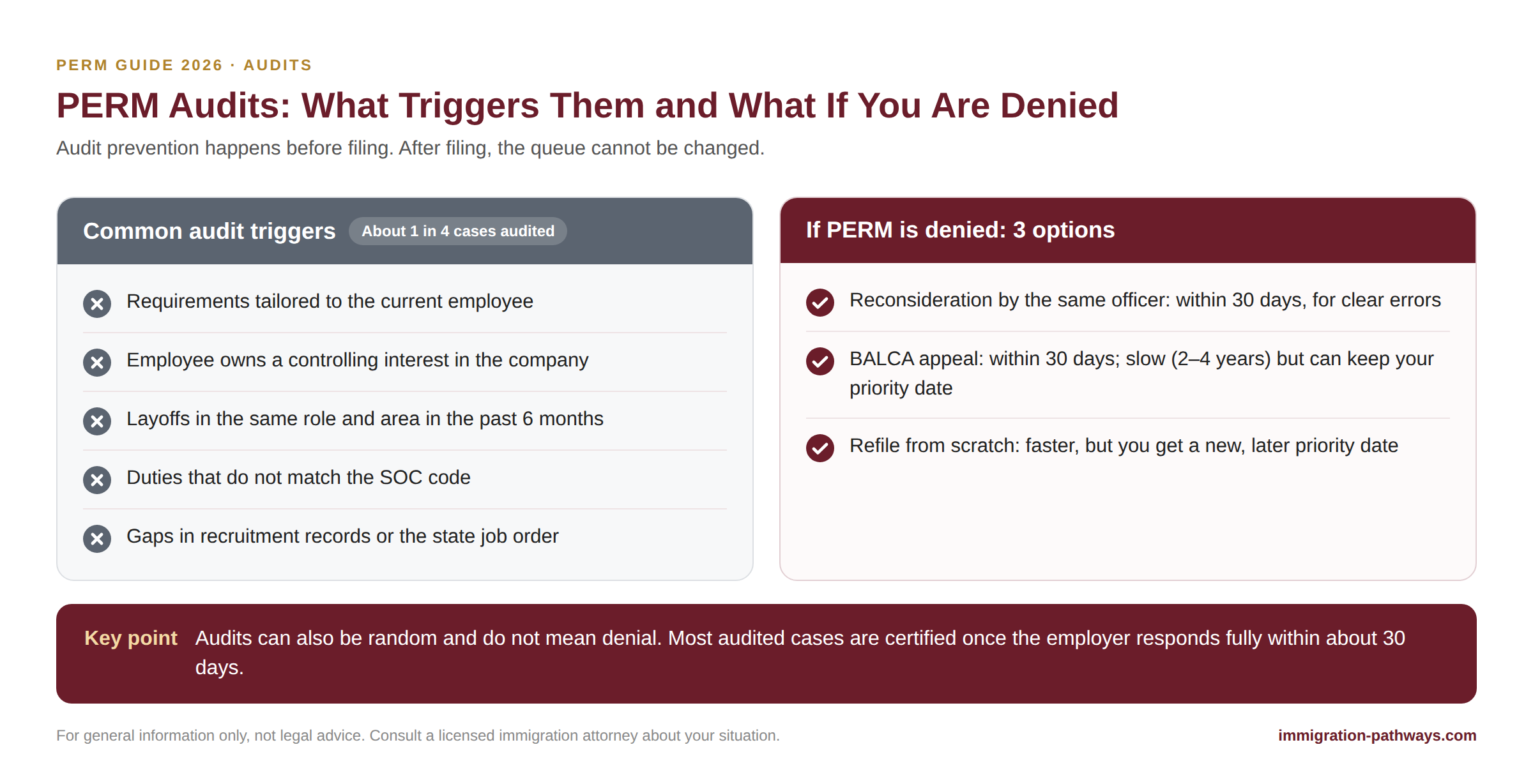
Common audit triggers:
- Minimum requirements that seem tailored to the current employee rather than the job
- The employee owns a controlling interest in the business
- Layoffs in the same occupation and location within the past six months
- Job requirements that do not match the SOC code used for the prevailing wage
- Gaps or irregularities in recruitment documentation
What happens in an audit. DOL requests documents, usually all recruitment materials, the reasons U.S. applicants were rejected, and support for the job requirements. The employer has about 30 days to respond. If the documents are complete and consistent, the case moves to certification; otherwise it is denied. An audited case often takes more than 30 months from filing.
If PERM Is Denied After an Audit
Refiling from scratch, with a new PWD, new recruitment, and a new ETA-9089, is one option. It makes sense when the original recruitment had a defect a new filing can fix. But there are two other options that matter most when an early priority date is at stake.
- Reconsideration: the employer has 30 calendar days to ask the same Certifying Officer to reconsider. This fits denials based on an error, such as a misread document or overlooked evidence. Only the employer can request it.
- BALCA appeal: instead of, or after, reconsideration, the employer can appeal to the Board of Alien Labor Certification Appeals within the same 30 days. Appeals are slow, about 2 to 4 years depending on the backlog, but a successful appeal can preserve the original priority date. For an India-born EB-2 worker with a 2023 or 2024 priority date, keeping that date versus refiling with a 2026 date could mean a decade or more of difference.
Because BALCA is slow, some employers refile a corrected PERM in parallel, accepting the later date for a faster certification. The right choice depends on how valuable the existing priority date is, how strong the appeal is, and whether the defect can be fixed in a new filing. Talk to an attorney right after a denial, not after defaulting to a refile.
Audit Prevention: What Employers Can Do Before Filing
Whether a case is audited is one of the few things you can influence. Once filed, the queue cannot be changed; before filing, the documentation can.
- Minimum requirements: include only genuine business requirements for the role, regardless of the current employee's qualifications. Requiring a master's degree is fine if the employer truly requires it, but it can trigger an audit if the employer accepts a bachelor's plus experience for similar roles.
- Recruitment records: keep every ad, date, applicant resume, and the lawful reason each applicant was not hired. Vague reasons are a frequent audit trigger.
- State Workforce Agency job order: place it with the SWA in the state where the job is located, not where headquarters is, and run it for 30 consecutive days. The ETA-9089 cannot be filed until at least 30 days after the job order closes, and recruitment must fall within 180 days of filing. Keep the posting printout or case number. A missing or inconsistent job order is a well-known, avoidable audit trigger.
- Job duties and SOC code: the duties must match the SOC code used for the prevailing wage and how the employer actually uses the role.
- Timing: avoid filing after recent layoffs in the same occupation and location; DOL requires a business necessity explanation in that case.
5 Things to Do While You Wait
The PERM queue cannot be sped up, but the wait does not have to be wasted.
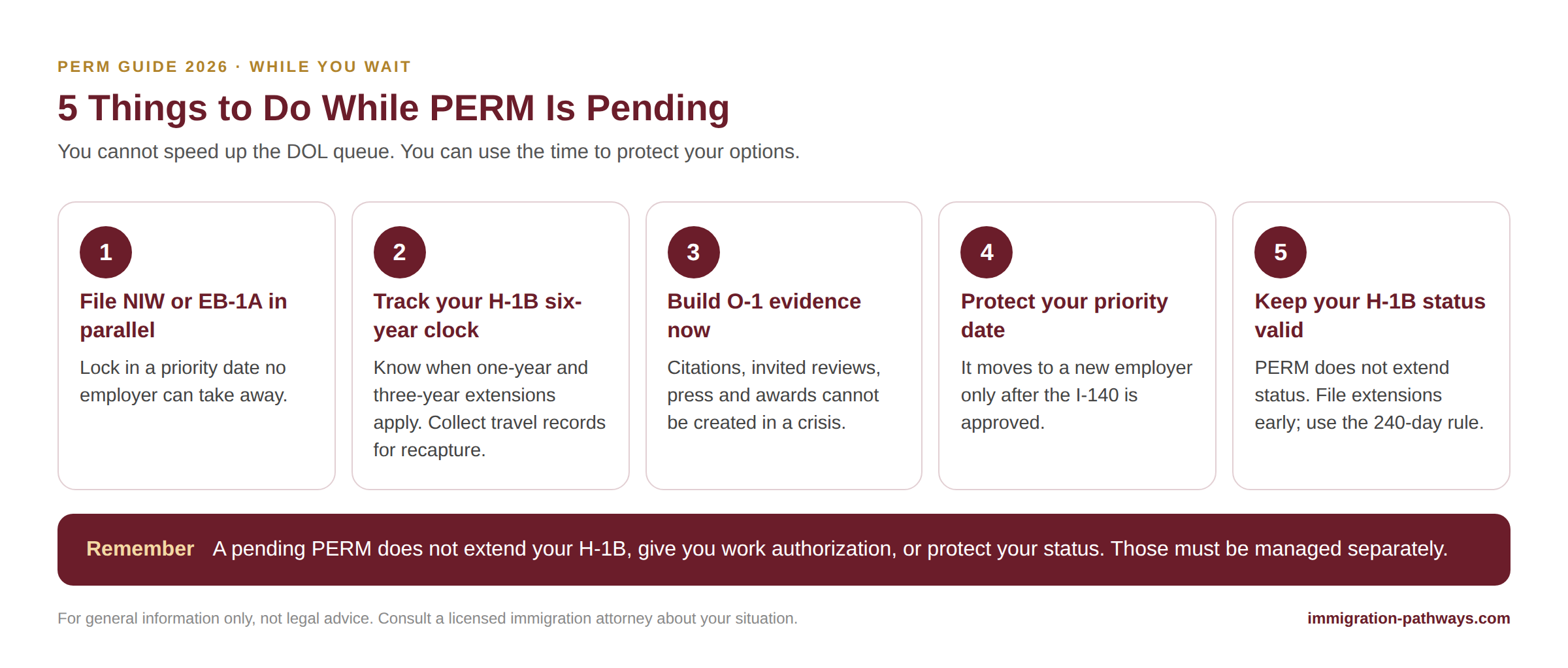
1. Consider EB-1A or EB-2 NIW in Parallel
PERM is required for standard EB-2 and EB-3 cases, but not for these:
- EB-1A (extraordinary ability): a self-petition with no employer and no PERM. The evidence bar is high (sustained acclaim and at least 3 of 10 criteria), but for the right profile it avoids the PERM wait entirely. EB-1 dates are generally current for applicants born outside India and China.
- EB-2 NIW (national interest waiver): a self-petition with no employer and no PERM, based on the national importance of your work. The bar is lower than EB-1A. For India-born applicants the Visa Bulletin wait is the same as PERM-based EB-2, but NIW locks in a priority date that does not depend on any employer.
Filing NIW while PERM is pending gives you a priority date that starts moving without waiting for PERM, and that stays yours even if your employer stops sponsoring you.
2. Track Your H-1B Clock and Extension Eligibility
Know how many months remain before your six-year limit. Time spent outside the U.S. during H-1B status can be recaptured and does not count toward the six years.
Recapture is not automatic. Your employer must request it in the extension petition and prove every day claimed. USCIS accepts passport stamps, I-94 records, CBP travel history, airline tickets, and boarding passes. Days without documentation are simply not credited, and USCIS will not send an RFE to let you fix it. Gather records early, not right before you reach six years.
Once PERM has been pending 365 days, confirm your employer and attorney know you qualify for a one-year extension. Once the I-140 is approved, ask whether they will file for the three-year extension.
3. Build O-1 Evidence Now, While You Have Access
If you might qualify for an O-1 (no lottery, no cap), use the PERM wait to build evidence, not a future crisis. Citations, review invitations, awards, media coverage, and salary comparisons cannot be created after the fact.
If PERM is denied, your employer withdraws sponsorship, or your H-1B runs out before the green card, O-1 may be the fastest way back to U.S. work authorization, but only if the evidence is already there.
4. Protect Your Priority Date Through Job Changes
- Before the I-140 is approved: your priority date is not portable. If you change jobs while PERM is pending, or after PERM certification but before I-140 approval, the new employer must start over with a new PERM and a new priority date.
- After the I-140 is approved: you generally keep the priority date for a future employer's I-140, even if the original employer later withdraws the petition, unless the approval is revoked for fraud, an invalid labor certification, or USCIS error. It is not automatic: you or the new employer's attorney must ask USCIS to apply the earlier date, usually with a copy of the approval notice.
- The 180-day mark for the I-140: if the I-140 had been approved for 180 days or more before a withdrawal, the petition itself also stays usable for things like H-1B extensions. If withdrawn sooner, it is revoked for those purposes, though the priority date carries into a new approved petition.
- Once your I-485 has been pending 180 days: AC21 portability lets you move to a same or similar job without losing the adjustment application. The 180 days is exact: at day 175 you are not protected. If the I-140 is withdrawn before your I-485 reaches 180 days, the I-485 can be denied for lack of an underlying petition; after 180 days, it can continue under portability.
Know exactly which side of each 180-day line you are on before changing employers.
5. Keep Your Nonimmigrant Status Valid
A PERM application is not a visa or an extension. It does not extend your H-1B status, your work authorization, or your authorized stay.
Make sure your employer files H-1B extensions well before they expire; they are not automatic. If an extension is filed before your I-94 expires, the 240-day rule lets you keep working while it is pending.
If you lose H-1B status while PERM is pending, through a layoff, an employer withdrawal, or expiration, the PERM itself may be withdrawn and you may need to leave the U.S. Talk to an immigration attorney before your 60-day grace period runs out.
What You Cannot Do: Realistic Expectations
- PERM cannot be expedited. There is no premium option, no paid fast track, and no priority category. You can contact DOL if a case is more than three months past the posted time, but it will not move faster.
- You cannot change jobs without affecting PERM. PERM covers a specific job, employer, and worksite. A new employer, a different position, or a major change in duties voids the pending PERM.
- PERM does not protect your H-1B. PERM is handled by DOL and H-1B by USCIS. You must maintain H-1B status separately.
- A pending PERM does not give you a usable priority date yet. The ETA-9089 filing date becomes your priority date only once PERM is certified and an I-140 is approved. A denied PERM leaves no usable date.
FAQ
Can I file NIW or EB-1A while my PERM is pending?
Yes. They are separate tracks and do not interfere. Filing NIW while PERM is pending is a common way to lock in a priority date that is yours regardless of what happens with PERM or your job.
What happens to my PERM if I am laid off?
Your employer will usually withdraw it. A withdrawn PERM does not establish a priority date. If an I-140 based on that PERM was already approved, you generally keep its priority date for a new employer's I-140, unless the approval is revoked for fraud or a similar reason. If PERM was not yet certified, or the I-140 not yet approved, you would start over. Talk to an attorney right away; your 60-day H-1B grace period starts the day after your last day of paid work.
Does an audit mean my PERM will be denied?
No. Most audited cases are certified after the audit. An audit is a request for documents, not a decision. A complete, prompt response is the key factor.
Can my employer withdraw PERM after it is approved?
Yes. If PERM is withdrawn before an I-140 is filed, the certification can no longer be used. If an approved I-140 is withdrawn, the petition is revoked, but you generally keep its priority date. Whether the petition itself stays usable for H-1B extensions depends on whether it had been approved for 180 days. Confirm the details with an attorney.
If my I-140 is revoked while my I-485 is pending, is my green card case over?
Not necessarily, but timing matters. If the I-140 is revoked before your I-485 has been pending 180 days, the I-485 is at real risk of denial. If it has been pending 180 days or more, AC21 portability generally lets it continue, as long as your job is the same or similar. Check your I-485 receipt date and count the days.
Does PERM guarantee a green card?
No. PERM approves the labor market test only. The I-140 must still be approved, your priority date must become current, and your adjustment of status must be approved. PERM is the first step, not the last.
Official Resources
- DOL FLAG processing times (updated monthly)
- DOL FLAG system for PERM filing
- USCIS processing times (I-140)
- USCIS Policy Manual
- Visa Bulletin (travel.state.gov)
- BALCA decisions and procedures
Final Takeaway
The 17-month PERM reality is not a temporary backlog. It reflects a structural gap between application volume and DOL capacity that has built up over several years, with no premium option to bypass it.
For H-1B workers, the wait is not a time to sit and hope. It is the time to check your H-1B clock, build an O-1 evidence base if your profile supports it, consider NIW as a parallel track, and understand exactly how to protect your priority date if your job changes.
The workers who come out of a 24-month PERM wait in the strongest position are the ones who used the time to build alternatives, protect their options, and plan H-1B extensions far enough ahead that no single event could derail them.
All data reflects DOL and practitioner figures as of August 2026. PERM processing times change monthly. Verify the current queue at flag.dol.gov/processingtimes before planning. This article is not legal advice.