O-1 Visa Evidence: What USCIS Actually Wants to See
O-1 visa evidence explained: the 8 O-1A criteria, what USCIS accepts and rejects, recommendation letters, and how to pass the final merits review.
Vera Kenahan
October 26, 2026 · 22 min read

Short answer: To win an O-1A, your evidence must meet at least 3 of 8 criteria, such as awards, judging, original contributions, or high salary, and then pass a final merits review showing you are among the top of your field. USCIS wants independent, documented evidence compared against your field's norms. O-1B (arts, film, TV) uses a lower "distinction" standard with 6 criteria.
This information is provided for informational purposes only and should not be considered legal advice. O-1 eligibility is highly fact-specific, and USCIS standards change through policy updates and case law. What counts as sufficient evidence depends on your field, your achievements, and how your case is presented. Information is current as of August 2026. Verify current guidance at uscis.gov/policy-manual and consult a licensed immigration attorney before filing.
Start Here: Which Profile Are You?
- Software engineer or AI/ML professional: see the Engineers section and Criteria 5, 7, and 8
- Startup founder or entrepreneur: see the Founders section and Criteria 7 and 8
- Researcher or academic: see the Researchers section and Criteria 2, 3, 4, and 6
- Artist, filmmaker, or designer: see the O-1B section
- Not sure you qualify: start with the two-step test below
- Already on O-1 and considering EB-1A: see From O-1 to EB-1A
The Most Important Thing to Understand First
Most O-1 guides list the eight criteria and stop there. That is not how USCIS decides these petitions. USCIS uses a two-step test, drawn from Kazarian v. USCIS (9th Cir. 2010) and adopted in the USCIS Policy Manual.
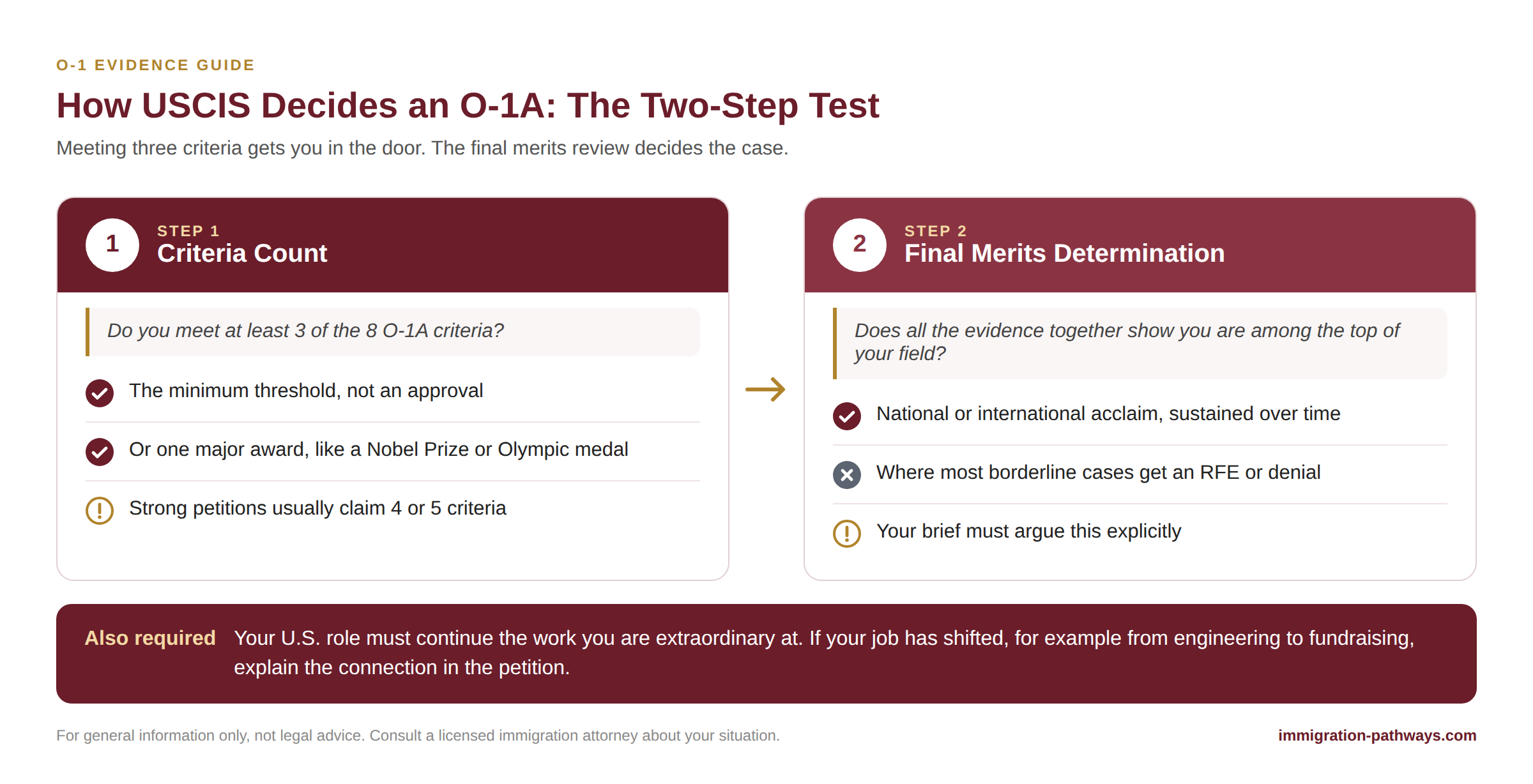
Step 1, criteria count. Does the petition meet at least three of the eight criteria in 8 CFR 214.2(o)(3)(iii)? This is the minimum threshold, not an approval.
Step 2, final merits determination. Does the evidence as a whole show national or international acclaim, placing you among the small percentage at the top of your field?
Step 2 is where most borderline cases fail. A petition can meet three criteria and still get an RFE or denial if it does not show that you are among the best in your field.
About 94% of filed O-1 petitions were approved through FY 2025. That figure partly reflects pre-screening: attorneys and clients evaluate the evidence before deciding to file. Your own odds depend on the strength of your evidence.
A second requirement people miss. Under 8 CFR 214.2(o)(1)(ii)(A) and the USCIS Policy Manual, extraordinary ability is not enough on its own. You must also be coming to the U.S. to continue work in that same area. USCIS treats these as two separate questions.
This gap shows up when an AI researcher moves into venture capital, an academic's U.S. job is mostly administration, or a technical founder's petition rests on engineering achievements while the U.S. role is mostly fundraising. If your work has shifted, say so and explain the connection between the U.S. role and your area of extraordinary ability. Do not leave it for the officer to assume.
O-1A vs. O-1B: Know Your Track
O-1A covers sciences, education, business, and athletics. It requires extraordinary ability shown by sustained national or international acclaim, judged against 8 criteria under 8 CFR 214.2(o)(3)(iii). You must meet at least 3.
O-1B covers the arts, film, and television. The standard is distinction: skill and recognition well above what is ordinarily encountered. It is a lower bar in theory but still needs strong, clear evidence, judged against 6 criteria under 8 CFR 214.2(o)(3)(iv). You must meet at least 3. Motion picture and television cases use a slightly different list and a field-specific consultation.
If your work mixes technology and art, such as UX design, game development, or creative direction, classification matters. Filing on the wrong track with the wrong criteria weakens the whole case, so ask an attorney first.
The Eight O-1A Criteria: What USCIS Wants to See
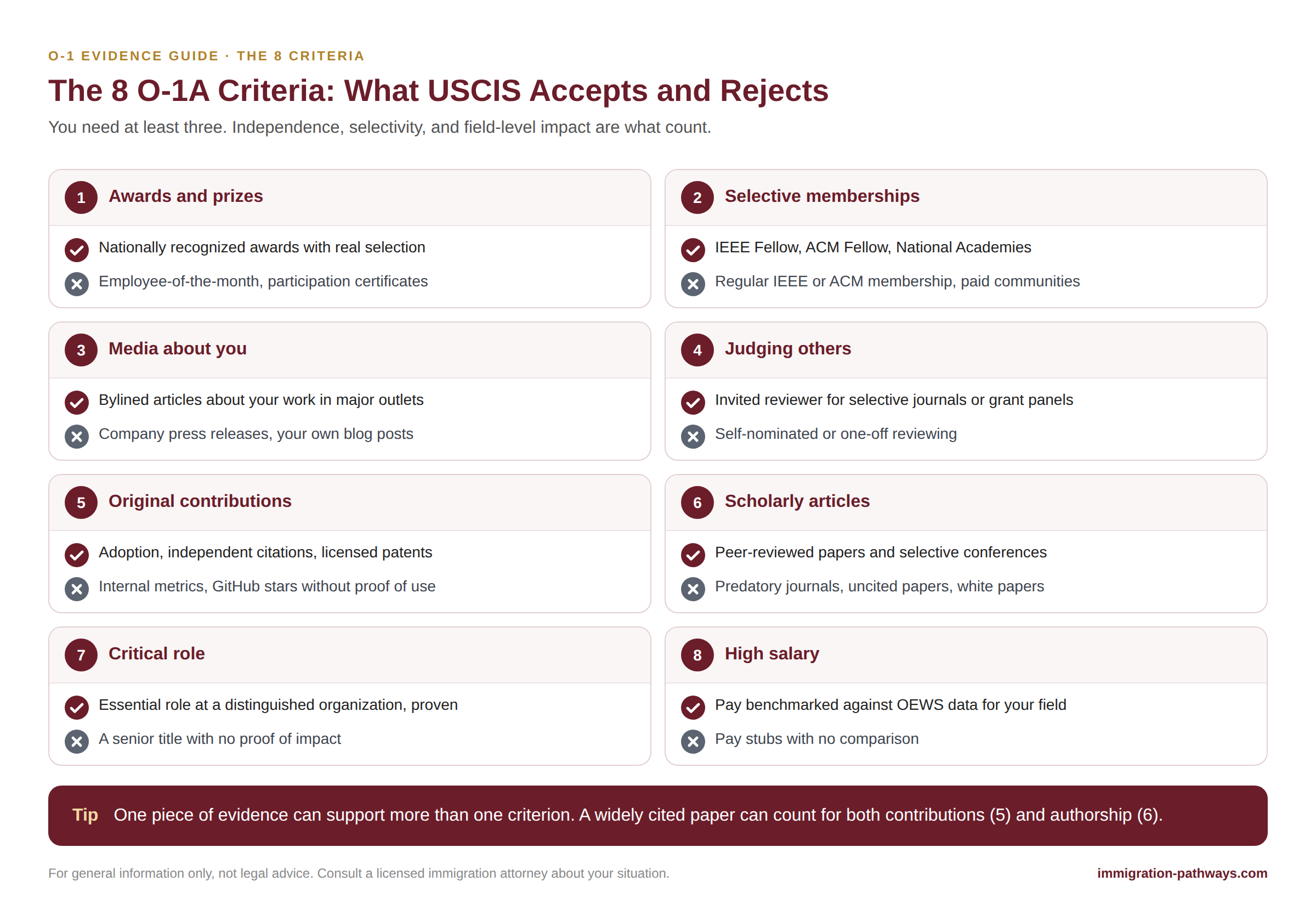
You must meet at least three of these, or show a one-time major achievement such as a Nobel Prize, Olympic medal, or Turing Award (8 CFR 214.2(o)(3)(iii)).
Criterion 1: Awards and Prizes for Excellence
The standard: nationally or internationally recognized prizes or awards for excellence in the field.
USCIS accepts:
- Awards from nationally or internationally recognized bodies with clear selection processes
- Competitive, merit-based fellowships
- Government recognition with independent judging
- Independently judged industry awards
USCIS does not accept:
- Employee-of-the-month or other internal company awards
- Participation or conference attendance certificates
- Awards with entry fees, or awards given to everyone who enters
- Regional or local awards with no explanation of national significance
The test: does the evidence show this is a nationally or internationally recognized award for excellence, not an internal one?
Weak vs. strong:
- Weak: Winner of the 2024 Engineering Excellence Award at Acme Corp.
Strong: Forbes 30 Under 30 in Technology, chosen by a committee of 50+ industry leaders from about 15,000 nominees, an acceptance rate under 3%. - Weak: Certificate of completion from a professional course.
Strong: NSF Graduate Research Fellowship recipient, ranked in the top 15% of applicants in the field nationally, per NSF data.
Criterion 2: Membership in Associations Requiring Outstanding Achievement
The standard: membership in associations that require outstanding achievement, as judged by recognized national or international experts.
USCIS accepts:
- Fellow designations requiring nomination and peer review, such as IEEE Fellow, ACM Fellow, AAAS Fellow, or the National Academy of Sciences
- Invitation-only associations with documented selection criteria
- Associations with documented achievement thresholds for membership
USCIS consistently rejects:
- General ACM or IEEE membership, open to anyone who pays
- Most licensing associations, where membership requires only passing an exam
- LinkedIn groups, Slack communities, and similar networks
The distinction: outstanding achievement must be a requirement for membership, judged by experts, not just a common trait of members. Selectivity has to be built into the membership process.
For engineers and researchers: IEEE Fellow, ACM Fellow, and National Academy memberships score well. Regular IEEE or ACM membership does not. If you have neither, Criterion 4 or 5 may be easier to prove.
Criterion 3: Published Material About You in Major Media
The standard: published material about you, in professional or major trade publications or other major media, relating to your work in the field.
USCIS accepts:
- Articles about you in respected trade publications, newspapers, or professional journals
- Coverage by established journalists in outlets with documented circulation
- Articles in professional journals that discuss your specific work
USCIS consistently rejects:
- Press releases from your company or PR team
- Coverage that names your company but not you
- Articles or posts you wrote yourself, including on Medium or LinkedIn
- Conference session descriptions
- Company website profiles
The test: is the article about you, not your company or product, and written by an independent author in an established outlet?
Weak vs. strong:
- Weak: A TechCrunch article about your company's funding round that mentions you in one sentence.
Strong: A TechCrunch feature on your AI research and its adoption in healthcare, by a named journalist, with the publication date and circulation documented. - Weak: A company blog post you wrote about your own work.
Strong: A bylined MIT Technology Review article covering your contribution to a technical area and quoting independent experts.
For engineers: personal media coverage is hard to get for internal or product work. Coverage of your published research in trade press is easier. Target outlets your field actually reads, such as MIT Technology Review, VentureBeat's AI section, or Wired's technology coverage.
Criterion 4: Judging the Work of Others
The standard: participation, alone or on a panel, as a judge of the work of others in the same or a related field.
USCIS accepts:
- Invitations to peer review manuscripts for named journals
- Service on grant review panels, such as NSF or NIH
- Invitation-based judging at hackathons in your field
- Selecting award recipients in a competitive process
- Program committee membership for selective conferences
USCIS now looks harder at:
- Self-nominated conference reviewing, where any volunteer is accepted
- One-time reviewing with no ongoing involvement
- Reviewing for predatory or low-impact journals
What matters: not how many reviews you did, but whether you were invited and how respected the venue is. One invitation to review for a leading journal in your area outweighs 20 conference reviews.
Documentation to include:
- The invitation email from the journal or conference
- The journal's editorial policies, impact factor, or acceptance rate
- The conference's selection criteria, acceptance rate, h5-index, or reputation
- For grants, the panel charter and how the agency selects reviewers
Weak vs. strong:
- Weak: Reviewed 12 papers for a major conference, with no proof of how reviewers are chosen.
Strong: Invited reviewer for a highly selective machine learning conference with a documented low acceptance rate, invitation from the program chair attached. - Weak: Judged a company-hosted hackathon.
Strong: Judge for a university-sponsored AI policy hackathon with hundreds of applicant teams, with external judges selected for domain expertise.
Criterion 5: Original Contributions of Major Significance
The standard: original scientific, scholarly, or business contributions of major significance in the field.
This is the most flexible criterion and the one most often rejected. Almost anything can fit, but petitioners often describe their work without showing why it matters to the field. USCIS is not asking whether your work is original. It is asking whether others in the field have adopted, cited, built on, or otherwise recognized it.
Ways to show major significance:
- Citations by independent researchers who have never worked with you
- Open-source software with documented use by named outside organizations
- Patents with evidence of licensing or adoption
- Documented adoption of your method or framework by others
- Independent experts explaining how your work changed their approach
Not enough on its own:
- Describing what you did without showing anyone used it
- Internal metrics, such as your users or your employer's ROI
- GitHub stars or downloads without proof of real-world adoption
- Your own claim that the work was widely adopted
The field-norm problem. Is 50 citations a lot? It depends on your subfield. The same paper could be in the top 5% of a niche biostatistics area and average in a crowded NLP area. USCIS cannot judge this on its own, so you have to provide the comparison.
Weak vs. strong:
- Weak: Developed a novel fraud detection algorithm deployed across Acme Corp's platform.
Strong: A fraud detection paper with 312 Google Scholar citations, in the top 8% of papers from the same year and journal. Researchers at two other institutions explicitly used the technique (references provided), and the open-source implementation is used by three companies. - Weak: Invented a new approach to distributed systems architecture.
Strong: A paper on a distributed consensus protocol referenced by seven engineering teams at different companies, with letters from two of them describing its effect on their production systems.
Criterion 6: Authorship of Scholarly Articles
The standard: authorship of scholarly articles in professional journals or other major media in the field.
This matters most for academics and scientists. For most engineers and founders, Criteria 4, 5, 7, and 8 carry more weight.
What USCIS weighs heavily:
- Peer-reviewed journal articles
- Papers at highly selective conferences, which in computer science and AI are equivalent to top journals
- Publication volume relative to career stage and field norms
- Citations compared with field norms, not raw counts
What USCIS increasingly discounts:
- Predatory journals that publish for a fee without real peer review
- Papers with few or no citations
- Many low-impact papers with no clear story
- Self-published white papers or blog posts
For computer science and AI: papers at NeurIPS, ICML, ICLR, ACL, and similar selective conferences often carry more weight than journal articles, because the field is conference-first. Explain this in the petition.
Criterion 7: Critical or Essential Role at a Distinguished Organization
The standard: employment in a critical or essential capacity for organizations with a distinguished reputation.
You must prove two things at once:
- The organization is distinguished, not just a good employer. For large companies, show market position, rankings, and media coverage. Smaller companies need more evidence of why they are distinguished.
- Your role was critical or essential, not just senior or well paid. Show what specific system or function depended on you.
The common trap: describing a famous company and a senior-sounding job without connecting them. USCIS needs to see why your role was essential to that organization's core work.
Weak vs. strong:
- Weak: Senior Principal Engineer at a large, well-known Fortune 500 company.
Strong: Led the architecture for a key feature of a flagship product used by hundreds of millions of people daily. An org chart shows a team of 12, budget authority is documented, and a senior executive letter explains the role was essential to a feature behind measurable user growth. The company's reputation is shown through industry rankings and news coverage.
Criterion 8: High Salary Compared With Others in the Field
The standard: a high salary or other high remuneration compared with others in the field.
What counts is relative pay. A salary that stands out in one field may be average in another, so you must show your pay is well above others in your field.
Accepted benchmarks:
- BLS OEWS wage data (free, government data, widely accepted)
- Industry compensation surveys from reputable organizations
- LCA wage data for your occupation, location, and level
What to include:
- Total compensation, including salary, bonus, and documented equity
- The benchmark source and your percentile
- A direct comparison with the OEWS median for your occupation and area
For founders: below-market pay is common at early-stage companies, so this may not be your strongest criterion. Properly documented equity can sometimes count. Look at your other criteria first.
One piece of evidence can support several criteria. A widely cited paper can support both Criterion 5 and Criterion 6. A program committee seat can support Criterion 4 and, for a prestigious conference, Criterion 2. This is not double counting. USCIS expects the brief to explain every criterion each piece of evidence supports.
The Comparable Evidence Provision
If the O-1A criteria do not readily apply to your occupation, 8 CFR 214.2(o)(3)(iii)(C) lets you submit comparable evidence. It exists for new fields, cross-disciplinary work, and professions where traditional markers, such as scholarly articles, are not how excellence is recognized. O-1B has its own provision at 8 CFR 214.2(o)(3)(iv)(C).
This route is underused. If your work truly does not fit the eight criteria, for example as a game designer, an influential technical creator, or a competitive esports player, discuss comparable evidence with an attorney.
What to Prioritize Based on Your Background
Software Engineers and AI/ML Professionals
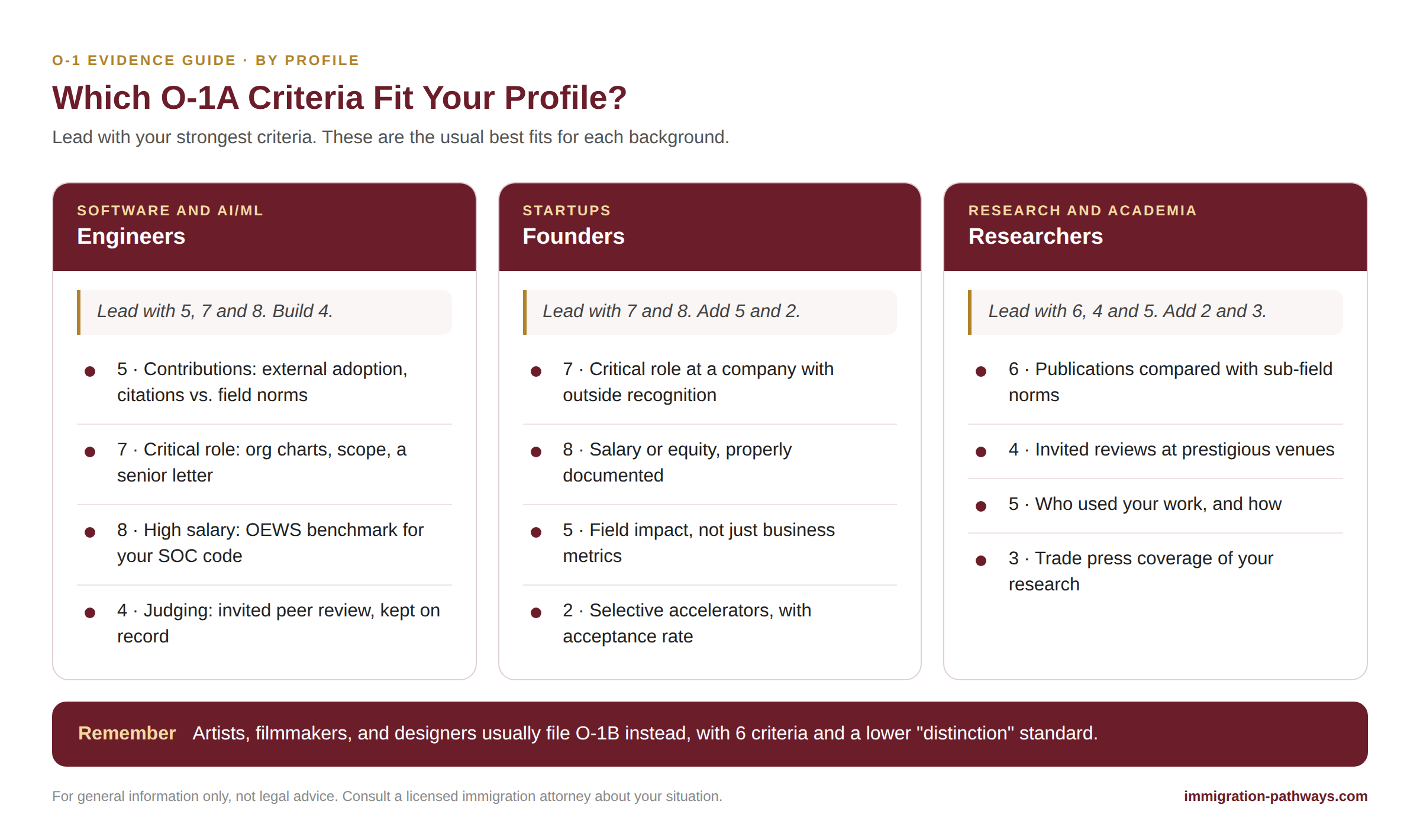
Your strongest criteria are usually 5 (original contributions), 7 (critical role), and 8 (high salary), with 4 (judging) as a fourth.
- Criterion 5 is your foundation. Document outside use of your open-source work, compare citations with field norms, and get letters from engineers at other organizations describing specifically how your work influenced theirs.
- Criterion 7 needs context. Do not just name a well-known employer. Show your exact role with org charts, impact metrics, and a senior letter explaining what would have been different without you.
- Criterion 8 works if you are well paid. Use OEWS figures for your SOC code and location, and state the comparison clearly in the brief.
- Criterion 4 can be built. Seek invitations to review for reputable journals and selective conferences, and keep a record of every invitation.
Common engineer mistake: presenting internal metrics, such as "my product serves 100 million users," as proof of significance without outside confirmation. Internal metrics are not field significance.
Startup Founders and Entrepreneurs
Your strongest criteria are usually 7 (critical role), 8 (high salary or investor recognition), 5 (original contributions, through commercial impact), and 2 (membership), if you were selected for a selective program.
Petition structure matters more for founders. You will often file through your own company, so USCIS needs to see a real employer-employee relationship with outside oversight. Document board members and investor oversight. A petition with no third-party oversight is riskier.
- Criterion 7: your company needs a distinguished reputation. Accelerator selection, funding from well-known investors, media coverage, or government grants help establish it.
- Criterion 5: customers, revenue, jobs, and adoption matter, but present them as impact on your industry, not just your company. "We have 500 customers" is a business metric; "trade press reports our method changed how the industry handles X" is field impact.
- Accelerators: selective programs such as Y Combinator and Techstars report acceptance rates in the low single digits. Presented with the acceptance rate and selection criteria, this can support Criterion 2. USCIS will not know what your accelerator is unless you explain it.
If your daily work no longer matches your area of extraordinary ability, address it. If your case rests on engineering or product achievements but your job is now mostly fundraising or management, explain how the U.S. work continues or connects to that area. A technical founder can usually make this case, but only by stating it directly.
Common founder mistake: treating the petition like a pitch deck. USCIS is not an investor. Revenue projections, market size, and vision statements do not prove extraordinary ability.
Researchers and Academics
Your strongest criteria are usually 6 (scholarly articles), 4 (judging), 5 (original contributions), and 2 (membership), with 3 (media) as one you can build.
- Criterion 6 is your base, compared with field norms. List publications and citations with an explicit comparison to researchers at a similar career stage in your subfield. A table of your citations and h-index versus field medians, plus venue rankings, persuades more than a list of papers.
- Criterion 4 sets you apart. Most researchers review; what matters is venue prestige and invitation-based selection. Keep a complete list of invitations with venue, date, and prestige metrics, plus editor letters where possible.
- Criterion 5 shows your influence. Show how your papers influenced others: a table of citing papers, the authors' affiliations, and one line each on what they used from your work.
- Criterion 3 is reachable. Trade press coverage of your research is easier to get than general press, especially for work with medical, technical, or environmental applications.
O-1B: Evidence for Arts, Film, and Television
O-1B uses six criteria and a "distinction" standard, which is easier in theory than extraordinary ability. The evidence still has to be concrete, documented, and independently verified.
- Leading or starring roles in productions or events with a distinguished reputation
- Critical or central roles for organizations with a distinguished reputation
- National or international recognition for achievements, shown by critical reviews or testimonials
- Commercial or critically acclaimed successes, such as box office receipts, ratings, or awards
- Recognition for achievements from peers, critics, government agencies, or recognized organizations
- High salary or remuneration for services
An O-1B petition requires an advisory opinion from the relevant peer group, labor union, or management organization. Film and TV cases need support from the relevant union or guild; fine arts cases from a relevant peer group. If no relevant organization exists, explain why.
The threshold in practice. You do not need to be the most famous person in your field, but you must show achievement well above what is ordinarily seen, even in a field full of accomplished people. Strong work without third-party validation, such as reviews or awards, is not enough.
Recommendation Letters: The Make-or-Break Evidence
Almost every O-1 petition includes recommendation letters, and how USCIS weighs them is one of the most underrated factors in the outcome.
Independence matters. Letters from supervisors, colleagues, your PhD advisor, or anyone at your organization carry less weight than letters from experts with no professional connection to you.
What a strong letter includes:
- The writer's qualifications to judge your field
- Specific achievements: what method or result you introduced, why it matters, and who uses it now
- Explicit comparison with others in the field, based on what the writer has seen over their career
What a weak letter looks like: generic praise anyone could have written, or language that reads like a LinkedIn profile.
How many: 5 to 8 letters for a well-prepared petition, with at least 3 from independent experts. More weak letters do not make up for fewer strong ones.
Weak example: "I have known this person for seven years and enjoyed working with them on many projects. They are one of the most gifted researchers I have met and have done great work in our area."
Strong example: "Although I have never worked with this researcher, I know their work on adversarial robustness in distributed systems well. Their paper proposed a defense against a weakness in my own research area, the vulnerability of gradient-based methods to perturbation attacks. I have since cited it in my own work (citation enclosed), and to my knowledge at least four other research teams have used this method in the past 18 months. In 12 years of reviewing papers in this subfield, I can recall no more than five papers with this much immediate impact."
The Advisory Opinion (Consultation) Requirement
O-1A petitions require an advisory opinion from a peer group or an expert in the field, but USCIS is not bound by it. A positive opinion helps, but USCIS can still deny, and it can approve despite a negative opinion.
O-1B petitions in arts, film, and television require an opinion from the relevant labor organization or peer group. There is no exception unless no appropriate organization exists.
Most technology fields have no formal peer group, so O-1A advisory opinions in tech are usually letters from individual experts.
An advisory opinion is not the same as a recommendation letter, even if one person writes both. The advisory opinion is a requested consultation from a qualified expert. A recommendation letter is general supporting evidence. One well-positioned letter can sometimes do both jobs, but do not assume every strong letter satisfies the consultation requirement. Have your attorney confirm at least one letter is framed specifically as the requested consultation.
What Triggers an O-1 RFE in 2026
Recent RFEs focus more on the quality and credibility of the evidence than on whether the minimum criteria are ticked off. The most common triggers:
- Missing required documents: no advisory opinion, no employer or agent agreement, or no itinerary or explanation of why one is not needed. These are procedural and fully avoidable.
- A gap between your area of ability and your U.S. role: USCIS wants to see you will continue work in your area of extraordinary ability. Researchers moving into venture roles, academics moving into administration, and founders whose evidence is technical but whose job is fundraising all risk this if the connection is not explained.
- Claims without field norms: calling your publications significant without showing what significant means in your field. Officers are generalists and cannot put your numbers in context.
- Weak recommendation letters: vague letters, letters only from colleagues, or letters that read as self-written.
- Non-independent press: employer press releases or company blog posts.
- No final merits argument: the petition meets three criteria on paper but never argues that the evidence as a whole places you in the top of your field. That argument is your job, not the officer's.
What counts as an adequate itinerary. O-1 filings need an itinerary of events or engagements, or a clear explanation of why one does not apply. For a single-employer role, a detailed job description and offer letter covering the petition period usually serves as that explanation. Performers, artists, and consultants with several engagements need a real calendar with dates and venues. Founders filing through an agent should document the engagements or the ongoing structure of the role in writing.
RFE or NOID: Not the Same Notice
A Request for Evidence means USCIS wants more information before deciding. A Notice of Intent to Deny means the officer is already leaning toward denial and is giving you one last chance to respond to the specific reasons.
NOID deadlines are usually shorter, often about 30 days, though the date on your notice controls. A NOID response must directly rebut the officer's reasoning rather than add more of the same evidence. If you receive a NOID, involve an attorney right away.
Building Your O-1 Evidence Portfolio From Where You Are
Not every profile is ready to file now. Some need 6 to 12 months of focused evidence building first.
What you can build in about 6 months:
- Peer review invitations from journals and conferences, through networking, not self-nomination
- A thorough salary analysis using current OEWS data
- Media coverage, by reaching out to journalists who cover your field
- Letters from independent experts on your achievements
What you cannot speed up:
- Citations, which build over time
- Major awards, most of which are given once a year
- Membership in selective organizations, where nominations take time
Keep your evidence current. USCIS checks whether acclaim is sustained, not just whether it existed. If your strongest evidence, such as a major paper, accelerator cohort, or funding round, is several years old and things have been quiet since, show that your standing is current: a recent invitation, recent citations of older work, or recent recognition.
The strategic choice: can your evidence pass the final merits review, or are you borderline on three criteria? If borderline, the cost of a possible denial, legal fees, extra work, and stress usually exceeds the cost of six months spent strengthening the case.
From O-1 to EB-1A: Using the O-1 Period Strategically
If your goal is an EB-1A green card, O-1 can be a useful stepping stone, though not a guaranteed one.
USCIS is not bound by an O-1 approval when deciding an EB-1A petition, and some O-1 holders have been denied EB-1A on the same evidence. O-1 approval does not reduce EB-1A risk.
What the O-1 period gives you is U.S. work authorization and time to strengthen your record with new independent citations, judging experience, and expert recognition.
EB-1A's final merits review is stricter: it asks whether you are among the very small percentage at the very top of your field. The O-1 standard is somewhat more flexible because the status is temporary.
Dual intent. O-1 is not formally a dual intent category the way H-1B and L-1 are under INA 214(h). In practice, USCIS has long allowed O-1 holders to pursue a green card, including an approved I-140 or pending I-485, without treating it as a threat to O-1 status.
Be careful with travel. Some recent accounts describe consular officers questioning or denying O-1 visa renewals abroad when they see immigrant intent, especially once a pending I-140 comes up. This risk applies to renewing your visa stamp abroad, not to your status inside the U.S. If a green card is in progress and you need an O-1 renewal abroad, plan the timing with an attorney.
FAQ
Do I need to meet all eight criteria?
No, three is the minimum. Most strong petitions claim four or five, because depth across more criteria strengthens the final merits review.
Does the order of the criteria matter?
Yes. Lead with your strongest. A petition that opens with a compelling, well-documented criterion builds credibility early; one that opens with the weakest invites skepticism.
Can I file an O-1 without an attorney?
Technically yes. In practice, the final merits argument decides the case, and structuring it well takes legal drafting skill. Petitions without a strong legal brief often get avoidable RFEs.
What happens if I receive an RFE?
You usually have 87 days from the date on the notice, not the date you receive it. Respond specifically to each concern and restructure the argument around the deficiency rather than adding more of the same evidence. Current data puts approval after a targeted RFE response for O petitions at roughly 60% to 70%. A NOID is a separate, more serious notice with a shorter deadline.
How long does O-1 processing take?
Reports vary from about 2 to 6 months in most sources to as long as 12 months at points in 2026. Check egov.uscis.gov/processing-times before planning. Premium processing ($2,965 as of March 2026) guarantees a response within 15 business days; it changes your timeline, not your odds.
Final Takeaway
O-1 evidence is never really about whether you have done extraordinary work. It is about proving it, in USCIS's terms, to a generalist officer who does not know your field.
That means field-norm context for every number, independent validation for every contribution, invitation-based evidence for judging and membership, and a final merits argument that ties it together: this person is among the small percentage at the top of their field, as recognized by the field itself, on a sustained basis.
If your evidence is ready, the numbers are encouraging: about 94% of filed petitions are approved. If it is not ready, the most valuable thing you can do is not file a weak case and fight an RFE. Spend the next 6 to 12 months closing the specific gaps between your profile and a petition that can pass the final merits review.
Build your O-1 evidence portfolio in Immigration Pathways, free.
This guide reflects USCIS standards as of August 2026. The USCIS Policy Manual is the authoritative source for the criteria. Approval and RFE figures reflect USCIS FY 2025 data for filed petitions unless noted. Verify current guidance at uscis.gov/policy-manual and consult a licensed immigration attorney. This article is not legal advice.