EB-2 NIW 2026: The Complete Guide to the National Interest Waiver
EB-2 NIW 2026: who qualifies, the 3 Dhanasar prongs, costs, timelines, and the evidence that gets a national interest waiver approved.
Vera Kenahan
October 12, 2026 · 31 min read

DISCLAIMER: This guide is for general information only. It is not legal advice. NIW eligibility depends heavily on the facts of your individual case. Always confirm current rules at uscis.gov/policy-manual and the monthly Visa Bulletin at travel.state.gov, and speak with a licensed immigration attorney before you act.
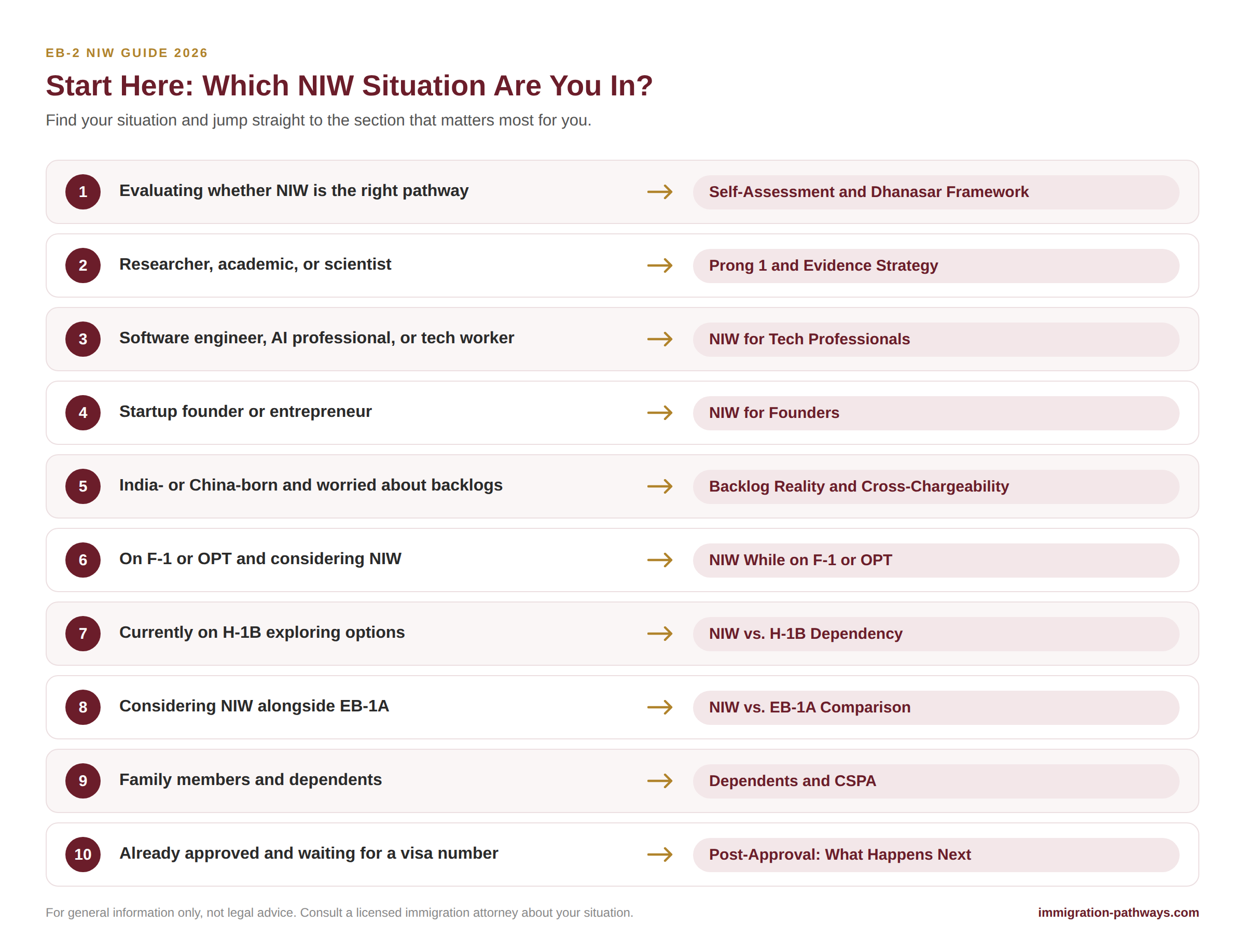
START HERE: WHICH SITUATION ARE YOU IN?
Use this table to jump to the section that matters most for you.
What Is the EB-2 NIW: and Who Is It Actually For?
The EB-2 National Interest Waiver (NIW) is a subset of the employment-based second preference (EB-2) green card category. It allows qualified professionals to submit their own green card petition without needing an employer sponsor, a permanent job offer, or PERM labor certification, provided that waiving these requirements serves the national interest of the United States.
What NIW Removes vs. What It Keeps
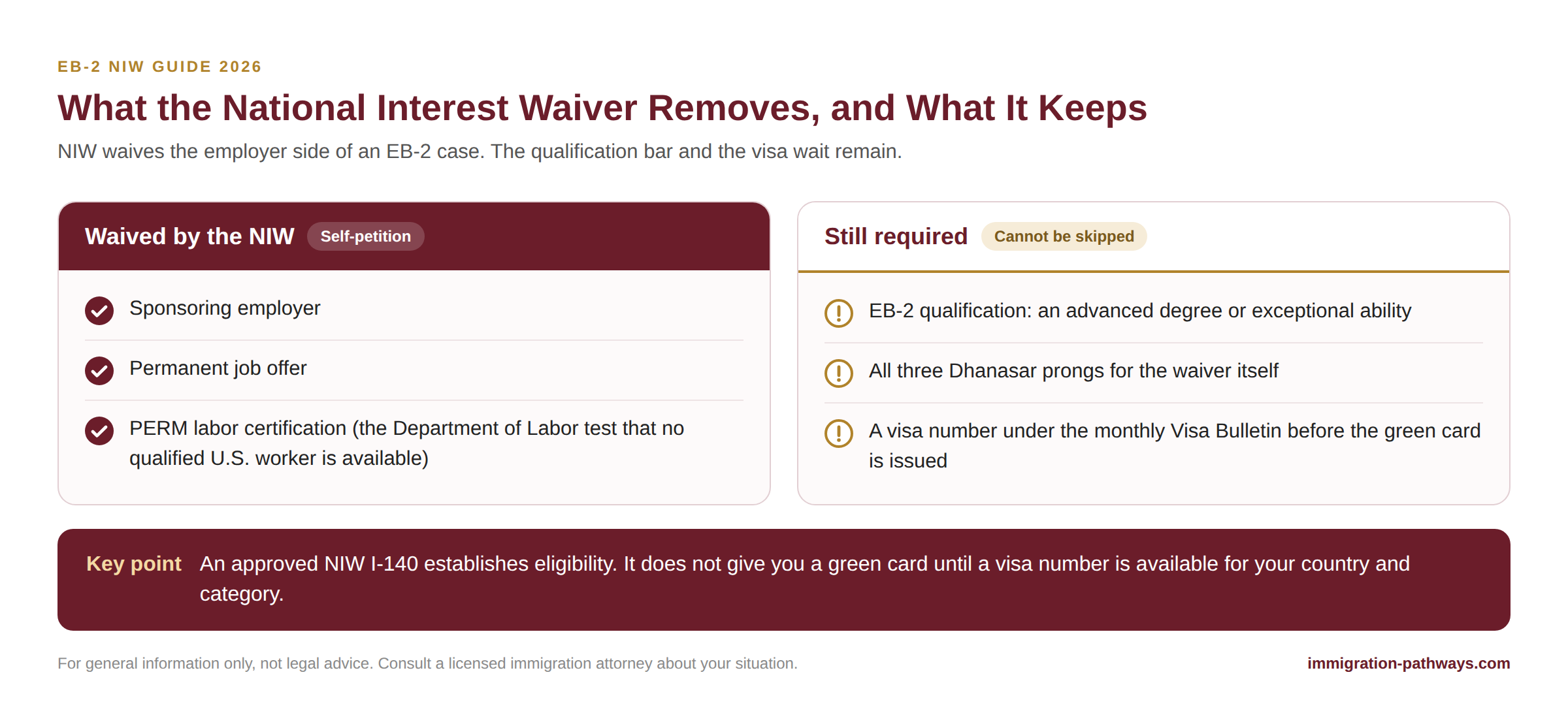
A typical EB-2 case needs three elements: a sponsoring employer, a permanent job offer, and PERM labor certification, which is a Department of Labor process where the employer must prove no qualified U.S. worker is available. The NIW eliminates all three of these requirements.
The NIW does not remove the need to qualify for EB-2 in the first place, which you do through either an advanced degree or exceptional ability. It also does not remove the wait for a visa number. You still cannot receive the green card until a visa number is available for your country and category under the Visa Bulletin, a point that many guides gloss over.
Who NIW Is Designed For
NIW is for people whose work has substantial merit and national importance to the United States, not simply people who are very good at their jobs. That distinction sits at the center of every NIW decision.
Profiles that tend to do well include researchers and scientists in nationally prioritized fields; engineers in AI, semiconductors, cybersecurity, clean energy, or infrastructure; physicians serving underserved areas; founders in strategic industries; and senior technical professionals with documented national impact.
NIW is not a shortcut, but it is also not reserved for famous people. A well-documented, well-argued case can succeed without publications, patents, or celebrity-level recognition. A weak case can fail even with an impressive resume. The outcome usually turns on how the case is argued, not just on what you have done.
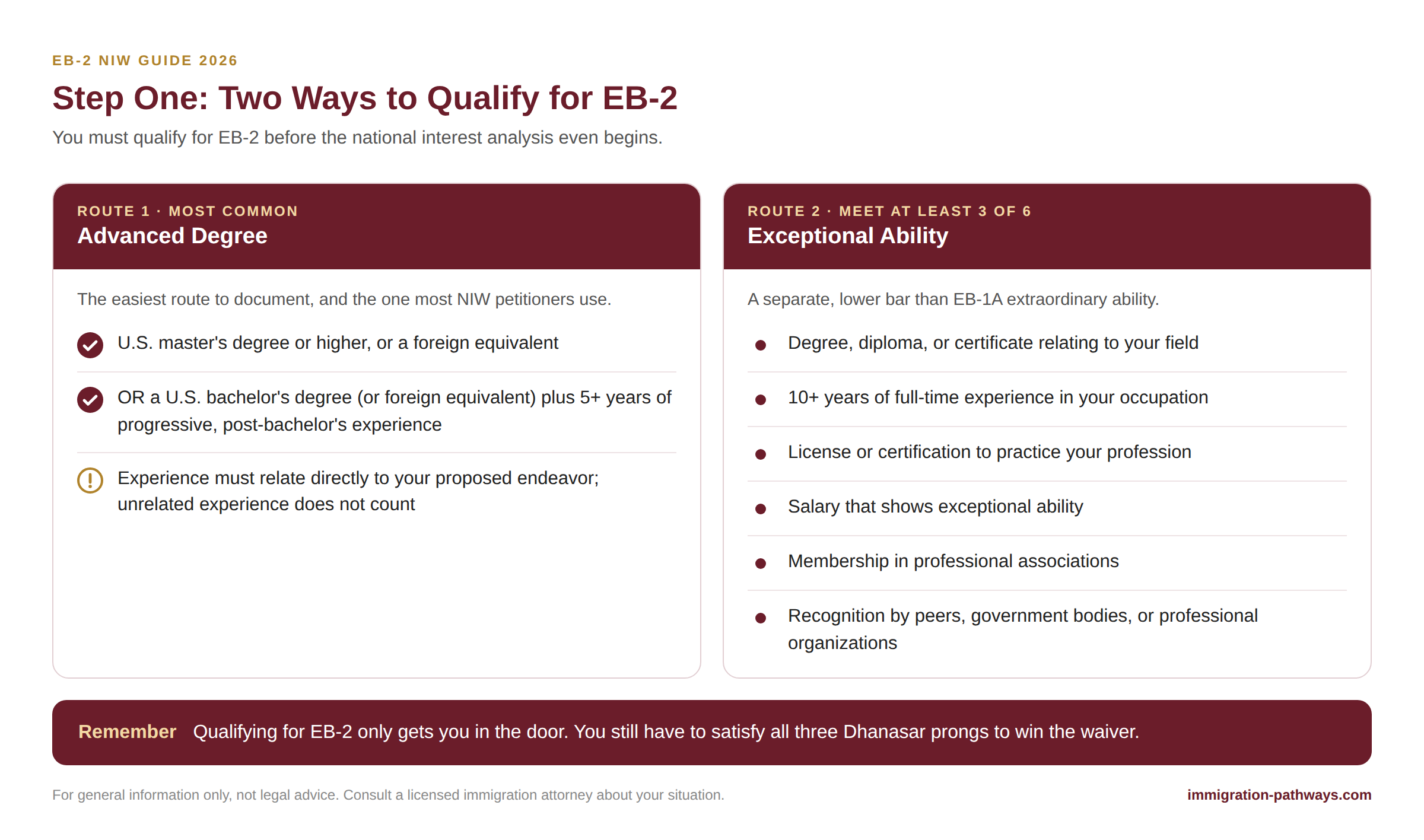
Step One: Do You Qualify for EB-2?
Before the national interest analysis even begins, you have to qualify for EB-2 through one of two routes.
Route 1: Advanced Degree
You need a U.S. master's degree or higher (or a foreign equivalent), or a U.S. bachelor's degree (or foreign equivalent) plus at least five years of progressive, post-bachelor's experience directly related to your proposed endeavor. General experience in an unrelated field does not count toward the five years. Most NIW petitioners use this route because it is the easiest to document.
Route 2: Exceptional Ability
Exceptional ability is a separate and lower bar than the EB-1A extraordinary ability standard. You must meet at least three of these six criteria:
1. A degree, diploma, certificate, or similar award from a college, university, or school relating to your field.
2. At least 10 years of full-time experience in your occupation.
3. A license or certification to practice your profession or occupation.
4. Evidence of a salary that shows exceptional ability.
5. Membership in professional associations.
6. Recognition for your achievements and contributions by peers, government bodies, or professional organizations.
Meeting these criteria only gets you into EB-2. It is separate from the NIW analysis. You still have to satisfy all three Dhanasar prongs to win the waiver itself.
The Legal Standard: Matter of Dhanasar (2016)
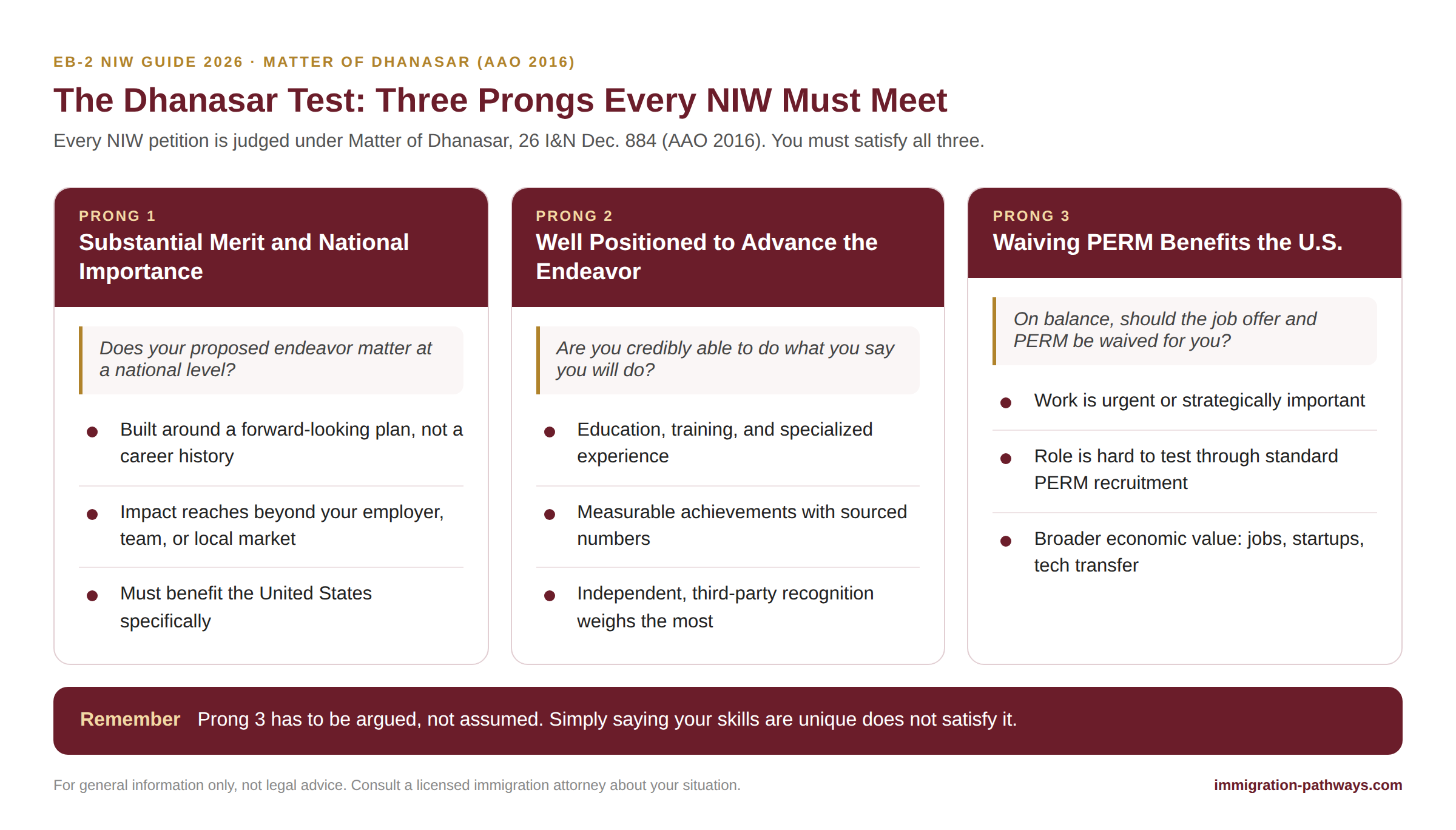
Every NIW petition is judged under the framework from Matter of Dhanasar, 26 I&N Dec. 884 (AAO 2016), a precedent decision issued by the USCIS Administrative Appeals Office (AAO) on December 27, 2016. Dhanasar vacated the older Matter of New York State Department of Transportation (NYSDOT) standard and put a more flexible framework in its place, one that fits private-sector professionals, entrepreneurs, and researchers better than the old test did.
Under Dhanasar, USCIS weighs three prongs, and you must satisfy all three.
Prong 1: Substantial Merit and National Importance
The first question is whether your proposed endeavor has substantial merit and national importance.
“Proposed endeavor” is a defined legal idea. Your case has to be built around a forward-looking plan, not a summary of your past career. Describing your career history when USCIS is asking about a future plan is one of the most common structural mistakes in NIW petitions.
“Substantial merit” means the work has real value: economic impact, scientific or technological advancement, public health benefits, educational impact, environmental impact, national security relevance, or infrastructure development. USCIS does not require commercial scale.
“National importance” is where many cases fall apart. USCIS is not asking whether your employer is important, your salary is high, or whether you are skilled. It is asking whether the broader endeavor matters at a national level, meaning its impact reaches beyond your organization, your team, or your local market.
Your Endeavor Has to Benefit the United States
This point is crucial but easy to overlook: the “national” in "national interest" specifically refers to U.S. national interest. Your proposed project must occur within the United States or clearly affect the U.S. in a significant way. If your main goal is to continue working in global or foreign markets after approval, it indicates a Prong 1 issue. Focus on framing your project around its U.S. impact from the beginning.
Arguments That Tend to Work for Prong 1
• AI systems that improve healthcare efficiency at a population scale.
• Semiconductor engineering that supports U.S. domestic manufacturing.
• Cybersecurity work that protects critical national systems.
• Renewable energy deployment that contributes to energy independence.
• Healthcare delivery in geographically underserved areas with documented provider shortages.
• Biotechnology that addresses diseases with a significant U.S. public health burden.
• Supply chain resilience in strategic industries.
Arguments That Consistently Fail Prong 1
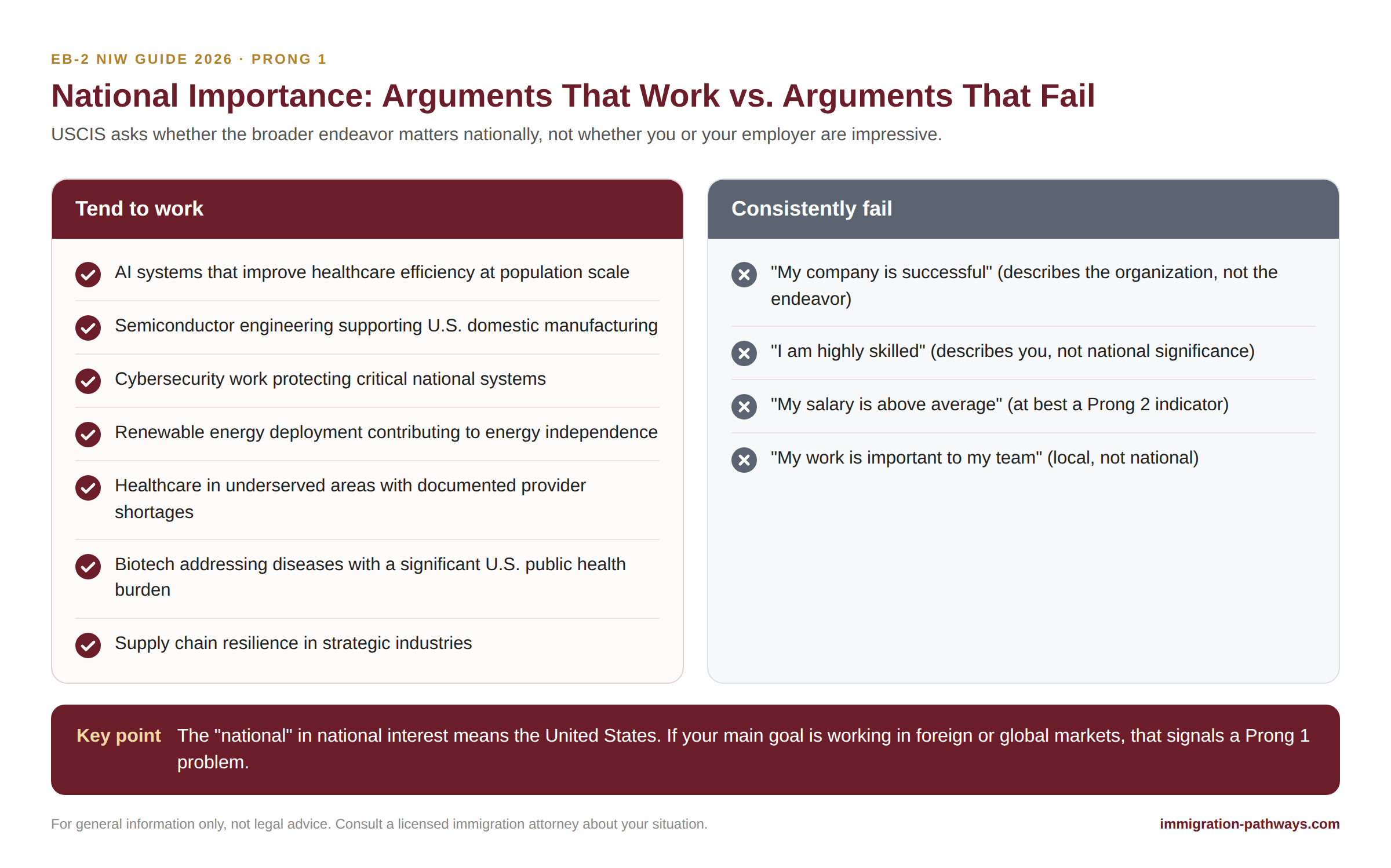
These describe individual or organizational value, not national importance:
• “My company is successful” describes the organization, not the endeavor.
• “I am highly skilled” describes you, not the national significance of the work.
• “My salary is above average” is, at best, a Prong 2 indicator, not Prong 1 evidence.
• “My work is important to my team” is local, not national.
Prong 2: Well Positioned to Advance the Endeavor
The second question is whether you are well positioned to actually advance the proposed endeavor. USCIS does not require a guarantee of success. It requires objective evidence that you are credibly able to do what you say you will do.
Evidence USCIS considers:
• Education and training: advanced degrees and relevant specialization.
• Professional experience: specialized experience, leadership roles, high-impact projects with documented outcomes, and clear career progression.
• Measurable achievements: publications and citation counts compared against field norms; patents with evidence of commercial adoption; awards with documented selection criteria; open-source contributions with adoption metrics; and revenue or efficiency impact with sourced figures.
• Independent recognition: the most heavily weighted category. USCIS gives more weight to third-party evidence from people who have no professional relationship with you, such as letters from independent experts, journalist-written media coverage, citations by independent researchers, government grants, and investor backing.
Internal praise on its own, such as letters from your managers, colleagues, or your own institution, is consistently not enough for Prong 2. It is not worthless, but it is low-weight evidence and cannot carry the case.
Prong 3: Why Waiving PERM Benefits the United States
The final question is whether it would benefit the United States to waive the normal job offer and labor certification requirements for you specifically.
USCIS runs a genuine balancing test here: the value of protecting the U.S. labor market through PERM, weighed against the national benefit of letting you work without that restriction.
Arguments that tend to work for Prong 3:
• The work is urgent or strategically important, for example AI competitiveness, national security technology, public health, semiconductors, or critical energy infrastructure.
• The work is hard to evaluate through standard PERM recruitment. This fits founders, researchers, independent consultants, and cross-disciplinary experts whose roles do not map to a job description PERM could reasonably test.
• You create broader economic value, such as job creation, startup-ecosystem growth, research commercialization, or technology transfer.
• Your expertise is meaningfully differentiated, not necessarily world-famous, but with specific contributions that standard recruitment could not easily replicate.
A common Prong 3 mistake is simply asserting that your skills are unique. Prong 3 has to be argued, not assumed. Explain specifically why standard labor-market testing would be inadequate or counterproductive for this particular endeavor.
Worked Example: All Three Prongs Together
Consider a senior software engineer with ten years of AI infrastructure experience, who led the design of a recommendation system serving 80 million users, holds three patents (one commercially licensed) and two widely cited technical publications, speaks at machine-learning conferences, has an MS in computer science, and earns $320,000 in total compensation. (The numbers here are illustrative.)
EB-2 qualification: advanced degree.
Prong 1. Proposed endeavor: continue building AI infrastructure for healthcare, specifically clinical decision-support systems for underdiagnosed conditions. Substantial merit is clear, since healthcare AI that closes clinical gaps has documented public health value. National importance needs framing: clinical decision support appears in NIH strategic plans, there is a documented shortage of engineers at this scale, and healthcare AI is a stated U.S. competitiveness priority. Without that framing, the work reads as valuable but local. With it, Prong 1 is arguable.
Prong 2. Strong points: ten years of specialized experience, a leadership role, three patents (one licensed, which shows external adoption), and conference speaking. Weak point: only two publications, both informal technical posts rather than peer-reviewed work, with citations from industry practitioners rather than academics. Ways to strengthen it: obtain three to four letters from independent ML or healthcare-AI experts who describe the licensed patent's adoption and the system's scale; document conference talks as invitation-based; and benchmark pay against BLS and industry surveys to show top-percentile placement.
Prong 3. The work spans AI research and healthcare systems, so it is cross-disciplinary and hard to fit into a single PERM job description. The licensed patent shows value beyond the employer, and the healthcare-AI focus lines up with documented national priorities. Finding a comparable U.S. worker with this ten-year specialization through PERM recruitment would be unlikely.
Realistic outcome. Framed around the national importance of healthcare AI, with independent letters that specifically address the patent's adoption and the system's scale, this profile has a credible path to approval. The same career history, described without national-importance framing and supported only by colleague letters, would likely draw an RFE on Prong 1 and on Prong 2 independence.
Evidence Strategy: What Actually Gets Approved
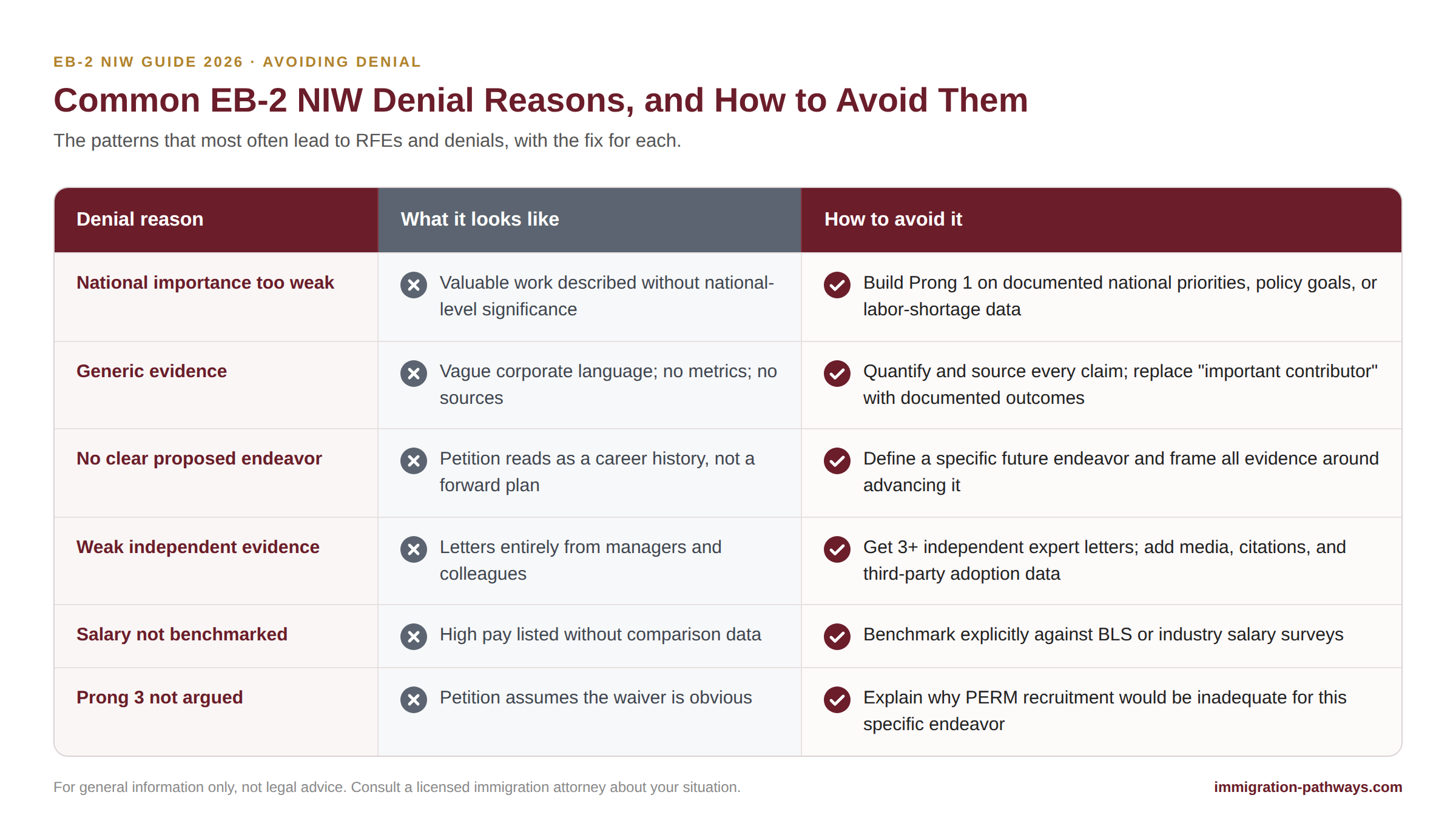
The single most common failure pattern in NIW denials is evidence that is submitted but not argued. The documents are in the file, but no legal analysis ties them to the three Dhanasar prongs.
Strong cases
• Open with a clear statement of the proposed endeavor and its national importance.
• Connect each piece of evidence to a specific prong through actual legal argument.
• Use independent, third-party evidence as the main support for Prong 2.
• Quantify everything that can be quantified, and cite the source.
• Tell one coherent story: here is what I will do, why it matters nationally, why I am credibly positioned to do it, and why waiving PERM serves the United States.
Weak cases
• Summarize a career history without framing a future endeavor.
• Submit documents without explaining what they prove.
• Rely entirely on letters from managers, colleagues, and institutional supervisors.
• Assert national importance with no national-level evidence.
• Use generic corporate language like “key contributor,” “critical employee,” or “highly talented” with no documented metrics.
Write It Like a Self-Petition, Not an Employer Petition
A self-petitioned NIW has a distinctive feature: the petitioner and the beneficiary are identical individuals. This means you are responsible for both proving your qualification and providing supporting evidence. The brief must be organized differently from an employer-sponsored petition, which relies on a third party endorsing the applicant. Immigration officers may view a self-petition as less credible if it sounds like an employer is speaking for the applicant. Therefore, use the first-person perspective and let the independent evidence serve as endorsement.
Recommendation Letters: What Makes Them Work
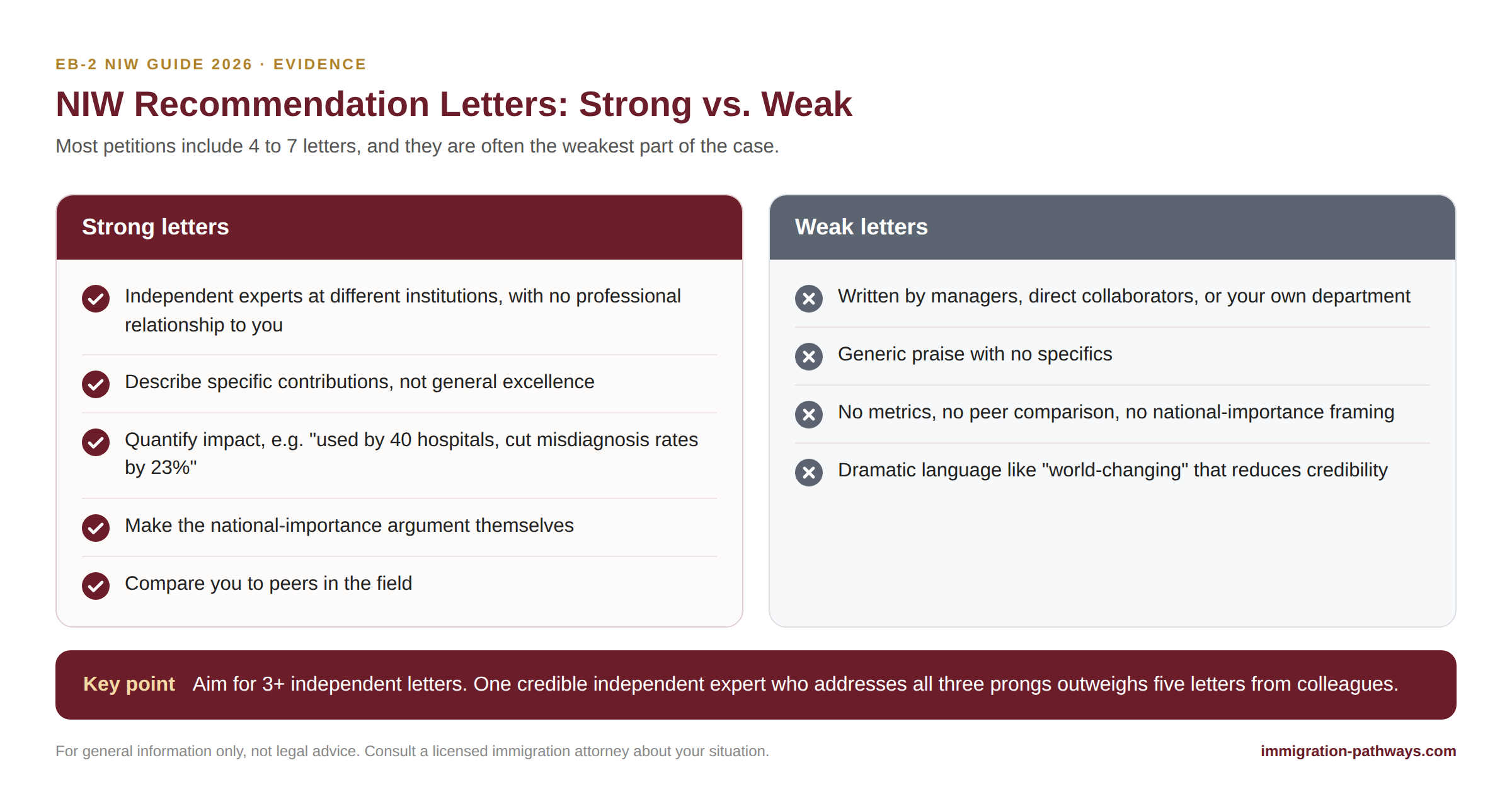
Most NIW petitions include four to seven letters of recommendation, and most of the time those letters are the weakest part of the petition.
Strong letters
• Come from independent experts at different institutions who have no professional relationship with you.
• Describe specific contributions, not general excellence.
• Quantify impact, for example: “This system is used by 40 hospitals and reduced misdiagnosis rates by 23% in documented studies.”
• Make the national-importance argument themselves, rather than just praising you.
• Compare you to your peers, for example: “In 20 years in this field, I have encountered fewer than five researchers whose contributions match this scale.”
Weak letters
• Come from managers, direct collaborators, or your own department.
• Offer generic praise with no specifics.
• Contain no metrics, no peer comparison, and no national-importance framing.
• Use dramatic language like “world-changing” or “once-in-a-generation talent,” which actually reduces credibility.
Aim for at least three letters from genuinely independent experts. One letter from a credible independent expert who addresses all three prongs is worth more than five letters from colleagues.
NIW for Tech Professionals
This has become one of the fastest-growing NIW categories, driven by U.S. policy attention on AI, semiconductors, cybersecurity, and critical infrastructure.
Fields with strong national-importance arguments in 2026
• Artificial intelligence and machine learning.
• Semiconductor design and manufacturing.
• Cybersecurity and critical-infrastructure protection.
• Cloud and distributed-systems infrastructure.
• Health technology and clinical AI.
• Fintech that serves underserved populations.
• Clean-energy technology.
• Large-scale data infrastructure.
Evidence that strengthens a tech case
• System-scale metrics (users served, data volume, uptime requirements) with sourced documentation.
• Revenue or efficiency impact tied to your specific work, not your team's work in general.
• Patents with evidence of commercial licensing or adoption.
• Open-source contributions with documented adoption metrics, such as downloads, forks, and named organizations using the tool.
• Talks at selective conferences, documented as invitation-based, with evidence of how selective the conference is.
• Media coverage of your specific work in technical or industry press, written by journalists rather than employer PR.
• Letters from independent engineers or researchers who quantify how your work influenced theirs.
Translate Your Open-Source Record for a Non-Technical Officer
Open-source contributions provide valuable evidence, but a GitHub profile alone doesn’t explain their significance. The officer reviewing your application isn’t necessarily a software developer. Your petition should clearly explain what open-source software entails, why contributing to popular projects demonstrates recognition in your field, and how to verify that the specific contributions were truly made by you. Instead of simply providing a link and expecting it to speak for itself, translate these metrics into the legal context to strengthen your case.
Healthcare and Clinical AI: A Note on the Current Climate
Healthcare delivery in underserved areas, and clinical AI that addresses documented shortages, remains a strong Prong 1 theme. One caution is worth adding.
Under prior administrations, physician NIW cases in designated shortage areas were among the most reliably approvable NIW petitions. As of 2026, practitioners report increased uncertainty in how USCIS evaluates healthcare national-importance arguments, particularly for applicants at for-profit facilities, even in designated shortage areas. The overall importance of healthcare work in underserved areas is widely recognized. However, the assertion that the 2026 adjudication environment will become more restrictive for for-profit facilities is based on practitioner opinions, not an official USCIS policy update. Consider it as a point to discuss current trends with an attorney, rather than as a confirmed regulation.
What consistently fails in tech cases
• Describing job duties without connecting them to national-level impact.
• Relying entirely on employer letters.
• Claiming AI or ML expertise without documenting specific contributions beyond internal roadmaps.
• Salary benchmarking with no actual comparison data.
NIW for Startup Founders and Entrepreneurs
USCIS now explicitly recognizes that entrepreneurship can serve the national interest, a real shift from the pre-Dhanasar era, when founders faced steady skepticism.
Strong founder evidence
• Venture funding from established investors, with documentation of the investors' reputations, since not all VC funding carries equal weight.
• Government grants or SBIR/STTR funding, which are especially powerful because they represent outside expert validation of national importance.
• Accelerator participation, documented with the program's selectivity (the acceptance rate matters).
• Job creation, shown with payroll documentation for U.S. employees hired.
• Customer traction: named customers, revenue metrics, and adoption documentation.
• A strategic-industry focus tied to documented national priorities.
• Patents granted or in development.
Three mistakes to avoid
• Treating the petition like a pitch deck. USCIS is not a venture capitalist. Projected market size, hockey-stick growth charts, and “disruption” language are not evidence of national importance. Ground every claim in existing, documented evidence.
• Projections without execution. A company with $2M in revenue and eight employees is more credible than a pre-revenue company with a ten-year vision. USCIS wants proof you can advance the endeavor, not ideas alone.
• Ignoring the petitioner structure. A founder petitioning through their own company has to address whether a genuine employer-employee relationship exists. That usually means documenting board oversight, investor control provisions, or other third-party governance. Leaving it unaddressed invites an avoidable RFE.
Backlog Reality: What NIW Approval Actually Gets You
This is the section most NIW articles bury or soften.
Important: An approved NIW I-140 does not mean you get a green card. It establishes eligibility. Whether and when you can actually receive a green card depends on the Visa Bulletin, which controls visa-number availability based on your country of birth and your category.
Visa Bulletin: EB-2 Final Action Dates
The figures below reflect the May 2026 Visa Bulletin (the Final Action Dates chart), confirmed by the U.S. Department of State.
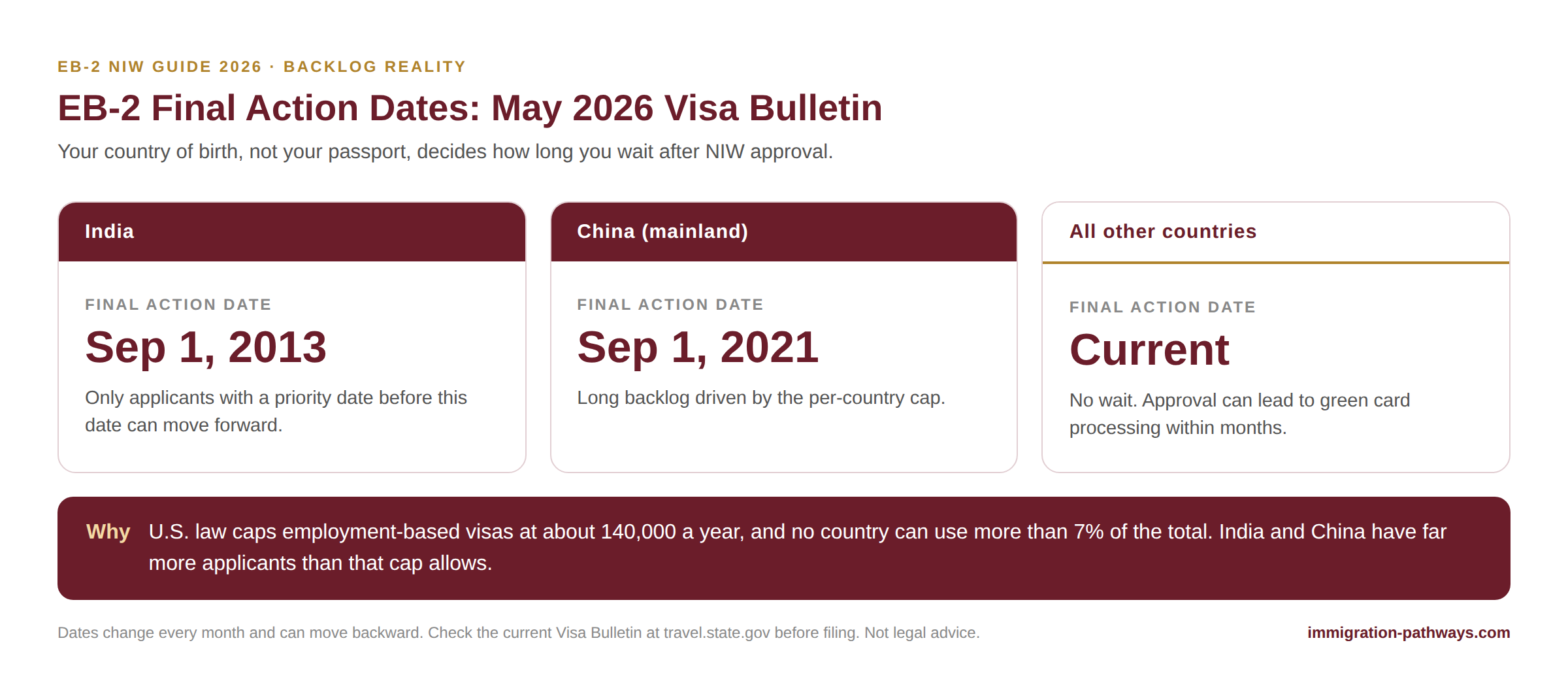
Update as of June 13, 2026: Visa Bulletin dates change every month and can advance or move backward without warning, so always check the current month at travel.state.gov before making any filing decision.
How to read the table
“Current” means you can proceed right away. A date means only applicants whose priority date falls before that date can move forward. Your priority date is generally the date USCIS received your I-140 petition.
Why Some Months Restrict the “Dates for Filing” Chart
The Visa Bulletin features two charts: the Final Action Dates and the Dates for Filing. The Final Action Dates chart determines when a green card can be officially approved or a visa issued. Meanwhile, the Dates for Filing chart, which is an earlier date, allows applicants to submit their I-485 earlier when USCIS approves it, granting access to interim benefits like a work permit (EAD) and advance parole. Each month, USCIS selects which chart applies to employment-based applications.
USCIS's rule is essentially a supply-and-demand test: it allows the Dates for Filing chart only when more immigrant visas are available for the fiscal year than there are applicants. When demand matches supply, it reverts everyone to the Final Action Dates chart. This shift usually occurs as the fiscal year nears its September 30 deadline and filings increase because approving more I-485s than the annual caps permit would cause a backlog of unapprovable cases. This was the case in May and June 2026, when USCIS used the Final Action Dates chart for all employment-based categories. Understanding this mechanism helps predict when restrictions might return: late in the fiscal year and in highly oversubscribed categories.
Why the backlog exists
U.S. law caps employment-based immigrant visas at about 140,000 per year, and no single country can use more than 7% of the combined family- and employment-based total (roughly 9,800 employment-based visas per country per year). India and China have long had far more applicants than that cap allows, which creates waits of years to decades.
Some analyses project that EB-2 India priority dates may not reach applications filed in 2024 for decades. This projection cannot be verified from a primary government source. While a multi-decade backlog in India is generally supported, specific forward projections vary significantly across different analyses, depending on future policies, visa usage rates, and retrogression. Consider this an estimate rather than a certainty.
What NIW Still Provides for Backlogged Applicants
• Filing now locks in a priority date that begins advancing immediately.
• An approved I-140 preserves that priority date even if you change employers (subject to AC21 conditions).
• An approved I-140 may make you eligible for a Compelling Circumstances EAD during a long wait (see that section below).
Important note: An approved, self-petitioned I-140 cannot be revoked by an employer. Since a NIW has no employer backing, it cannot be withdrawn. Conversely, employer-sponsored EB-2 or EB-3 I-140s, even after approval, can be canceled by the sponsoring employer if your I-485 has not been pending for 180 days, potentially invalidating years of effort. In contrast, a self-petitioned NIW is protected from this risk. This is one of the key distinctions to consider when comparing NIW to an employer-sponsored green card
If you were born outside India and China, EB-2 NIW is often current or close to current, so approval can lead to green card processing within months.
The EB-3 Downgrade Strategy
For India-born applicants facing EB-2 backlogs, having an employer submit an EB-3 petition establishes a separate EB-3 priority date. Occasionally, the EB-3 India Final Action Date surpasses the EB-2 India date by a year or more, allowing applicants to transition to EB-3 and file I-485 earlier. This strategy is a common planning tool used by practitioners for backlogged India-born clients. It requires employer involvement, so it complements, rather than replaces, a self-petitioned NIW. Consulting an attorney is advisable to compare pursuing an NIW alone versus combining it with an employer-sponsored EB-3.
Cross-Chargeability
If you and your spouse were born in different countries, and your country of birth has a severe backlog, you may be able to “charge” your green card application to your spouse's less-backlogged country, as long as you file together and your spouse qualifies as a derivative beneficiary.
Example: an India-born EB-2 NIW applicant married to a spouse born in Germany could potentially use Germany's chargeability, since EB-2 is currently there. This is one of the most underused planning tools in the Visa Bulletin. Raise it with an attorney early, because doing it correctly takes advance planning.
Timeline: What to Actually Expect
Building your petition
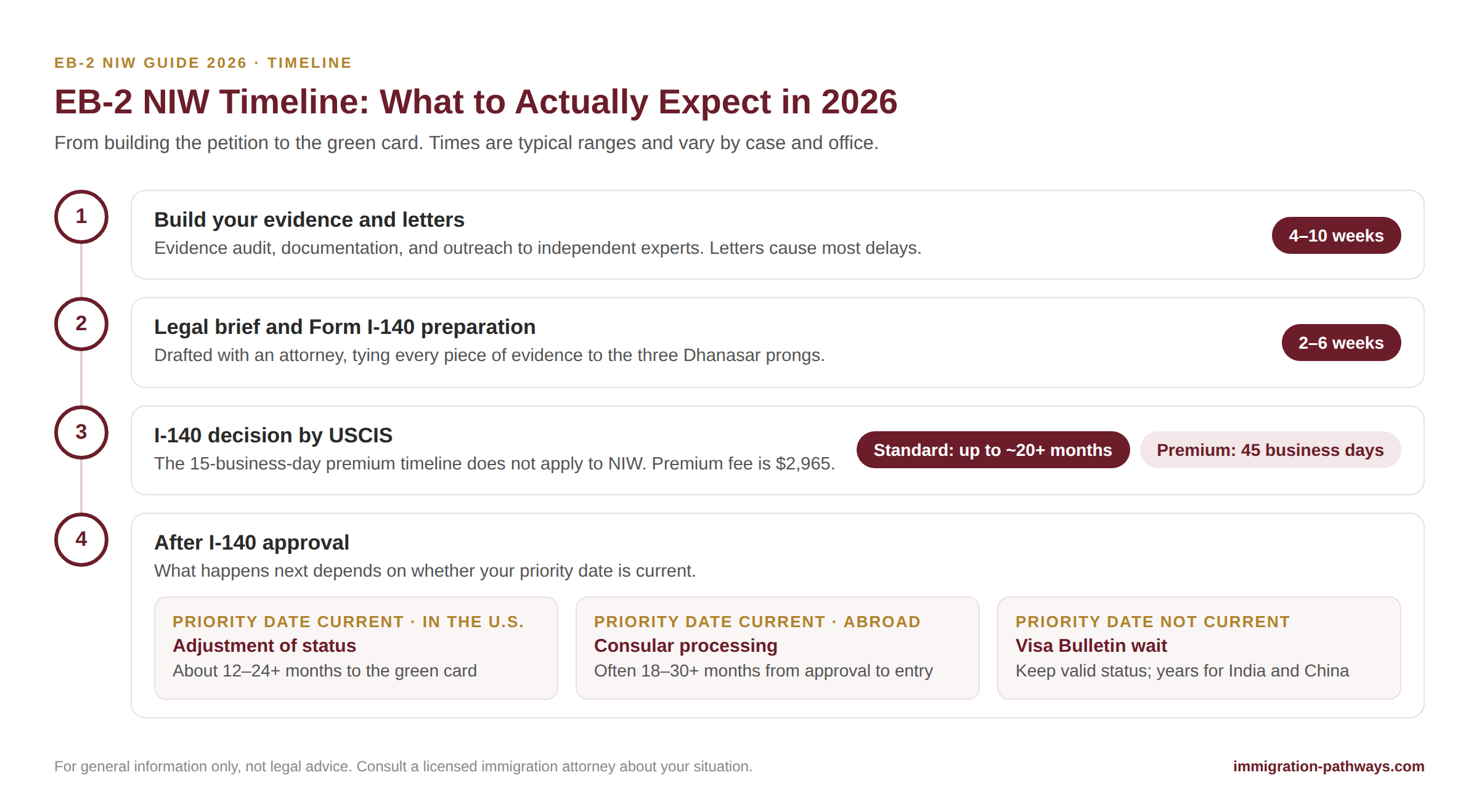
• The evidence audit, documentation, and recommendation letters typically take about 4 to 10 weeks. The main delay usually comes from the letters, as reaching out to independent experts, securing their agreement, and gathering strong, specific drafts can take four to eight weeks of outreach and follow-up. Therefore, it's advisable to start this process early and alongside other tasks.
• Legal brief and Form I-140 preparation with an attorney: about 2 to 6 weeks.
I-140 adjudication after filing
• Standard processing: currently up to about 20 months or more for EB-2 NIW. The main drivers are service-center workload and the high RFE rate for NIW cases, not a fixed queue, so the figure moves. Check your specific service center at uscis.gov/processing-times.
• Premium processing: a decision or action (approval, RFE, denial, or NOID) within 45 business days for NIW. The 15-business-day timeline does not apply to NIW. The fee is $2,965 as of March 1, 2026.
After I-140 approval, if your priority date is current
• Adjustment of status (you are in the U.S.): file I-485 and expect roughly 12 to 24+ months to the green card, depending on the field office and whether an interview is required.
• Consular processing (you are outside the U.S.): the National Visa Center stage (6 to 12+ months), plus interview scheduling and the interview, often totals 18 to 30+ months from I-140 approval to entry as a permanent resident.
After I-140 approval, if your priority date is not current
Wait for the Visa Bulletin to reach your priority date. Use the time to keep valid nonimmigrant status, build an EB-1A record if you are also pursuing that, and check whether a Compelling Circumstances EAD applies.
What to Do During a Long I-485 or Priority-Date Wait
For India- and China-born applicants this middle stretch can run for years. The actions that matter most during the wait are straightforward, and they are easy to neglect:
• Keep valid nonimmigrant status the entire time.
• File EAD and advance-parole renewals early, never at the last minute.
• Check the Visa Bulletin every month.
• Keep building an EB-1A record if that is a realistic upgrade for you.
• Re-evaluate the EB-3 downgrade option as the India dates shift.
Post-Filing Sequence: What Happens After You File
After filing the I-140
7. Receipt notice (Form I-797C) confirming receipt, usually within 2 to 4 weeks.
8. Premium-processing acknowledgment, if you filed for it, confirming the 45-business-day clock has started.
9. An RFE (Request for Evidence) may be issued by USCIS at any time, even during premium processing. Receiving an RFE is not a denial. The response deadline is 87 days from the date on the notice. Always verify the exact date on your notice and answer all concerns thoroughly. A poor or incomplete response might result in denial, even if the initial petition was strong.
10. Approval notice (Form I-797B), which confirms approval and states your priority date.
A possible NOID, not just an RFE
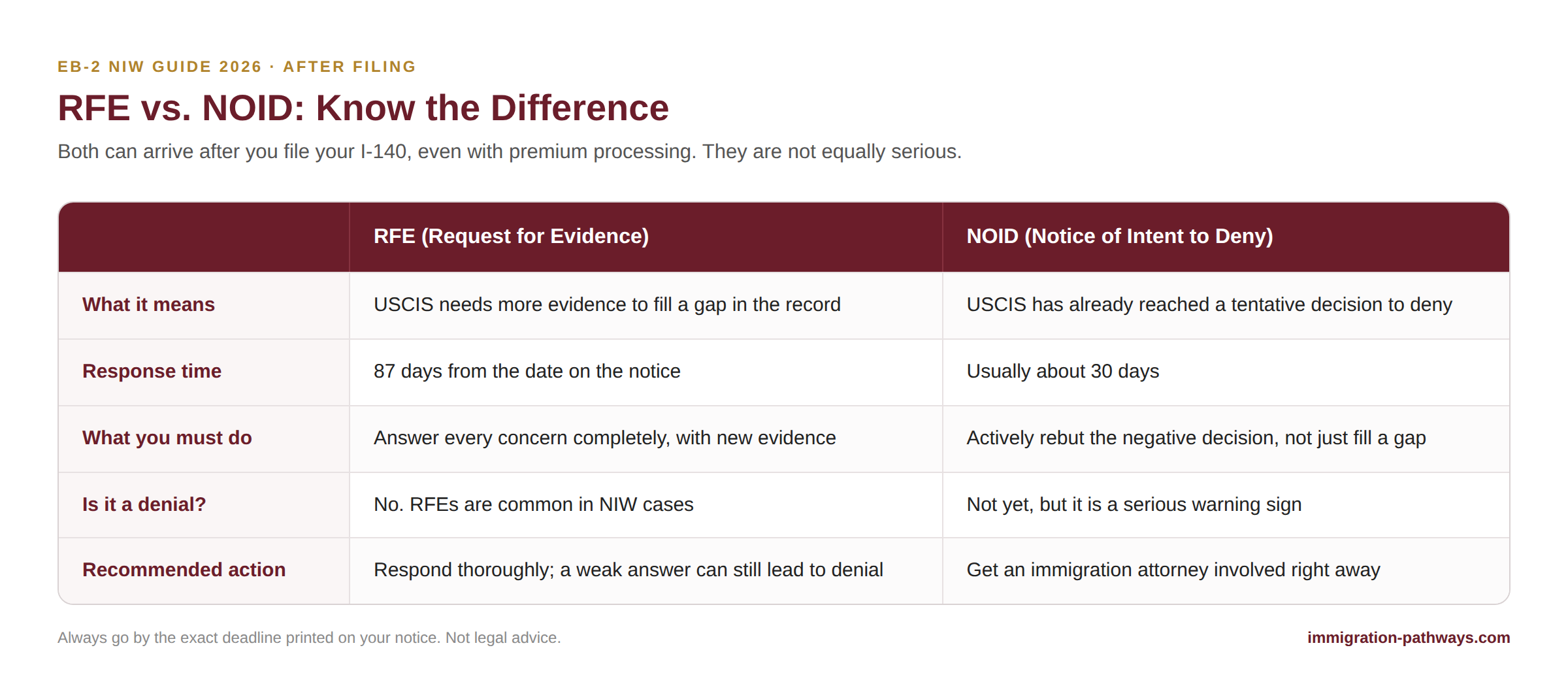
oRFEs are not the only adverse actions you may encounter. USCIS can also issue a Notice of Intent to Deny, or NOID. A NOID differs from an RFE in three key ways: it usually offers a shorter response period (about 30 days compared to the 87 days for an RFE), it indicates that USCIS has already reached a tentative decision, and it requires you to actively challenge a negative decision rather than simply addressing a record gap. If you're handling this process without legal assistance, consider a NOID to be more serious than an RFE.
After I-140 approval (priority date current): adjustment of status
11. File Form I-485, along with Form I-765 (work authorization) and Form I-131 (advance parole for travel).
12. Attend the biometrics appointment. A separate I-797C notice gives you the time. This step is mandatory.
13. Receive the EAD/advance-parole combo card, typically 3 to 6 months after filing. Verify current times at uscis.gov.
14. A possible interview notice. Not all employment-based I-485 cases need an interview, and field-office practices vary (see below).
15. The green card decision, then the physical card by mail.
What tends to trigger an I-485 interview
Interviews are more common if the I-140 adjudication questions your credentials, your field office regularly conducts interviews, there are discrepancies in the record, or if USCIS Fraud Detection and National Security (FDNS) flagged the case for fraud review. For self-petitioned NIW cases that already faced scrutiny via an RFE, the likelihood of an interview increases. Assuming no interview will occur can leave you unprepared.
After I-140 approval: consular processing
16. The case goes to the National Visa Center (NVC), which collects fees and civil documents.
17. The NVC schedules a consular interview. Timing varies by embassy and is often 6 to 12+ months.
18. You attend the immigrant-visa interview.
19. You receive the immigrant-visa stamp and enter the United States.
20. Verify your I-94 record at i94.cbp.dhs.gov right after entry. Your authorized period of stay is recorded there, not on the visa stamp.
Affidavit of Support at the NVC Stage
Many guides discuss the NVC and consular interview but often omit the Affidavit of Support (Form I-864), which can catch applicants off guard when it appears. Here is the correct information for those self-petitioning for an NIW.
For employment-based cases, an I-864 is only needed if a relative filed the I-140 or owns 5% or more of the company that filed it. A self-petitioned NIW has no employer or relative petitioner, so most often, no Affidavit of Support is required. Additionally, anyone who has earned 40 qualifying Social Security quarters, about ten years, is generally exempt from this requirement. This exemption was previously claimed on Form I-864W, but USCIS now includes it in the I-485 form. In summary, most self-petitioning NIW applicants do not need a sponsor's affidavit. However, confirm how this requirement is handled for your specific case before the interview.
Unlawful Presence and the 3- and 10-Year Bars (Important for Consular Cases)
If you have ever fallen out of status while in the United States, even for a short time, this can significantly impact your processing at a consulate abroad. Typical examples include a gap between OPT and H-1B, a lapse during a job change, or an employer filing a late extension.
Under the law, if you stay unlawfully for more than 180 days but less than a year in a single visit and then leave, you face a 3-year bar to reentry. If you stay for a year or longer, departing triggers a 10-year reentry ban. Since consular processing requires leaving the U.S., a self-petitioned NIW applicant with previous unlawful presence might find reentry effectively impossible without an inadmissibility waiver. If this situation applies to you, consult an attorney before leaving, not afterward.
Medical Exam (Form I-693)
Validity begins on the date the civil surgeon signs the form, which may differ from the exam date. Many civil surgeons now submit the I-693 to USCIS electronically, so the old practice of carrying a sealed envelope to your interview does not apply everywhere. Confirm current procedures at uscis.gov/i-693 before scheduling.
Travel While Your I-485 Is Pending
Do not leave the United States without a valid advance-parole document, or a valid H or L visa stamp with maintained H or L status. Departing without advance parole while your I-485 is pending is generally treated as abandoning the application.
Job Changes, Portability, and Employment Flexibility
Changing Jobs After I-140 Approval (Before Filing I-485)
If your I-140 is approved and your priority date is not yet current, you can generally change employers without losing your priority date, as long as the new role is in the same or a similar occupational classification. Your priority date is preserved and can be captured in a new employer's I-140.
This is one of the most important things to handle correctly when you change employers during a long wait. Do not let a new employer tell you your priority date cannot carry forward without getting a second legal opinion.
AC21 Portability (After the I-485 Has Been Pending 180+ Days)
If your I-485 has been pending for 180 days or more and your I-140 is approved, you can move to a new job in the same or a similar occupational classification without jeopardizing your pending I-485.
The 180-day threshold is exact. Someone at day 175 of I-485 pendency who changes jobs does not have portability protection. If the timing allows, wait the remaining days. If a layoff forces a change before day 180, talk to an attorney immediately.
What “Same or Similar Occupational Classification” Actually Means
USCIS assesses whether your new job is “same or similar” using Standard Occupational Classification (SOC) codes, which evaluate job duties, required skills, and the SOC code itself, not solely the job title. For instance, a software engineer switching to product management or a researcher moving into industry consulting may cross a SOC-code boundary, affecting job portability. Before accepting a new role, it is advisable to consult your attorney to compare the SOC codes of your current and potential positions.
Supplement J Is What Actually Triggers Portability
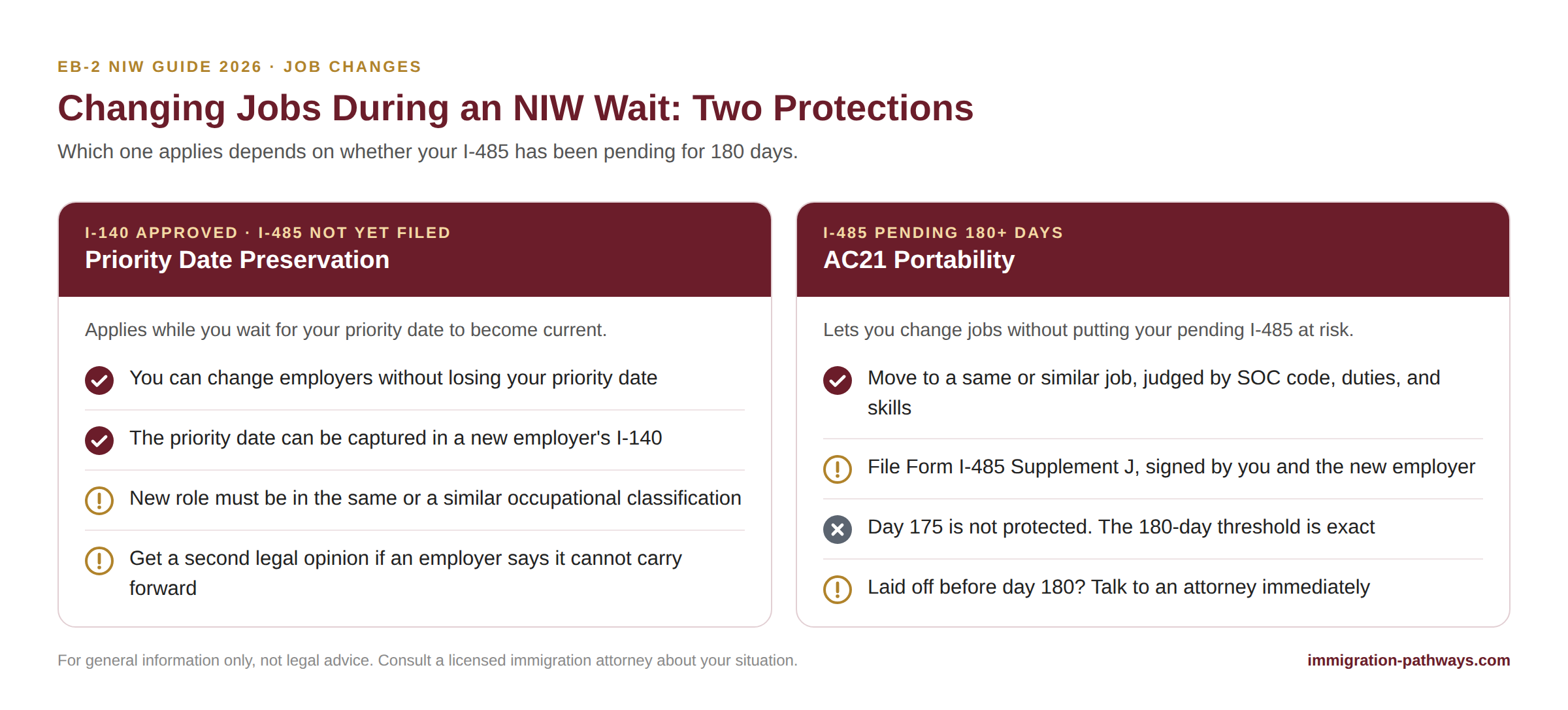
Portability doesn't automatically take effect after 180 days. You or your new employer typically need to submit Form I-485 Supplement J, which confirms the new job position and its occupational classification, including the SOC code. Both you and your new employer must sign this form. Without Supplement J, the officer reviewing your I-485 might send a Request for Evidence (RFE) or make an incorrect decision. This form is essential to activate portability, so it should not be seen as just a routine formality.
Compelling Circumstances EAD
If you have an approved I-140 in EB-1, EB-2, or EB-3, your priority date is not yet current, and you face job loss or another compelling circumstance (serious financial harm, a medical hardship, or your children being forced out of school, for example), you may be eligible for a Compelling Circumstances EAD. It is discretionary, not guaranteed, but it exists, and most people in long backlogs have never heard of it.
To file, you must be in valid E-3, H-1B, H-1B1, O-1, or L-1 status (or an authorized grace period) when you file, your I-140 must be in EB-1, EB-2, or EB-3, and you must not have already filed an I-485.
Renewing Your EAD During a Long Wait
If your EAD expires while your I-485 is still pending, including during a retrogression period, file Form I-765 to renew it early. EADs do not auto-renew, and processing times vary, so do not wait until your current card expires.
NIW While on F-1 or OPT
Students moving from F-1 and OPT to a green card route are increasingly common NIW profiles, especially in STEM fields. They encounter timing questions that H-1B visa holders do not face. Key considerations include: the expiration of your OPT, eligibility for the 24-month STEM OPT extension, whether to participate in the H-1B lottery simultaneously, and whether to file an NIW now to secure a priority date while still on OPT, or to wait until H-1B status is obtained.
There is no single right answer because it depends on your field, timeline, and risk tolerance. Two points are worth keeping in mind. First, filing an NIW does not grant work authorization; you still need valid F-1, OPT, STEM OPT, or another status to work. Second, locking in an earlier priority date can be valuable if you are likely to face a backlog later, so the “file now versus wait” question is really about your country of birth and your status runway. Map this out with an attorney before your OPT clock runs short.
Dependents: Spouses and Children
Your spouse and your unmarried children under 21 can be included as derivative beneficiaries on your NIW petition and share your priority date.
Child Status Protection Act (CSPA): A Narrow, No-Recovery Window
Warning: If a child listed as a derivative turns 21 before the green card is issued, they can lose eligibility under the original petition. CSPA provides a formula to calculate a “CSPA age” that may keep the child eligible longer, but the formula is complex, the window to act is narrow, and once the deadline passes there is no recovery. Any family with a child who will turn 21 within two to three years during a long wait needs to address this before the birthday, not after. Raise it with an attorney as early as possible.
Spouses and Cross-Chargeability
If you and your spouse were born in different countries, your spouse's country of birth may give a better Visa Bulletin position through cross-chargeability. It requires filing together and careful structuring, so evaluate it early.
NIW vs. EB-1A: Choosing the Right Pathway
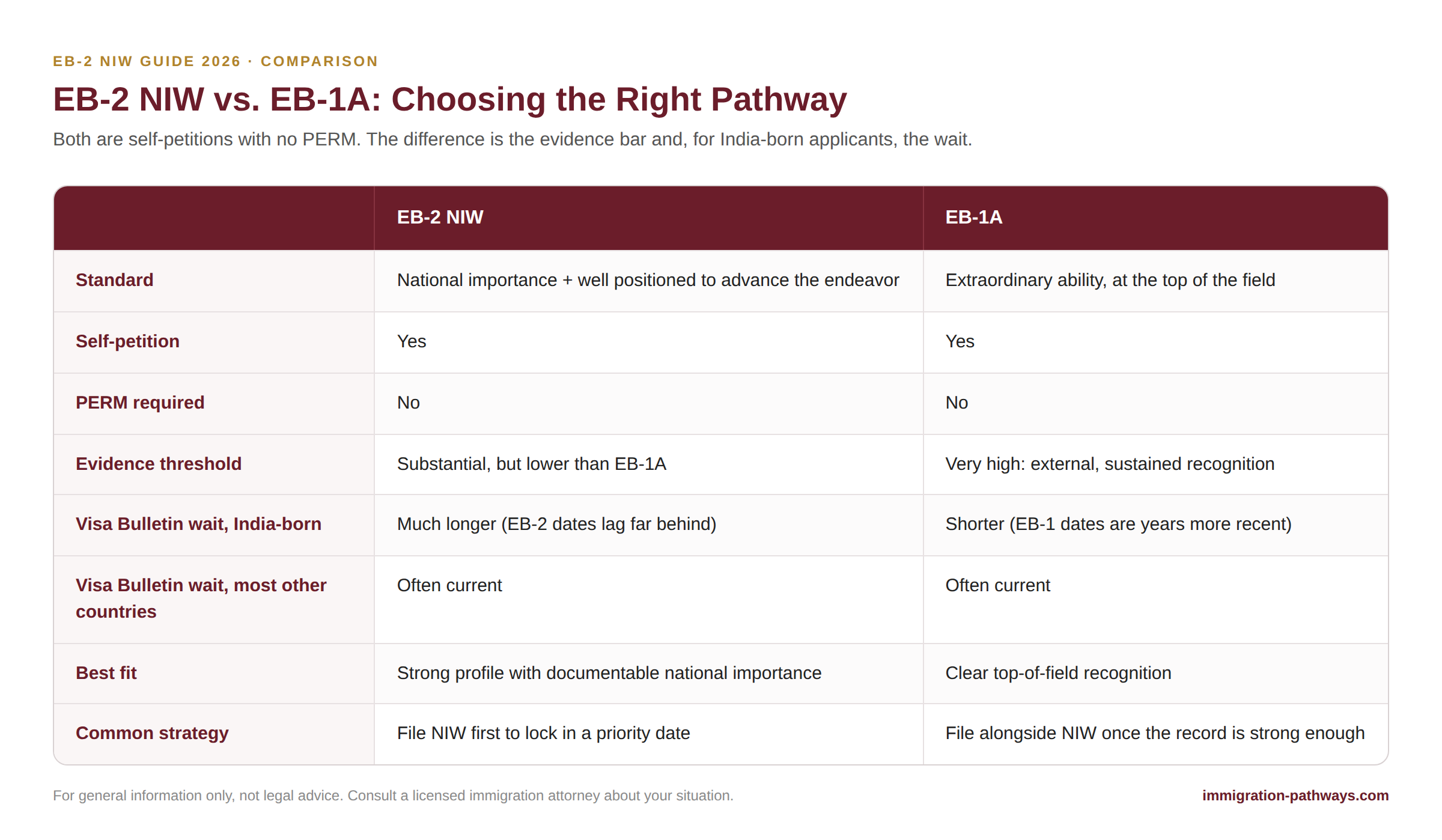
When NIW is the better first step: your profile is strong but does not clearly meet the EB-1A bar; your field has documentable national importance; and you want to lock in a priority date now while building toward EB-1A.
When to pursue both at once: many applicants file NIW and EB-1A concurrently to lock in a priority date. If the EB-1A is approved, the earlier NIW priority date can often carry forward. (The EB-3 downgrade strategy described in the Backlog section is a related option for India-born applicants who also have an employer willing to sponsor EB-3.)
When EB-1A is the better primary path: your profile clearly meets the extraordinary-ability standard with strong external recognition, and your country of birth makes the EB-1 Visa Bulletin position much more favorable than EB-2. For India-born applicants, EB-1 dates are roughly 9 years more recent than EB-2 dates, which is a significant difference.
One caution if you hold O-1A status and are considering EB-1A: do not assume the O-1A approval de-risks the EB-1A petition. USCIS is not bound by a prior O-1A approval when it adjudicates EB-1A, and it has denied EB-1A petitions for O-1A holders after reviewing the same evidence under a stricter standard.
NIW vs. H-1B Dependency
For H-1B workers, NIW is usually about independence and risk management more than speed.
What NIW gives you that H-1B does not
• An independent green card path that does not depend on your employer continuing to sponsor you.
• Priority-date preservation even through employer changes or layoffs.
• Protection against losing green card progress in a corporate restructuring.
• The ability to start the green card process earlier, without waiting for an employer to begin PERM.
What NIW does not solve
• Your current status. An approved NIW I-140 does not give you work authorization if your H-1B expires or is revoked. You still need valid H-1B or another nonimmigrant status until your I-485 is approved or an immigrant visa is issued.
• The backlog. For India- and China-born applicants, NIW approval does not meaningfully shorten the Visa Bulletin wait.
The 60-Day Grace Period
If you lose your H-1B job, the rules give you up to 60 consecutive calendar days, or until your authorized validity period ends, whichever is shorter, to find a new petitioner, file a change of status, or depart. The clock starts the day after your last day of paid employment. An approved NIW I-140 does not extend this period, but it does preserve your priority date and may support a Compelling Circumstances EAD application.
A Note on Employer Site Visits
Many NIW petitioners are also H-1B employees. An employer employing both active H-1B workers and NIW self-petitioners may face FDNS site visits to verify H-1B compliance. These visits can lead to additional documentation requirements and, especially if there are open compliance questions, may impact the perceived credibility of your overall immigration history. While the NIW is independent of your employer, it’s important to be aware of this connection.
Costs: What to Budget
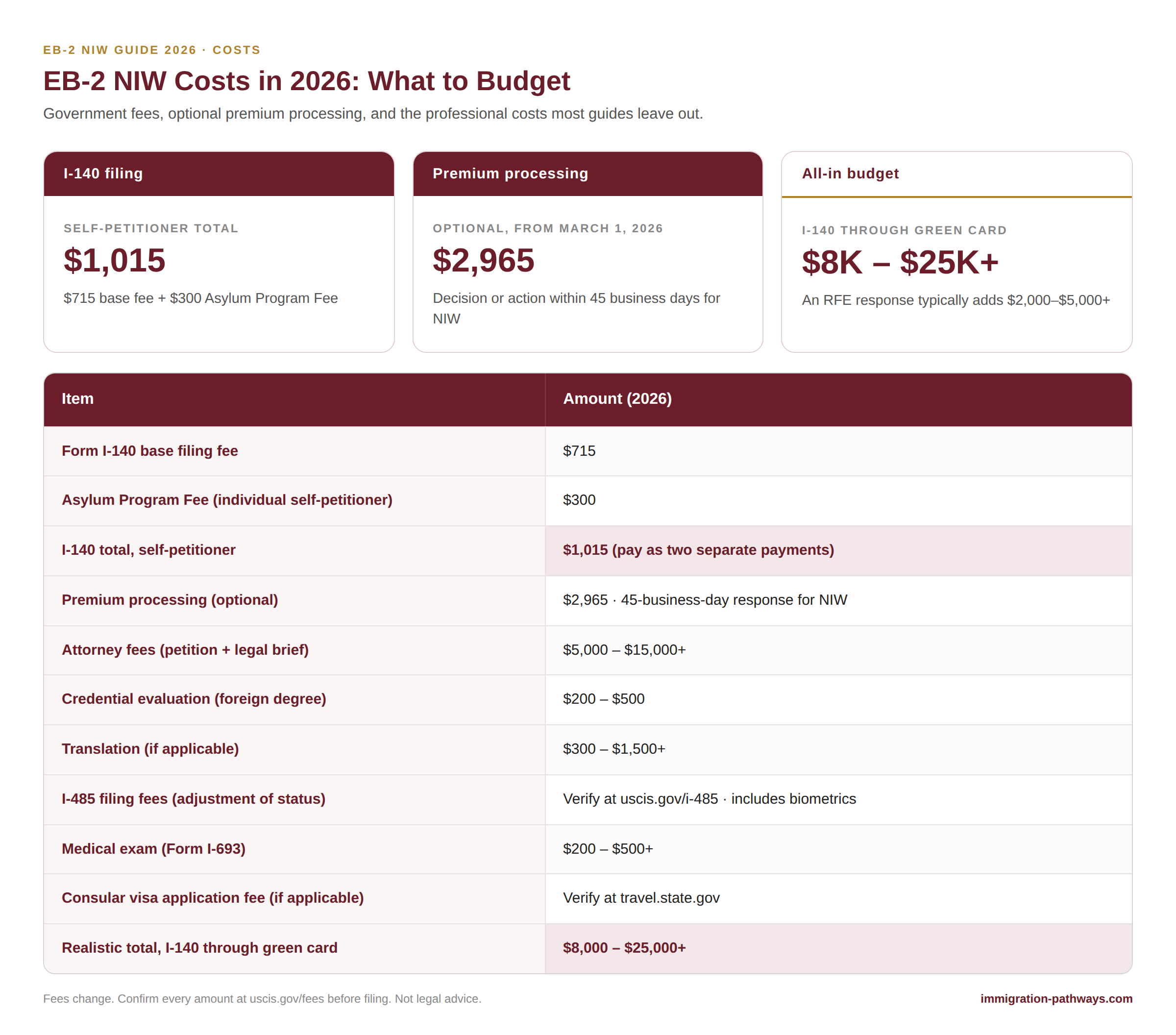
The $715 base fee, the $300/$600/$0 Asylum Program Fee tiers, the $1,015 self-petitioner total, and the $2,965 premium-processing fee (effective March 1, 2026) are confirmed against USCIS fee guidance. Note that the base fee and the Asylum Program Fee must be paid as two separate payments, or USCIS may reject the filing.
RFE responses typically add $2,000 to $5,000+ in attorney fees. A stronger initial petition is consistently cheaper than answering an avoidable RFE. Verify all fees before filing at uscis.gov/forms.
If Your Petition Is Denied
A denial after you have spent $10,000 to $20,000 deserves more than a sentence, so here is a fuller picture. You generally have two paths, and they are not the same.
• A motion to reopen or reconsider with new evidence. If the problem was an evidentiary gap, a motion that adds the missing proof is often faster and cheaper than a formal appeal, and many practitioners prefer it for that reason.
• An appeal to the Administrative Appeals Office (AAO). AAO appeals are appropriate when you believe USCIS applied the law incorrectly. They tend to be slow, often 12 to 24 months or more, and add attorney fees.
Refiling a strengthened petition is also a real option and is frequently faster than appealing. There is no single best answer, but the framework to ask is this: was the denial based on missing evidence (which points toward a motion to reopen or a refile) or on how USCIS applied the legal standard (which points toward an appeal)? Bring that question to an attorney before you decide.
Self-Assessment: Do You Have a Potentially Strong NIW Case?
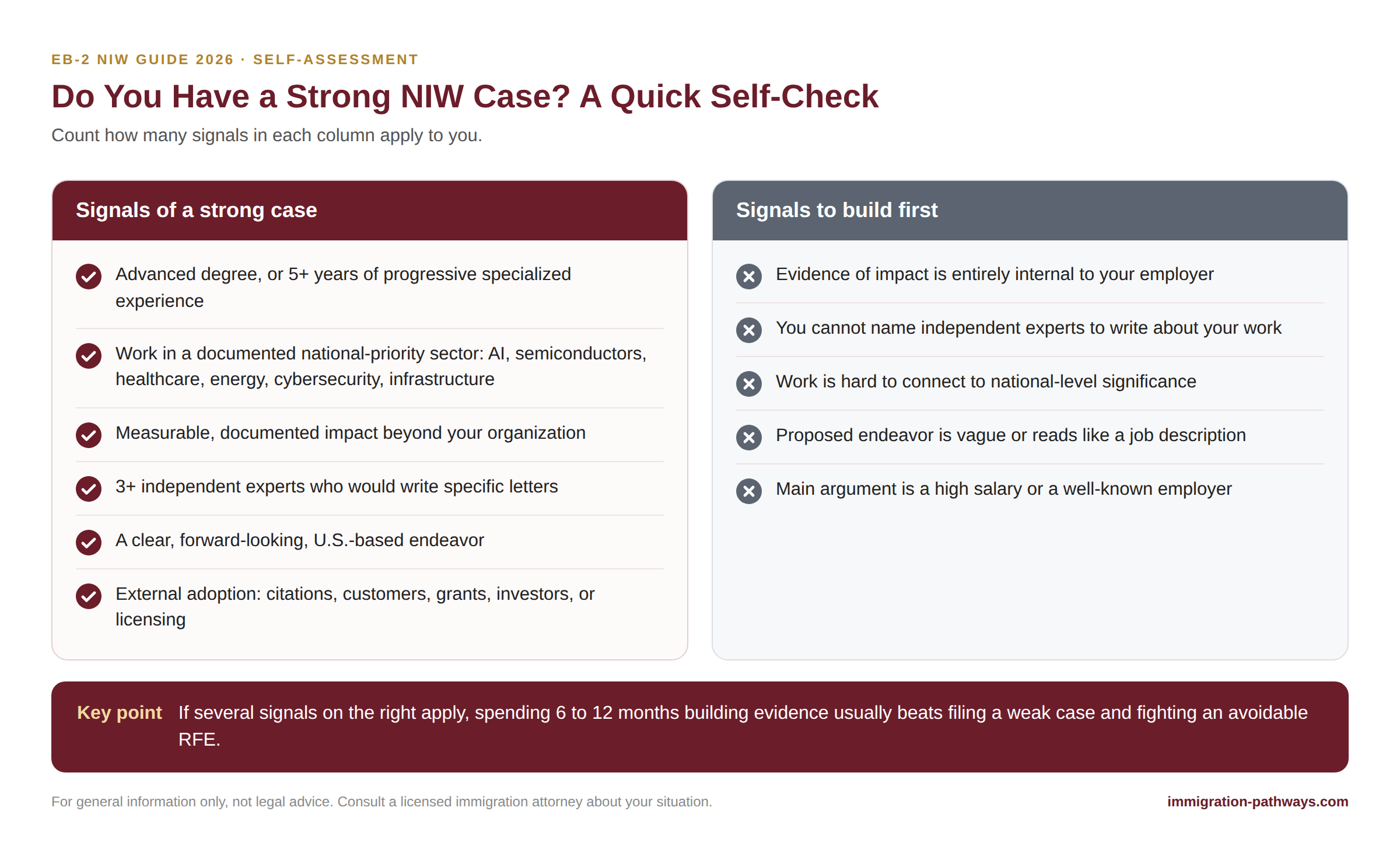
Signals your case may be strong
• An advanced degree, or 5+ years of progressive specialized experience.
• Work tied to a sector with documented national priority (AI, semiconductors, healthcare, energy, cybersecurity, infrastructure).
• Measurable, documented impact beyond your organization.
• Three or more independent experts who would write specific, substantive letters.
• A clear, forward-looking, U.S.-based endeavor.
• External evidence of adoption: citations, customers, grants, investors, or licensing.
Signals your case needs development first
• Your evidence of impact is entirely internal to your employer.
• You cannot name independent experts who would write substantive letters about your specific work.
• Your work is genuinely hard to connect to national-level significance.
• Your proposed endeavor is vague or reads like a standard job description.
• Your main national-importance argument is that your salary is high or your employer is well known.
If several signals in the second group apply, the better move is usually to spend 6 to 12 months building evidence before filing, rather than filing a weak case and then fighting an avoidable RFE.
Common Denial Reasons: and How to Avoid Them