H-1B in 2026: Lottery Results, Policy Changes, and What Every Applicant Needs to Know
H-1B in 2026: how the wage-weighted lottery works, who pays the $100K fee, key FY 2027 dates, status protections, and options if you weren’t selected.
Vera Kenahan
October 19, 2026 · 32 min read

This guide reflects H-1B developments up until June 2026 and is for informational purposes only. This is not legal advice. The H-1B visa is subject to ongoing changes and legal challenges especially with regards to the regulations, fee requirements, and adjudication standards. For this reason it is important to always verify what the current requirements are with USCIS and to consult a licensed immigration attorney before making decisions about your immigration status.
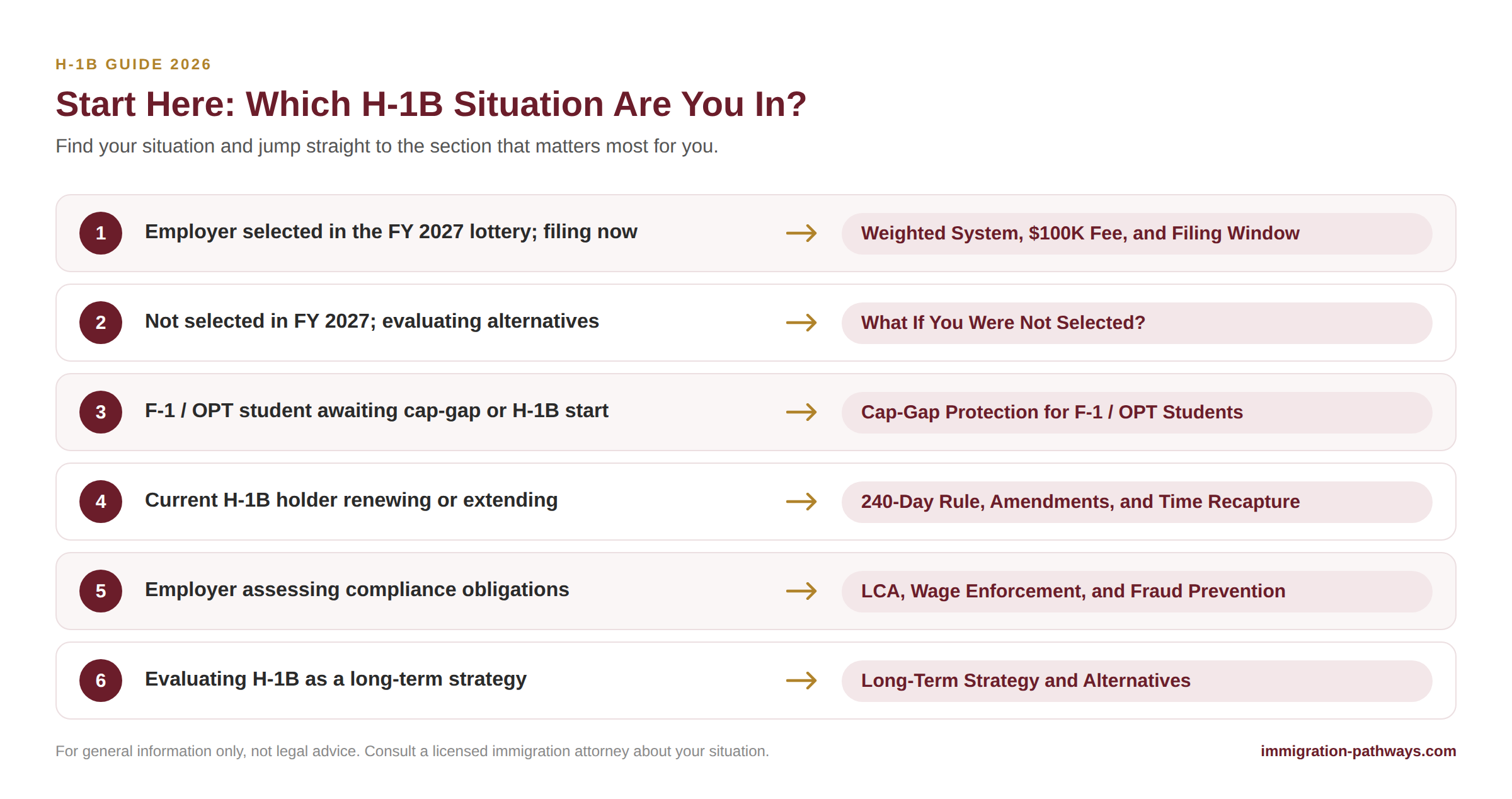
Start Here: Which Situation Are You In?
The State of H-1B in 2026: What Changed and Why It Matters
The FY 2027 H-1B has been subject to three major changes in the past year. the first is the introduction of the wage weighted lottery system which has replaced the random draw. The second is the imposition of a $100,000 supplemental fee on new petitions for overseas hires. The third is the severe increase in restriction of Dropbox stamping and the elimination of third-country stamping entirely. In combination, they have fundamentally altered the process for employers and employees navigating the H-1B system.
The FY 2027 lottery is the first to use the new wage weighted selection process that was established under a DHS rule and took effect on February 27, 2026. On March 31, 2026, USCIS announced that it had completed its initial round of selections for FY 2027, which marks the first cap season in which USCIS applied its new weighted selection process.
These changes are not isolated events but rather a pattern. The elimination of third-country stamping, the severe restriction of Dropbox, the new weighted lottery, and the $100,000 fee all arrived in the same policy cycle under the current administration. All three changes represent a broader agenda of the executive branch's policy to restrict certain legal immigration pathways, particularly the hiring of large offshore IT services and outsourcing firms, while still maintaining access to higher wage domestic workers. Understanding this is useful in anticipating what might come next for employers and applicants.
How the H-1B Cap Works
The H-1B visa program operates under an annual numerical cap system set by Congress.This cap has not changed since 2004. The caps are shown in the table below.
The advanced degree exemption differs from the regular cap as it works as a two-stage process: holders of U.S. master's degrees or higher are first entered into the master's cap pool; the candidates not selected from the master's pool are then entered into the regular cap pool, which effectively gives them two chances at selection. This structure has remained unchanged.
Cap-exempt employers: Certain employers are not subject to the annual cap and can file H-1B petitions year-round regardless of lottery results. Cap-exempt employers include institutions of higher education, nonprofit organizations affiliated with universities, and nonprofit or governmental research organizations. That's why working for a cap-exempt employer is one of the most reliable ways to avoid the uncertainty of the lottery entirely.
FY 2027 Lottery: Key Dates and What Happened
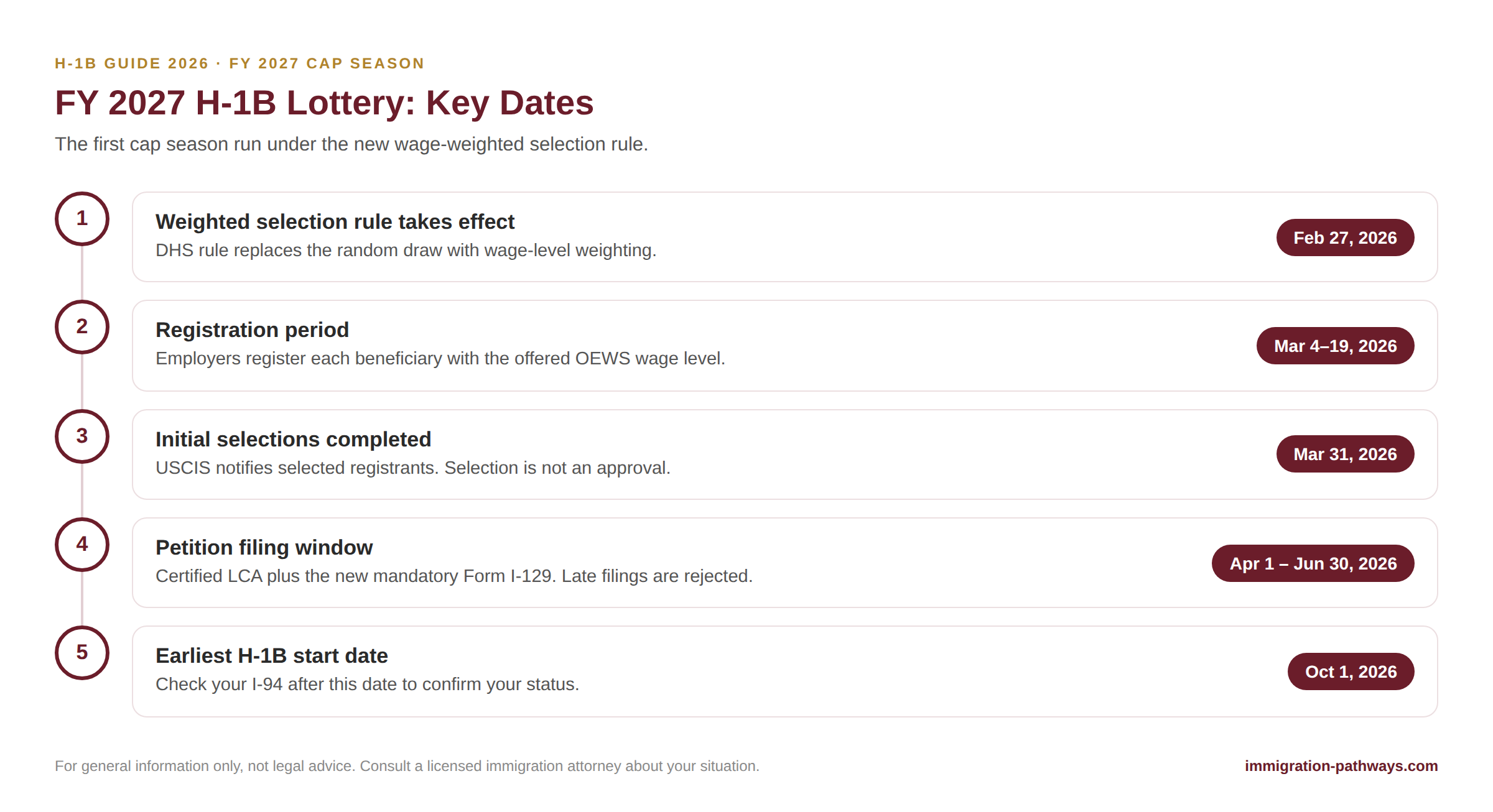
Key dates ( in chronological order)
- weighted selection rule effective February 27, 2026
- registration period March 4–19, 2026
- initial lottery selections completed March 31, 2026
- petition filing window April 1 – June 30, 2026
- earliest employment start date October 1, 2026
The annual quota of 85,000 H-1B cap beneficiaries was met in the registration period for FY 2027.
Historical registration volume and selection rates:
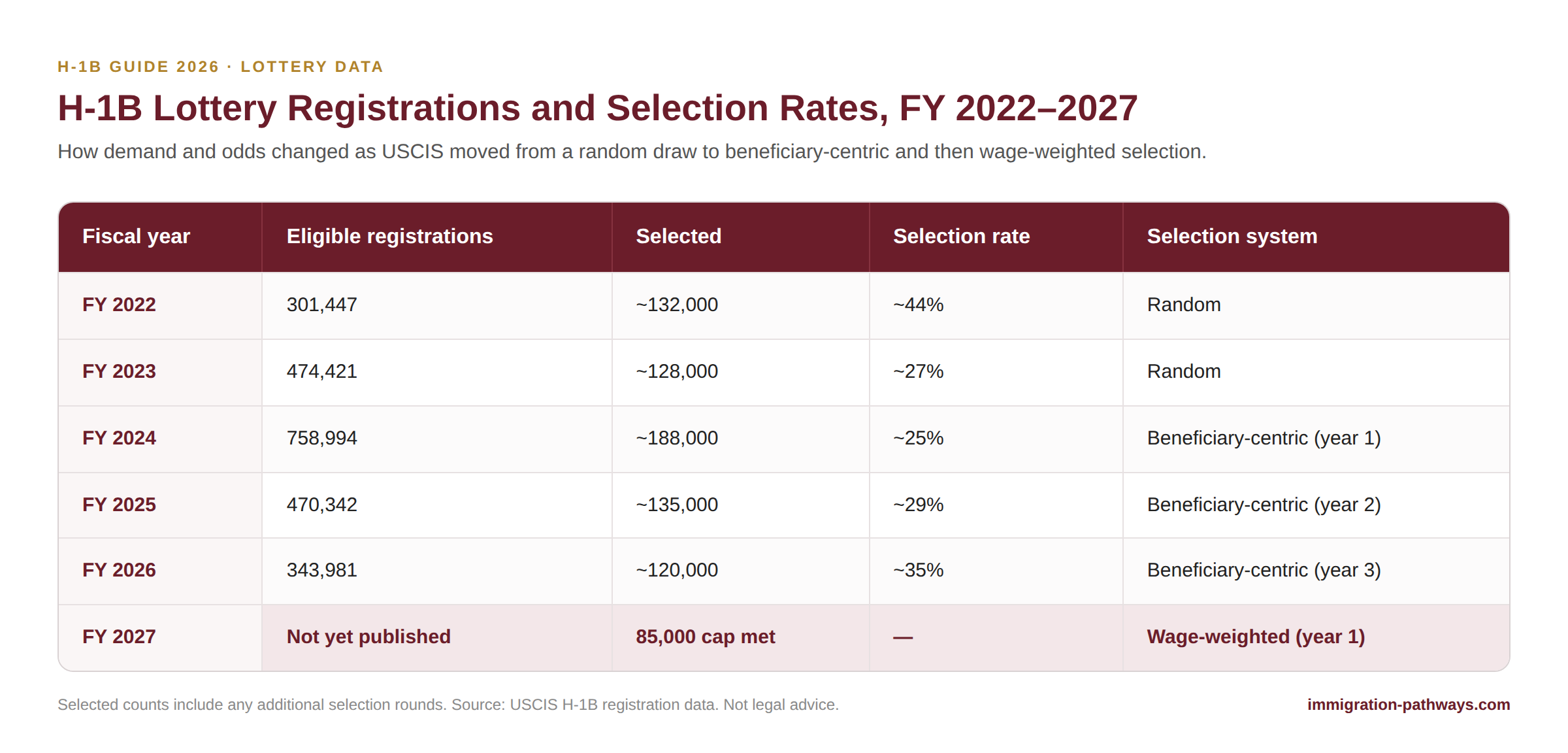
The decline in registrations from FY 2024's peak reflects the beneficiary centric system which helped eliminate duplicate registrations, and more recently, the $100,000 fee on some overseas hires had an additional deterrent effect.
Will there be a second lottery for FY 2027?
In recent years, USCIS has conducted additional selection rounds when it was determined that the annual H-1B numerical allocations would not be reached with the initial group of selected registrants. That is why USCIS conducted a second lottery for FYs 2024 and 2025 but did not conduct a second lottery for FY 2026. While it is possible that a second lottery could occur for FY 2027, there is no guarantee that an additional selection will be held.
The New Weighted Lottery: How It Actually Works
The Core Change
Under the new rule, USCIS will still run a selection when registrations exceed the cap. The key difference now is that instead of giving every eligible beneficiary the same chance of getting accepted, USCIS will enter each beneficiary into the selection pool multiple times based on the relevant Occupational Employment and Wage Statistics (OEWS) wage level tied to the job they are offered. This stacks the probability in the favour of certain candidates depending on wage level, while keeping a path open for registrations at all wage levels.
The Four OEWS Wage Levels
OEWS wage levels range from Level I (entry-level) to Level IV (fully competent/senior). Under the weighted system:
- Level I (entry-level): One entry in the selection pool — the lowest odds
- Level II (qualified): More entries — moderate odds
- Level III (experienced): More entries — higher odds
- Level IV (fully competent/senior): The most entries — highest odds
The exact multipliers USCIS uses are determined by location, salary and industry which in practical effect means that a senior software engineer offered at Level IV has significantly better odds than an entry-level engineer offered at Level I for the same position.
Who This System Hurts Most And Why F-1/OPT Students Need to Read This
This new system was designed in order to reduce the number of ”lower wage” registrations. In practice, this has the largest negative impact on entry level positions which are most commonly offered to recent F-1/OPT graduates. If you are an F-1/OPT and you are receiving an entry-level job offer at a Level I or Level II wage, it is important to understand that your odds in the new lottery system are significantly lower than what they used to be under the random system. Even though the new lottery doesn't make selection impossible, this change does mean that building a back up plan such as: cap-exempt employment, STEM OPT extension or returning for a further degree, is more urgent for graduates now than it was for graduates just a few years ago.
How Is the Wage Level Determined?
Before an employer can file an H-1B petition, it must obtain a certified Labor Condition Application (LCA) from the Department of Labor. The LCA identifies:
- The occupation (SOC code)
- The work location
- The offered wage
- The corresponding OEWS wage level
This matters because the weighted lottery is not just based on salary. The same $120,000 salary could be Level IV in one market and Level II in another depending on the occupation and geographic area.
For example, a software engineer earning $120,000 in a lower cost metropolitan area may qualify as Level III or IV, while the same salary in San Francisco could correspond to Level II due to the higher wages of the area.
Under the FY 2027 system, the wage level assigned through the LCA process is what determines lottery weighting. This means that employers who offer wages substantially above local market rates will receive a significant selection advantage.
What Employers Must Now Include in Registrations
A new addition this year is that H-1B cap petitions must include the source material that led to the determination of the OEWS wage level and must be included in the foreign national's submitted registration. Registering at an inflated wage level to gain an advantage in selection and then filing at a lower level can create serious legal exposure.
The Integrity Safeguard
As a safeguard a measure has been implemented that means if a beneficiary has multiple registrations submitted on their behalf, USCIS will assign the beneficiary to the lowest wage level among all those registrations for selection weighting. This prevents employers from taking advantage of the system by submitting multiple registrations at different wage levels and hoping the highest one gets counted.
The $100,000 Supplemental Fee: Who Pays and Who Doesn't
This is the most misunderstood aspect of the FY 2027 cycle. The fee is real, significant, and has important exceptions that are often misstated.
What the Proclamation Says
Presidential Proclamation 10973, signed September 19, 2025, requires a $100,000 payment to accompany any new H-1B visa petitions submitted after 12:01 a.m. Eastern time on September 21, 2025. This includes FY 2027 cap filings and any other H-1B petitions submitted after that time.
Who Must Pay
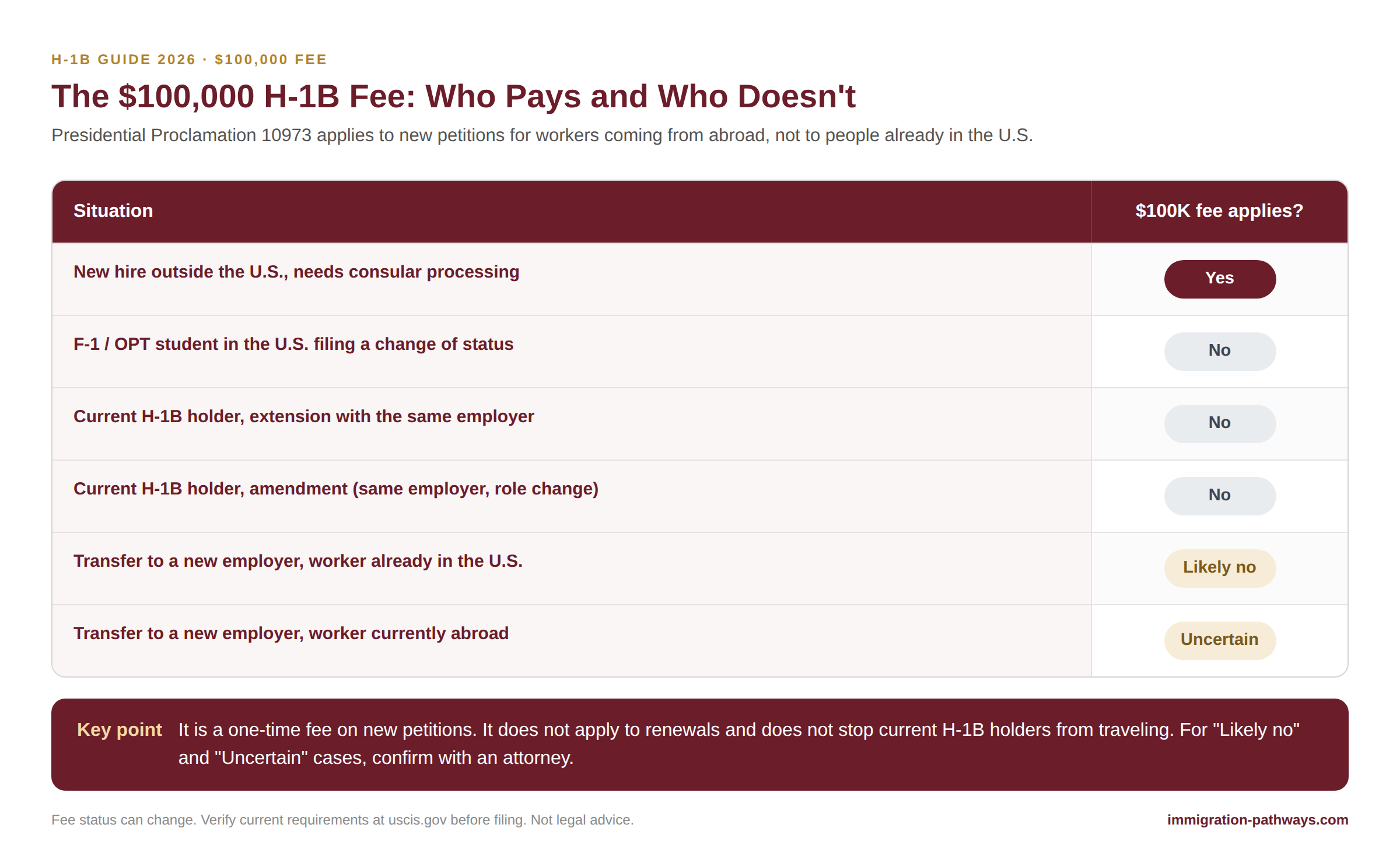
The $100,000 H-1B supplementary fee applies to new H-1B petitions filed for beneficiaries who are outside the United States or who require consular processing.
Put simply, if the employee is currently abroad and needs to come to the U.S. for the first time on H-1B status, which requires consular processing and a visa stamp, the $100,000 fee applies.
Who Is Exempt
USCIS confirmed this proclamation applies only to prospective H-1B beneficiaries who are seeking entry into the United States from outside of the country, and it is not applicable to current H-1B visa holders or other foreign nationals in the United States eligible for change of status to H-1B. F-1 OPT students eligible for change of status to H-1B in calendar year 2026 (fiscal year 2027) are not affected by the proclamation.
The proclamation does not change any payments or fees required for H-1B renewals. The fee is a one time fee on submission of a new H-1B petition. It does not prevent any holder of a current H-1B visa from traveling in and out of the United States.
Summary of who pays and who doesn't:
The Policy Intent Behind The Fee
The $100,000 fee was deliberately targeted at offshore hiring through large IT services firms and outsourcing companies, the business model of sponsoring candidates abroad, obtaining H-1B approval, and then placing them at U.S. client sites. For a domestic employer whose candidate is already in the U.S. on F-1/OPT or another status, the fee does not apply. For a multinational firm sponsoring candidates from overseas, it does. Understanding this helps both employers and candidates assess whether they are in the affected group and why the fee was structured this way.
Legal Status of the Fee
The $100,000 fee is currently scheduled to expire on September 21, 2026, unless the government decides to extend it. Before then, government officials must review the policy and advise the President on whether the fee should be renewed, changed, or allowed to expire.
Several states have challenged the fee in court, but as of June 2026 it still remains in effect. Employers should not assume the courts will cancel the fee before it expires and should always plan accordingly when filing H-1B petitions.
What Happens After Selection: The Petition Filing Process
Selection in the lottery does not mean you have an H-1B visa. It means your employer is eligible to file a full petition. This is what comes next:
Step 1: Obtain a Labor Condition Application (LCA)
Before filing the H-1B petition, the employer must obtain a certified LCA from the Department of Labor. The LCA confirms that:
- The employer will pay the H-1B worker at least the prevailing wage for the role in the geographic area or the actual wage paid to similarly qualified workers at the employer, whichever is higher
- The working conditions will not adversely affect U.S. workers
- There is no strike or lockout at the worksite
LCA processing through the DOL FLAG system typically takes 7 business days. The LCA must be certified before or at the time the I-129 petition is filed and not after.
LCA Posting Requirement: A Step Employers Frequently Miss.
Before filing the LCA, the employer must post notice of the LCA at the worksite for 10 consecutive business days. This is a mandatory procedural requirement, not optional, and is particularly easy to overlook for employers filing for the first time or opening a new worksite location. Failure to post properly is an LCA compliance violation and can expose the employer to DOL investigation. It is necessary to ensure the posting requirement is completed and documented before the LCA is filed.
Step 2: File Form I-129
The employer files Form I-129 (Petition for Nonimmigrant Worker) with USCIS during the filing window.
Starting April 1, 2026, a new version of Form I-129 is mandatory and requests more detailed information about the H-1B position than prior versions, focusing on the minimum requirements necessary to perform the duties of the H-1B position.
Why The New I-129 Form Matters Beyond Paperwork
The new form fields are designed to surface mismatches between what the job actually requires and what the employer has listed. USCIS has increased scrutiny of whether the minimum educational requirement for the position genuinely required the exact degree the applicant claimed and that it wasn't just a general bachelor's. Practitioners who understand this framing write petitions that directly address the specialty occupation standard. Employers who treat the form as a bureaucratic checklist are more likely to receive RFEs that challenge the wording of the minimum requirements . When completing the new form, the job description should state explicitly why the specific degree is required for the duties described and not merely that a degree is preferred.
Filing window: April 1 – June 30, 2026 for FY 2027 selections. Petitions filed outside this window are rejected.
Premium processing: Available for H-1B cap petitions. Premium processing guarantees a 15-business-day response however this does not guarantee an approval. As of March 1, 2026, the premium processing fee increased to $2,965. This can be subject to change so always verify current fees before filing. Premium processing is not limited to lottery-selected cap petitions, It can also be used for H-1B extensions (staying with the same employer longer) and H-1B transfers (changing employers) filed at any time of the year. For a worker whose extension petition is pending and the 240-day rule clock is running, or for a worker who needs a faster answer on a transfer petition, premium processing can be of great benefit. It is not limited to the April–June filing window.
If you receive an RFE: An RFE is not a denial. You typically have 87 days to respond, it is important to confirm the exact deadline on your specific notice. Respond directly and specifically to every concern USCIS raised. A weak or incomplete RFE response can result in denial even after a strong initial petition.
How To Deal With NOIDS: NOIDs are different from RFEs and require a different response. USCIS may also issue a Notice of Intent to Deny (NOID), the main way it differs from an RFE is that they are significantly more serious. A NOID means USCIS has reached a tentative conclusion to deny and is giving the petitioner an opportunity to rebut that conclusion. The response window is typically 30 days (not 87), the evidentiary burden is higher, and the framing of the response must directly rebut a negative finding rather than simply supplementing an incomplete record as an RFE response does. A petitioner who receives a NOID and treats it like an RFE will likely be denied. If you receive a NOID, contact an immigration attorney immediately.
Step 3: H-1B Approval
If USCIS approves the petition, you receive Form I-797B (approval notice).
If you are in the U.S. (change of status): H-1B status begins no earlier than October 1, 2026. Your work authorization under H-1B begins on that date or alternatively the requested start date, whichever is later. Verify your I-94 after October 1 to confirm your authorized period of stay.
How to verify your I-94 and what to do if it is wrong: Your I-94 record is maintained electronically by CBP and is accessible at (https://i94.cbp.dhs.gov). After any status change, entry, or extension approval, check your I-94 to confirm it accurately reflects your authorized period of stay and the correct visa classification. I-94 errors are actually more common than most people expect. Common errors include incorrect class of admission, wrong expiration date, or missing records which can create serious status complications that are much easier to correct when caught early. If your I-94 appears incorrect, contact your immigration attorney; do not attempt to correct it without legal guidance.
If you are outside the U.S. (consular processing): You must attend a visa interview at a U.S. consulate to obtain an H-1B visa stamp before entering the U.S. Under current conditions, this step carries significant risk. If you fall under this category, see the Stamping section below.
H-1B Status vs. H-1B Visa Stamp: A Critical Distinction
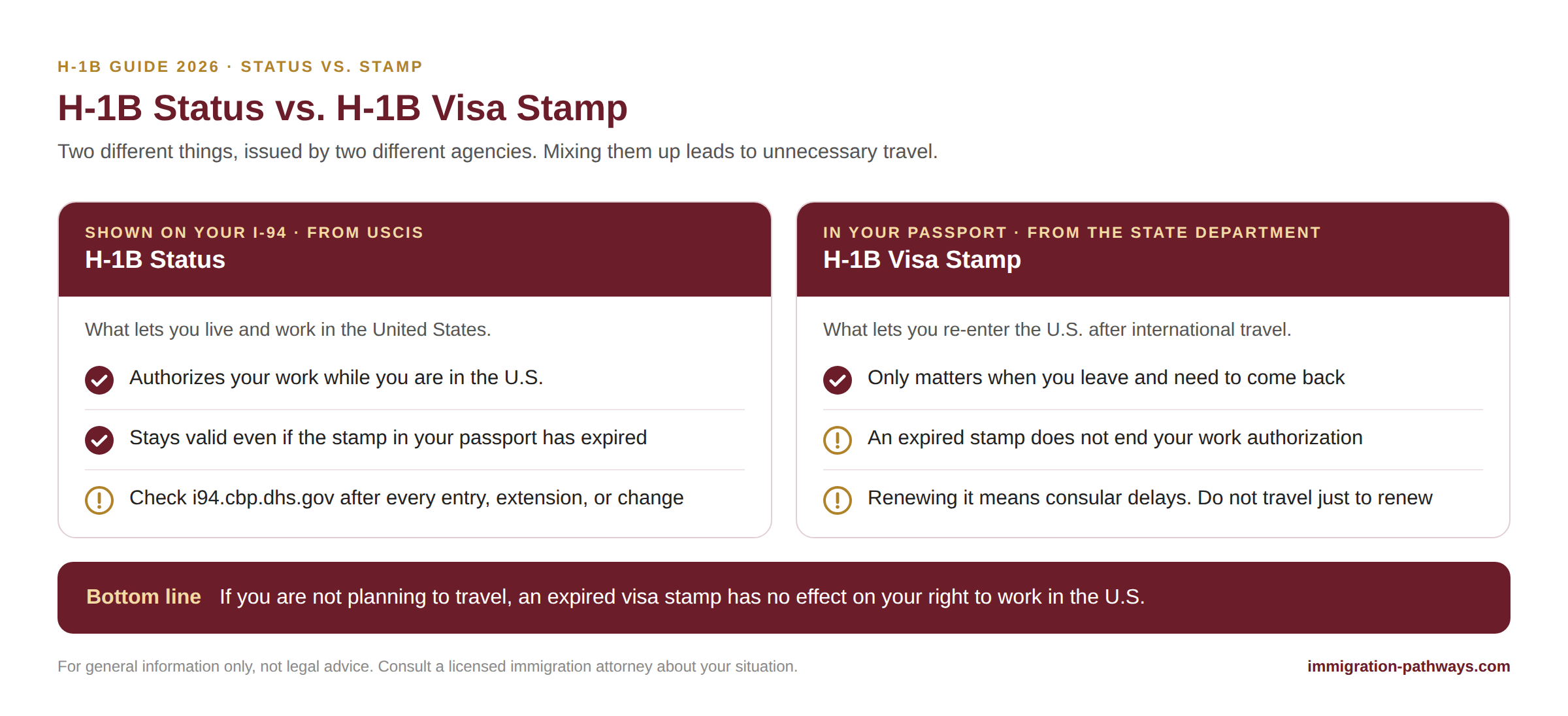
This distinction causes unnecessary anxiety and sometimes premature travel decisions for a significant portion of H-1B holders. To clarify, Your H-1B status is what authorizes you to live and work in the United States. Whereas, your H-1B visa stamp is what allows you to re-enter the U.S. after international travel. These are two separate things issued by two separate government agencies.
> You can be in completely valid H-1B status inside the U.S. with a long-expired visa stamp in your passport, this is both legal and common. An expiring or expired visa stamp does not mean your work authorization is expiring. Many H-1B holders who misunderstand this travel internationally to "renew their stamp" when no travel is required, and they are exposed to current consular delays unnecessarily.
The stamp is only of significance when you leave the U.S. and need to re-enter. If you do not plan to travel internationally, an expired stamp has no practical consequence on your U.S. work authorization.
Visa Stamping: A Critical Step
H-1B petition approval does not mean you can travel to and from the U.S. freely. If you need a visa stamp, which can happen either because you are outside the U.S. or because your existing stamp has expired, you face a separate, currently severe bottleneck.
The current situation in brief: As of early 2026, all five U.S. consulates in India show no available H-1B stamping appointments through the end of 2026, with the earliest open dates in May 2027. Third country stamping was eliminated in September 2025. The Dropbox (interview waiver) program was severely restricted to only applicants whose previous stamp expired within 12 months. You can read about this in more detail here. see our dedicated [H-1B Stamping in India 2026 guide
If you are a H-1B holder and need to travel urgently for family emergencies or humanitarian reasons, Consulates do accept emergency appointment requests, but the requirements are high: typically documented life-threatening medical situations or death in the immediate family. Employment urgency alone historically, has generally not been accepted as grounds for expediting the process. If you have a genuine urgent humanitarian need, check the specific consulate's current expedite criteria, document the emergency thoroughly, and submit the request promptly. You should not assume it will be granted; have a contingency plan for the possibility that it is not. For the full picture on stamping wait times, consulate-by-consulate conditions, and what to do if you are stranded: see our dedicated [H-1B Stamping in India 2026 guide].
What Happens If You Lose Your H-1B Job
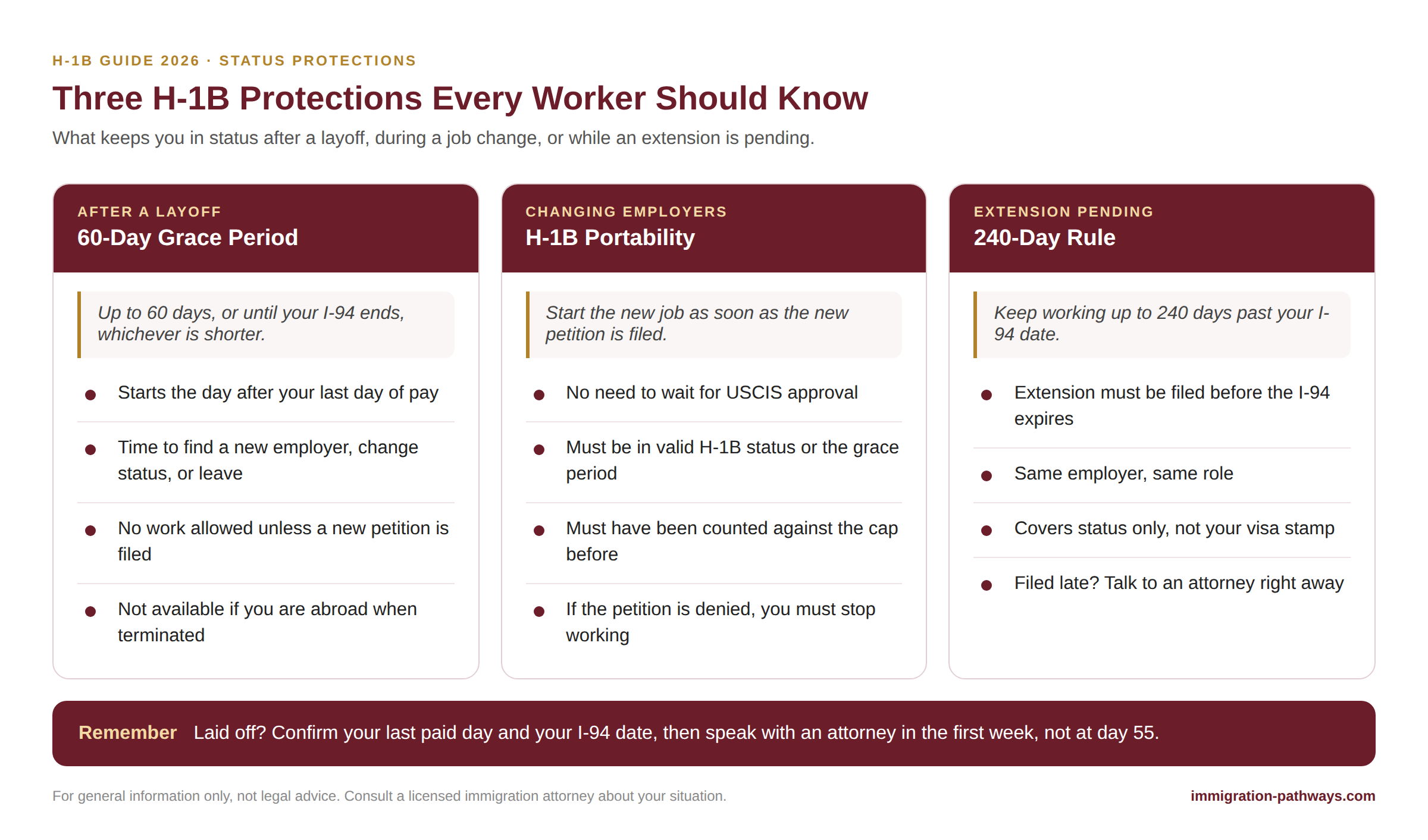
The 60-day grace period, the most important thing in this article for many readers: If an H-1B holder is laid off, terminated, or otherwise loses their employment, federal regulations provide a 60-day grace period. During this period, the worker is considered to be maintaining valid nonimmigrant status which means they are not immediately out of status upon termination.
How the grace period works:
- Begins the day after the last day of paid employment (typically the last day a salary or wage is paid)
- Lasts up to 60 consecutive calendar days, or until the end of the authorized validity period on the I-94, whichever is shorter
- Can be used once per authorized validity period
- Allows the worker time to find a new employer, initiate a transfer, file a change of status, or depart the U.S.
What the grace period does not do: It does not extend your work authorization. You cannot work during the grace period unless a new employer has filed an H-1B transfer petition on your behalf (see H-1B Transfer Portability below). It also does not apply if you are physically outside the U.S. when the termination occurs as the grace period is only available to workers present in the United States in valid status.
What to do immediately if you are laid off:
1. Confirm the exact date your employment ends (the last date of paid compensation)
2. Check your I-94 expiration date
3. Determine whether a new employer can file a transfer petition immediately
4. Consult an immigration attorney — ideally within the first week, not at day 55
What happens to your I-140 if you have started a green card case: An I-140 that has already been approved is generally not automatically withdrawn when you leave an employer. If the I-140 has been approved for 180+ days and your I-485 has been pending for 180+ days, AC21 portability protections may apply. Even if you are not yet at the I-485 stage, an approved I-140 can preserve a priority date that a new employer can capture. Do not assume the green card case is lost when employment ends; however you should consult an attorney immediately.
H-1B Transfer Portability: Working for a New Employer
This is one of the most important and most commonly misunderstood protections in the H-1B program. An H-1B holder can begin working for a new employer immediately upon the new employer filing a non-frivolous I-129 transfer petition and does not have to wait for USCIS to approve it. This is called H-1B portability or "cap-exempt transfer."
The rule is: once a new employer files the petition, the worker is authorized to work for that new employer while the petition is pending, as long as the worker:
- Is currently in valid H-1B status (or within the 60-day grace period)
- Was previously counted against the H-1B cap
- Is not changing to a new visa category
What this means practically: You do not have to quit your old job, wait for USCIS to process the new petition, and then start. You can start working for the new employer the day the new petition is filed. Workers who believe they must wait for approval before starting a new job are being unnecessarily cautious and in some cases are taking unpaid leave they do not legally need.
Caution: "Non-frivolous" means the petition must be a good-faith, legally supportable filing and not a placeholder. If the new petition is later denied, the worker's ability to continue working under portability ends. Consult an attorney when timing a transfer, especially if using portability during a grace period.
H-1B Amendments: When They Are Required
A material change in job duties, work location, or employment terms generally requires filing an H-1B amendment and failure to do so is a compliance violation. The $100K fee table earlier in this article references "amendment (same employer, role change)" without explaining when an amendment is actually required.
These are the key situations:
- New worksite in a different metropolitan statistical area (MSA): If an H-1B worker moves to a new worksite location covered by a different LCA, an amended petition (and new LCA) is generally required
- Significant shift in job duties: If the core duties of the role change materially from what was described in the approved petition, an amendment is required
- Change in employer entity through acquisition or merger: A change in the legal employer, even if the worker's day-to-day role is identical, may require an amendment or a new petition
- Change in worksite for third-party placements: Workers placed at client sites who are moved to a new client location in a different area require a new LCA and potentially an amended petition
What doesn't require an amendment: a salary increase, a minor title change, or a promotion that does not materially change duties. What is "material" is fact-specific. When in doubt, consult your immigration attorney before the change occurs rather than after.
The 240-Day Rule: Continuing to Work While an Extension Is Pending
This is a critical bridge provision that most H-1B holders do not know exists until they need it. When an H-1B holder's current status expires while a timely-filed extension petition with the same employer is still pending with USCIS, the worker can continue to work for up to 240 days beyond the I-94 expiration date while the petition remains pending. However, this is subject to the condition that:
The extension petition must have been filed before the current I-94 expired ("timely filed"), and it must be with the same employer in the same role.
What this protects against: USCIS processing delays can mean an extension petition takes 6–12+ months even with premium processing on some occasions. Without the 240-day rule, a worker whose I-94 expired while USCIS was still processing a routine extension would have no legal work authorization even if they had done everything correctly. The 240-day rule prevents that gap.
What it does not do: It does not have any effect on your visa stamp for travel purposes. If your visa stamp expires during this period and you travel internationally, you will need a new stamp before re-entering. The visa stamp and visa status are two different things.
If you are approaching or past your I-94 expiration with a pending extension: Verify the filing date of the extension petition against your I-94 expiration. If the petition was filed before expiration, you are covered. If it was filed after, you may have a gap. Consult an attorney immediately.
H-1B Time Recapture
Time spent physically outside the U.S. during an H-1B period can be recaptured which in turn extends your stay beyond the standard six-year limit. If an H-1B holder traveled internationally during their H-1B period and can document those absences, those days spent abroad are not counted against the six-year maximum. For workers who have traveled extensively, whether visiting family, attending international conferences, or taking extended trips, this can represent weeks or months of additional authorized status.
How it works: when you file an extension beyond the six-year maximum that is otherwise unavailable, or when you seek to maximize your remaining H-1B time, the petitioner submits documentation of international travel (passport stamps, I-94 departure records, airline records) showing days outside the U.S. USCIS then credits those days back against the six-year count.
This is particularly valuable for H-1B holders who are in a long Visa Bulletin wait and need additional time to bridge to their green card. If you are approaching the six-year cap without a green card case in process, consult an attorney about recapture before assuming you have no remaining H-1B time.
LCA Compliance and DOL Wage Enforcement
The Labor Condition Application is not a formality. The Department of Labor actively audits compliance, and the consequences of violations are severe.
What the LCA Requires
- Wage compliance: The employer must pay the H-1B worker the higher of: (a) the prevailing wage for the occupation in the area of intended employment, as determined by OEWS or a private survey, or (b) the actual wage paid to similarly qualified workers at the employer
- Working conditions: The employer must provide working conditions that do not adversely affect U.S. workers
- No strike or lockout: The employer must attest that there is no ongoing strike or lockout at the worksite
- Public access file: The employer must maintain a public access file documenting LCA compliance, available for inspection upon request
DOL Enforcement
The DOL's Wage and Hour Division investigates LCA complaints and conducts targeted enforcement. Employers found to have willfully violated LCA obligations can face:
- Back wage liability for affected workers
- Civil money penalties up to $35,000 per violation
- Debarment from the H-1B program for up to three years
- Referral for criminal prosecution in egregious cases
The DOL maintains public lists of H-1B program violators. These lists are publicly searchable and can affect an employer's reputation with prospective hires.
Third-party placement and LCA compliance: If an H-1B worker is placed at a third-party client site (common in consulting and IT services), a separate LCA may be required for each worksite location. Employers who move H-1B workers between client sites without updating LCAs are a common enforcement target.
Fraud Prevention: What USCIS Is Checking
USCIS has significantly expanded fraud detection since implementing the beneficiary-centric registration system in FY 2024.
Beneficiary-Centric System
The beneficiary-centric system ensures that if multiple employers register the same person, that person counts as one unique registrant rather than multiple entries. This reduces the ability to cheat the lottery through multiple registrations. Under the weighted system, if a beneficiary has multiple registrations, USCIS assigns them the lowest wage level among all registrations for weighting purposes. This prevents taking advantage of the wage level system.
What USCIS Flags
- Registrations with inconsistent wage level information
- Employers with no verifiable operations or payroll history
- Job descriptions that do not support the specialty occupation requirement
- Mismatches between registration information and the filed petition
- Patterns suggesting a company exists primarily to file H-1B petitions rather than operate a legitimate business
Important: USCIS site visits are the physical enforcement mechanism. USCIS's Fraud Detection and National Security (FDNS) directorate conducts unannounced site visits in order to verify that H-1B workers are performing the duties described in the petition, at the stated worksite, for the stated employer. For workers placed at third-party client sites, the officer may visit the employer of record, the client site, or both. This is a live compliance risk rather than a theoretical one. Employers and workers who are unaware of site visits will not be prepared for them. Key things to understand: the worker should be performing the role described in the petition at the location listed; LinkedIn profiles, company websites, and public records that contradict the petition are fair game for review; and any material change in duties or worksite should have triggered an amendment before the visit occurs.
Specialty Occupation: The Often Missed Threshold Requirement
Before any of the above applies, the position must qualify as a "specialty occupation". This is a legal standard that USCIS has been scrutinizing increasingly closely.
A specialty occupation requires: theoretical and practical application of a body of highly specialized knowledge, and attainment of a bachelor's degree or higher in a specific specialty (or its equivalent) as the minimum entry requirement for the position.
What USCIS scrutinizes:
- Whether the job duties actually require a specialized degree, not just a general bachelor's
- Whether the employer consistently requires a specialized degree for the position across its workforce
- Whether the offered wage is consistent with a position that genuinely requires specialized expertise
- For positions at consulting firms or staffing companies: whether the placement at a client site involves a genuine specialty occupation role
Generic titles like "IT consultant," "business analyst," or "software developer" receive greater scrutiny if the job description does not demonstrate specialized knowledge requirements. The specialty occupation requirement has been the basis for a significant number of RFEs and denials in recent years.
H-4 Spouses: Work Authorization Status
Spouses of H-1B holders are admitted in H-4 status. H-4 holders are generally not authorized to work unless they qualify for an H-4 EAD.
H-4 EAD Eligibility
An H-4 spouse may apply for employment authorization (H-4 EAD) if the H-1B principal:
- Has an approved I-140 petition (in any employment-based category), or
- Has been granted an H-1B extension beyond the standard six-year maximum based on an approved I-140 or a pending I-485 that has been filed for more than 365 days
Important: H-4 EAD authorization is not automatic. The H-4 spouse must apply for it separately on Form I-765. The EAD is tied to the principal's H-1B status, This means that if the H-1B principal's status lapses (due to job loss, employer withdrawal, or status expiration), the H-4 EAD authorization is also affected.
H-4 EAD processing delays and renewal risks: H-4 EAD processing can take 6–12+ months, which means that a dependent who submits an H-4 EAD application as soon as they become eligible following I-140 approval may wait for a significant timespan before work authorization is actually granted. H-4 EAD renewal must be filed before the current EAD expires. USCIS has not consistently applied automatic extension rules to H-4 EADs the way it has for some other EAD categories, meaning a lapse in coverage is a real risk if renewal is filed late. A spouse planning their career and finances around H-4 EAD work authorization should build these processing gaps into their timeline and file renewal petitions as early as possible.
H-4 EAD policy stability: a stronger warning than "monitor developments." H-4 EAD has been subject to multiple proposed rescissions, court challenges, and rulemaking proceedings over the past decade. Under the current administration, it faces renewed pressure. Workers who have built their career and financial planning around H-4 EAD authorization should be aware that this rule could change and with potentially limited notice. Maintaining awareness of regulatory developments through an immigration attorney is not optional but a practical necessity for anyone whose livelihood depends on H-4 EAD authorization.
Policy stability note: H-4 EAD eligibility rules have been subject to ongoing policy debate and potential regulatory changes under the current administration. Holders should monitor developments closely with an attorney, especially if their work authorization depends on this status.
Cap-Gap Protection for F-1 / OPT Students
Students in F-1 status with valid OPT who are selected in the H-1B lottery and have an H-1B petition filed on their behalf receive "cap-gap" protection, this is an automatic extension of their F-1/OPT status and employment authorization that bridges the period between OPT expiration and the H-1B start date of October 1.
Key cap-gap facts:
- Cap-gap protection applies automatically when the H-1B petition is timely filed (no separate application required)
- It extends both status and work authorization through September 30, or until the H-1B petition is denied, withdrawn, or revoked — whichever is earlier
- If the petition is denied before October 1, cap-gap protection ends immediately
- Cap-gap does not apply to students whose OPT expired before the H-1B petition was filed
- The $100,000 supplemental fee does not apply to F-1 students filing a change of status to H-1B while in the U.S.
If you are an F-1/OPT student not selected in the FY 2027 lottery, you cannot continue working under OPT authorization beyond its expiration unless you are in a STEM OPT extension period. Begin evaluating alternatives immediately; do not wait until the OPT expiration date.
The realistic short-term options for recent graduates who were not selected: The alternatives section below lists O-1, EB-1A, NIW, L-1, and TN however many of these require years of evidence-building that a recent graduate does not yet have. The most realistic near-term options for an F-1 student whose OPT is expiring in 6 months and who was not selected are:
- Cap-exempt employment at a university, affiliated nonprofit, or government research organization. This is as these employers can file H-1B petitions year-round without a lottery, and this is often the fastest path to H-1B status for recent graduates
- STEM OPT extension: if you have a qualifying STEM degree and a qualifying employer with an E-Verify account, a 24-month STEM OPT extension buys time for the next lottery cycle
- Returning for a further degree: this entails enrolling in a graduate program which restores F-1 status and CPT/OPT eligibility, and a U.S. master's degree increases lottery odds under the advanced degree exemption in future cycles
Building toward O-1 or EB-1A is a medium-term strategy, rather than a six-month solution. Be honest with yourself about which timeline applies to your situation.
What If You Were Not Selected?
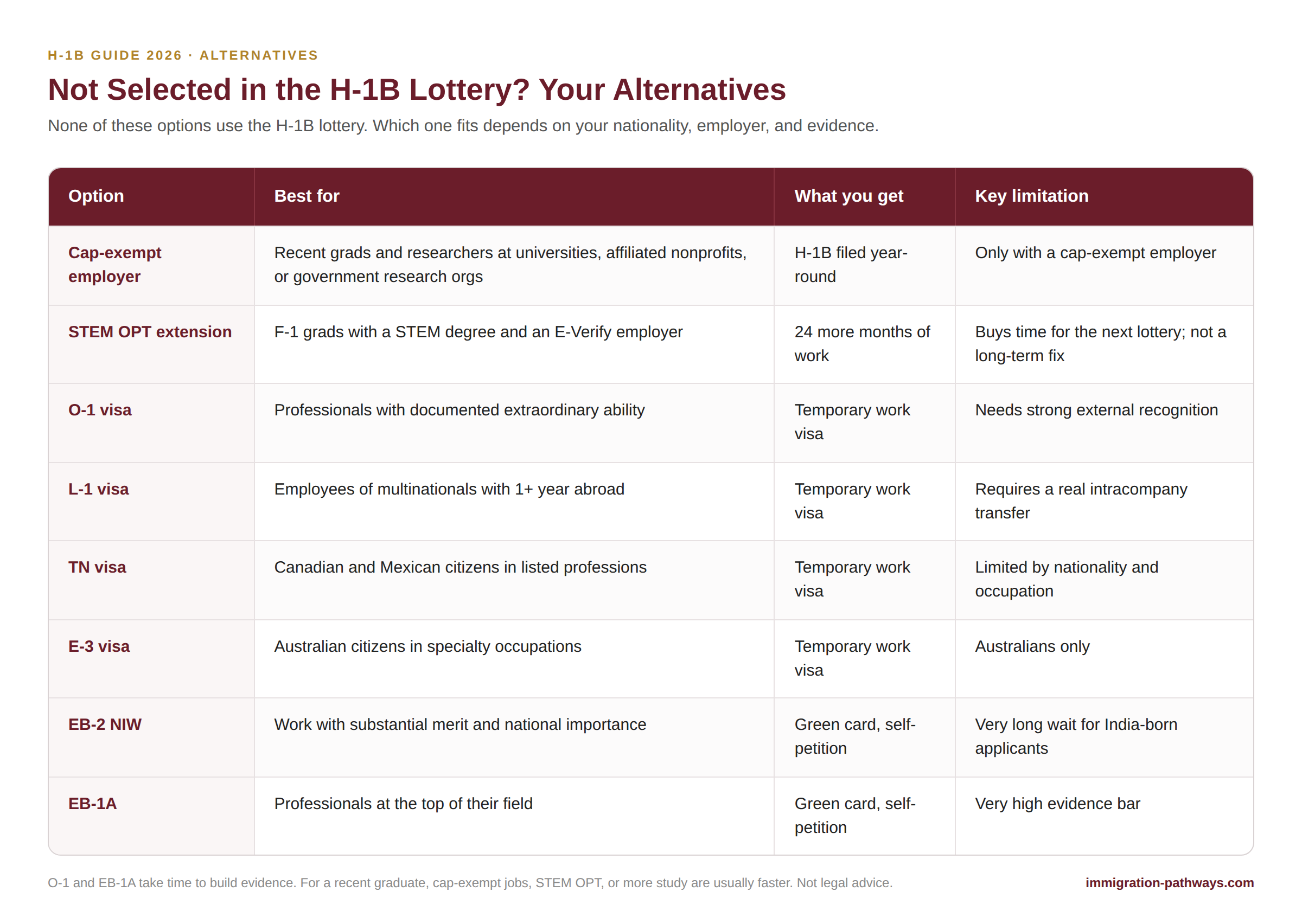
Not being selected in the H-1B lottery does not mean you are out of options. It simply means that the H-1B is not available for this cycle.
Evaluate these alternatives:
O-1 Visa: For individuals with extraordinary ability in their field. No lottery, no cap, no degree requirement. Requires strong external evidence of recognition by the field. Useful for founders, senior researchers, and professionals with documented industry recognition. Renewable indefinitely in one-year increments.
EB-2 NIW (National Interest Waiver): A self-petition green card pathway. No employer sponsorship or PERM required. The standard requires showing your work has substantial merit and national importance. For India-born applicants, EB-2 has a multi-decade backlog, but filing NIW now locks in a priority date and creates employment independence.
The EB-2 India backlog "multi-decade" understates the reality: The current EB-2 India Final Action Date is July 2014. Some independent analyses project the EB-2 India backlog at 50–100+ years under current visa utilization patterns. A 30-year-old engineer filing EB-2 NIW today to "lock in a priority date" should understand that the priority date they are locking in may not become current within their working career. Filing early is still strategically correct as a priority date that advances for 30 years is better than one that starts 30 years from now, however, this should be understood as a long-term asset and insurance policy, not a path to an imminent green card.
EB-1A (Extraordinary Ability): A self-petition green card for individuals at the top of their field. Higher threshold than NIW. For applicants born outside India and China, priority dates are currently current.
L-1 Visa: Available to employees of multinational companies with at least one year of qualifying foreign employment. No lottery, no cap. Requires a genuine intracompany transfer relationship.
TN Visa: Available to Canadian and Mexican citizens in specific professional occupations. No lottery, no cap, no petition required (Canadian citizens can apply directly at the border; Mexican citizens require a consular appointment).
E-3 Visa for Australian nationals: The E-3 visa is available exclusively to Australian citizens in specialty occupations. It has an annual cap of 10,500 but to date has never been exhausted. It requires an LCA but no lottery. For Australian nationals, the E-3 is significantly more accessible than H-1B and should be the first alternative evaluated rather than an afterthought. Processing is typically faster than H-1B and the application can be completed at a U.S. consulate in Australia or through a change of status in the U.S.
Cap-exempt employment: Consider employers that are not subject to the H-1B cap such as universities, nonprofit research organizations, and affiliated entities. These employers can file H-1B petitions year-round
Concurrent H-1B employers: An H-1B holder can work for multiple employers simultaneously, provided each employer files a separate H-1B petition. For workers who want to consult, moonlight, hold a second academic or research position, or maintain part-time work while transitioning, this is a legal and available option. Each employer must file their own I-129 and their own LCA. The primary employer's petition does not cover work performed for a second employer.
Long-Term Strategy: Reducing H-1B Dependency
For professionals who have navigated multiple lottery cycles or who are concerned about the increasing complexity and cost of the H-1B system, the question is no longer just "how do I get selected?" but "how do I reduce my dependence on this system?"
The most effective strategies:
Lock in a priority date now. An approved I-140 in any employment-based category preserves a priority date that advances regardless of future employer changes (subject to AC21 portability rules). Filing EB-2 NIW or asking an employer to file EB-2 or EB-3 now, even if the Visa Bulletin wait is long, is one of the most valuable things a currently employed H-1B holder can do.
Priority date preservation when changing employers, a concept that can mean years of difference: When you change employers, the priority date from an approved I-140 filed by your previous employer can be captured in a new employer's I-140 petition, this is as long as the original I-140 was approvable when filed. This means a worker at year four with an approved EB-2 I-140 from their current employer does not lose that priority date when they move to a new job. This is provided that the new employer files a new I-140 and the worker specifically asks for the priority date to be captured. For a worker with an India-born EB-2 priority date from 2019, this could represent years of queue advancement that would be permanently lost if they do not know to ask. Make priority date preservation a negotiating point in any employer transition. Do not assume the new employer's immigration team knows to do this automatically.
Build toward O-1. O-1 evidence such as publications, judging invitations, press coverage, awards with documented selection criteria can be accumulated over 12–24 months. If your H-1B renewal cycle aligns with a period where O-1 could plausibly be filed, build the evidence in advance rather than at the last minute.
Understand the six-year cap. H-1B is limited to six years of total stay (three years initial + three years extension for most cases) unless extended beyond six years based on a pending or approved I-140 or I-485. Workers approaching the six-year mark without a green card case in process face a real status gap. Plan the green card timeline proactively, this is as the six-year limit is a hard deadline, not a suggestion.
Consider EB-1A. For senior professionals with strong external recognition, EB-1A self-petition can be filed at any time, independently of the employer, with no PERM and no labor market test. An approved EB-1A I-140 creates an independent immigration asset that persists through employer changes.
FY 2027 Summary Checklist
If your registration was selected:
- Confirm wage level documented during registration is consistent with the planned petition
- Obtain certified LCA from DOL before filing I-129 (allow 7 business days)
- File I-129 with new Form I-129 (mandatory as of April 1, 2026) by June 30, 2026
- Confirm whether the $100,000 supplemental fee applies to your specific case — consult attorney
- Include OEWS wage level source documentation in the petition
- Consider premium processing ($2,965 as of March 2026 — verify current fee at uscis.gov) if faster adjudication is needed
- If beneficiary is outside the U.S.: plan for consular processing timeline realistically — current appointment waits are 12–18+ months in India
- If beneficiary is an F-1 student in U.S.: confirm cap-gap protection applies and OPT/STEM OPT expiration dates
- Verify I-94 after October 1 entry or status change
If your registration was not selected:
- Evaluate O-1, L-1, TN, EB-2 NIW, or EB-1A as alternatives
- Determine whether any current employer or prospective employer is cap-exempt
- If on OPT: confirm remaining OPT and STEM OPT extension eligibility
- If I-140 has been filed: verify priority date preservation and begin planning for adjustment
- Register for FY 2028 lottery when the window opens (typically March of the following year)
All information reflects developments through mid-2026. H-1B regulations, fee requirements, Presidential Proclamation status, and USCIS policies are subject to ongoing change and legal challenge. Verify all current requirements directly at uscis.gov before filing. This article is not legal advice.