H-1B to Green Card. Complete Roadmap 2026, EB-2, EB-3, EB-1A, and NIW
H-1B to green card 2026: compare EB-2, EB-3, EB-1A, EB-1B and NIW, PERM timelines, waits by country of birth, and how to protect your priority date.
Vera Kenahan
October 20, 2026 · 32 min read

This information is provided for informational purposes only and should not be considered as legal advice. The dates, processing times, and USCIS policy regarding the Visa Bulletin change on a month-to-month basis and sometimes without prior notice. Unless stated otherwise, all the information contained herein is valid as of the Visa Bulletin dated August 2026. Please check up-to-date dates on travel.state.gov and uscis.gov before filing anything and consult an immigration attorney regarding your individual situation.
Start Here. The One Thing That Determines Everything
Before continuing, ask yourself one question. What is your country of birth?
Just this one fact, not your nationality, not your passport, not your place of residence, decides if it will take you two years or twenty years from your H-1B to green card. The per-country cap in American immigration system restricts each country's percentage of yearly employment-based green cards to about 7 percent of annual allotment, irrespective of the need. The end result of this restriction for India and China, which have much higher needs than this percentage, is the decade-long wait in EB-2 and for India the exhaustion of green card category.
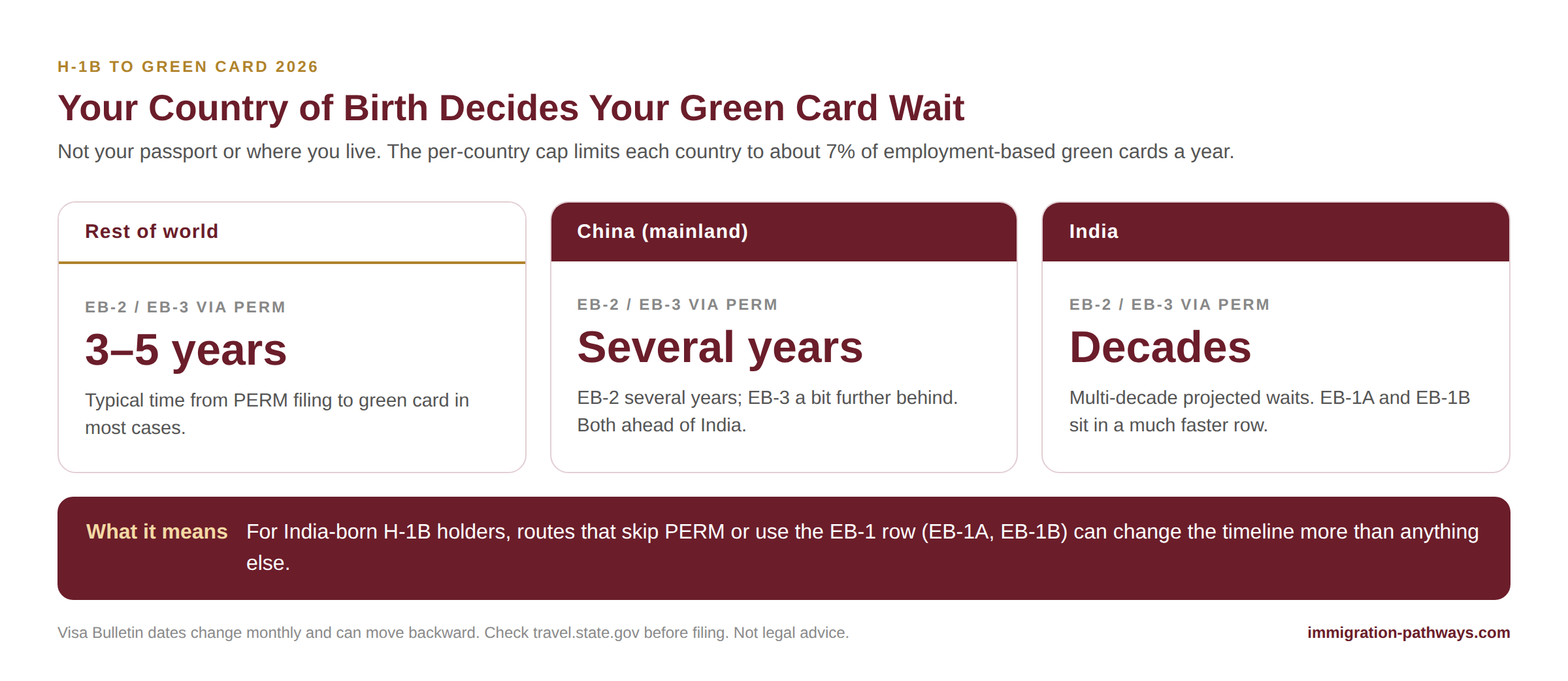
The figures are not intended to be discouraging. They are intended to inspire the rest of the guide. For those H-1B holders from India in particular, the most important contribution that this guide will make is getting you to refocus on self-petition avenues that avoid the PERM process altogether or are significantly quicker with the Visa Bulletin wait times.
Why H-1B Is the Starting Point for Most Green Card Cases
H-1B is considered a dual intent visa because you are allowed to concurrently be in the H-1B nonimmigrant category and apply for permanent residence. It is the dual intent nature of the H-1B visa which makes it the most popular visa for initiating the employment-based green card process. If one is on an F-1, B-2, or other visa categories, the declaration of immigrant intent may result in revocation of nonimmigrant status. But not if you are on an H-1B visa.
Thus, you have the right to approach your employer and request that he starts the green card process even though you have been with him for just a month or two. Each month you postpone doing so only adds up to a waiting period which is going to last a few years anyway.
The Four Main Routes from H-1B to Green Card
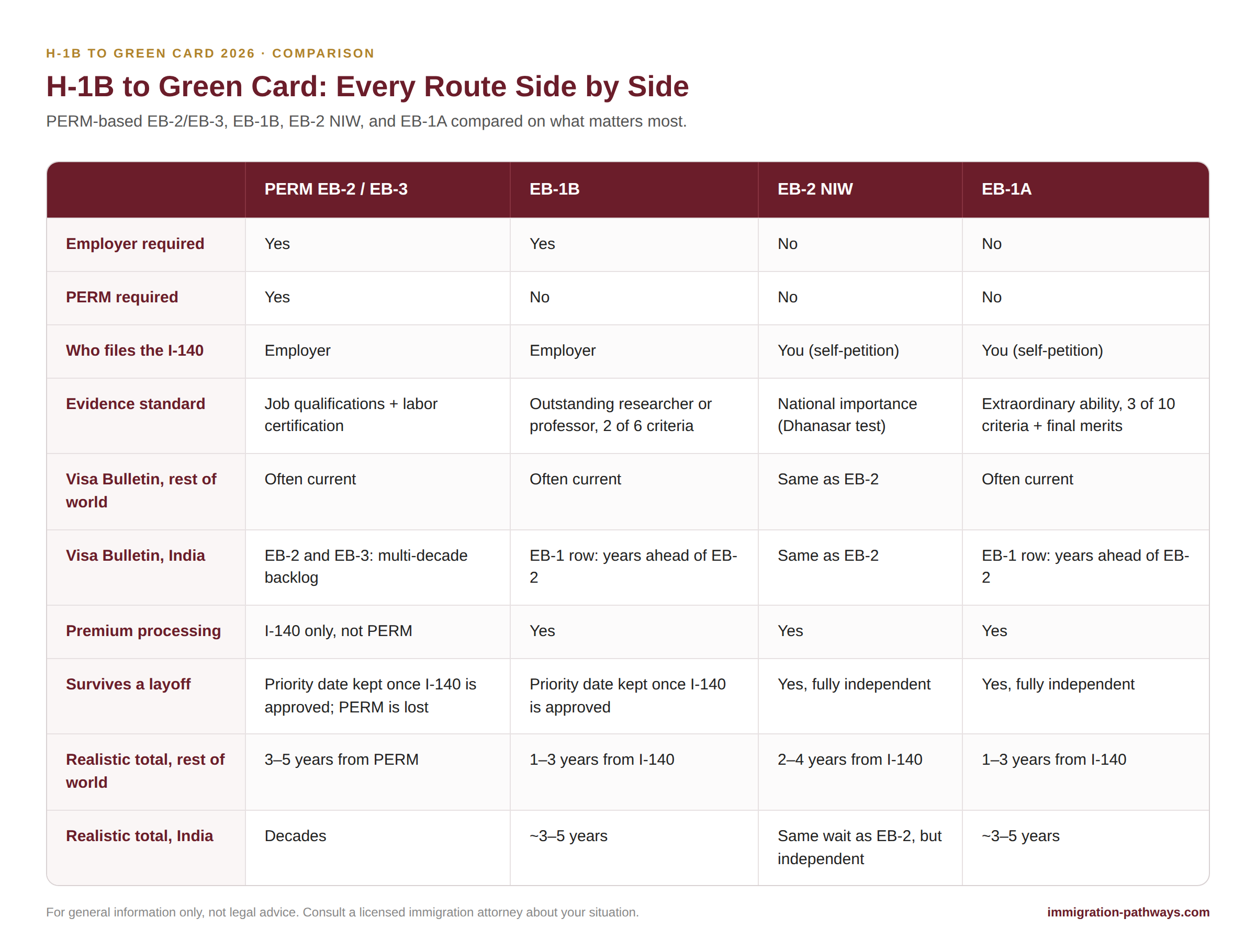
The Four Main Routes from H-1B to Green CardThe rest of this guide walks through each route in detail, then helps you decide which combination makes sense for your profile.
Route 1, Employer Sponsored EB-2 and EB-3, the Standard Path
What These Categories Are
EB-2 applies to professionals holding an advanced degree, either master's or higher, or bachelor's degree with five years of progressive experience, as well as persons of exceptional ability. The majority of the employees in the H-1B category from technology, engineering, finance, and related occupations can be placed into the EB-2 category due to their advanced degrees.
EB-3 includes skilled workers, two years of training or experience required, professionals, bachelor's degree required, and other workers. EB-3 can also be utilized as an alternative and complementary category in relation to the EB-2 category.
Both of these categories include a requirement of PERM labor certification in case of employment-based petitions.
The Full Process, Stage by Stage
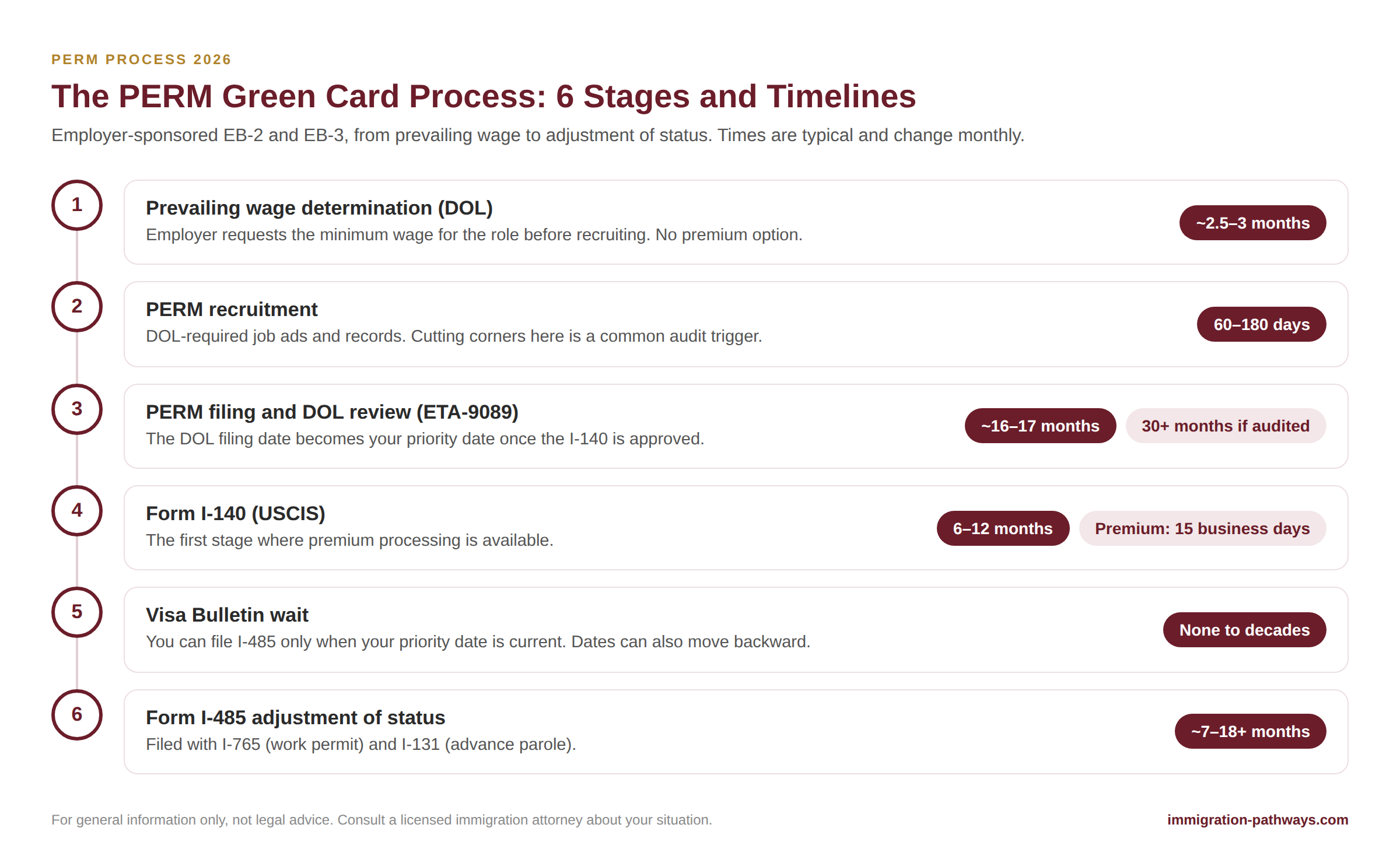
Stage 1: Determination of Prevailing Wage, DOL. The current timeline is around 2.5 to 3 months. This figure has actually improved over the past year, DOL reporting through August 2026 shows the National Prevailing Wage Center processing requests filed roughly 2.5 to 3 months earlier, an improvement from the 6 or more month waits some cases saw earlier in 2025. Since this figure moves monthly, check the DOL's current processing time page before assuming any specific number still applies by the time you file. The employer applies for the prevailing minimum wage determination prior to the start of recruitment from the National Prevailing Wage Center. There is no premium processing in this stage.
Stage 2: PERM Recruitment. Timeline of a minimum of 60 days and a maximum of 180 days. In this stage, the employer does DOL mandated job advertisement and keeps record of recruitment. This stage is under the control of the employer and cutting corners in this stage is one of the triggers for audits.
Stage 3: PERM Application and DOL Review Process. Current timeline around 16 to 17 months if not audited, 30 or more months if audited. Employer files the Form ETA-9089 with the DOL. It is worth being precise about what becomes the priority date here. The date DOL receives that ETA-9089 filing is what becomes the priority date, but only once USCIS subsequently approves the I-140 that references the certified PERM. If DOL denies the PERM and the employer refiles, the new filing date creates a new priority date, the old one does not carry forward. If a worker changes employers after PERM certification but before I-140 approval, the new employer cannot use the certified PERM at all, a new PERM must be filed with its own new filing date. Treating a certified but not-yet-referenced PERM as a secured priority date, when I-140 has not yet been filed or approved, is one of the more common misunderstandings in this whole process. No premium processing in any part of the PERM process.
Stage 4, I-140 Petition, USCIS. Timeline typically about 6 to 12 months for the regular process, or 15 business days for Premium Processing, costs $2,965 starting March 2026. Once the PERM case has been certified by DOL, the Employer will file Form I-140 with USCIS. It is the first step in the overall employment based green card application process where premium processing is available. For H-1B visa holders close to the 6-year maximum period, use of Premium processing of I-140 can mean the difference between having your case in approved shape in time or not.
Stage 5, Visa Bulletin Wait. Timeframe from Zero to Decades depending upon country of birth and preference type. Once the I-140 has been approved, employee cannot apply for I-485 until their priority date has become current according to Visa Bulletin. For Rest of World applicants in categories of EB-2 and EB-3, this waiting period would be negligible. For Indians applying in EB-2 preference type, current status is "Unavailable for remainder of the fiscal year" and even after that becomes available, it will take decades before current priority date is reached.
The Visa Bulletin does not only move forward. It is worth flagging this explicitly here, since the rest of this guide talks about monitoring the Visa Bulletin monthly in a way that could imply steady, one directional progress. Dates retrogress, meaning they can move backward, not just stall. EB-1 India retrogressed in 2020. EB-2 India has moved backward more than once on its way to becoming Unavailable. If your priority date becomes current, you file I-485, and the date then retrogresses, USCIS pauses adjudication on your case until the date advances again, which can take a year or more even after you have already done everything correctly. During that pause, your EAD may need renewal if the wait runs long, and your case will show no visible movement for reasons entirely outside your control. Monitoring the Visa Bulletin monthly means watching for both directions, not just checking whether your date has advanced.
I-485 Adjustment of Status, Stage 6, USCIS. The typical duration stated in most guides is 12.5 months, but in reality, this duration varies quite a bit based on the field office and case, ranging from about 7 to 8 months in the faster offices to over a year in other offices. After the priority date becomes current, the employee files the I-485 form with USCIS. In addition to the I-485 form, the forms I-765 and I-131 are required to be filed simultaneously.
The critical point for India born H-1B holders. The multi decade EB-2 India projection is not catastrophizing, it is the structural arithmetic of the per country cap, not a processing delay that will clear on its own. EB-2 India's Final Action Date sat at around September 2013 just before the category ran out of annual visa numbers and was marked Unavailable partway through the current fiscal year. The Department of State has indicated the Final Action Date should advance to at least July 2014 once the new fiscal year allocation opens on October 1, meaning even the reopened category will still reflect a backlog measured in well over a decade for a new filer. Independent projections for the resulting wait, using different methodologies, historical pace of movement versus simple queue size math, range widely, from roughly 12 to 20 years on the more optimistic end to 50 years or considerably more on projections that assume little to no improvement in annual visa number availability. Treat any single specific figure, including the ranges in this guide, as an estimate that depends heavily on assumptions rather than a settled number, and expect that estimate to keep moving as new data comes in.
This does not mean you should not file PERM. Filing PERM now locks in the earliest possible priority date. That priority date begins advancing immediately and will be your most valuable long term immigration asset, independent of employer changes, status changes, or future policy shifts. The priority date you establish in 2026 is better than the one you establish in 2028. But understand that filing PERM is planting a seed whose fruit you may not see for a very long time, and plan your broader immigration strategy accordingly.
Route 2, EB-2 National Interest Waiver, Self Petition, No PERM
What NIW Is
EB-2 NIW is a provision that enables eligible professionals to petition for a green card without an employer sponsor, without PERM labor certification, without needing a job offer, since their contribution has national importance and merit. This is done according to the three-prong standard of Matter of Dhanasar, 26 I&N Dec. 884, 2016.
1. First prong: The proposed endeavor has substantial merit and national importance
2. Second prong: The applicant is well-positioned to advance the endeavor
3. Third prong: In the interest of the United States, it would be beneficial to waive the job offer requirement
NIW is not limited to researchers or academics. USCIS now recognizes a broad range of professional endeavors as qualifying, including AI and machine learning, semiconductor engineering, cybersecurity, renewable energy, healthcare delivery in underserved areas, biotechnology, fintech, and other fields with documented national priority.
Why NIW Matters for H-1B Holders Specifically
For most of the H-1B workers, NIW doesn't change the Visa Bulletin wait. If the applicant is born in India, then the same EB-2 India Final Action Date and Unavailable status applies to both NIW based and PERM based EB-2 petitions. However, NIW offers something which is not possible through PERM.
An approved NIW I-140 is personal and cannot be withdrawn by the employer. Also, it keeps the priority date regardless of any employment issues such as lay-offs, employment changes or reorganizations. Finally, the NIW gives you a chance to establish your place in the Visa Bulletin wait list at the present moment without having to rely on the employer starting a multi-year PERM process on your behalf.
Strategic reasons to file NIW even with a long wait
- Priority date established in 2026 beats the one established in 2030
- NIW provides independence from the employer, especially useful during these times of layoffs and restructuring
- In case your EB-1A application is qualified in the future, you may capture that NIW priority date in the EB-1A petition
- Filing NIW does not block your way for filing PERM through your employer
Who Qualifies for NIW
NIW requires first qualifying for EB-2, either through an advanced degree, a master's or higher, or a bachelor's plus 5 progressive years of experience, or exceptional ability, meeting 3 of 6 regulatory criteria. Then the three Dhanasar prongs must be satisfied.
Strong NIW profiles in 2026. AI and ML engineers with documented field level impact, semiconductor professionals, cybersecurity researchers, healthcare providers serving documented shortage areas, clean energy engineers, biotechnology researchers, public health professionals. The common thread is work that can be connected to documented national priorities, not just excellent individual performance.
See the full guide, EB-2 NIW 2026, Complete Guide to the National Interest Waiver.
Route 3, EB-1A, Self Petition, No PERM, Fastest Visa Bulletin Position
What EB-1A Is
Under the EB-1A, which is the Extraordinary Ability category, an individual at the top of their profession is entitled to apply for permanent residency without any employer sponsorship, without PERM, and even without a job offer. The evidentiary standard mandates sustained national or international recognition as shown through satisfying three out of 10 regulatory criteria found in 8 CFR 204.5(h)(3). These applicants must be able to meet the Kazarian Final Merits Determination.
Why EB-1A Is the Most Important Alternative for India Born H-1B Holders
For those who are born in India, EB-1A has its own row in the Visa Bulletin compared to EB-2. This row is significantly more current than the EB-2 India row. In terms of EB-1 India's Final Action Date, it is currently around October 15, 2022, whereas the EB-2 India Final Action Date, which was around September 2013 before becoming Unavailable or when Department of State was expected to reopen around July 2014, would mean that there would be a 8 to 9-year gap in priority date advancement.
While an H-1B holder may have to endure several decades of wait in EB-2 India, in EB-1 India it may be closer to 3 to 5 years if he qualifies.
The honest caveat. EB-1A is truly difficult to prove. Showing three criteria on paper is only a starting point. The USCIS evaluates applicants for EB-1A on Final Merit Determination basis, that means does the totality of evidence indicate that an applicant is one of that small percentage of people who are in the top of his/her profession. The rejection rate of EB-1A RFE's is currently around 40 to 50 percent, while that of petition approval after filing is approximately 43 to 67 percent per quarter.
See the full guide, EB-1A 2026, How to Beat Stricter Standards and RFEs.
Route 4, EB-1B, Outstanding Researcher or Professor, Employer Required, No PERM
This route is genuinely underused in most H-1B to green card guides, and it belongs alongside EB-1A and NIW as a named self-petition alternative, even though, unlike those two, it still requires an employer. EB-1B sits in the same EB-1 preference category as EB-1A, meaning it shares the same, more favorable Visa Bulletin row for every country, including India, October 15, 2022 for India born applicants as of August 2026, the same figure cited for EB-1A above. It requires employer sponsorship and a permanent job offer, tenure or tenure track teaching, or a comparable permanent research position, but critically, it does not require PERM, which removes the single longest stage of the standard EB-2 or EB-3 path entirely.
The evidentiary standard is meaningfully lower than EB-1A. Where EB-1A requires meeting 3 of 10 criteria and a Final Merits Determination showing sustained acclaim at the very top of the field, EB-1B requires international recognition as outstanding in a specific academic field, demonstrated by meeting at least 2 of 6 regulatory criteria, roughly similar in category to EB-1A's, awards, membership in selective associations, original scientific or scholarly contributions, and authorship of scholarly work, plus at least three years of qualifying teaching or research experience. Standard I-140 processing runs 4 to 7 months, or 15 business days with premium processing.
Who this is actually for. Full time tenured or tenure track faculty, and researchers in permanent, not fixed term grant funded, positions at universities, research institutions, or private employers with an established research department. A standard postdoctoral position, being fixed term by nature, generally does not qualify for EB-1B specifically, and EB-1A remains the relevant self-petition route for postdocs instead. For H-1B holders in qualifying university or research roles who do not think they can clear the EB-1A bar, EB-1B is frequently the most relevant alternative to a multi-year PERM based wait, and it should be evaluated alongside NIW, not skipped in favor of it by default.
The EB-3 Downgrade Strategy. What It Is and When It Makes Sense
Some people with H-1B visa that have PERM and I-140 application made under EB-2 also file for another PERM and I-140 under EB-3, either with the same employer or different ones, to get their second priority date in EB-3. The above process is known as the EB-3 downgrade process, which can be useful in some situations.
Why EB-3 downgrade is worth it
In some cases, where there are particular combinations of countries and categories, EB-3 and EB-2 run at relatively equal pace; therefore, keeping both dates is necessary to give you a back-up in case of major retrogression in the dates of EB-2. Also, for those intending to change jobs, having an approved I-140 under EB-3 with a favorable priority date will provide more leverage.
When it does not solve the problem
The Per Country Limitation is equal in its application to both EB-2 India and EB-3 India. Furthermore, EB-3 India Final Action Dates are found in a multi-decade backlog position, similar to the position in which EB-2 India dates used to be found prior to its designation as Unavailable. Downgrading to EB-3 does not speed up availability for Indians by any significant amount.
Important. Downgrading from EB-2 to EB-3 doesn't mean that you will abandon your current EB-2 petition. Many people apply simultaneously with both petitions. Please discuss all the details with an attorney before submitting your second PERM.
The H-1B Six-Year Cap. Why Timing the Green Card Is Critical
An H-1B visa usually expires after six years, with three years being the initial period and an extension of another three years possible for most individuals. The six-year period associated with most H-1B visas coincides directly with the green card process for most individuals.
The Extension Rules: Two Milestones That Matter
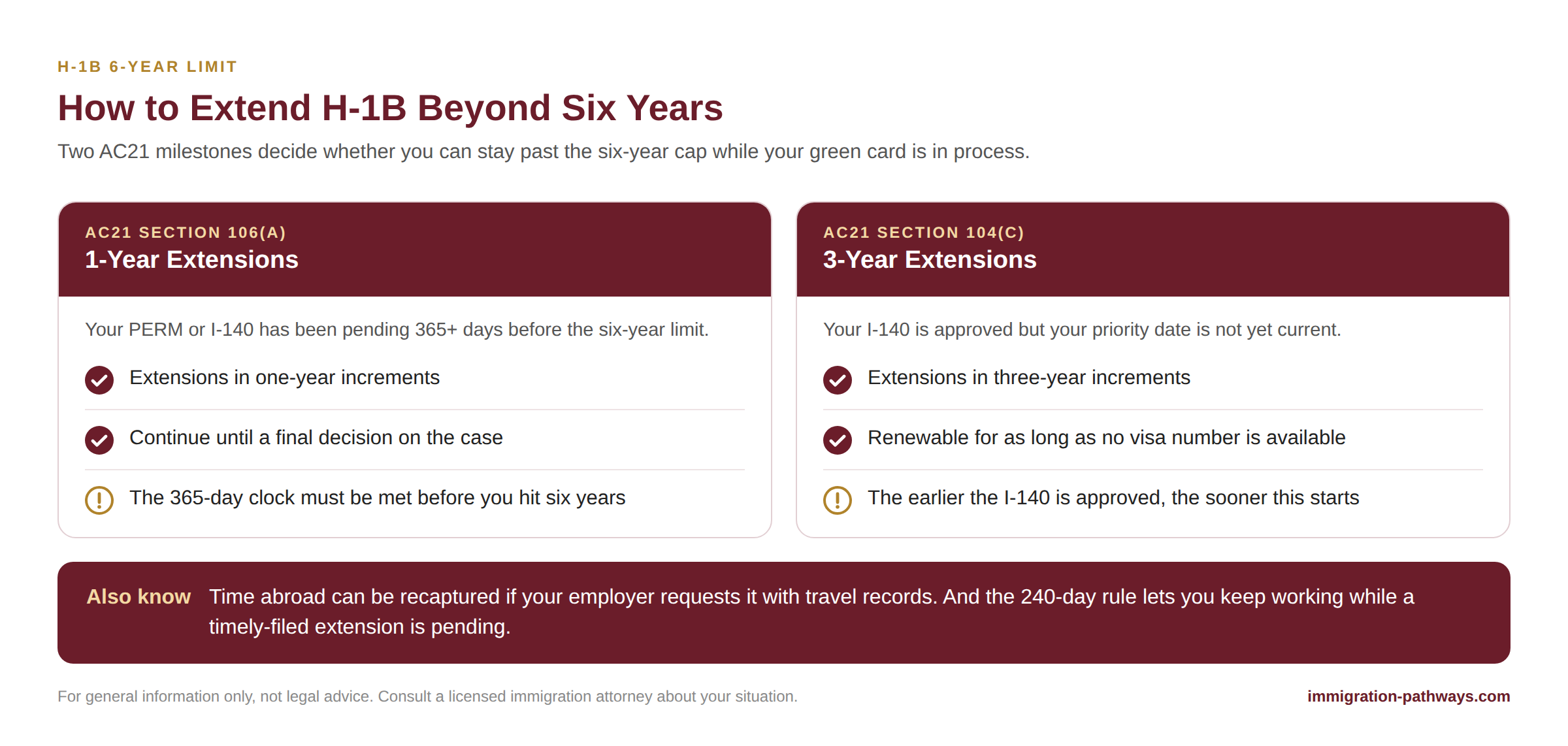
Milestone 1: The PERM or I-140 has been pending for 365 days, AC21 Section 106(a). If the PERM or I-140 has been pending for 365 days or more prior to the expiration of the six-year period of H-1B, then extensions beyond the six years are possible for as long as the application has not been denied finally and irreversibly.
Milestone 2: I-140 Approved; Priority Date Not Current; AC21 Section 104(c). If an I-140 has been approved and the priority date is not current in the Visa Bulletin, unlimited three year H-1B extensions beyond the six years cap are possible.
What this implies for the process of planning. The sooner the I-140 is approved, the sooner three-year extension eligibility begins. For Indians who will have to wait many years before getting their priority date current, the I-140 approval cannot be considered as a milestone in itself but marks just the beginning of their ability to extend H-1B. This is one of the reasons why I-140 filing is the most important thing an H-1B holder can do, even if he will not get his priority date current for many years.
Time Recapture
The time spent abroad during H-1B period is usually not counted toward the six-year limit and can be recovered. Recapture does not happen automatically. It must be affirmatively requested by your employer in the H-1B extension petition, supported by documentation of the specific days claimed, passport entry and exit stamps, I-94 arrival and departure records, employer travel records, and airline itineraries where available. Document all international travels during your H-1B period as they happen, note the exact departure and return dates, and keep the supporting records together. It will be much harder to document international travel after five years of H-1B than it was in the first year, and days claimed without matching documentation are simply excluded from the calculation rather than flagged for you to fix.
The 240 Day Rule
In case of filing of extension application before expiry of I-94 validity, individual can work even beyond expiry of I-94 till 240 days from its expiry date if extension of visa petition has been filed prior to expiry of I-94, not after that.
Protecting Your Priority Date Through Employer Changes
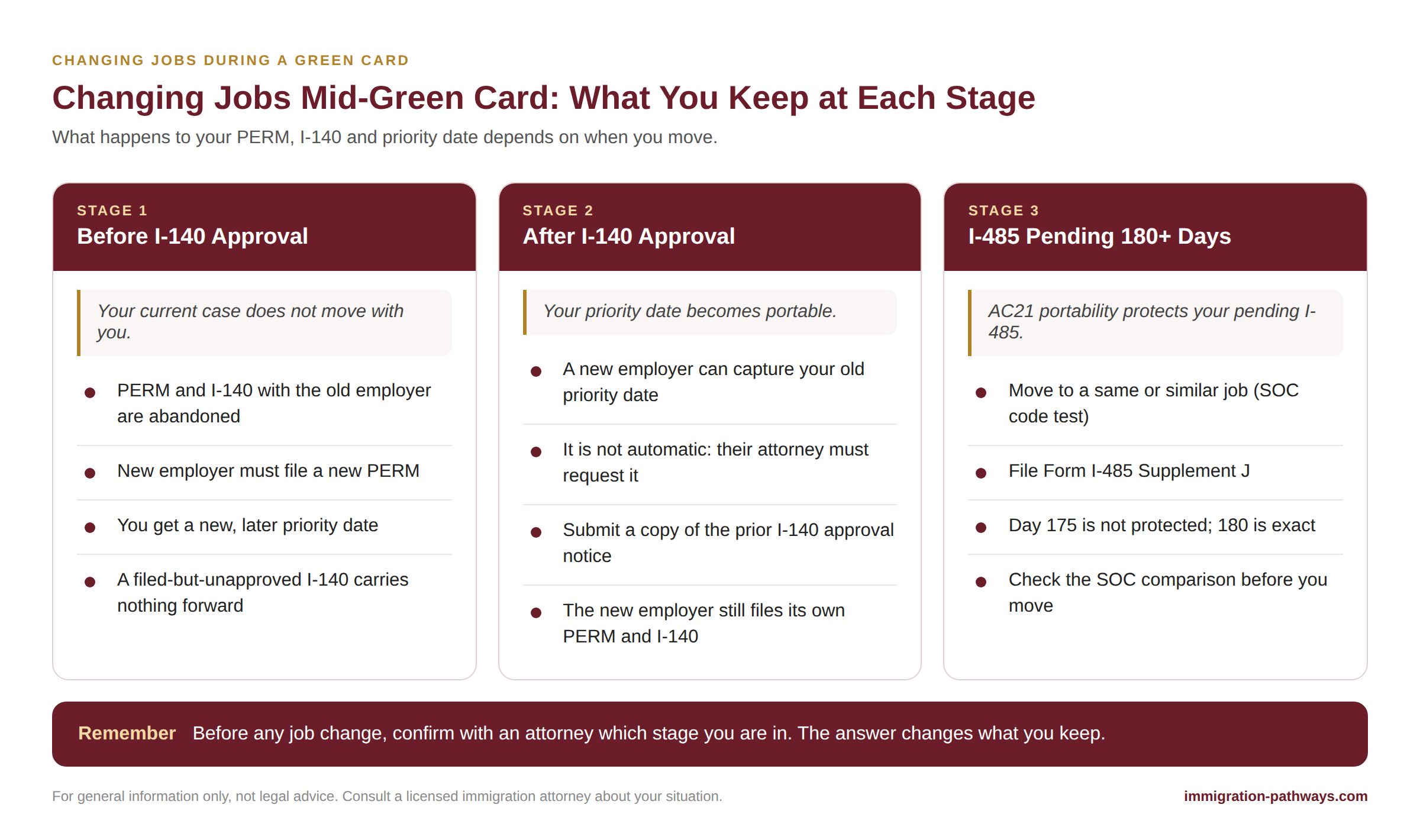
What many people do not know regarding the H-1B to green card process is what happens to the green card application if the employee changes employment.
Prior to I-140 Approval
Should you change employers before the I-140 is approved, then the PERM application and the I-140 application by the previous employer become abandoned. In such circumstances, the new employer will have to file another PERM application with a new filing date as well as a new priority date. The governing standard here requires an actually approved I-140 from the prior employer, not merely one that was approvable. A new employer can capture the earlier priority date only if that prior I-140 was genuinely approved by USCIS. An I-140 that was filed but never adjudicated, or one that was filed and then denied, carries no priority date forward, there is no approved petition for a new filing to reference. This does not happen automatically even when the prior I-140 was approved, it must be specifically requested by the new employer's immigration attorney, generally by submitting a copy of the prior approval notice as evidence. Talk to an attorney before assuming either outcome.
After I-140 Approval, Prior to I-485 Filing
After the approval of the I-140, the priority date becomes portable. Therefore, a new employer may be able to use it in his/her own I-140 petition. This does not take place automatically. Rather, it needs to be requested of the immigration attorney representing the new employer.
After 180 Days of I-485 Pendency, AC21 Portability
Provided that your I-485 is pending for more than 180 days and I-140 is approved, you are eligible for changing employers and still retaining your I-485 adjustment of status application and priority date without any problems in the same or similar occupational classification. USCIS makes this same or similar determination using Standard Occupational Classification, SOC, codes, comparing the SOC code tied to your original position against the SOC code that best describes your new one. This is a real classification exercise, not a gut check, and it is not automatic just because both roles sit at the same company or in the same general industry. A software developer moving into an engineering management role, for example, may or may not satisfy the same or similar test depending on how USCIS classifies the new role against the original SOC code. Assuming any role at a similar type of company automatically qualifies is a mistake that can result in your I-485 being denied on portability grounds. Verify the SOC code analysis with counsel before making a job change after day 180, not after the move.
On the paperwork itself. You do not simply notify USCIS of the change. Form I-485J, Supplement J, is the formal document on which USCIS makes its AC21 portability determination, and the same or similar SOC classification standard above is what it actually evaluates, not a formality to check off. Supplement J is submitted either concurrently with the I-485 if the job change happens before filing, or in response to an RFE or interview request asking USCIS to confirm continued eligibility.
A period of 180 days is accurate. If you are working on day 175 and switch your job, then you do not have portability rights. But if you are working on day 185 and switch your job, then you do have portability rights provided that the new job is in the same or similar occupational classification.
I-140 Withdrawal by Employer
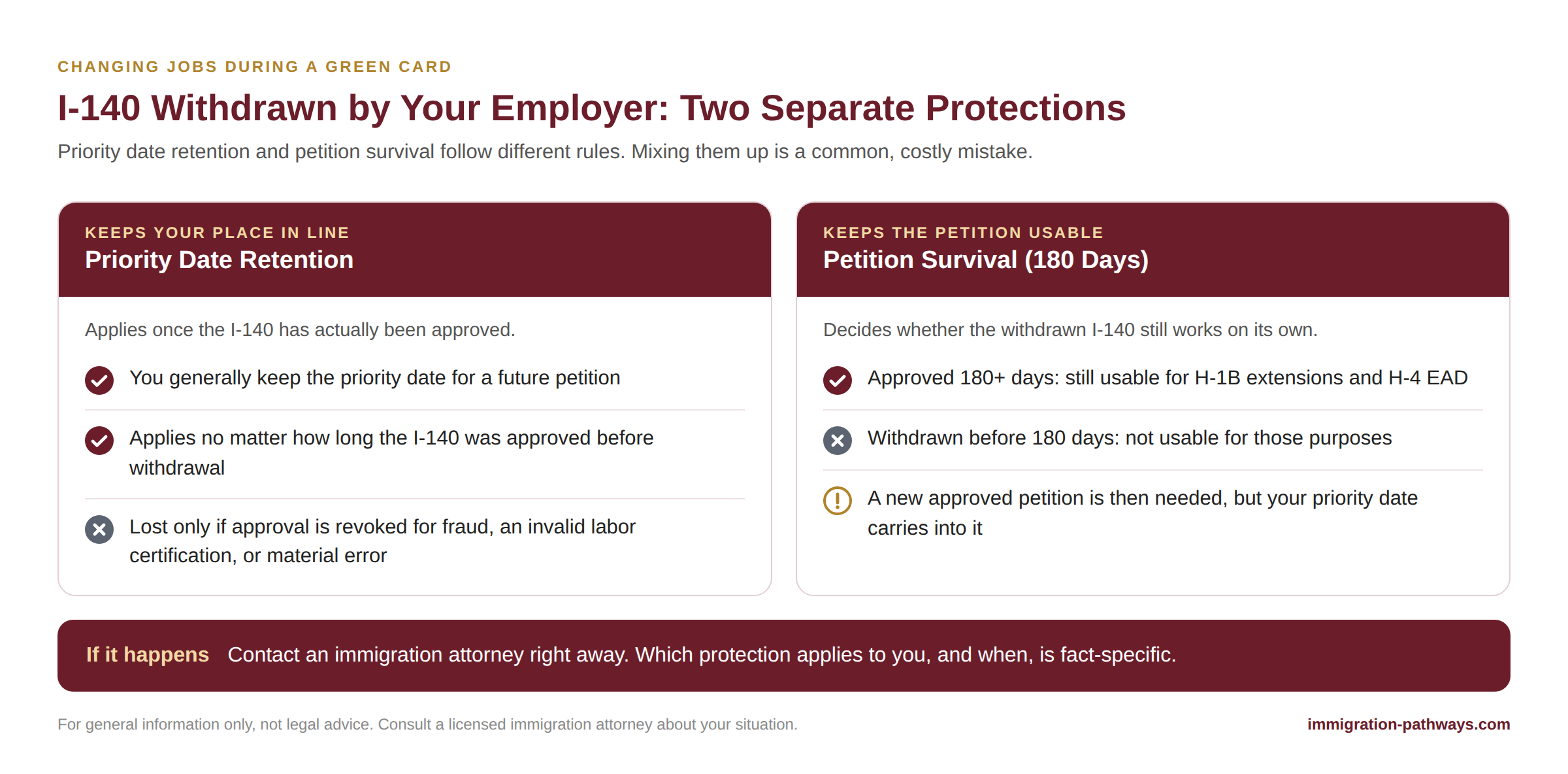
The employer may also revoke a petition that has been approved. It is worth separating two distinct rules here, since they are easy to conflate and protect different things. Priority date retention is the broader rule, once an I-140 is genuinely approved, the priority date it establishes is generally retained for a future petition regardless of how long that I-140 had been approved before any withdrawal, unless the approval is later revoked on specific substantive grounds such as fraud, a revoked or invalidated underlying labor certification, or material USCIS error. A simple employer withdrawal is not on that list. Petition survival, separately, is what the 180-day mark actually controls, whether the specific withdrawn I-140 itself remains usable on its own, for things like H-1B extensions or H4 EAD eligibility, without first needing an entirely new petition filed and approved. If an employer withdraws an I-140 that has been approved for 180 days or more, that petition generally continues to be usable for those purposes despite the withdrawal. If withdrawn before the 180 day mark, that specific petition is generally treated as invalidated for those purposes, and a new qualifying petition would need to be approved before extension or H4 EAD eligibility based on it resumes, even though the priority date itself is still yours to carry into that new petition. If your employer revokes an I-140, seek legal advice at once, since which of these two protections applies to your situation, and when, is a fact specific question.
Protecting Your Status During the Wait
Waiting for the next priority date can take years or, in certain categories and for certain countries, decades. In that period of time, quite a few things can happen that are unrelated to the Visa Bulletin.
Expiration of EAD. When filing I-485, you should file I-765 if your EAD will expire because of an extended retrogression. EADs don't automatically renew. An interruption of work authorization means that you won't be authorized to work even while your EAD renewal is being processed.
Traveling without advance parole. Filing I-485 and traveling abroad without advance parole, I-131, approval generally means abandonment of the I-485. Apply for advance parole when filing I-485. There is an important exception worth knowing, not just a passing mention: if you hold a valid, unexpired H-1B visa stamp, you may be able to re-enter the U.S. after travel using that stamp instead of advance parole, without abandoning your pending I-485, provided you remain in H-1B status and are returning to work for the same H-1B sponsoring employer. This is genuinely useful in an emergency, a family situation abroad where advance parole approval would take too long to arrive, but it is fact specific: using the H-1B stamp instead of advance parole to re-enter means you are not using advance parole for that trip, so confirm your specific situation, including your visa stamp's validity and your intended employer on return, with an attorney before you travel, rather than assuming this applies by default. It doesn't apply to all situations.
CSPA for Aging Out of Children. In case the child falls under the category of derivative beneficiaries listed under your visa petition and is about to be 21 years old while waiting, there is a formula under the Child Status Protection Act that can help retain his/her eligibility, but time is limited and, once missed, there is no second chance for recovery. If you have any child who is close to two to three years of becoming 21 years old, talk to an attorney.
The Compelling Circumstances EAD. If you are an EB-1, EB-2, or EB-3 worker with an approved I-140, in a lawful status as E-3, H-1B, H-1B1, L-1, or O-1, you have not filed the I-485 application yet, and your priority date is not yet current, there might be a possibility of obtaining a Compelling Circumstances EAD based on a USCIS determination of your particular situation being compelling enough. It is an optional form of immigration relief that lasts for one year and is renewable in order to protect immigrant workers from being forced to leave the country due to job loss or similar hardships while on their way to getting a green card. Very few people who are in the process know about its existence.
Cross Chargeability. A Strategy That Can Change Everything
In case you and your spouse were born in two different countries, and if your country of birth faces a Visa Bulletin backlog that is severe, you can take advantage of your spouse's country of birth for chargeability if both of you file together and your spouse is considered a qualifying derivative beneficiary.
A real-life example. An individual who was born in India and is applying under EB-2 visa category and his/her spouse was born in some other country like Germany and also holds the EB-2 category, the couple can use the country of birth of spouse rather than India for their chargeability purpose, since EB-2 category from India is marked as "Unavailable".
Important facts. The two spouses must file together. Also, the spouse must be a qualifying derivative beneficiary. The cross chargeability is not applicable to previously filed cases. It needs to be properly prepared prior to filing. Consult your lawyer about this issue at an early stage of process.
Choosing the Right Route. A Decision Framework
Question 1. What is your country of birth?
However, should you be from outside India and China, rest of the world, then the regular PERM-based EB-2 and EB-3 process, although lengthy because of the PERM process, will provide you with a green card in a reasonable period of time. Although an evaluation of either the EB-1A, EB-1B, or NIW route may still be worth considering for quicker options and employer independence, the need is less urgent.
Should you be from India, the regular PERM-based EB-2 and EB-3 process will face the worst bottleneck situation in the whole system with both being unavailable for the remaining part of the fiscal year, as well as the categories having multi-decade projected waits after they reopen. The key decisions that you must consider making are filing PERM now to ensure that you have the earliest priority date, evaluating whether EB-1A or EB-1B would qualify for you given their faster visa bulletin position, filing NIW alongside in order to establish employer independence and priority date, and evaluating cross-chargeability if your spouse is born in a different country.
If you are China-born, the period is shorter than India but still stretches several years in most EB-2 and EB-3 cases. Historically, EB-1A visa has been easier for China-born people compared to India-born people due to their backlog positions.
Question 2. Is it possible for your employer to begin PERM process now?
Ask directly and specifically, can we begin the PERM process this quarter, and not generally will you sponsor my green card? Some employers have unofficial policy of waiting a certain period before beginning PERM process. Knowing where you stand helps you make plans accordingly. Each month that you delay in beginning PERM is a month that you add to the Visa Bulletin wait period.
Question 3. Does your profile support EB-1A, EB-1B, or NIW?
EB-1A self-assessment. Have you received sustained national or international recognition in your field, evidenced by publications with citations, selective awards, invitation-only judging at reputable locations, media attention by independent reporters, or other forms of external validation? Would you be able to make a reasonable case for being in the tiny group of best professionals in your specific field? If the answer is "not yet," do you see how you could develop such a record within the next 12 to 18 months?
EB-1B self-assessment. Do you hold, or could you obtain, a tenured or tenure track teaching position, or a permanent, non fixed-term research position, at a university, research institution, or qualifying private employer? Is your work internationally recognized as outstanding within your specific academic field, even if it falls short of the sustained acclaim EB-1A demands? If your role and recognition fit, and your employer is willing to sponsor, EB-1B skips PERM entirely and shares EB-1A's faster Visa Bulletin position.
NIW self-assessment. Is your research in the field of national significance, like AI, semiconductors, healthcare, energy, cybersecurity, infrastructure? Are you having an impact outside of your company, citations, adoption, governmental funding, investors' recognition? Can you list three or more independent people who would agree to write strong recommendation letters on your achievements?
If the answer to any of those questions is positive, following both that path and your employer-sponsored PERM process in parallel is usually the correct approach.
Question 4. Are you approaching the H-1B six-year cap?
The most crucial factor in your immigration situation is if you are less than two years away from the six-year cap, and you have not received an approved I-140 yet. In order to obtain the extensions, you should either have a PERM that will be pending for at least 365 days before you reach the cap, which gives one-year extensions, or an approved I-140 before you reach the cap, giving three years extensions.
Comparison Table. All Routes Side by Side
The Recommended Strategy for Most H-1B Holders
Unlike choosing one option and ignoring the others, most H-1B beneficiaries need an all-of-the-above strategy, within the limits of what they can actually afford. That financial constraint deserves to be stated plainly before the layers below, since it changes which of them are realistic for a given reader.
The layered approach has a real cost, and it is worth doing the arithmetic before committing to it. A PERM based I-140 is typically employer paid, though not always. An NIW I-140 is typically a self-petition the employee pays for, commonly $5,000 to $12,000 or more in attorney fees. An EB-1A I-140 runs similarly, commonly $5,000 to $12,000 or more. A worker pursuing PERM, NIW, and EB-1A at the same time can be looking at $10,000 to $25,000 or more in out of pocket legal costs before any Visa Bulletin wait even begins, on top of government filing fees. For someone earning a mid six figure salary while carrying student loan or rent obligations in a high cost city, that is not a footnote, it is a central constraint on which of the layers below are actually feasible right now versus something to phase in as finances allow.
Layer 1, start PERM process immediately if your employer agrees to sponsor. This secures for you the earliest possible priority date in EB-2 and EB-3 categories. Even with an extended wait period, this priority date is the most reliable immigration currency you have. Every month you delay gives one more month to wait in an already long line.
Layer 2, consider filing NIW if your situation and budget allow for it. By filing NIW you create another I-140 application and priority date that are entirely independent from your employer. For the price of an additional petition, I-140 filing fee and attorney fee, you buy yourself employer independence and potential advantage in obtaining priority date.
Layer 3, prepare for an EB-1A or EB-1B petition if you have sufficient evidence base. Those 12 to 18 months of waiting for PERM process to clear the DOL queue are also 12 to 18 months you can use to create your evidence base, citation record and get independent recognition that will allow you to file an EB-1A petition later, or, if you are in a qualifying academic or research role, to confirm your EB-1B eligibility with your employer.
Layer 4, discuss cross chargeability at an early stage. In case your spouse originates from a country with a shorter or non-existent backlog, bring up the topic of cross chargeability before both of you file individually for I-485 status.
Layer 5, take into account the timing of the H-1B cap. Find out when you hit your cap limit of six years, what needs to happen before then and whether it makes sense to go with premium processing of the I-140.
Post Filing; What Happens After I-485
Almost all of them leave off the process at I-485 application. Below is what should happen realistically next.
1. Notice of receipt for the applications submitted, I-485, I-765, and I-131, will take about 2 to 4 weeks to receive
2. Biometrics appointment. For adjustment of status applicants specifically, this remains mandatory under current USCIS policy, USCIS updated its biometric reuse rules effective December 12, 2025, and explicitly excluded Form I-485, along with N-400, N-600, and I-90, from photo and biometric reuse, regardless of how recently you may have had biometrics taken for another filing. Plan to attend an in person Application Support Center appointment, timing varies by location
3. Employment authorization document and advance parole combo card, issued usually within several months of filing and allows both employment and traveling internationally
4. RFE if necessary, USCIS can ask for more information at any point, respond within the period specified on the notice that you received, usually 87 days
5. Interview, some employment-based I-485 applications do not need this, field office procedures differ
6. Green card issuance, notice of approval followed by physical green card sent by mail
An interesting policy change to note. On May 21, 2026, USCIS released Policy Memorandum PM 602 0199, clarifying that adjustment of status is discretionary in nature and is essentially an administrative grace and not a right for which applicants are eligible, instructing officers to consider the positives and negatives in the applicant's history prior to granting approval of I-485. USCIS has made clear that this memo applies to those applications already pending at the time of its issuance and does not affect the dual intent classification of H-1B and L-1 visa holders who file their I-485 application while being in non-immigrant status. For the majority of routine cases, there will be no difference in the result. However, if you have ever overstayed or engaged in unauthorized employment or have had other immigration problems in the past, discuss consular processing as a possible alternative to adjustment of status and consider documenting your positives, such as community ties and contribution, more extensively than before.
Summary Checklist. H-1B to Green Card
Regardless of which route you pursue
- Verify your country of birth and its standing in the Visa Bulletin in every preference category
- Determine your six-year H-1B cap date and what steps you have to accomplish before that
- Examine your I-94 expiration date rather than your visa stamp expiration date
- When your employer has not yet started PERM, inquire about when he will be able to start
For PERM based EB-2 or EB-3
- Check whether your employer is ready to initiate PERM
- Check whether there has been no change in your job description since your previous PERM petition
- Take note of the date DOL received your PERM filing, which becomes your priority date once I-140 is later approved, not automatically at PERM certification alone
- Consider using premium processing for I-140, which costs $2,965, at uscis.gov
- Follow the Visa Bulletin on a monthly basis, watching for both advancement and retrogression
For EB-1B, if you work in a qualifying academic or research role
- Confirm your position is permanent, tenure track or non fixed-term research, not a fixed term postdoctoral appointment
- Confirm your employer is willing to sponsor and file the I-140 on your behalf
- Gather evidence for at least 2 of the 6 outstanding researcher or professor criteria
- Compare this route against EB-1A and NIW rather than defaulting to NIW as the only self-petition style option
For EB-2 NIW, self-petition
- Assess yourself whether your area and body of evidence qualifies for the three prongs of the Dhanasar test
- Select at least three independent experts who would be willing to provide detailed letter(s) about your contributions
- Filing of Form I-140 to secure your priority date, despite the extended waiting period in the Visa Bulletin
- Determine if this priority date can be used in any future EB-1A petition
- Budget realistically, typically $5,000 to $12,000 or more in attorney fees for a self-petition, before deciding whether to layer this with EB-1A at the same time
For EB-1A, self-petition
- Check if you satisfy at least three out of the ten criteria based on strong external evidence
- Analyze if it is possible to satisfy the Final Merits Determination, rather than simply meeting the number of criteria
- Analyze if 12-18 months of purposeful accumulation of evidence will help strengthen the case significantly before filing it
- Confirm that the India EB-1 priority date is materially superior to your India EB-2 priority date
For all routes, protect your priority date
- If your I-140 is approved, confirm that your new employer takes on your old priority date before you start working elsewhere, and confirm the prior I-140 was actually approved, not merely filed, before assuming this is available
- If your I-485 has been pending for more than 180 days, confirm AC21 portability is available using the actual SOC code comparison, not just a same-company or same-industry assumption, before making a move
- If your current employer removes the I-140 petition, contact an attorney right away, and understand that your priority date and the petition's own usability for extensions are two separate questions with two different answers
Official Resources
- USCIS employment based immigration: uscis.gov/working-in-the-united-states/permanent-workers
- USCIS I-140 filing: uscis.gov/i-140
- USCIS I-485 filing: uscis.gov/i-485
- DOL PERM processing times: flag.dol.gov/processingtimes
- Visa Bulletin, current month: travel.state.gov, verify priority dates monthly
- USCIS Visa Bulletin Info, which chart is authorized: uscis.gov/visabulletininfo
- USCIS processing times: egov.uscis.gov/processing-times
Final Takeaway
The H-1B to green card journey in 2026 is defined by a stark divide between those born outside India and China, who can often complete the process in under five years, and India born professionals who face a category that has run out of annual numbers in EB-2 entirely and a multi decade projected wait through the standard PERM based route even once it reopens.
The most important decisions are not procedural. They are strategic, which route to prioritize, which to run in parallel within what you can actually afford, and when to invest in the evidence base that makes EB-1A, EB-1B, or NIW viable. Filing PERM now to lock in a priority date is almost always the right call. Evaluating whether EB-1A or EB-1B offers a materially faster Visa Bulletin position for your specific country of birth is the decision that can change the entire timeline.
The professionals who navigate this most successfully are not those who chose one route and waited. They are those who layered their options as their budget allowed, filed early, kept their H-1B extensions on track, and understood exactly where each piece fit in the sequence before anything went wrong.
All processing times, Visa Bulletin dates, and policy references are current as of early August 2026 and change frequently. Verify current information at uscis.gov, flag.dol.gov, and travel.state.gov before making any filing decisions. This article is not legal advice.