Laid Off on H-1B. Your 2026 Options, O-1, EB-1A, EB-2 NIW
Laid off on H-1B? How the 60-day grace period works, what happens to your I-140, H-1B transfer portability, and O-1, EB-1A or NIW options in 2026.
Vera Kenahan
October 23, 2026 · 20 min read

This information is provided for informational purposes only and should not be considered as legal advice. The dates, processing times, and USCIS policy regarding the Visa Bulletin change on a month-to-month basis and sometimes without prior notice. Unless stated otherwise, all the information contained herein is valid as of the Visa Bulletin dated August 2026. Please check up-to-date dates on travel.state.gov and uscis.gov before filing anything and consult an immigration attorney regarding your individual situation.
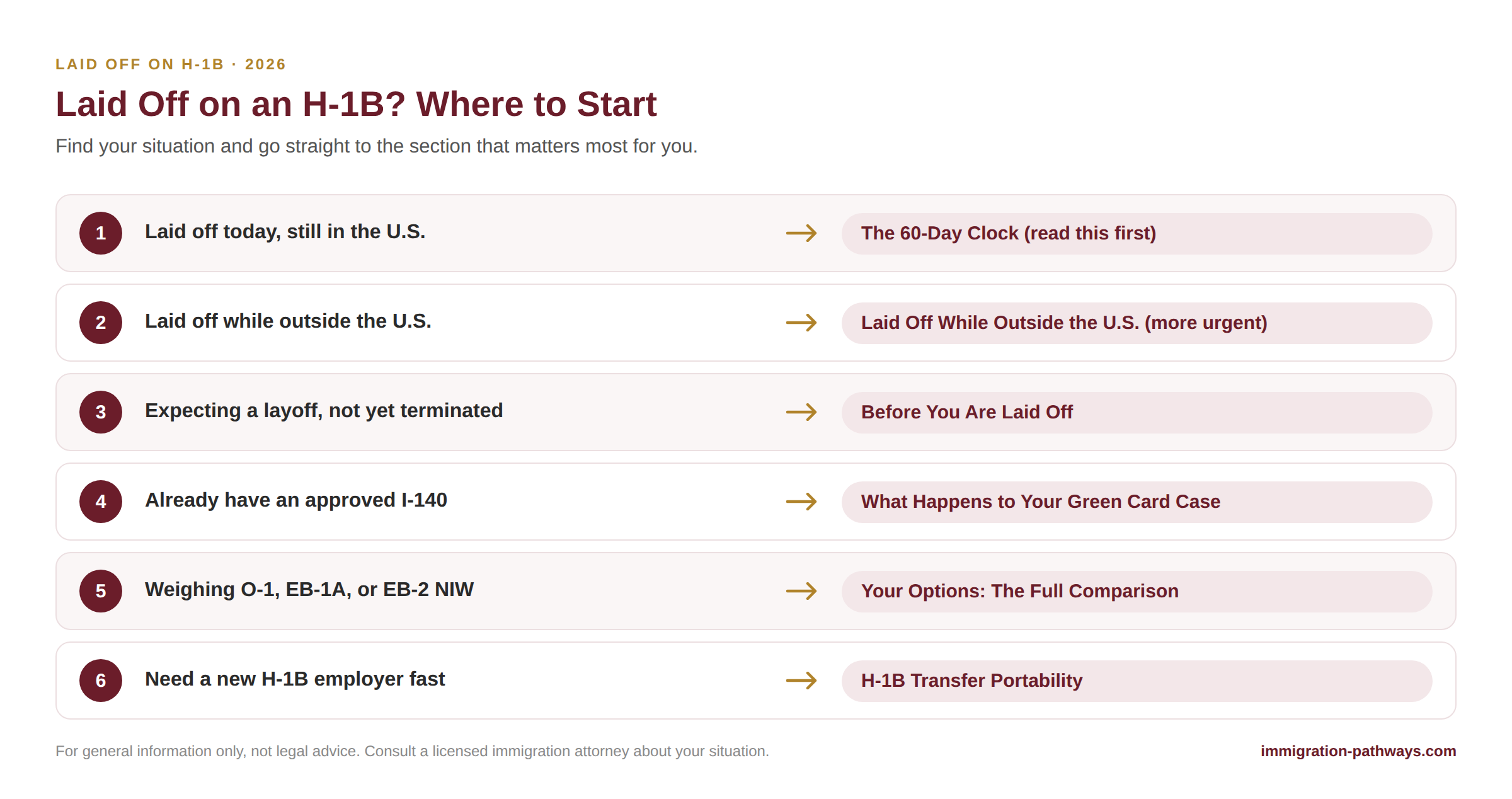
Start Here. Which Situation Are You In?
The 60-Day Clock. What It Actually Is
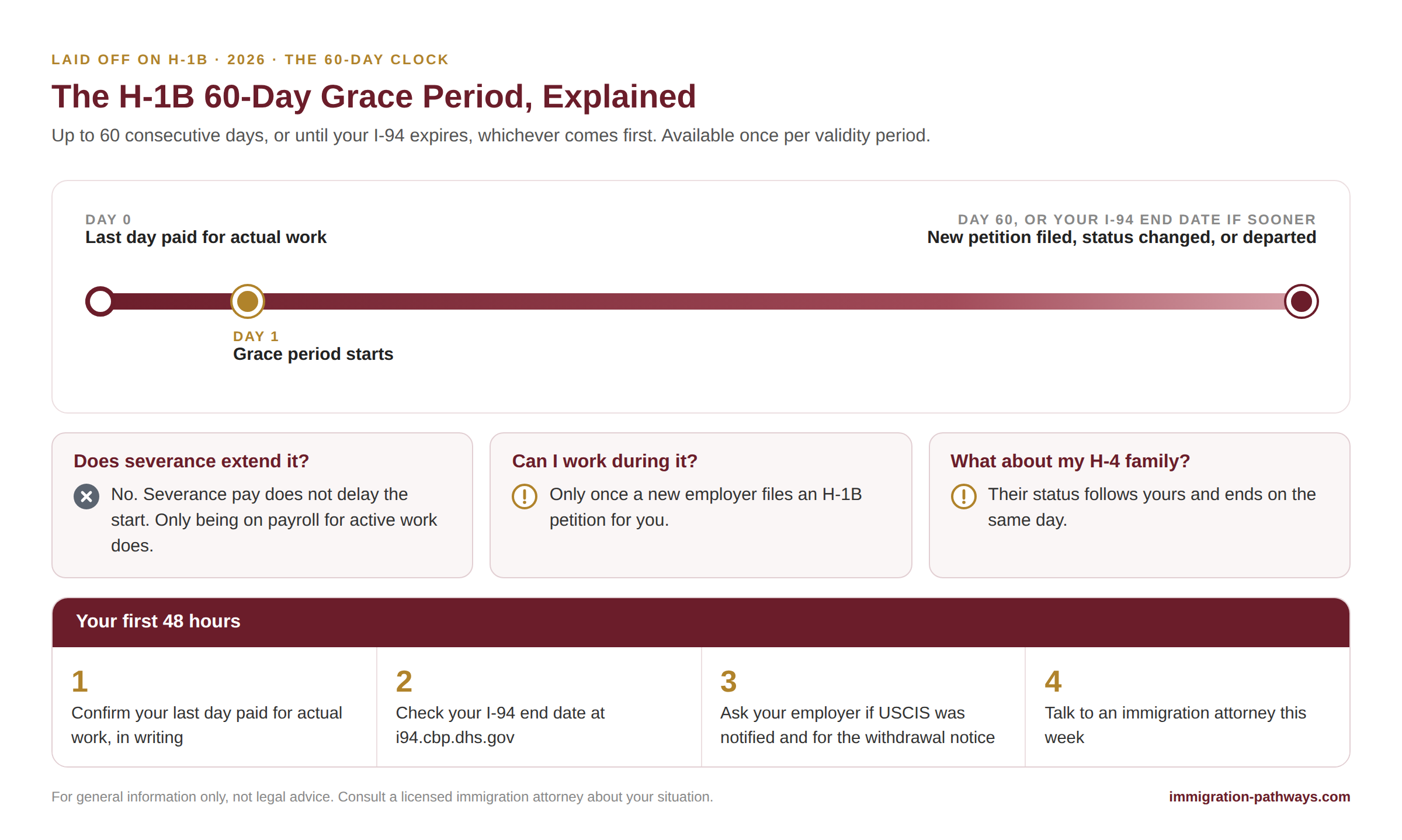
If your employment ends under an H-1B classification because of a layoff, termination, or voluntary resignation from employment, it does not mean that you automatically lose your status. There is a discretionary grace period under federal regulations that is good for up to 60 consecutive days or until the expiration of your validity period as indicated on your I-94 record, whichever comes first.
Grace Period: What You Need to Know
- The period starts the day after your last day of employment, and this is the point most laid off workers with severance get wrong. USCIS's own standard is that the grace period begins the day after the last day for which a salary or wage was paid for actual work performed, not simply notice or intent to terminate. The critical distinction is what counts as pay for actual work versus severance. A continuing severance payment, whether it is two weeks, one month, or three months, is compensation for the loss of your job, not payment for ongoing work, and it does not push your grace period start date later. If your employer lays you off today and pays out a 90 day severance package, your 60-day clock started today, not in 90 days. The one genuine exception is if you remain formally employed and on payroll during a period where the employment relationship itself is still active, such as a WARN Act notice period where duties are winding down but you have not yet been separated, in which case the grace period has not started because the relationship has not ended yet. If you are unsure which situation you are in, confirm your exact last day of active employment with HR in writing rather than assuming severance buys you more time
- It is available only once for every authorized validity period
- It is intended to give you the time to find a new sponsor or change your status or leave the U.S.
- It does not authorize you to work. The grace period does not allow you to work unless you have an H-1B petition filed by a new employer. See below
The grace period is available only if you are physically in the U.S. at the time you cease employment; if you are abroad, it does not apply to you in the same way. See section "Laid Off Abroad"
Your case status on the USCIS website may seem perfectly normal even though you have received your case status. It
does not mean that everything is alright as the case status is related to your petition but not to your immigration status.
First 48 hours:
1. Establish the precise day of your last day of paid work for actual employment, not merely your last paycheck date if severance is involved, this is your countdown start date
2. Check your I-94 expiration date on i94.cbp.dhs.gov, your grace period expires either in 60 days or on your I-94 expiration, whichever happens earlier
3. Find out from your former employer whether the USCIS has been informed about your termination and ask for a copy of the notice of withdrawal
4. Consult an immigration lawyer, this step is crucial and should not be put off
If you have an H-4 dependent, their clock is tied to yours, and this deserves its own attention, not an afterthought. H-4 status is derivative of the H-1B principal's status, which means your spouse and any children on H-4 generally remain in valid status for as long as you remain within your grace period, and their status lapses at the same time yours does if no transfer or change of status is secured by day 60. If your spouse holds an H-4 EAD, that work authorization rides on the same chain, it depends on your maintaining status and, further back, on the underlying I-140 approval remaining valid. If you find a new H-1B sponsor and a transfer petition is filed in time, your spouse generally does not need to file anything new to keep an already valid H-4 status and EAD, though if their own H-4 validity period is separately expiring soon, coordinate that renewal alongside your transfer rather than treating it as unrelated. Build your dependents into the same 60 day timeline you are building for yourself, not as a separate problem to solve later.
What Happens to Your Green Card Case
In case your employer has already filed an I-140 for you, the chances are usually better than what one would think.
If your I-140 is approved. In case your I-140 is approved, it normally remains valid after your departure from the filing company. Your I-140 is not automatically invalidated due to termination of employment, but the employer can withdraw it, more details down below. In case your I-140 has been approved for more than 180 days, you may reach the point of being protected by job portability rules according to AC21 even without filing an I-485 yet.
In case your I-485 has also been filed and is pending for 180 or more days. Portability of AC21 allows you to transfer to another company within the same occupational category, without having to lose your queue place.
The same or similar test is a real classification exercise, not a general impression. USCIS evaluates whether your new role is in the same or similar occupational classification by comparing Standard Occupational Classification, SOC, codes, the code tied to your original position against the code that best describes the new one. A software engineer moving into an engineering management role, for example, may or may not clear this test depending on how USCIS classifies the new role. Do not assume that any technology role at a similarly sized company automatically qualifies, asserting portability that USCIS does not agree with can put your I-485 at risk. On the paperwork itself, Form I-485J, Supplement J, is the document on which USCIS actually makes this determination, and it is not something you simply file the moment you change jobs as a courtesy notice. It is typically submitted either proactively when the change happens or in response to an RFE or interview request where USCIS specifically asks you to confirm continued eligibility. This is probably one of the most important rights of employment-based immigration. Most laid off immigrants aren't even aware of this!
If only the I-140 has been approved, and no I-485 yet. You may be able to keep your priority date and use it in a new employer's I-140 petition, but the standard here is stricter than it might sound. Your original I-140 must have been actually approved, not merely approvable at the time it was filed. A prior I-140 that was submitted but never adjudicated, or one that was filed and later denied, does not transfer a priority date, there is no approved petition for the new filing to reference. Assuming an unapproved but well documented petition counts the same as an approved one is a mistake that can cost you your priority date entirely. There's nothing automatic about this even when the prior I-140 was genuinely approved. It's you or your new employer's immigration attorney who needs to make sure the priority date will be used in the new filing, generally by submitting a copy of the prior approval notice as evidence. Don't rely on your new employer's HR department to take care of this for you.
If your employer withdraws the I-140. Withdrawal doesn't undo any history, but it makes things more complicated procedurally, and the actual rule here is more precise than a vague case-by-case standard. There are two separate protections worth knowing, not one. First, priority date retention, once your I-140 was genuinely approved, the priority date it established is generally retained for a future petition regardless of exactly how long it had been approved before the withdrawal, unless the approval was revoked on specific grounds like fraud, a revoked labor certification, or material error, an ordinary employer withdrawal is not on that list. Second, and separately, petition survival, this is where the 180 day mark actually matters, an I-140 that had been approved for 180 or more days before the employer withdrew it generally remains usable on its own for things like H-1B extensions or H4 EAD eligibility without a new petition first being approved. If it was withdrawn before that 180 day mark, that specific petition is generally treated as invalidated for those purposes, even though your priority date is still yours to carry into a new petition once one is approved. Check with your attorney on which of these two protections applies to your particular timing.
H-1B Transfer Portability. The Fastest Path Back to Work Authorization
This is one of the most essential things that you need to know if you want to go back to work faster.
You do not need USCIS approval to start working for a new company. As soon as a new employer files an H-1B transfer petition, Form I-129, in your favor, you will be authorized to start working for the new employer even while the petition is still under review by USCIS.
Requirements
- You should be in lawful H-1B status or within 60-day grace period at the time the new petition is filed;
- You must have been counted against H-1B cap limit previously, most H-1B visa holders fall into this category;
- The petition should be legitimate and not just a placeholder.
How this works in practice. You need to find a new employer willing to sponsor you for H-1B within 60 days and file the H-1B transfer petition before day 60 of grace period, then you can start working as soon as the petition is filed, not approved.
Not the legal process but the time frame is the challenge. Securing a new employer for your H-1B visa who can give you an offer letter and then have them draft a transfer petition within the time span of 60 days can be a difficult task to do, especially when the job market is sluggish. It should be started on the same day that you are fired.
Laid Off While Outside the U.S. A Different and More Urgent Situation
If you are physically outside the U.S. when your H-1B employment expires, your circumstances are considerably less favorable than those of someone who is laid off while inside the U.S.
The grace period does not offer you the same protection. The USCIS has expressly confirmed that, if an H-1B employee is physically outside the U.S. at the time of their termination of employment without any notice period or whose notice period expires before he/she can enter the country, the grace period does not apply and the person must find another immigration status under which they can reenter the country. If you are able to reenter the U.S. before the expiration of your employment contract, the discretionary grace period can be extended to you as well. The end result is the same. It is much better for you if you were laid off inside the U.S.
Does a new employer sponsor you from overseas? Yes, technically, they can file an H-1B transfer petition. However, you cannot enter the United States with an approved H-1B transfer petition until it becomes approved with a visa stamp that shows the new employment. Considering the current stamping availability situation, the five U.S. consulates in India, for instance, do not show any H-1B stamping appointments even up to 2026, according to multiple immigration law firms tracking consular appointments, and the earliest available date being around May 2027, this means it can take 12-18 months or more before you can return to the United States.
This is the cause for the current H-1B visa crisis affecting thousands of employees. People who went overseas to attend weddings, family events, or emergencies and lost their job while they were overseas find themselves having no way to return anytime soon. This applies to you if you are in this situation. Consult an immigration lawyer right now as there are many other factors involved in your case and the timing.
Your Options. The Full Comparison
If you cannot find a new H-1B sponsoring employer within your grace period, or if you want a more durable long-term solution that does not depend on continuous employer sponsorship, here is how the realistic alternatives compare.
The plain truth, and the cost that goes with it. If you require income today, a new H-1B transfer or O-1 petition is your only solution. EB-1A and EB-2 NIW applications are green card solutions. They provide long term immigration security and preservation of the priority date, but they are not themselves your work authorization solution for tomorrow. Many displaced workers choose to combine both, a quick solution through an H-1B transfer or O-1 and then a filing of either EB-1A or EB-2 NIW for eventual freedom from dependency on one employer. Before committing to that combined approach, it is worth being honest about what it costs while you are simultaneously losing your income. Attorney fees run roughly $2,000 to $5,000 for an H-1B transfer, $3,000 to $8,000 for O-1, and $5,000 to $12,000 or more each for NIW and EB-1A as self-petitions. Pursuing all of these at once, on top of losing your paycheck, can mean $15,000 to $35,000 or more in combined legal fees at exactly the moment your income has stopped. The sequencing below reflects both legal logic and financial reality, the H-1B transfer or O-1 is the immediate income solution and should come first, NIW and EB-1A are medium and long term investments that should be prioritized based on what you can actually afford to pursue at the same time, not treated as a package deal everyone should attempt simultaneously.
Option 1, O-1 Visa, If You Need to Work Again Quickly
O-1 is a non-immigrant visa for individuals with extraordinary ability in a field. It needs to have a sponsor that could be the employer or an agent but has no lottery process and no quota per year compared to H-1B.
Why it should be considered after being laid off
- No element of randomness involved; if you have a sponsor and satisfy the requirements, you are granted the visa
- Can be renewed indefinitely at intervals of one year, as opposed to H-1B that can only be extended for six years maximum
- Could be submitted not only by your employer, but by a consultant or agent
The legitimate catch. O-1A means having met 3 of 8 regulatory requirements in 8 CFR 214.2(o)(3)(iii), or 3 out of 6 for the O-1B in the arts, and successfully getting through the final merits test showing sustained national or international recognition. If you do not already have the required external documentation and accomplishments, building one from scratch is not a 60 days task.
When it is realistic for someone right now. Employees who have already gathered some of that evidence, senior engineers with patents or any kind of recognition in open source, researchers with citations, professionals with industry awards, and simply have not applied yet. If your documentation is weak, O-1 is a medium-term goal, not a quick fix after layoffs.
Option 2, EB-1A, Extraordinary Ability Green Card
EB-1A makes it possible for persons at the pinnacle of their field to apply individually for a green card without employer sponsorship, labor certification (PERM), or job offer.
Why this will matter when facing a potential layoff situation. Approval of EB-1A generates an immigration benefit which is entirely independent of any employer. Once the case is approved, the green card case will no longer depend on continued sponsorship, and you will no longer be in danger of losing your immigration status due to loss of employment.
The truth of the matter. This is the most rigorous evidentiary threshold for employment-based immigration in the United States. To qualify for this category, the applicant has to satisfy at least three out of ten criteria listed in 8 CFR 204.5(h)(3) and survive the ultimate evaluation proving your preeminence in your field of endeavor. Most professionals will not satisfy these requirements without extensive case preparation.
Timing issues with reality. Assuming approval, the EB-1A category does not resolve an immediate income issue. It is a green card petition and not a work authorization application. At this moment, EB-1 Final Action Date is at about July 2023 for China born individuals and about October 2022 for India born individuals, which means that even if the I-140 is approved, it will not lead to immediate green card issuance but will take less time than in EB-2 or EB-3 categories.
Applicability of the program as of today. The senior professional category, having external recognition and patents with licensing rights, significant citation records, industry leadership and recommendation letters that can be provided independently fits well. If you are at the early stage of career or you have mostly company-specific accomplishments, then this is a mid-term target to achieve and not a 60-day filing opportunity.
Option 3, EB-2 NIW, National Interest Waiver
EB-2 NIW is a green card route where there is no need for sponsorship by an employer or PERM as it involves proving that your work has great value and national significance to the US.
Why it is important when you are laid off. Similar to EB-1A, NIW provides a pathway to immigration that does not depend on one specific employer. The evidentiary bar is considerably lower compared to EB-1A, making NIW available to more professionals especially those working in AI, healthcare, climate, semiconductor, and other areas of national interest.
The truth about NIW. NIW is reviewed using the three-pronged Dhanasar criteria of having substantial merit and national significance, well positioned to make progress in this endeavor, and that waiving the job offer requirement is in the best interest of the US. A petition that only explains your profession but fails to tie it to the national level significance will be denied, even if you have many achievements.
Scheduling reality, and how wide the honest range actually is. As with EB-1A, NIW itself is not a job authorization. Regarding individuals born in India, EB-2 was declared Unavailable in the July 2026 Visa Bulletin and therefore cannot see any approvals issued until after October 1, 2026, due to exhaustion of visa numbers. Its Final Action Date was at around September 2013 prior to that, and the State Department indicated that it should re-open at about July 2014. The resulting wait for a new filer is genuinely uncertain and the range of credible projections is wider than a single figure can capture. Using the historical pace of movement, some projections land around 12 to 20 years. Using simple queue size arithmetic, older estimates put the figure at 50 years or more. The most current independent analysis available, published by the National Foundation for American Policy in August 2026, estimates the wait for an Indian EB-2 applicant whose petition is filed in January 2026 or later at up to 179 years, with the Cato Institute having separately projected figures in the 134 to 151 year range in earlier analyses using similar backlog based methods. The 12 to 20 year figure is the optimistic end of this range, not a central or typical estimate, and a reader making life decisions based on that number alone is planning around the best case, not the most likely case. Filing now can still be very meaningful by securing a priority date and creating flexibility, but go in understanding the honest range, not just its most comfortable number.
People who can make such filing realistically. Individuals working in strategically important areas for the country, such as AI, semiconductors, healthcare, cybersecurity, energy, with evidence of impact beyond their immediate employer, either in the form of patents, publications, system-scale metrics, or grant funding. Even modest evidence could help build a case if properly positioned with respect to its national significance.
A Realistic Combined Strategy
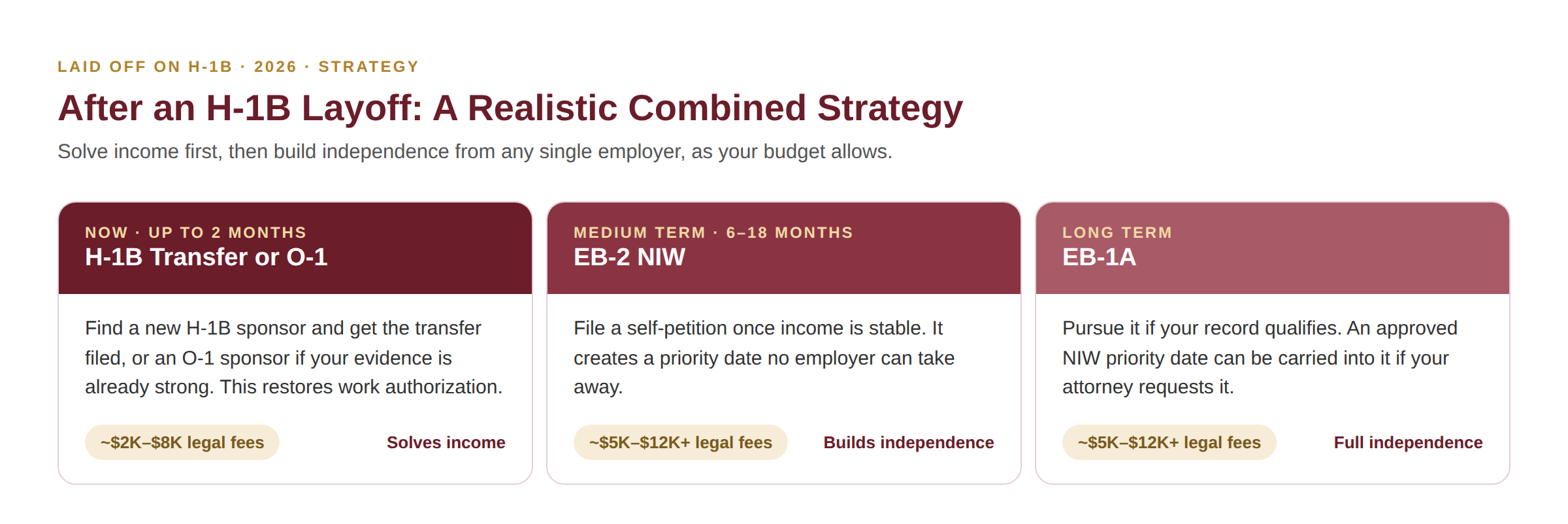
For the vast majority of laid off H-1B holders, it makes sense to pursue several tracks simultaneously since each of them addresses different concerns, sequenced according to what you can actually afford as your income situation changes.
Income gap in the short run, up to two months. Concentrate all your efforts on finding a new H-1B sponsor and initiating a transfer petition, or an O-1 sponsor if there is enough evidence for this category of visas. This is the cheapest and fastest track, and it should come first both because it solves the most urgent problem and because it is the one you can least afford to delay while other legal fees accumulate.
Independence in the medium-term run, 6-18 months. Start preparing or filing an EB-2 NIW case if your profession and evidence fit for that, and if your finances allow for a self-petition's attorney fees once your immediate income situation has stabilized. The NIW is easier to obtain than EB-1A and even though waiting for green card approval takes a lot of time, especially if you were born in India or China.
Security in the long run. If your case qualifies, pursue EB-1A track in parallel, once your financial footing allows for it. Once the EB-1A case gets approved, it will ensure your immigration status will no longer depend on any employer since this petition is not contingent upon an employer.
The Priority Date Stacking Approach. Even though you will apply for NIW now and qualify for EB-1A in future, you will benefit from carrying the priority date from your NIW application to EB-1A. This does not happen on its own. Exactly as with capturing a priority date between employers, the new EB-1A I-140 must specifically request to capture the earlier NIW petition's priority date, and your attorney has to take that affirmative step when preparing the EB-1A filing, it is not something USCIS applies automatically just because the two petitions share an applicant. Therefore, you do not lose anything by filing NIW application now and using it in future if EB-1A becomes your choice, provided the request to carry the date forward is actually made.
Before You Are Laid Off; What to Do If You See It Coming
If there are any indications of impending layoffs in your organization such as wide scale layoffs, restructuring or discussions regarding performance and job security, it is time to take action and not wait until the layoff actually happens.
- Come up with O-1 or NIW proof right away, when you still have your job, have access to your work product and recommendations from your manager and can think clearly about the issue
- Check with your employer about filing the I-140 if you don't have it and find out what your employer's intentions are in case of a layoff in the future
- Find 2-3 independent experts in your field who can provide a recommendation letter at short notice, it is always easier to do so when you don't have an emergency
- Know your numbers, your I-94 expiry date, H-1B petition expiry date, whether you have an I-140 filed and how long has your I-485 been pending
- Don't leave the U.S. if you are facing a layoff and don't have a valid visa stamp, it will be much worse for you if you get stranded abroad
What Not to Do
Do not make the assumption that your status portal accurately represents your current status. Your portal is not real-time and shows petition status, not your status validity.
Do not wait until day 55 to begin your search and contact a lawyer. Your grace period is shorter than you think, particularly when you factor in the amount of time it will take for a new employer's immigration attorney to file your transfer petition.
Do not travel outside of the country during your grace period, unless it is absolutely necessary and you can verify that you will be able to come back into the country. You will run into the additional problem of reentry if you are traveling outside the country while you do not have status anymore.
Do not take the word of a new employer that they will handle all of the paperwork on your behalf. Verify that the I-129 transfer petition has been filed. Do not let your emotions get the best of you after being laid off.
Official Resources
- USCIS H-1B Portability Information
- USCIS AC21 Portability
- USCIS O-1 Visa Overview
- USCIS EB-2 NIW Overview
- I-94 Record
- Visa Bulletin
- USCIS Processing Times
Final Takeaway
A layoff on H-1B is frightening, but it is not automatically a crisis if you act in the first days, not the last days, of your 60 day window. The grace period exists for a reason. H-1B transfer portability means you can start working again the moment a new employer files, not after approval. And if a new H-1B sponsor proves difficult to find quickly, O-1, EB-1A, and EB-2 NIW each offer a path that does not depend on any single employer ever again.
The right combination depends entirely on your specific evidence, field, country of birth, timeline pressure, and what you can actually afford to pursue at once. There is no universal answer, but there is a universal first step, confirm your dates, including where your dependents stand, contact an attorney, and start moving today.
All information reflects guidance current as of early August 2026. H-1B regulations, USCIS policies, and consular processing conditions change frequently. Verify all current requirements at uscis.gov before acting. This article is not legal advice.