Understanding the Visa Bulletin
How to read the Visa Bulletin: Final Action Dates vs. Dates for Filing, priority dates, C and U, retrogression, and how to check if you can file I-485.
Vera Kenahan
October 22, 2026 · 9 min read

The Visa Bulletin is a monthly U.S. Department of State publication that shows which green card applicants can move forward, based on their priority date, category, and country of birth. If your priority date is earlier than the date listed for your category and country, you can file Form I-485 or have your green card approved.
Disclaimer: This guide is for informational purposes only and is not legal advice. The Visa Bulletin is updated monthly by the U.S. Department of State and can change without notice. Your eligibility depends on your specific visa category, country of chargeability, priority date, and individual circumstances. Always verify current dates at travel.state.gov and consult a licensed immigration attorney before making any decisions.
What Is the Visa Bulletin?
The Visa Bulletin is a monthly publication by the U.S. Department of State that monitors when eligible applicants can take the next step toward a green card. If the applicant is inside the U.S., then it requires filing Form I-485 (Adjustment of Status). If you are outside the U.S. the next step is receiving an immigrant visa through consular processing.
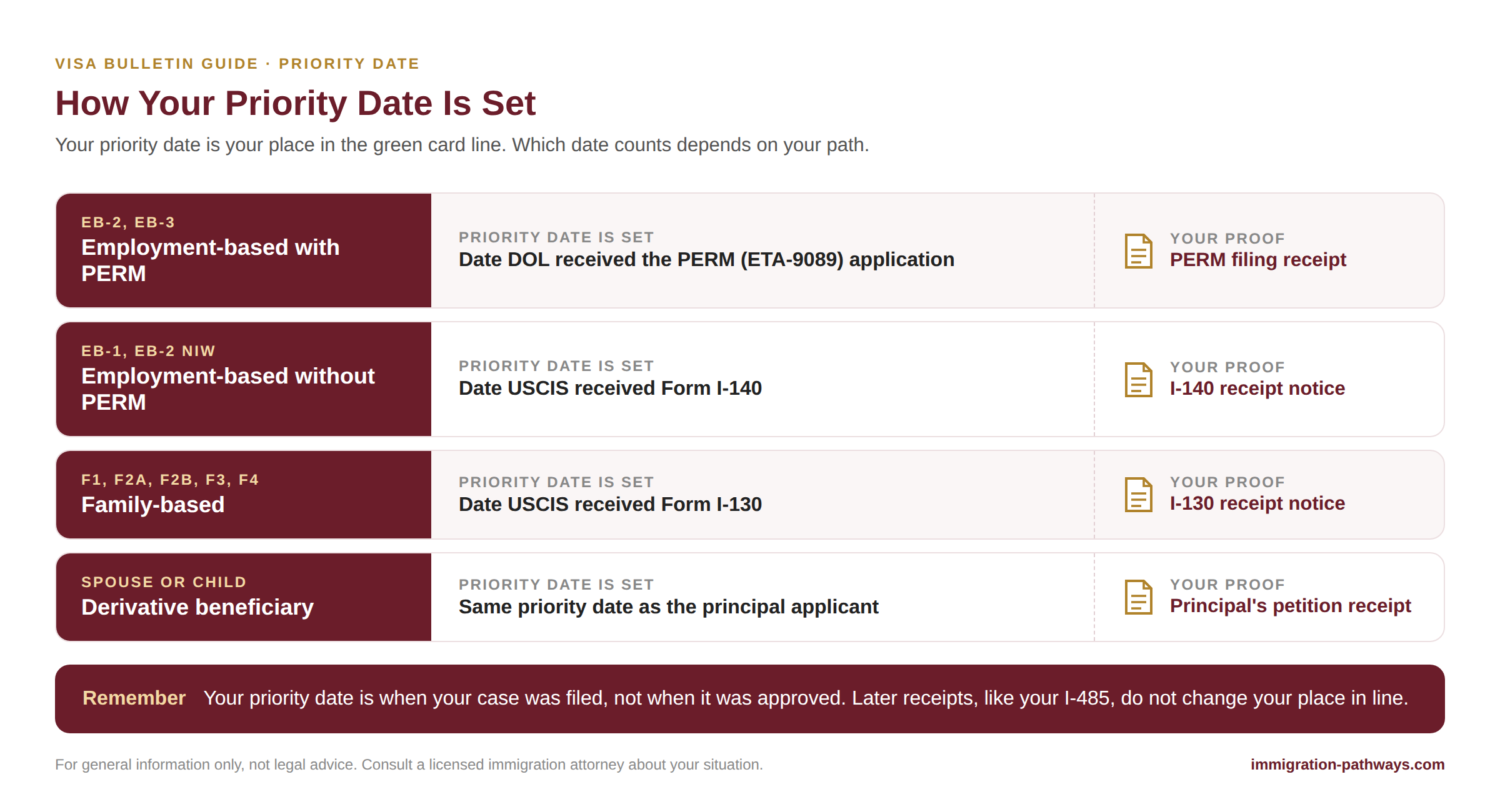
Your priority date determines your place in line for the green card and is usually the date your I-140 petition is filed with USCIS; If your case requires a labour certification then it is the date your PERM application is filed with the U.S. department of labour.
It’s important not to confuse your priority date with a receipt date. A receipt date simply reflects when USCIS receives a form or issues a receipt notice, including later filings like Form I-485. These later dates do not affect your place in line. Your priority date is set by your original petition whether its the I-130, I-140, or PERM filing. What matters is when your green card process officially began, not when it was processed or approved.
What the Visa Bulletin Controls
The Visa Bulletin governs two distinct actions. Understanding which applies to you is essential:
The Two Charts: and Why They Matter
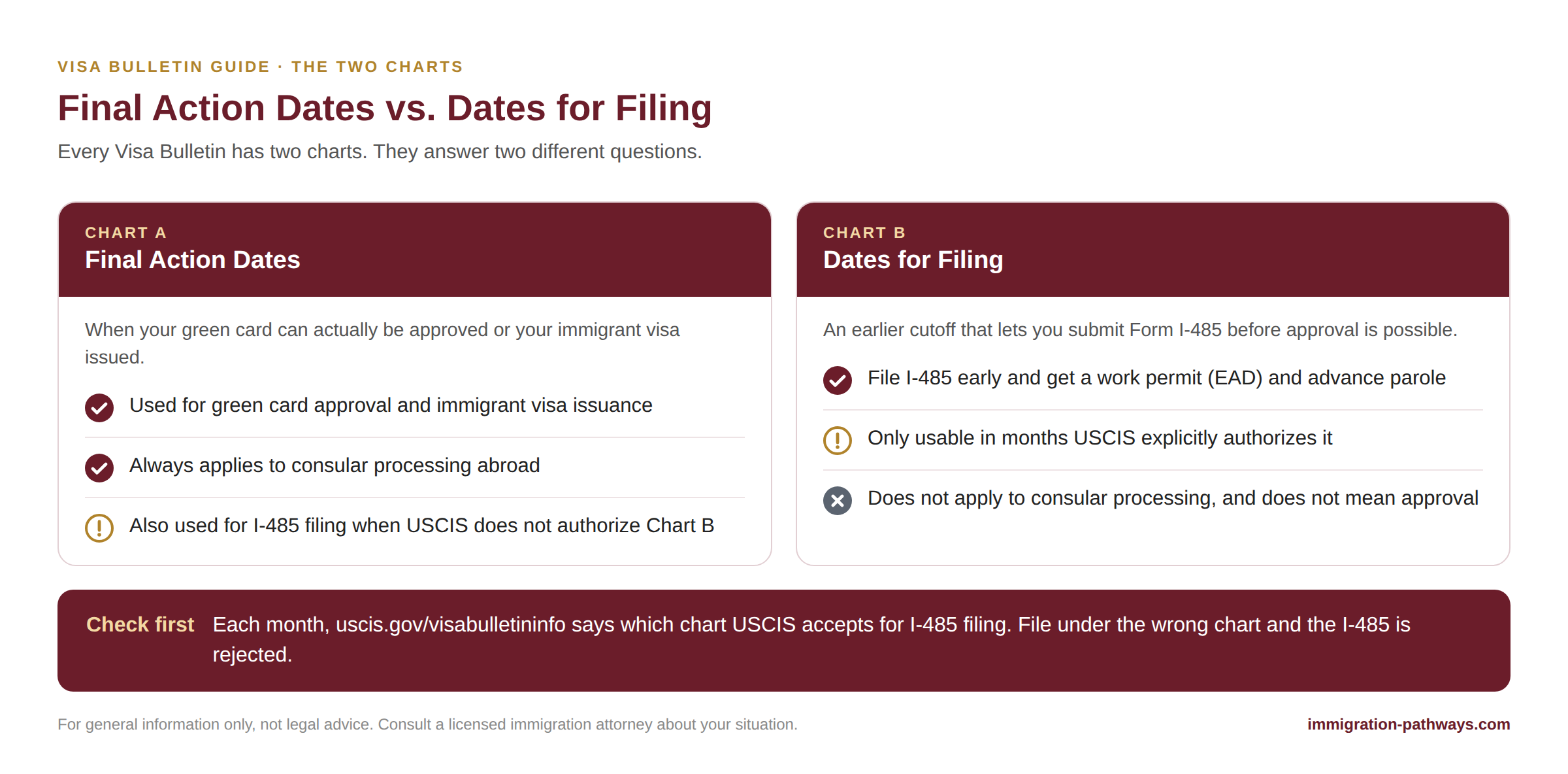
Chart A: Final Action Dates
This is the date your green card can actually be approved and issued. Your priority date must be earlier than or equal to the date shown in this chart for your category and country of birth.
• Used for: green card approval and immigrant visa issuance
• Used for: I-485 filing when USCIS has not authorized the Dates for Filing chart
• Always applies for consular processing abroad
Chart B: Dates for Filing
This is when an earlier threshold exists and allows you to submit Form I-485 before your green card can be approved. Filing early lets you obtain work authorization (I-765) and advance parole (I-131) while waiting for a final action date.
• Only usable when USCIS authorizes it explicitly for that month
• It does not mean your green card will be issued, it only mean that you can submit paperwork
• This does not apply to consular processing, it is only applicable to adjustment of status inside the U.S.
Common mistake: the Dates for Filing chart is not always available despite the common applicant perception. USCIS may restrict it to Final Action Dates only in any given month, usually when annual visa numbers are running low (demand for visas is high). Always verify before submitting.
Your Priority Date - How It Works
Your priority date is your place in the queue. Here is how it is established by depending on your path:
AC21 portability and job changes:
If you change employers while an I-485 has been pending for 180 or more days, your priority date can be preserved, provided the new position is in the same or similar occupational classification under the AC21 Act. you have to file Form I-485J (Supplement J) to notify USCIS. If the 180-day threshold has not yet been reached, or if you are unsure whether the new role qualifies as the same or similar, consult an attorney before making any move.
Cross-Chargeability: Using Your Spouse’s Country
If you and your spouse were born in different countries and your country of birth carries a longer
backlog, you may be eligible for cross chargeability: this is where you charge your green card against your spouse’s country of birth rather than your own, as long as you are filing together. For example, an Indian-born EB-2 applicant married to a Canadian-born spouse, for example, could potentially be treated as a “Rest of World” applicant which could reduce a decade-long wait to just a few months.
Derivative Beneficiaries and the Aging-Out Risk
If your petition includes a child as a derivative beneficiary, and that child is approaching age 21,
be aware of the Child Status Protection Act (CSPA). CSPA provides a formula that may
reduce a child’s calculated age for eligibility purposes, which could potentially preserve their status as a minor even after their 21st birthday.
Time sensitive warning: The CSPA formula is complex, and the window to act is narrow. If
a child in your petition is approaching age 20, consult an immigration attorney immediately.
Once a child ages out and the CSPA formula does not apply, there is no recovery option, they would need a separate petition filed on their behalf.
Caution: If you change employers while keeping the same I-140 you should consult an attorney as your original priority date is preserved only when specific legal conditions are met.
How to Read the Visa Bulletin Charts
The Visa Bulletin is published at the start of each month for the following month. For example, the bulletin published in early October governs November filings.
Each chart is organized by:
• Columns: Country of chargeability
• Rows: Preference category (EB-1, EB-2, EB-3, F1, F2A, etc.)
• Cell values: A date or the letter C (Current) or U (Unavailable)
Country of chargeability: This is the country your green card is counted against for visa limits. This is almost always your country of birth rather than your citizenship, current residence or passport country.
Here is how to check whether you can file your I-485 this month:
1. Go to travel.state.gov and open the current month’s Visa Bulletin.
2. Find the Final Action Dates chart. Locate the EB-2 row and the India column.
3. If the date shown is 15JAN15 (January 15, 2015), your priority date of January 1, 2014 is
earlier your date IS current for final action.
4. Next, check the Dates for Filing chart for the same row and column. If it shows 15JAN15
as well, your date is current there too.
5. Go to uscis.gov/visabulletininfo to confirm which chart USCIS has authorized for I-485
filings this month.
6. If USCIS has authorized the Dates for Filing chart and your date is current on it, you may
file your I-485 this month even if the Final Action Date is slightly later.
Why Backlogs Exist
The U.S. issues a fixed number of immigrant visas each year: approximately 140,000 employment-based and 226,000 family-based. There is a separate rule that caps any single country at 7% of the annual employment-based total, regardless of demand. Therefore , countries with large applicant populations such as India and China for employment-based categories, and Mexico and the Philippines for family-based categories, generate far more qualified applicants each year than their allocation allows. This results in applicants born in high-demand countries facing decades long waits for the same category that applicants from low-demand countries clear in months or even immediately. This is not a processing delay, it is a structural quota constraint built into U.S. immigration law.
Understanding Bulletin Movement
All month and date in the charts are not fixed, they can move forward, stay the same, or move backward. Here is what each means:
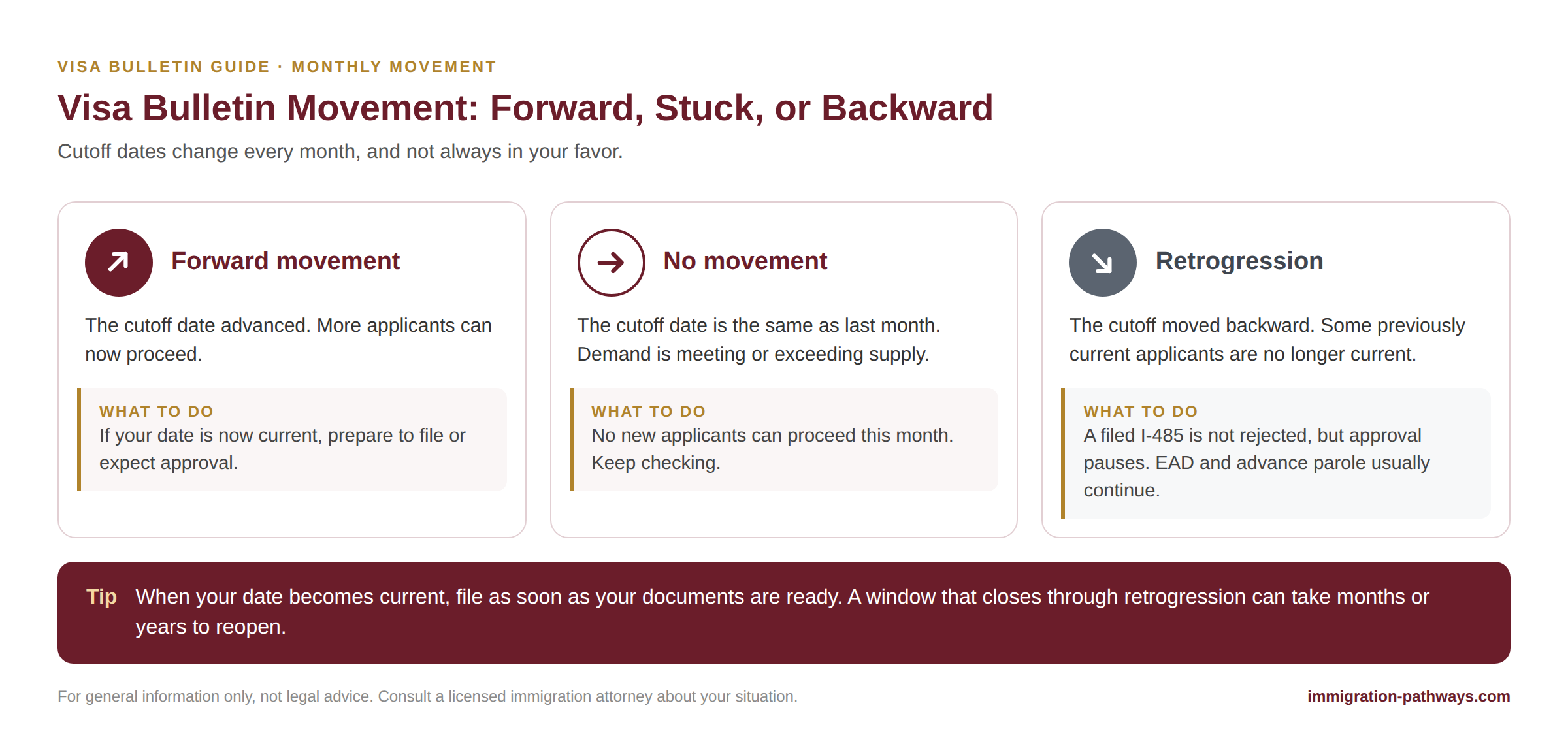
Note: Retrogression does not cancel a filed I-485, if your I-485 was filed properly and your date was current when filing, your application is not invalidated. What it does mean is that your case will not be approved until your date becomes current again. Your EAD and advance parole (if filed concurrently) are typically not affected by retrogression.
Current Month Summary — Employment-Based May 2026
What to Do Based on Your Timeline
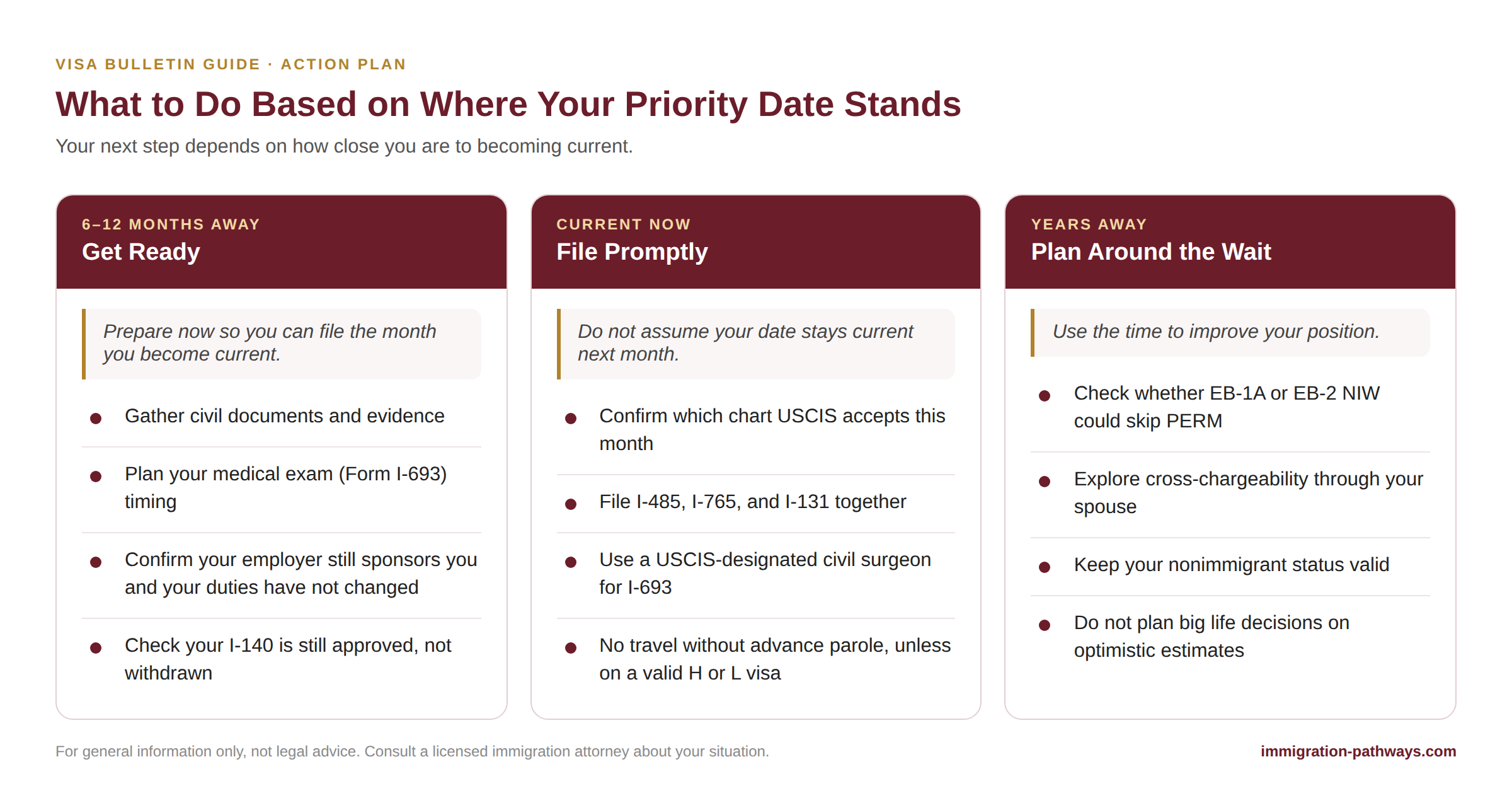
If you are roughly 6–12 months from becoming current
- It is imp
- ortant you start gathering all necessary documents now
- Schedule your medical exam (Form I-693). Results are valid for 2 years from the date of the exam, but the sealed envelope must not be opened
- Confirm your employer's continued sponsorship and that your job duties have not materially changed
- Verify your I-140 approval is still valid and has not been withdrawn
If your date is current now
- Act promptly — do not assume your date will remain current next month
- File I-485, I-765, and I-131 concurrently if eligible (USCIS I-485)
- Confirm which chart USCIS has authorized this month: uscis.gov/visabulletininfo
- Ensure your medical exam (I-693) is completed by a USCIS-designated civil surgeon and is still within the validity window
- Do not travel internationally after filing I-485 without advance parole (I-131) approved — unless you hold a valid H or L visa
If you are far from current
- Explore alternative pathways: EB-1A (extraordinary ability) requires no PERM and no employer sponsorship
- EB-2 National Interest Waiver (NIW) also bypasses PERM — if you qualify
- Discuss with your employer whether a different classification or petition structure could help
- Do not make major life decisions (buying property, accepting international roles) based on optimistic timeline estimate
- Keep your nonimmigrant status current and valid throughout the wait — falling out of status can affect I-485 eligibility (USCIS unlawful presence)
Common Mistakes and How to Avoid Them
Assuming "current" means immediate approval
A current priority date only means you can file or be approved; it does not mean that USCIS will act immediately. I-485 processing can take months after filing. This is why it is important to file promptly when current. Then expect 8–18+ months for the I-485 decision.
Using the Dates for Filing chart without checking USCIS authorization
If USCIS has not authorized the chart for that month, an I-485 filed under it will be rejected. It is therefore important to check the status every month before filing.
Confusing priority date with I-140 approval date
Your priority date is when the petition was filed — not approved. An I-140 can take 4–9 months to approve; the clock started before approval. Check your original I-140 or PERM receipt notice for the correct priority date.
Not monitoring the bulletin after a date becomes current
Dates can retrogress. If you delay filing and your date moves back, you may miss a window that does not return for months or years. Set a monthly reminder to check the bulletin. File as soon as your date is current and documents are ready.
Travelling internationally after I-485 filing without advance parole
Departing the U.S. after I-485 is filed, without an approved I-131 (advance parole), is typically treated as abandonment of the I-485. Apply for I-131 concurrently with I-485. Do not travel until advance parole is approved, unless you hold a valid H or L visa.
The Visa Bulletin controls one of the most consequential queues in U.S. immigration. A single missed filing window, a misread chart, or an uninformed job change can cost years. This guide is designed to help you understand the system — not to replace qualified legal advice. If you are within 12 months of a current date, or if your situation involves any complexity (job change, dependent aging out, prior immigration issues), consult a licensed immigration attorney before acting.