What to Do When Your USCIS Case Status Hasn't Updated
USCIS case status not updating? See what silence is normal, how to find your case inquiry date, and when to use e-Request, Congress or the Ombudsman.
Vera Kenahan
October 24, 2026 · 24 min read

A USCIS case status that hasn’t changed is usually normal. It only updates when something happens, like biometrics, an RFE or a decision. Use the USCIS Processing Times tool to find your case inquiry date. Only after that date passes should you file an e-Request, then escalate to the Contact Center, Congress or the Ombudsman.
This information is provided for informational purposes only and should not be considered as legal advice. The dates, processing times, and USCIS policy regarding the Visa Bulletin change on a month-to-month basis and sometimes without prior notice. Unless stated otherwise, all the information contained herein is valid as of the Visa Bulletin dated August 2026. Please check up to date dates on travel.state.gov and uscis.gov before filing anything and consult an immigration attorney regarding your individual situation. Processing times, inquiry thresholds, and escalation procedures also change. Consult a licensed immigration attorney if your case involves time sensitive status, work authorization, or travel concerns.
Start Here. How Long Has It Been Silent?
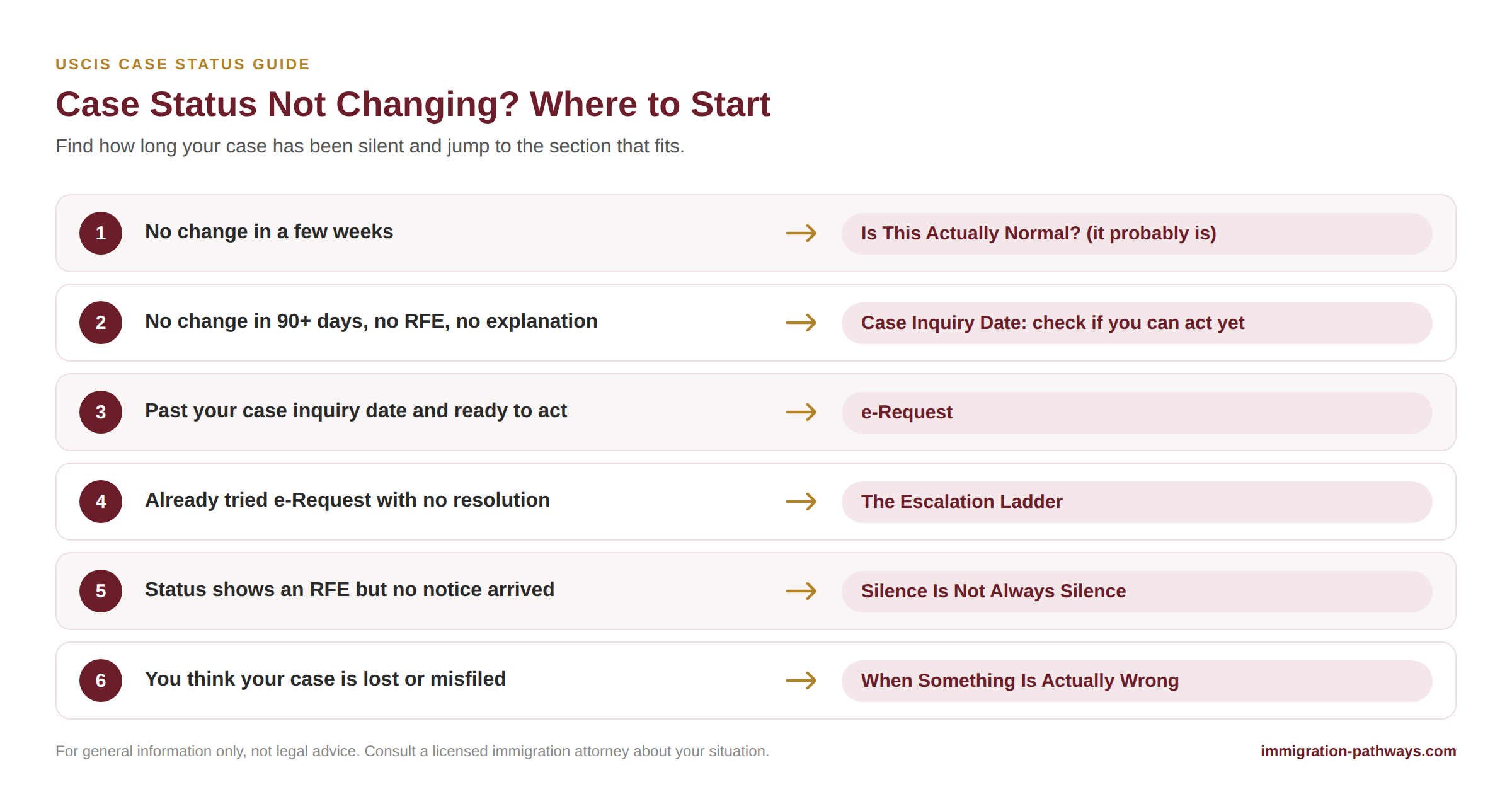
The First Thing to Understand. Silence Is the Default, Not the Exception
If you've refreshed the USCIS Case Status page five times today and hoped for something different to appear, this is the new frame you need most of all. The status page will only update in response to an event occurring within USCIS' internal system, case received, biometrics appointment scheduled, fingerprints collected, RFE sent, interview scheduled, decision rendered. In between each of these events, there might be weeks or even months of substantive activity taking place behind the scenes, with no apparent status update on display.
Where you sit now, your application seems like it's going nowhere fast. Where USCIS sits, your case might be progressing perfectly normally but along lines for which their online case tracker was not built.
This is not to say that there is nothing to worry about in all extended silences. It simply means that there is no cause for concern in silence on its own. The proper question to ask is not whether my status has been updated lately. It is whether my case has gone past the amount of time USCIS itself claims is normal for a case like mine. Everything else in this guide flows from this question.
One thing worth keeping in mind throughout this guide. Processing times are not a fixed, purely bureaucratic constant. They move with policy decisions, how many officers are adjudicating benefits versus assigned to enforcement functions, fee rule changes, and staffing levels all affect the pace of adjudication in ways that have nothing to do with how strong your individual case is.
The Black Hole Periods. When No Update Is Actually Normal
Each form has at least one part of the process where silence is the norm, not the sign of something going wrong. Knowing these beforehand keeps you from freaking out about something that was supposed to happen all along.
Following biometrics, prior to making a decision, family based and many employment-based adjustment cases. You go through biometrics, and then for a period of 12 to 24 months, nothing happens and finally there is an interview or decision made. That's fine. The background check is taking place and your application is being reviewed, but none of these steps results in any sort of update to the status.
Following initial submission, prior to the first update, EAD and many other applications. Nothing happening for 3 to 7 months after the initial notification of receipt isn't unusual in and of itself.
During RFE response review period. After submitting your RFE response, there will be another long silence as the officer checks on the new information provided. This is a new silence period that is different from the previous silence period prior to issuing the RFE.
Post approval but before Card Was Mailed to Me. Despite having shown approval, there is normally a waiting period prior to showing Card Was Mailed to Me.
Waiting on the Visa Bulletin, employment and family based I-485 cases. If your I-485 was filed while your priority date was current and the Visa Bulletin later retrogressed, meaning the cutoff date for your category and country moved backward, USCIS pauses adjudication until your priority date is current again. This produces exactly the kind of extended, silent, no visible update situation this guide is otherwise built to help you diagnose, but it is not a delayed case in the sense the rest of this article addresses. It is a paused case. The correct response is to monitor the Visa Bulletin monthly, not to file an e-Request claiming you are outside normal processing time, since your case genuinely is not, USCIS cannot act on it regardless of how long it has been pending until a visa number is available again.
The pattern among all these. The lack of any visible update is normal because the system is operating as intended during a phase where there are no trigger events.
How to Tell If You Are Actually Outside Normal Processing Time
It's the one thing that can be of utmost importance to you but most individuals fail to utilize it properly as they judge the wait times on the basis of some hazy estimates.
Step 1. Find your receipt date and exact form and office information
The receipt notice, Form I-797C, mentions the type of your form, the date of your receipt, and the office or service center processing your application. However, there is one change that you should be aware of. The USCIS processing times of many forms do not mention the name of any specific service center anymore. In their place is mentioned the term 'Service Center Operations' which is shortened to 'SCOPS'. This is due to the fact that casework is processed in more than one location according to staffing requirements.
Two related points worth knowing at this stage. First, USCIS routinely transfers cases between service centers when one is overloaded and another has capacity. A transfer shows up as a status update, and your case can then go quiet for a period while the receiving office picks up the file. Second, different phases of the same case can be handled by different parts of USCIS entirely, not just different service centers. An I-140 is typically processed at a service center throughout. An I-485 often begins at a service center but transfers to your local field office once an interview is needed, and the field office has its own separate queue and processing time, distinct from the service center figure. If you have been checking your I-485 against a service center benchmark for months and the case seems to have gone quiet, confirm whether it has actually moved to your local field office and check that office's processing time instead.
Step 2. Use the Processing Times tool with your receipt date
Head over to the USCIS Processing Times page, choose your exact form and classification, and provide your receipt date when required. The processing time shown is indicative of how long it took for USCIS to process 80% of their cases in the previous six months. It is neither a guarantee nor deadline.
Step 3. Let the tool calculate your case inquiry date
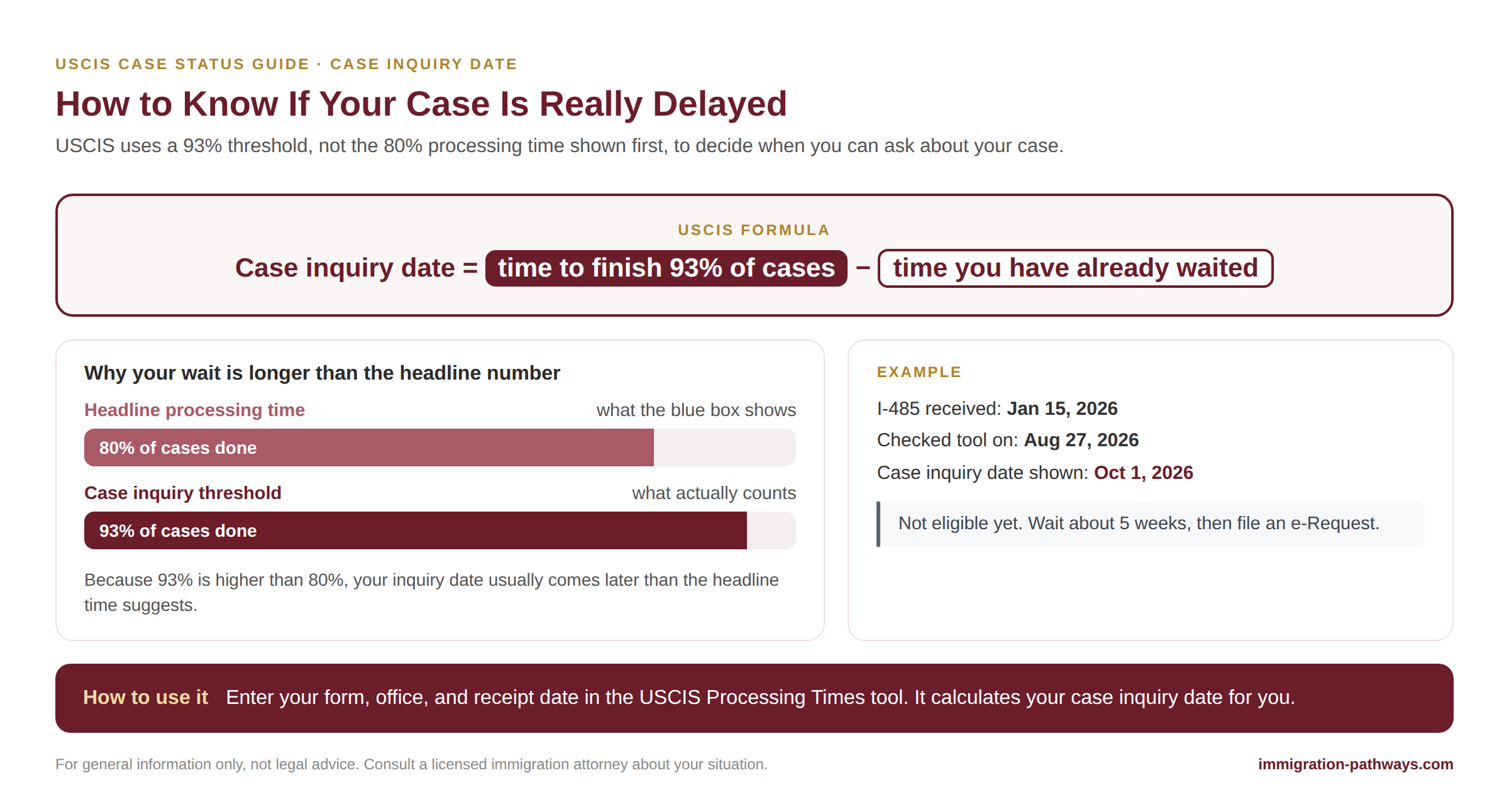
This is where most guides make mistakes, and hence the reason for being very clear. The processing time that appears on the blue box on the results page, which is what many people tend to read first, is based on the period taken to process 80% of adjudicated cases. However, this is not the cutoff used to determine when you become eligible to make an inquiry. The formula that USCIS provides for calculating the case inquiry date is based on 93%, not 80%.
Case Inquiry Date = [time to complete 93% of adjudicated cases] minus [today's date minus your receipt date]
To put it simply, the period equals the time needed for USCIS to process 93 percent of applications similar to yours, not 80 percent, which was shown as processing time, minus the waiting period that you've had, and it will show you the date when you will be able to submit your request for case inquiry, or, in case if you have already waited enough, provide you a direct link to submit your inquiry. Due to the fact that the 93 percent figure is greater than the 80 percent shown as the headline processing time, your case inquiry date will be more distant than you might think by comparing the number of days spent with processing time.
A concrete example makes this easier to apply. Suppose your I-485 was received on January 15, 2026, and you check the Processing Times tool today, August 27, 2026. If the tool's case inquiry date calculation returns October 1, 2026, that means USCIS has not yet reached the point where it considers your case outside normal range, and you are not yet eligible to submit an e-Request. In this example, you would need to wait roughly five more weeks and check back, rather than filing anything today. Run the actual calculation with your own dates rather than estimating, since the gap between your receipt date and your real case inquiry date is often longer than it feels.
If your form type does not appear in the processing time chart, then the standard goal of USCIS is a decision within 6 months from the time of filing, and you should wait six months before sending your inquiry.
Step 4. Know what the tool is actually measuring
Processing times encompass all the time taken from receipt to completion, including the time taken in processing the RFE, your response time to that RFE, as well as any delays related to biometrics appointments. This implies that cases which have had an RFE issued and have taken some time to respond are not actually being delayed any more than others because that time is built right into the average. Another thing to remember is that premium processing cases are not included in such calculations as premium processing takes a separate window of time, usually 15 business days.
Another little point to know. The processing times information is updated on a monthly basis but refers to a six-month look-back period, so what you see today is an indicator of recent performance.
When You Are Genuinely Outside Normal Processing Time. e-Request
As soon as your case has reached the case inquiry date, the next step would be the e-Request process through Case Outside Normal Processing Time inquiry, available either from the Processing Times tool or egov.uscis.gov/e-request.
What the e-Request can do.
- Report the case as being outside normal processing time and ask for a status update
- Request resending a notice or document you never received by mail
- Correct a typographical error in your case
- Solve other limited-service problems as defined by USCIS
What it cannot do. This process cannot help you speed up your case outside of the USCIS expedite criteria, and it will not give you any instant answer. This process takes time. You have to make an inquiry in writing, and not to get any immediate response. So, you will need to wait some more.
Why you have to do it anyway. All following processes, a contact center call, a congressional inquiry, an ombudsman request, work better if you have on record an already completed e-Request proving that you have used all available channels before.
Reading the Status Itself, What Stuck Messages Actually Mean
However, in case your case status shows specific language and not just a static case status, then the specific language is important.
Case is taking longer than expected. This language is used by USCIS to refer to a situation where the case has taken more time than the estimated range of similar cases. The term itself is often a sign that your case has probably exceeded the case inquiry date. It is worth treating this as a signal to go check, not as a green light on its own, since this message can sometimes appear when a case ages past an internal system threshold that does not perfectly track the 93 percent case inquiry date formula. Run the actual calculation before filing an e-Request rather than treating the message alone as confirmation that you are eligible.
Case was updated to show fingerprints were taken versus Case was updated to show all fees were paid. These terms sound very alike, however, they mean two different things. Read each case status update carefully.
No case status changes at all, the same message for months. This is the truly ambiguous case status. Do not read the lack of any change into it, use the formula from above to make your judgment.
Silence Is Not Always Silence, The RFE Timing Trap
One of the biggest mistakes that people make does not relate to being stuck in an application. The problem is a misunderstanding of an application that is moving forward.
When your status changes to Request for Evidence, the deadline for responding starts from the issuance date which is stated in the letter. It cannot be considered the day when you realized it yourself or even when you receive the letter via mail service. It may take some time for the letter to arrive in your mailbox.
If you are represented by an attorney, there is an added wrinkle worth knowing about. When a Form G-28 is on file, USCIS generally directs official notices, including RFEs, to the attorney of record, and the applicant typically also receives a copy, though exactly how that copy is handled can vary. The response clock still runs from the notice's issuance date regardless of who has actually seen it or whether your attorney has gotten around to forwarding it to you. If your case status changes to reflect an RFE and the physical notice has not reached you, do not simply wait for the mail.
What to do the moment you see the status change. Call your attorney immediately if you are represented, and ask them to confirm they have received the notice and the exact issuance date on it. Separately, call the USCIS Contact Center and ask them to confirm the issuance date and, if needed, request reissuance of the notice. Do not wait for either of these calls to be returned before you start pulling together the evidence you expect the RFE will require, since the deadline is already running regardless of when the paperwork physically reaches anyone.
The Escalation Ladder. What to Do, In Order
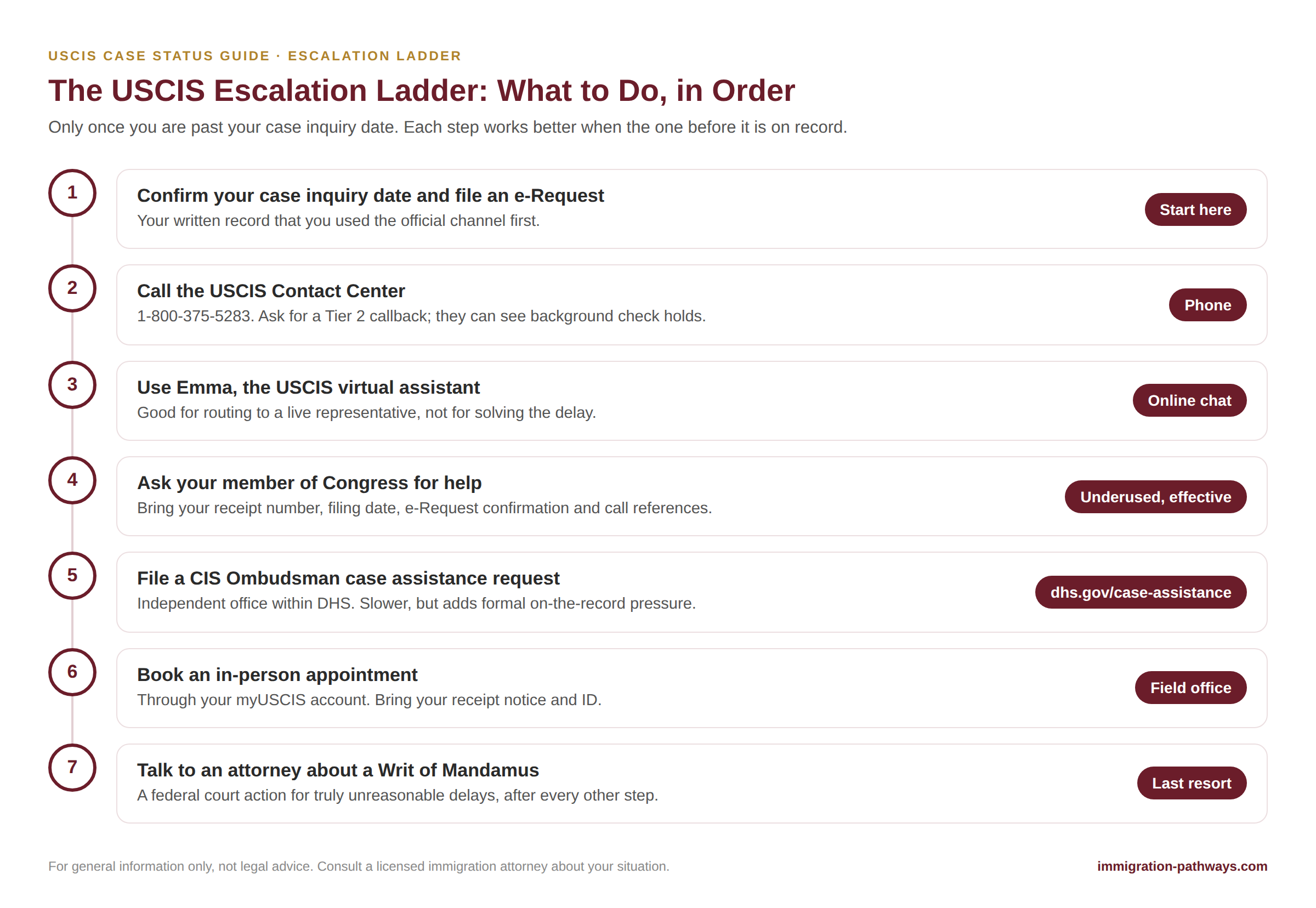
In the event that you have established that you are truly outside of regular processing times, and an e-Request has not sorted out your issue to date, then here is the proper procedure for escalating.
1. Re confirm before escalating further
Double-check that you calculated the date of your case inquiry properly and confirm that your e-Request has been submitted and is on file. Escalating without this verification only causes delay at all future steps.
2. Call the USCIS Contact Center
1-800-375-5283; TTY: 1-800-767-1833 (within the U.S.), 212-620-3418 (outside the U.S.), or reach out directly to one of the USCIS international field offices. Be sure to have your receipt number handy and specify clearly that your case is out of processing schedule, not just slow. The representative will possibly elevate your question, even though the answer may come in general form.
Here comes an advice. In case the first-tier call was not fruitful for you, make a direct request for the Tier 2 callback. Sometimes the Tier 2 representatives have knowledge about the background check hold that frontline representatives lack. They might not give you all details, yet at least they would let you know whether there is a background check hold on your case or not.
If you hear that there is a hold, it is worth understanding what that actually means, since this is one of the most common reasons a case sits far outside normal processing time with no visible update. A background check hold generally means your case has been referred for additional review before an officer can act on it, sometimes an FBI name check that is taking unusually long, sometimes a referral under USCIS's Controlled Application Review and Resolution Program, CARRP, which is the agency's process for handling cases that raise a potential national security concern, and sometimes a broader vetting hold tied to a specific policy change. As of April 27, 2026, USCIS began an enhanced, fingerprint based background check process affecting a large volume of pending cases across nearly every category, adjustment of status, naturalization, family and employment based petitions alike, following expanded FBI database access authorized that February. That process was described at the time as producing delays extending weeks to months for affected cases, and coverage of it was still developing as of this writing, so verify the current status of any such vetting initiative with your attorney or through current news coverage rather than assuming it has resolved by the time you read this. What matters practically is this: a background check hold is not resolved by e-Request, it is not something USCIS or you can meaningfully speed up on demand, and in most cases the honest answer is that you monitor and wait, though an attorney can sometimes confirm what type of hold applies and whether there is anything productive to do about your specific one.
3. Try USCIS's virtual assistant Emma for routing, not resolution
Emma can be accessed by clicking the chat icon on the website of USCIS and can answer any general query that you may have. She can also help you navigate through the website as well as connect you with a live representative.
4. Submit a congressional inquiry
This procedure is greatly underutilized considering how effective it is. You can make an inquiry to USCIS for your case through the Congress people (representative in the US house of representatives and senators) who represent you in congress and are greatly likely to give you better results than the ones that you get using the self-service channel. In the process, you just need to find out who your Congress people are from your home address, then contact their office and fill the privacy release form to enable them to inquire for you.
What you actually give the caseworker matters as much as making the call. A congressional office cannot open a productive inquiry with just your name and a complaint that things are slow. Have ready, and provide in writing where possible, your receipt number, the exact form type, your filing date, your current case status as displayed online, confirmation that you are past your USCIS calculated case inquiry date, and a short record of what you have already tried, your e-Request confirmation and date, and any Contact Center call reference. A caseworker who receives this information can open a specific, documented inquiry with USCIS. One who receives only a general complaint is more likely to generate a form letter response that does not move your case forward.
5. File a case assistance request with the USCIS Ombudsman
Citizenship and Immigration Services Ombudsman Office are a separate office in DHS that is independent from USCIS itself and is established in order to assist the applicant in case of delays and other problems. File a complaint through dhs.gov/case-assistance. The Ombudsman will not be able to reverse USCIS's decision, but will work out the problem directly with USCIS for you. This solution is recommended in case congressional investigation does not solve the problem or in addition to it. It usually needs contacting USCIS in the past 90 days and letting the agency 60 days to solve it.
Set your expectations for timing and purpose correctly here. The Ombudsman's office generally acknowledges a submitted request fairly quickly, but formally engaging USCIS on the substance of your case, and getting any kind of response back, typically takes additional weeks to months beyond that initial acknowledgment, not a rapid turnaround. The Ombudsman is most valuable for documenting a case that fits a broader, systemic pattern and applying formal, on the record pressure, rather than as a tool for quick individual resolution. The office also publishes a congressionally mandated annual report identifying the form types with the longest documented delays and USCIS's responses to systemic issues, which is publicly available and worth a look if you want context on whether your specific delay is idiosyncratic or part of a broader, already documented pattern.
6. Schedule an in-person appointment
If your case has been stalled for many months without any progress and the above remote avenues have not resulted in any responses, then you can schedule an appointment in person at your nearest USCIS field office. Please be informed that USCIS has withdrawn from using the InfoPass website alone some time back and integrated that booking facility with an appointment service available in myUSCIS, so that you are likely to use my.uscis.gov for booking the same instead of the InfoPass website anymore. The InfoPass facility continues to be used informally, even as a way to talk to the agent via the Emma chat facility, although the booking facility has been incorporated into your USCIS online account now. Please carry your receipt notice along with ID.
7. Consult an attorney about a Writ of Mandamus
As a true last resort. If USCIS has unreasonably delayed your application beyond all reasonable periods of time, notwithstanding all the efforts mentioned above, a lawyer can file for a Mandamus action in federal district court, forcing USCIS to make the decision. This is a serious legal measure that costs money, and it is applicable only if all other steps from above have been exhausted, and the delay is unreasonable, not simply annoying.
Practical point on attorney's participation at any level. The fact of attorney representation makes the letter or phone call of an applicant more credible than a communication of an applicant without a lawyer. If your application is truly delayed, and if your efforts to get information are fruitless, involving an attorney early in this process, not waiting till the Mandamus stage, might be helpful.
When Something Is Actually Wrong, Not Just Slow
The truly lost cases occur rarely, but they do occur occasionally, mostly because of an address change which was not reported to USCIS in time or because the document got misdirected during its internal transfer from one office to another.
Indicators that your case is lost or delayed due to administrative reasons, not merely because of delay.
- Your case is well overdue after the case inquiry date, and it is not just a few days late, but way past that date.
- You filed several e-requests but received no reply in substance to those requests.
- The USCIS phone agent is unable to find anything going on with your case when you call.
Where there is a combination of more than one of these conditions, then the two particular actions of the congressional inquiry and Ombudsman request, Nos. 4 and 5 above, are precisely what is needed. They are much better suited to the purpose of unearthing real administrative mistakes than is further use of the e-Request mechanism on the case status website, which is designed for reporting delays and not for looking into lost cases.
Keep your address up-to-date with USCIS. It may seem elementary, but many lost case instances have their origin in the failure to file an address change, which results in notices, such as RFEs and interviews being sent to an outdated address. Update your address using USCIS's official Change of Address service whenever you move, even temporarily, while awaiting your case decision.
Practical Habits That Prevent Most Stuck Case Panic
Check only weekly and not daily. Updates from USCIS are not scheduled, and frequent checking causes unnecessary stress without giving you any information. Weekly checking is more than enough in order to detect any update timely, without the added stress of constant checking.
Make use of automatic notifications rather than manual checking. Not only the Case Status subscription but even your free myUSCIS account allows you to receive an automatic email/text notification about any status change. This allows you not to check your status manually anymore. Setting this up requires creating a myUSCIS account and linking your specific case using the online access code printed on your Form I-797C receipt notice, not simply your receipt number. Not every form type supports full online account linking, and the setup steps differ slightly depending on whether your case was filed electronically or on paper. If you try to link a case and either the form type is not supported or you cannot locate your access code, that is a known limitation rather than something you are doing wrong, check your receipt notice again for the access code before assuming the system is broken.
Make sure to keep your I-797 receipt notice and your approval notice always with you. This is your official confirmation of having submitted your case and is necessary for any further action you might take.
Avoid sending duplicate and premature requests for escalation. Escalation procedures are used only in cases that are outside regular processing procedures. Premature escalations will not assist in expediting your case and will just add to the noise in the system that does not benefit anybody, including you.
Do not automatically conclude that something has gone wrong if your card or documents do not reach you after an approval status change. Give some time for the postal system to deliver your card or documents after an approval status change. As per USCIS instructions regarding non delivery of card inquiry process, you have to wait for a minimum of 90 days after getting approval notification before applying for a non-delivery of card, which is more than the 30-day period mentioned elsewhere. Once that 90 day window has passed, file the non delivery request through e-Request, selecting the specific Non-Delivery of Card inquiry type, a distinct category from the Case Outside Normal Processing Time inquiry discussed earlier in this guide, at egov.uscis.gov/e-request.
If your I-485 is pending and international travel comes up, treat it as its own separate question, not a status tracking issue. Leaving the United States while an I-485 is pending, without an approved Form I-131 advance parole document already in hand, is generally treated by USCIS as abandonment of the I-485. This is one of the most common and most irreversible mistakes made during a long wait. If travel is on the table while your green card case is pending, confirm your advance parole status and check with an attorney before you book anything, not after.
FAQ
How often does USCIS actually update case status?
There is no fixed schedule. Updates occur whenever a specific triggering event happens internally. There is no daily or weekly refresh guarantee, which is exactly why long stretches of visible silence are common and not automatically concerning.
My case has been stuck on Case Received for months with literally zero other updates, is that normal?
It can be, particularly during the black hole periods described above, post biometrics, pre RFE response review, and so on, but it is also exactly the situation the case inquiry date calculation exists to evaluate. Run your specific receipt date and form type through the Processing Times tool before assuming either that everything is fine or that something is wrong.
Does checking my status frequently slow it down or speed it up?
Neither. Checking status, regardless of how often, has no effect on processing speed in either direction.
I submitted an e-Request, how long until I hear back?
There is no published guaranteed timeline, and the process is often described by practitioners as usually slow. Expect to wait, and do not submit a second, duplicate e-Request while the first is still pending. That does not accelerate anything and can confuse the inquiry record.
Is a congressional inquiry only for emergencies?
No. Congressional offices handle routine immigration delay inquiries regularly, not just emergencies. If your case is genuinely outside normal processing time, this is a legitimate and commonly used tool, not something to reserve only for crisis situations.
Can an immigration attorney actually make my case move faster?
An attorney cannot make USCIS adjudicate faster than its internal queue allows, but a represented applicant's inquiry is sometimes taken more seriously in practice, and an attorney can correctly identify whether your situation has reached the point where escalation tools like a congressional inquiry or Mandamus lawsuit are actually appropriate, which prevents wasted effort on premature escalation.
What is the difference between the USCIS Ombudsman and just calling the Contact Center?
The Ombudsman is an independent office within DHS, structurally separate from USCIS, created specifically to investigate delays and systemic problems and liaise with USCIS on your behalf. The Contact Center is USCIS's own customer service line. The Ombudsman is generally the stronger tool once routine Contact Center calls have not resolved a genuine delay, though it works on a slower timeline than a phone call and is not built for rapid turnaround.
My receipt number starts with IOE, does that change anything?
An IOE receipt number indicates your case was filed electronically, or paper filed but processed through USCIS's electronic intake system. You may already have an online account associated with the filing, or can create one and link the case using an online access code USCIS mails separately. Account functionality can still vary by form type even with an IOE number.
Official Resources
- USCIS Case Status Online, check your current status
- USCIS Processing Times Tool, calculate your case inquiry date
- USCIS e-Request, submit a formal inquiry once outside normal processing time
- USCIS Contact Center, 1-800-375-5283
- USCIS Change of Address, keep this current at all times
- DHS Case Assistance/USCIS Ombudsman, independent escalation channel
- CIS Ombudsman Annual Report to Congress, available through dhs.gov/cis-ombudsman, for documented, systemic delay patterns by form type
- Find Your Congressional Representative, for congressional inquiries
- myUSCIS Appointment Scheduling, for in person appointments
Final Takeaway
A status that has not changed is, more often than not, exactly what a normally processing case looks like for long stretches of its life, not evidence that something has gone wrong. The right response is not more refreshing. It is running your specific receipt date and form type through USCIS's own case inquiry date calculation, remembering that this calculation uses a 93 percent completion threshold rather than the 80 percent figure displayed as the headline processing time, to find out, objectively, whether you are still within normal range or genuinely past it.
If you are past it, there is a clear, structured path forward, e-Request first, then the Contact Center, then a congressional inquiry or Ombudsman request, with an in-person appointment or attorney led Mandamus action reserved for situations that do not resolve through the steps before them. Following that order, rather than jumping straight to the most dramatic option out of frustration, gets you answers faster and keeps every later step more credible because you can show you tried the right channel first.
All information reflects USCIS tools, processing time methodology, and escalation procedures current as of early August 2026. Processing times, inquiry thresholds, and contact information change. Verify all current details directly at uscis.gov before relying on any timeline for a decision. This article is not legal advice.