O-1 and EB-1A RFE Survival Guide 2026: What the 40–50% Number Actually Means
The 40–50% RFE rate is EB-1A, not O-1. See 2026 RFE and approval rates, RFE vs. NOID deadlines, and a 6-step plan to answer an RFE.

Vera Kenahan
November 2, 2026 · 12 min read

Short answer: The widely quoted 40–50% RFE rate applies to EB-1A green card petitions, not the O-1 visa. In FY2025, about 20% of O-1 petitions received an RFE and about 94% were approved overall. EB-1A is harder and more volatile, but it has been recovering since a late-2025 low. In both categories, a targeted RFE response wins far more often than a bigger pile of documents.
This article is for informational purposes only and is not legal advice. The statistics come from official USCIS data, independent case-tracking platforms and law firm caseload analysis. USCIS publishes detailed statistics with a long delay, so treat these figures as directional trends, not a prediction for any individual case. Consult a licensed immigration attorney about your situation.
Start Here: Which Situation Are You In?
- About to file an O-1 and worried by the headlines: read the O-1 Reality Check.
- About to file EB-1A and the 40–50% number is keeping you up at night: read the EB-1A Reality Check and the RFE triggers.
- Already received an RFE in either category: go to The RFE Response Playbook.
- Received a NOID, not an RFE: go to RFE vs. NOID.
- Deciding between O-1 and EB-1A: go to Should You File O-1, EB-1A, or Both?
Is the 40–50% RFE Rate About O-1 or EB-1A?
It's EB-1A. If you've seen a "40–50% RFE rate" tied to your visa category and felt your stomach drop, you're not alone, and you haven't seen the whole picture. The number is real, but it describes the EB-1A green card, not the O-1 visa.
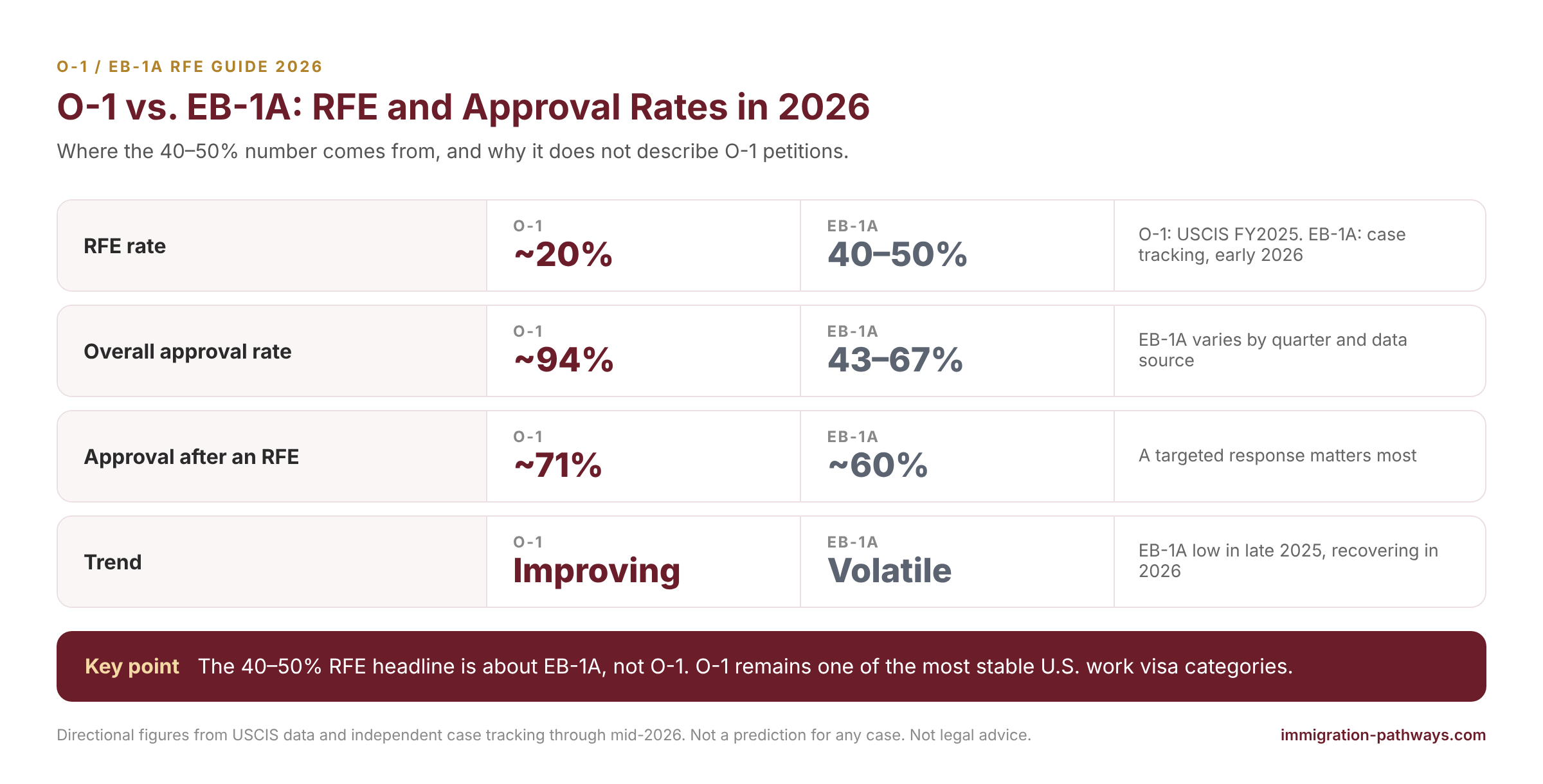
Here is the comparison as of mid-2026:
- RFE rate: O-1, about 19.7% (USCIS data, FY2025). EB-1A, 40–50% (independent case tracking, early to mid-2026).
- Overall approval rate: O-1, about 93.9% (FY2025). EB-1A, 43–67%, depending on the quarter and data source.
- Approval rate after an RFE: O-1, about 71% (70.9% in FY2025). EB-1A, about 60% overall, with some practitioners reporting up to about 81% for well-targeted responses.
- Standard processing time: O-1, recently about 12 to 15 months; EB-1A, anywhere from several months to nearly two years depending on backlog. Both offer premium processing with a 15-business-day decision. CHECK: confirm current O-1 and I-140 times on egov.uscis.gov/processing-times.
- Trend: O-1 is stable to improving; its RFE rate fell from 27.8% in FY2021 to 19.7% in FY2025. EB-1A is volatile; independent tracking showed approvals dropping to 31% in September 2025 and recovering to 43% by February 2026.
The first takeaway: if you are filing an O-1, you are in one of the most stable, highest-approval employment visa categories. The headlines about "skyrocketing RFEs" are about EB-1A, the green card category.
O-1 Reality Check: The Data Is Better Than You Think
In FY2025, USCIS approved 93.9% of O-category I-129 petitions: 29,733 approvals and 1,948 denials out of 31,681 decisions. About 19.7% received an RFE, roughly 1 in 5, and about 71% of those were then approved.
Why the O-1 stays stable as EB-1A gets harder
You can't self-petition for an O-1. An employer or agent has to file, which filters out many weak cases before they reach USCIS. O-1 petitions also typically come with substantial documentation: contracts, an itinerary, a consultation letter, publications and recommendation letters.
What is changing in O-1 review
Even as the RFE rate falls, the RFEs themselves have changed. Officers increasingly question whether the evidence is relevant and strong enough, not just whether it was submitted. Practitioners link this to new 2025 policy guidance on evidence and to USCIS's growing use of automated screening before an officer reviews the case.
The most common O-1 RFE triggers right now
- Missing required documents. A consultation (advisory opinion) letter from an appropriate peer group, a signed employer or agent contract, and a detailed itinerary are baseline requirements. Leaving any of them out is one of the most common, and most avoidable, RFE triggers.
- Generic or mismatched consultation letters. For tech founders especially, the letter must come from a body or expert that can actually assess achievements in that industry.
- Evidence not tied to a criterion. Documents are submitted with no argument linking them to the specific regulatory criterion they are meant to prove.
- Press or awards that aren't independent. Self-published pieces, press releases and paid placements don't count as published material about you. A feature in a "30 Under 30" list with an open selection process carries more weight than an award that came with paying to join an accelerator.
- Failing the final merits review. Even with every criterion met on paper, a petition can fail if the evidence as a whole doesn't show extraordinary ability.
For O-1B (arts and entertainment), the consultation from a peer group or labor organization is just as strictly enforced. Missing consultation letters are among the most common, and entirely avoidable, O-1B RFE reasons.
Processing time matters too. Standard O-1 processing has stretched from about 7.5 months in December 2025 to about 12 months by May 2026, and longer since, through gradual month-by-month slowdowns rather than a single policy change. If your timeline is tight, premium processing costs $2,965 since the March 1, 2026 fee increase. For what strong O-1 evidence looks like, see O-1 visa evidence: what USCIS wants to see.
EB-1A Reality Check: The Number Is Real, But So Is the Recovery
EB-1A is where some anxiety is justified, but even here the picture is more nuanced than "approval rates are collapsing."
The volatility, in order
EB-1A approval rates fell from 70.5% in FY2023 to 60.65% in FY2024, then dropped sharply to 53.4% in Q4 FY2025, against a full-year FY2025 figure of 66.9%. Independent case tracking (Lawfully data, reported by Manifest Law) showed an even deeper trough: approvals for regularly processed cases hit 31% in September 2025 and recovered to 43% by February 2026. Over the same period, the RFE rate rose from 46% in January 2026 to 49% in February.
What this tells you: EB-1A went through a very tough stretch in late 2025 and has been recovering since; it is not in a straight-line decline. The category is harder than two years ago, and easier than six months ago.
The real bottleneck is the final merits review, not the criteria count
Meeting 3 of the 10 criteria under 8 CFR 204.5(h)(3) has rarely been the hard part for strong candidates. The harder part, and the main driver of today's RFEs, is the final merits determination, the second step of the two-step review from Kazarian v. USCIS (9th Cir. 2010). At that step, USCIS asks whether all your evidence together proves you are among the small group at the very top of your field. One immigration law firm's analysis of its own cases found that failing this totality test, after meeting 3 criteria, accounted for about 60% of the RFEs it received since 2021. For how to build an EB-1A case that clears this step, see our EB-1A 2026 guide.
Longer processing means closer review
EB-1A processing has stretched to about 21 months in some recent reports, after USCIS moved these decisions into its Service Center Operations directorate instead of splitting the work between two service centers. Longer review times mean more scrutiny per case, which cuts both ways.
A Concerning Trend: RFE Quality Has Declined
Several immigration law firms report more RFEs that ignore evidence already in the petition, cite criteria that don't apply to the category, or contain factual errors and inconsistencies. Lawyers attribute this to USCIS's increased use of automated screening before human review.
What this means for you: if your RFE seems to ignore evidence you already submitted, you are not imagining it, and it does not mean you did something wrong. Calmly point to exactly where in your original filing the issue was addressed, then add whatever new support you can. Don't just resubmit the same document without explaining why.
RFE vs. NOID: Know Which One You Received
People often confuse the two, and that causes real harm, because the response strategy is different.
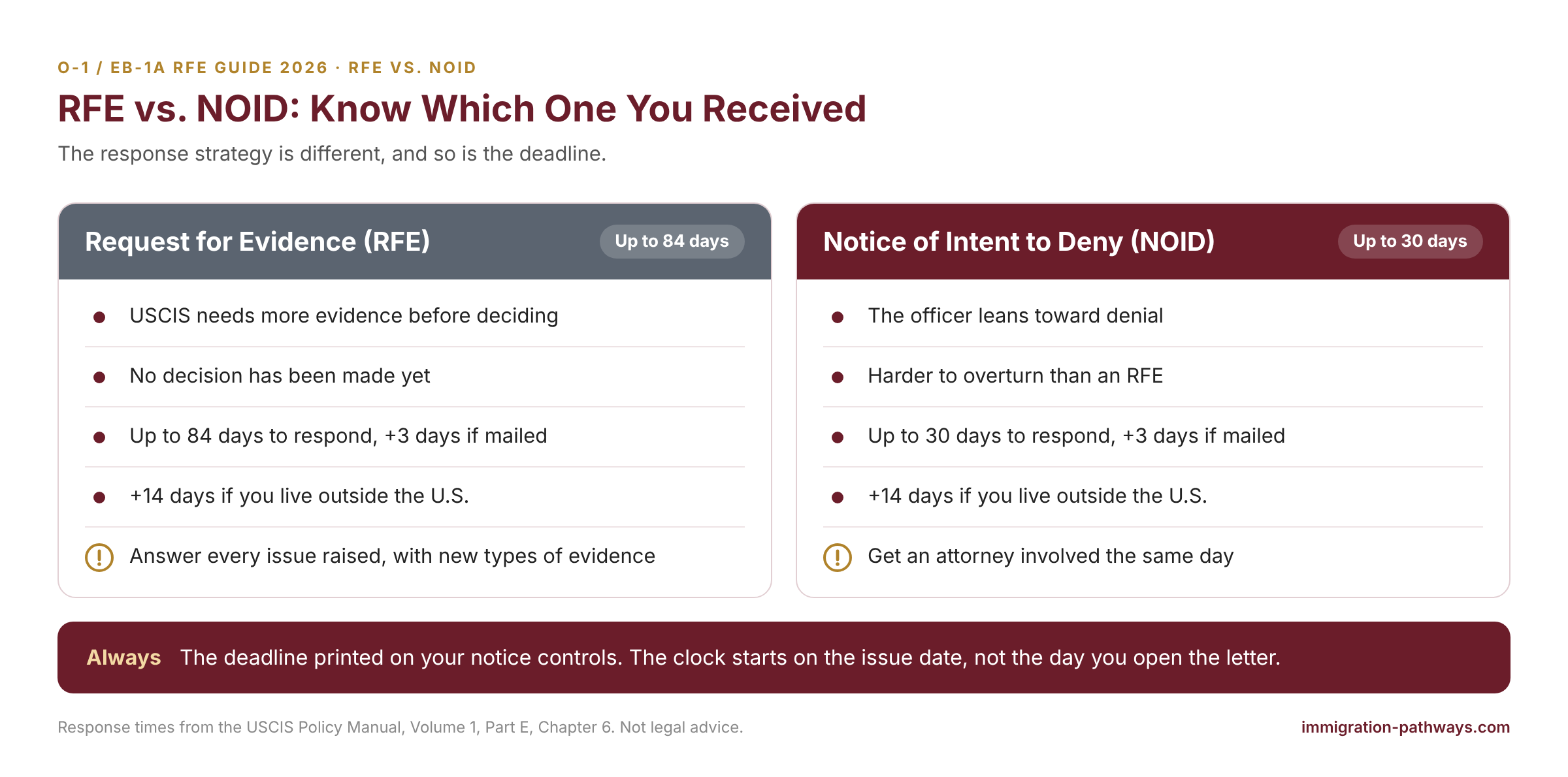
- Request for Evidence (RFE): USCIS needs more evidence before it can decide. No decision has been made. You have up to 84 days to respond.
- Notice of Intent to Deny (NOID): an officer has reviewed the case and concluded you likely don't qualify. Denial is probable without a strong rebuttal. You have up to 30 days to respond. USCIS doesn't publish comparative statistics, but practitioners consistently describe NOIDs as harder to overturn than RFEs.
Treating a NOID with the same urgency as an RFE, instead of as the more serious document it is, is a common and costly mistake. If you're not sure which one you received, check the heading on the notice and get it to an attorney right away.
The RFE Response Playbook: 6 Steps
This applies to both O-1 and EB-1A RFEs. The categories differ in frequency and stakes, but the discipline is the same.
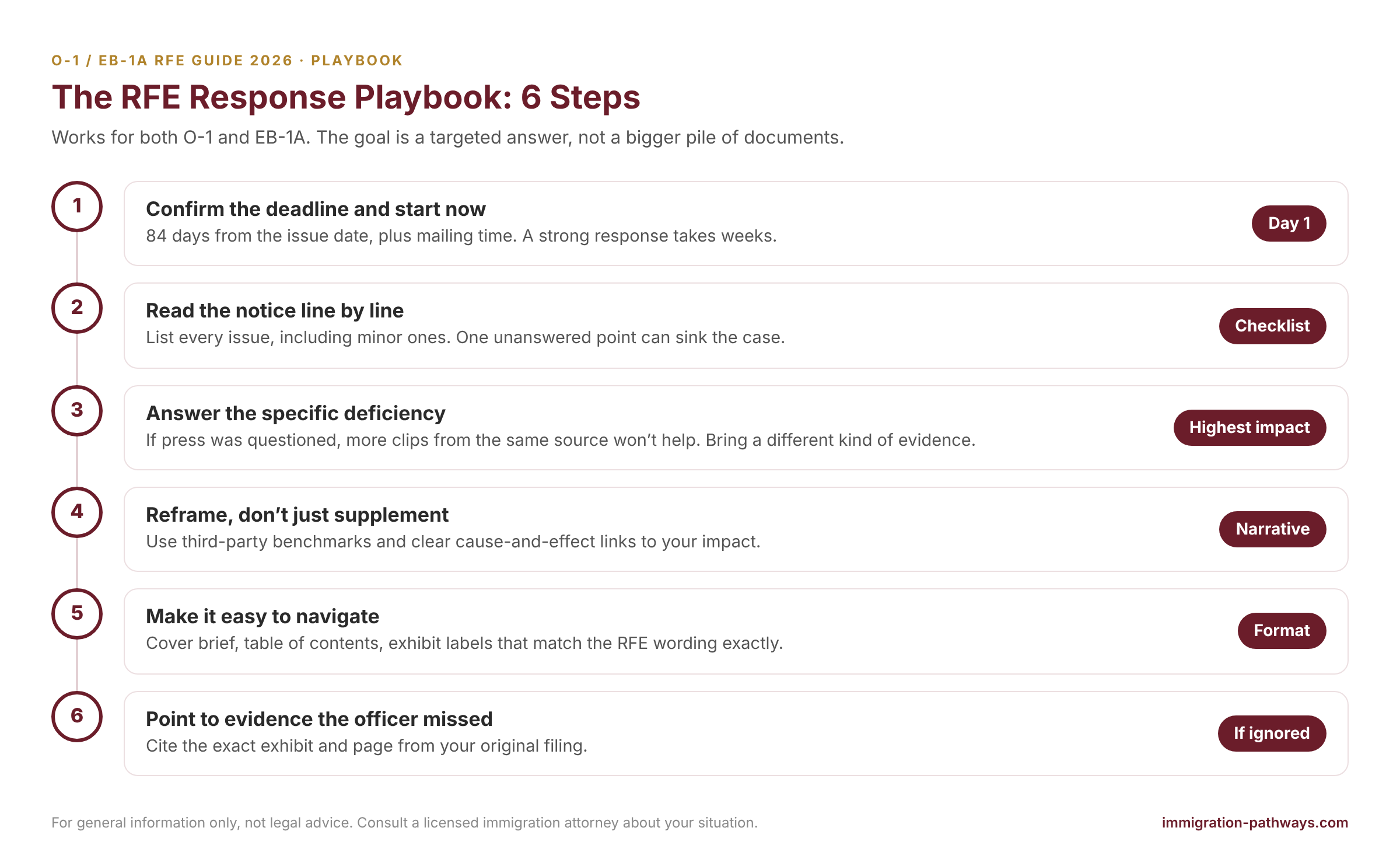
Step 1: Know your exact deadline and start immediately
Under USCIS policy, the maximum RFE response time is 84 days (12 weeks) from the date the RFE was issued. If it was mailed, a response received within 3 days after the deadline still counts (87 days total). If you live outside the U.S., USCIS adds 14 days. The clock starts on the issue date printed on the notice, not the day you received or opened it, and the deadline on your notice always controls. Don't wait until the end; a thorough response can run 50 to 100 pages of legal argument plus new evidence.
Step 2: Read the entire notice line by line
USCIS states which criteria or documents are in question. Some RFEs target one narrow gap; others challenge the whole theory of the case. List every issue, including minor ones. A response that thoroughly answers four of five concerns but skips the fifth gives USCIS an easy reason to deny.
Step 3: Answer the specific deficiency
This is the highest-impact step. If USCIS doubted that your press coverage was independent and national in reach, five more clips from the same source won't fix it. You need a different type of evidence.
Step 4: Reframe and restructure, don't just add
The best responses use third-party benchmarks to put existing evidence in context, add independent verification, and draw clear cause-and-effect links between your work and its impact. They rewrite the argument rather than just adding documents. If part of your original petition is solid, keep it; just show how it answers this specific issue.
Step 5: Make it easy for a busy officer to navigate
Include a cover letter that works as a legal brief, a table of contents, and exhibit headings that use the exact wording of the RFE. If the notice asks for "Evidence of Membership," label the exhibit exactly that way. This is not cosmetic; officers with heavy caseloads engage more with clear filings.
Step 6: If the RFE ignores evidence you already submitted
Politely but clearly point to where you already made the case, citing the exact exhibit and page. Don't assume the officer will reread your original petition; make the point inside the RFE response.
After a Denial: Your Real Options
A denial, whether on the first filing or after an RFE response, is not the end of the road. The right next step depends on why it happened.
- Use the denial notice as a roadmap. It tells you whether USCIS found the evidence insufficient, inconsistent, irrelevant or legally inadequate. A denial after an RFE means USCIS gave you a chance to fix specific points and wasn't persuaded.
- Appeal or motion generally makes sense when USCIS made a clear legal or factual error.
- Refiling is usually more effective when the original filing was weak, unclear or poorly organized. Simply rearranging the same evidence rarely works; a strong refile reframes the case, ties documents directly to the regulatory criteria and closes the gaps.
For O-1 petitions in particular, many people have been approved on refiling after adding new achievements, getting stronger letters from independent experts, or fixing problems with the petitioner or agent structure.
Should You File O-1, EB-1A, or Both?
Given the gap in RFE rates and stability, it helps to be clear about how the two categories relate strategically.
- The O-1 is the more forgiving, faster and more stable category right now. If your credentials are solid but you're not sure they will survive EB-1A's stricter final merits review, the O-1 gets you U.S. work authorization in a category approved at around 94%.
- EB-1A doesn't require an O-1 first, and an O-1 approval doesn't guarantee EB-1A. USCIS is not bound by its O-1 decision when it reviews an EB-1A petition. People approved for O-1 have been denied EB-1A, because the standards are similar but not the same, and EB-1A puts more weight on the final merits review.
- Filing both, in a planned sequence, is common and appropriate. Many people get an O-1 first to establish themselves in the U.S., then file EB-1A once their record is stronger.
For the full O-1 picture, see our O-1 Visa 2026 Complete Guide.
FAQ
Is the 40–50% RFE rate about O-1 or EB-1A?
EB-1A. The O-1 RFE rate is about 19.7% in the most recent full-year USCIS data, much lower, and it has been falling for several years.
If the O-1 approval rate is 94%, why is there so much alarming O-1 content online?
Mostly because the O-1 and EB-1A use similar evidence criteria and are discussed together, and because even a stable category produces real RFEs that feel alarming to the person who gets one. The category trend and your individual case can both be true: favorable data doesn't guarantee your petition sails through.
Does an RFE mean my case is weak?
Not necessarily, in either category. RFEs are often triggered by avoidable problems with how evidence is presented, such as documents that exist but aren't clearly tied to the right criterion, rather than a real lack of achievement.
How long do I have to respond to an RFE?
Up to 84 days from the issue date for both O-1 and EB-1A, plus 3 days if the notice was mailed and 14 days if you live outside the U.S. For a NOID, up to 30 days, with the same additions. The deadline printed on your notice controls. Start immediately.
Does premium processing reduce my chance of an RFE?
No, in either category. Premium processing guarantees USCIS will act within 15 business days, but it doesn't change the evidence standard. Premium and standard petitions face the same bar; premium just gets you the answer sooner.
What's the difference between an RFE and a NOID, and why does it matter?
An RFE means USCIS needs more information and hasn't concluded against you. A NOID means an officer has reviewed your case and leans toward denial unless you rebut it, and you have less time to respond. Practitioners consistently describe NOIDs as harder to overturn. Confirm which one you received before deciding how to respond.
Should I file EB-1A now, or build my case first?
If your evidence has clear gaps, such as thin independent validation, generic recommendation letters or citation counts you haven't benchmarked against your field, it is almost always faster and cheaper to close those gaps before filing than to file a weak case and treat the RFE as free case development.
The Bottom Line
If you came here worried about a 40–50% RFE rate, that number most likely doesn't describe your case if you are filing an O-1. The O-1 is one of the most stable U.S. employment categories, with about 94% approved and fewer than 20% receiving an RFE.
For EB-1A, the numbers are real, but they describe a difficult category that is recovering from a low point, not a wall. The data is clear about what separates approvals from denials: external validation over self-description, measurable impact over general praise, and, if an RFE arrives, a targeted answer to the specific issue USCIS raised.
If you want a structured look at your own profile before you file or respond to an RFE, that is more useful than worrying about averages that may not apply to you. Check your O-1 or EB-1A profile with Immigration Pathways' free eligibility check.
All statistics come from official USCIS data, independent case-tracking platforms and law firm analyses current as of mid-2026. Treat them as directional trends, not guarantees for any individual petition. Check current USCIS processing times and policy at uscis.gov before making filing decisions. This article is not legal advice.