O-1 Visa 2026: The Complete Guide for Extraordinary Ability
O-1 visa guide for 2026: O-1A vs. O-1B criteria, why strong cases fail, petitioner rules for founders, costs, timeline, and the path to a green card.

Vera Kenahan
October 30, 2026 · 20 min read

Short answer: The O-1 is a temporary U.S. work visa for people with extraordinary ability: O-1A for sciences, education, business and athletics, O-1B for arts, film and TV. There is no lottery, no cap and no degree requirement, but you need a U.S. employer or agent to file, and you must show strong external recognition, usually by meeting at least 3 regulatory criteria. Initial approval is for up to 3 years.
This guide is for informational purposes only and is not legal advice. O-1 eligibility is highly fact-specific, and USCIS standards change with policy updates and case law. Check current information in the USCIS Policy Manual and consult a licensed immigration attorney before acting on anything here.
Start Here: Which Situation Are You In?
- Strong resume, but no major internationally recognized award: start with The Two-Step Review and Evidence Strategy.
- Founder, freelancer or working with several clients: start with You Still Need a Petitioner.
- Artist, filmmaker or creative professional: start with O-1A vs. O-1B and the O-1B criteria.
- Currently on H-1B and exploring alternatives: start with O-1 vs. H-1B.
- Outside the U.S. and planning to enter: start with the timeline and consular processing.
- Using O-1 as a step toward a green card: read The Green Card Path, including the caveats.
- Family members who need status: see Dependents: O-2 and O-3.
What Is the O-1 Visa, and Who Is It For?
The O-1 is a temporary nonimmigrant work visa for people who can show extraordinary ability in their field. It is not a green card. It lets you live and work in the United States for a set period.
There are two main tracks:
- O-1A: sciences, education, business and athletics
- O-1B: arts, film and television
For O-1A, you must show sustained national or international acclaim under 8 CFR 214.2(o). For O-1B in the arts, you must show "distinction": a high level of achievement, substantially above the ordinary, so that you are prominent, leading or well known in your field. For O-1B in motion pictures or television, the standard is "extraordinary achievement."
How the O-1 differs from the H-1B
- No lottery
- No annual cap
- No minimum education requirement
- No traditional employer sponsorship required, but you still need a U.S. petitioner: an employer, an agent or, in some cases, your own properly structured company
- A much higher evidence bar than the H-1B
The O-1 is not a "top 1% in the world" visa, but it is well above "excellent professional." Many people with strong resumes don't qualify because they lack external, independent recognition from their field, not just from their employer or colleagues. Senior titles, high salaries and internal awards are usually not enough on their own. External validation is at the heart of every successful O-1 case.
A note on approval rates
USCIS does not publish O-1 approval data by field. Overall, O petitions have been approved at around 93 to 94 percent in recent fiscal years. That does not mean the bar is low. It means a well-documented, well-argued petition has a realistic path to approval, and a poorly documented one will fail no matter how impressive the person behind it is.
O-1A vs. O-1B: Know Which Track You're On
Filing under the wrong track is a common and costly mistake. The criteria are different, the evidence is different, and a petition built for the wrong category is a weak petition.
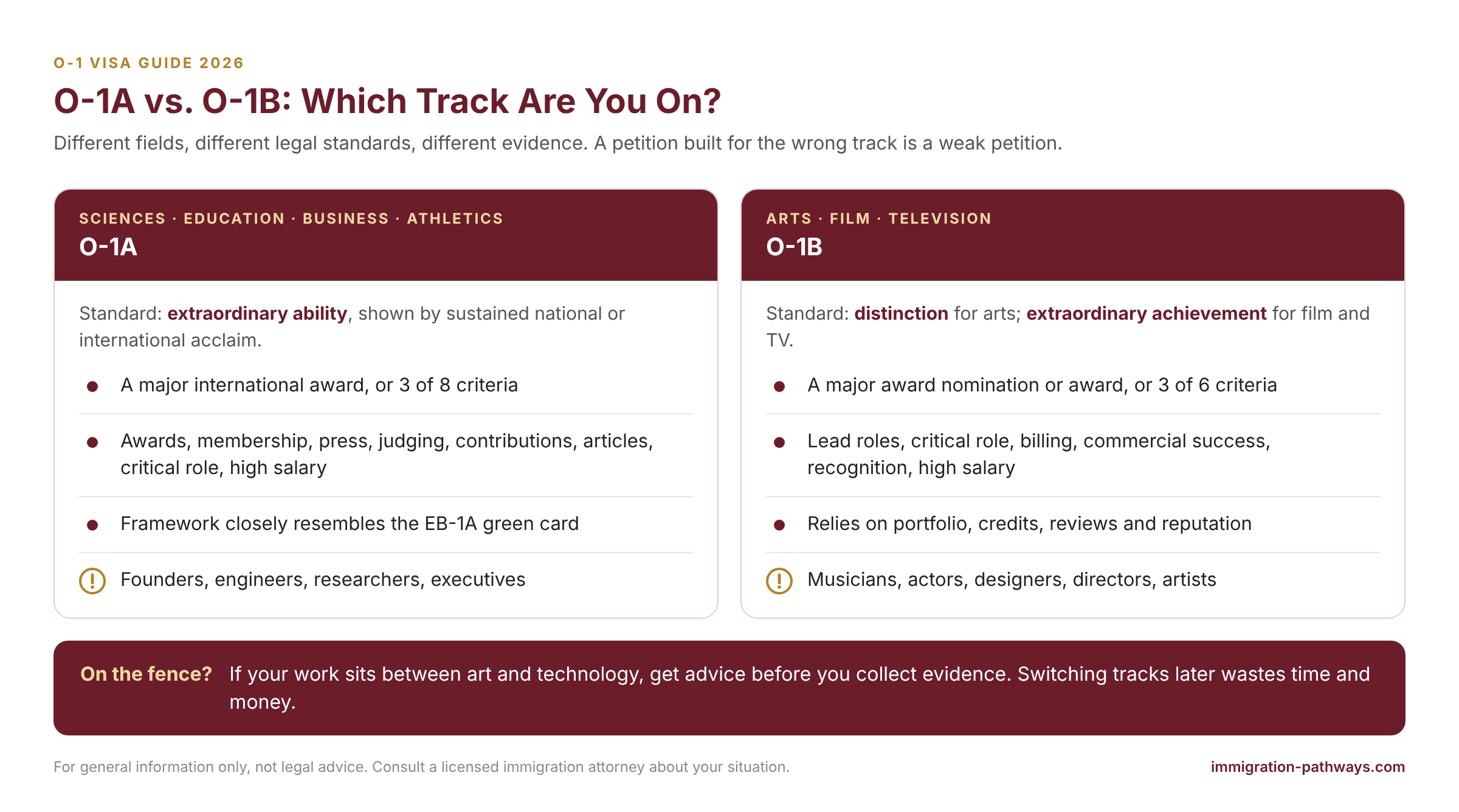
- O-1A (sciences, education, business, athletics) is judged against structured regulatory criteria and specific types of evidence. The framework closely resembles the EB-1A green card standard.
- O-1B (arts, film, television) relies more on portfolio, press coverage, credits and industry reputation. O-1B in the arts uses the "distinction" standard, which is meaningfully lower than O-1A's "extraordinary ability." O-1B for film and TV uses "extraordinary achievement."
The line between the two is not always clear. If your work sits between art and technology, talk to an attorney before you assemble evidence; building for the wrong track wastes significant time and money.
O-1A Requirements: The 8 Criteria USCIS Looks For
Unless you have a major, internationally recognized award (a Nobel Prize, an Olympic medal or similar), you must meet at least 3 of these 8 criteria under 8 CFR 214.2(o)(3)(iii):
- Awards: nationally or internationally recognized prizes or awards for excellence in your field
- Membership: membership in associations that require outstanding achievement, as judged by recognized national or international experts
- Press: published material about you in professional or major trade publications or other major media
- Judging: judging the work of others in your field, individually or on a panel
- Original contributions: original scientific, scholarly or business contributions of major significance
- Scholarly articles: authorship of scholarly articles in professional journals or other major media
- Critical role: employment in a critical or essential capacity for organizations with a distinguished reputation
- High salary: a high salary or other pay compared with others in your field
Meeting 3 criteria is the minimum, not automatic approval. Read The Two-Step Review below before you build your case. For what strong evidence looks like under each criterion, see O-1 visa evidence: what USCIS actually wants to see.
O-1B Requirements: Arts, Film and Television
O-1B petitions must show distinction (arts) or extraordinary achievement (film and TV), either through a significant national or international award or nomination, or by meeting at least 3 of these criteria:
- A lead or starring role in productions or events with a distinguished reputation
- National or international recognition for achievements, shown by critical reviews or other published material
- A lead, starring or critical role for organizations with a distinguished reputation
- A record of major commercial or critically acclaimed successes
- Significant recognition from organizations, critics, government agencies or recognized experts
- A high salary or other pay compared with others in the field
The Two-Step Review: Why O-1 Cases Actually Fail
USCIS reviews O-1A petitions in two steps. The approach comes from Kazarian v. USCIS, 596 F.3d 1115 (9th Cir. 2010), which USCIS adopted in a December 2010 policy memo and later built into the USCIS Policy Manual.
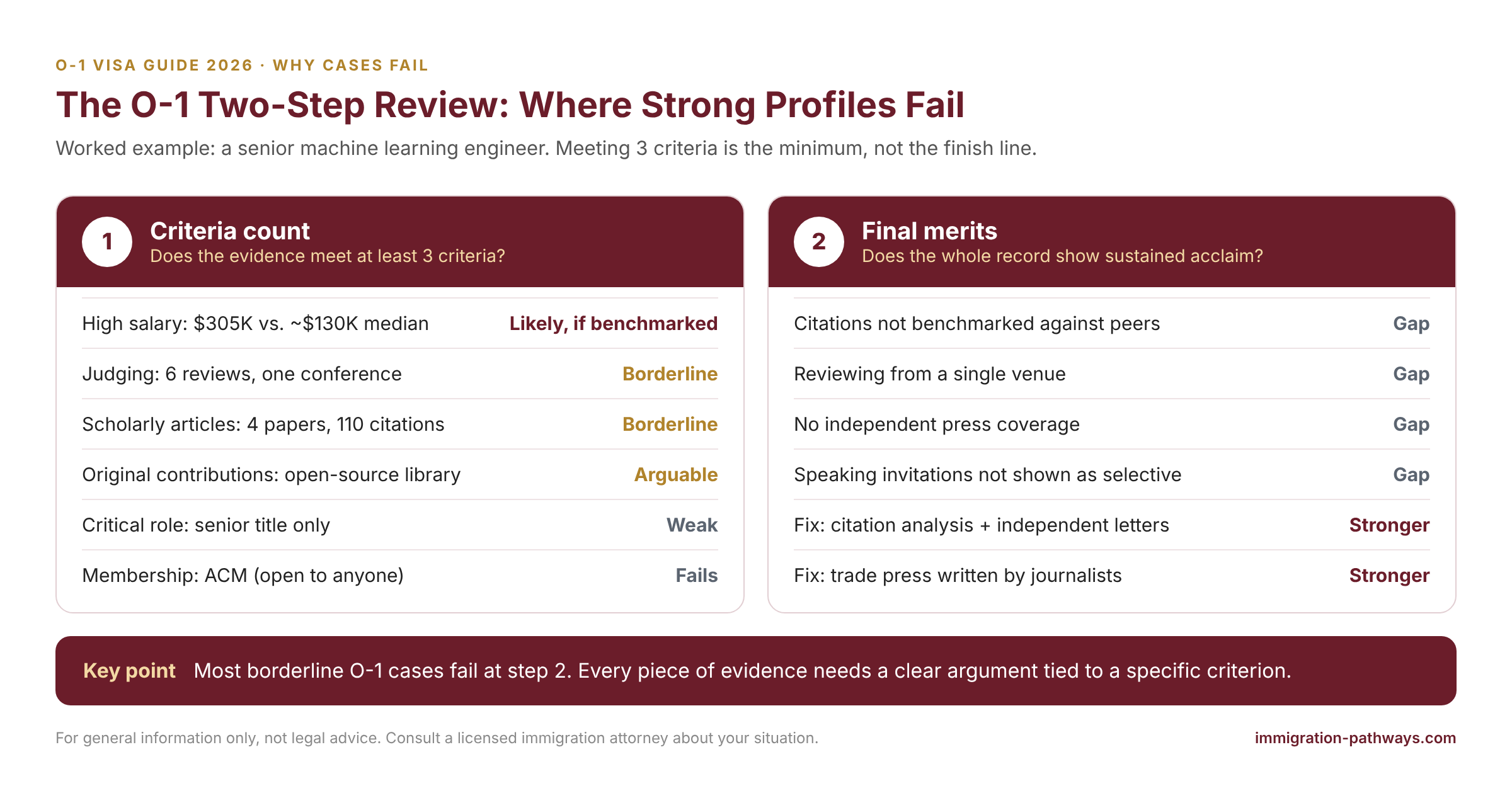
- Step 1, criteria count: does the evidence, taken at face value, meet at least 3 criteria?
- Step 2, final merits determination: even with 3 criteria met, does the evidence as a whole show sustained national or international acclaim that places you at the top of your field?
Step 2 is where most borderline cases fail. Submitting documents is not enough. Each piece of evidence must be tied to a specific criterion with a clear legal argument, and the full record must tell one coherent story: this person is at the top of their field, recognized by the field itself, over time.
Worked example: a machine learning engineer
Sample profile:
- Senior ML engineer at a well-known technology company, $305,000 total compensation
- 4 conference papers with 110 citations combined (Google Scholar)
- Reviewed 6 papers for one ML conference over two consecutive years
- Co-author of an open-source ML library with 3,400 GitHub stars
- Speaker at two industry conferences
- Member of the ACM
Step 1 analysis:
- High salary ($305K vs. a BLS median of about $130K for software developers): likely meets the criterion, but only if the brief cites the BLS benchmark. The number alone is not the argument.
- Judging (6 reviews, one conference, two years): borderline. "Sustained" is arguable; you must document the conference's selectivity and that reviewing was by invitation.
- Membership (ACM): fails. ACM is open to anyone, and this criterion requires membership that demands outstanding achievement.
- Scholarly articles (4 papers, 110 citations): borderline. It depends on field norms; 110 citations in ML may be average or strong depending on subfield and career stage, so it must be benchmarked.
- Original contributions (open-source library, 3,400 stars): arguable. "Major significance" requires proof of real adoption and impact, not just usage numbers.
- Critical role (senior title at a known company): weak as submitted. You must show the organization has a distinguished reputation and that your role was critical to it.
Step 2 (assuming step 1 is met): USCIS would still ask whether the whole record shows sustained national or international acclaim, and here it may not. Citations are not benchmarked, the reviewing comes from one venue, there is no independent press, and the speaking invitations are not shown to be selective. An RFE would likely ask for a citation analysis, proof that reviewing was by invitation, and independent coverage of the contributions.
What changes the outcome:
- A citation analysis showing 110 citations puts this researcher in the top 10 to 15 percent of ML researchers at their career stage
- Proof that the conference is highly selective (acceptance rate, h5-index) and that reviewing was by invitation, not self-nomination
- Trade press about the open-source library written by journalists, not the employer's PR team
- Letters from 2 or 3 independent ML researchers who quantify the contributions and compare the petitioner with peers in the subfield
Evidence Strategy: What Actually Gets Approved
Most weak O-1 cases fail because they are assembled, not argued. Evidence goes in without the legal analysis connecting it to a criterion. Officers are not required to infer your argument, and they won't build your case for you.
Strong cases
- Tell a coherent story of sustained, externally recognized impact
- Show validation from people and institutions with no relationship to the petitioner
- Quantify impact wherever possible: citations, adoption metrics, revenue, market share, audience numbers
- Show progression over time, not a single achievement
Weak cases
- Submit documents without explaining what they prove
- Rely on letters from managers, collaborators or people at the petitioner's own institution
- Claim criteria that don't meet the regulatory standard (open memberships, employer awards, internal press releases)
- Assume the officer will draw favorable conclusions
Criterion by criterion: common mistakes and what works
- Awards. Mistake: employee recognition, participation certificates, regional awards; these are not nationally or internationally recognized or merit-based. What works: awards with an independent selection process, a competitive acceptance rate and an external judging committee.
- Membership. Mistake: IEEE, ACM and other open professional societies. What works: elected fellowships, nomination-based honor societies and invitation-only bodies with documented selection criteria.
- Press. Mistake: employer press releases, LinkedIn posts, company blog mentions; these are not independent, not major media, or not about you. What works: named articles in trade publications, written by journalists, about your specific work, not just your company.
- Judging. Mistake: one review for one conference; not sustained and possibly not by invitation. What works: regular reviewing for named journals, invited panels and award committees, with proof of how you were selected.
- Original contributions. Mistake: internal projects or patents with no evidence of adoption. What works: published research with citations, open-source tools with adoption metrics, and patents that are licensed or in commercial use, all documented.
- High salary. Mistake: stating the number. What works: a BLS or industry survey comparison showing your pay exceeds the median for your role, region and experience, cited in the legal brief.
- Critical role. Mistake: a senior title at a well-known employer; a title is not a critical role, and a famous company is not automatically "distinguished" under the regulation. What works: proof that the organization has a distinguished reputation and that your specific role was essential to a critical function.
Recommendation Letters That Help (and Ones That Don't)
Weak letters
- Written by managers, direct collaborators or people at your own institution
- Generic praise without specifics
- No metrics, no comparison with peers, no explanation of why the work matters to the field
Strong letters
- Written by independent experts with no professional relationship to you
- Quantify specific contributions ("this paper has been cited 47 times and changed how our subfield approaches X")
- Compare you directly with others in the field ("in 20 years of reviewing work in this area, fewer than 5 percent of researchers have produced contributions of this significance")
- Explain the significance to the field, not just your personal excellence
A letter from a Nobel laureate who managed you directly is generally weaker than a letter from an independent researcher who has never worked with you but can describe exactly how your work influenced theirs.
Aim for 3 to 6 letters from independent experts. Independent means a different institution, no co-authorship and no direct working relationship. More letters from weak sources do not make up for fewer letters from strong, independent ones.
You Still Need a Petitioner: A Common Structuring Mistake
Unlike the EB-1A green card, you cannot self-petition for an O-1. A U.S. employer or agent must file Form I-129 for you. Mistakes here are among the leading causes of denials, especially for founders and freelancers.
Standard employer petitioner
If a U.S. company is offering you a full-time role, that employer files as the petitioner. This is the simplest setup.
Agent petitioner (founders, freelancers, multiple employers)
If you are a founder, an independent consultant or working for several clients at once, a U.S. agent can file for you. An agent can be:
- A management company or talent agency
- An individual acting as your representative
- In some cases, your own U.S. company, under important conditions
When your own company is the petitioner, USCIS looks closely at whether there is a real employer-employee relationship and real oversight of your work. A sole owner petitioning for themselves faces extra scrutiny. The petition must show real work, actual clients or projects, a legitimate business and, importantly, some form of third-party control. USCIS policy guidance from January 2025 confirms that a company you own can petition for you, as long as there is a proper oversight structure, such as a board of directors with real authority over your work.
What USCIS checks in agent petitions
- Is there real, itinerary-based work, not a paper arrangement?
- Is the relationship between petitioner and beneficiary legitimate and documented?
- Is there a written contract or engagement agreement for each project?
- Is there a realistic itinerary of engagements, or an explanation of why the work makes one impossible?
Agent petitions must explain the terms and conditions of employment and include a complete itinerary (or an explanation of why there can't be one). Missing either one will very likely lead to an RFE.
O-1 vs. H-1B: When Each Makes Sense
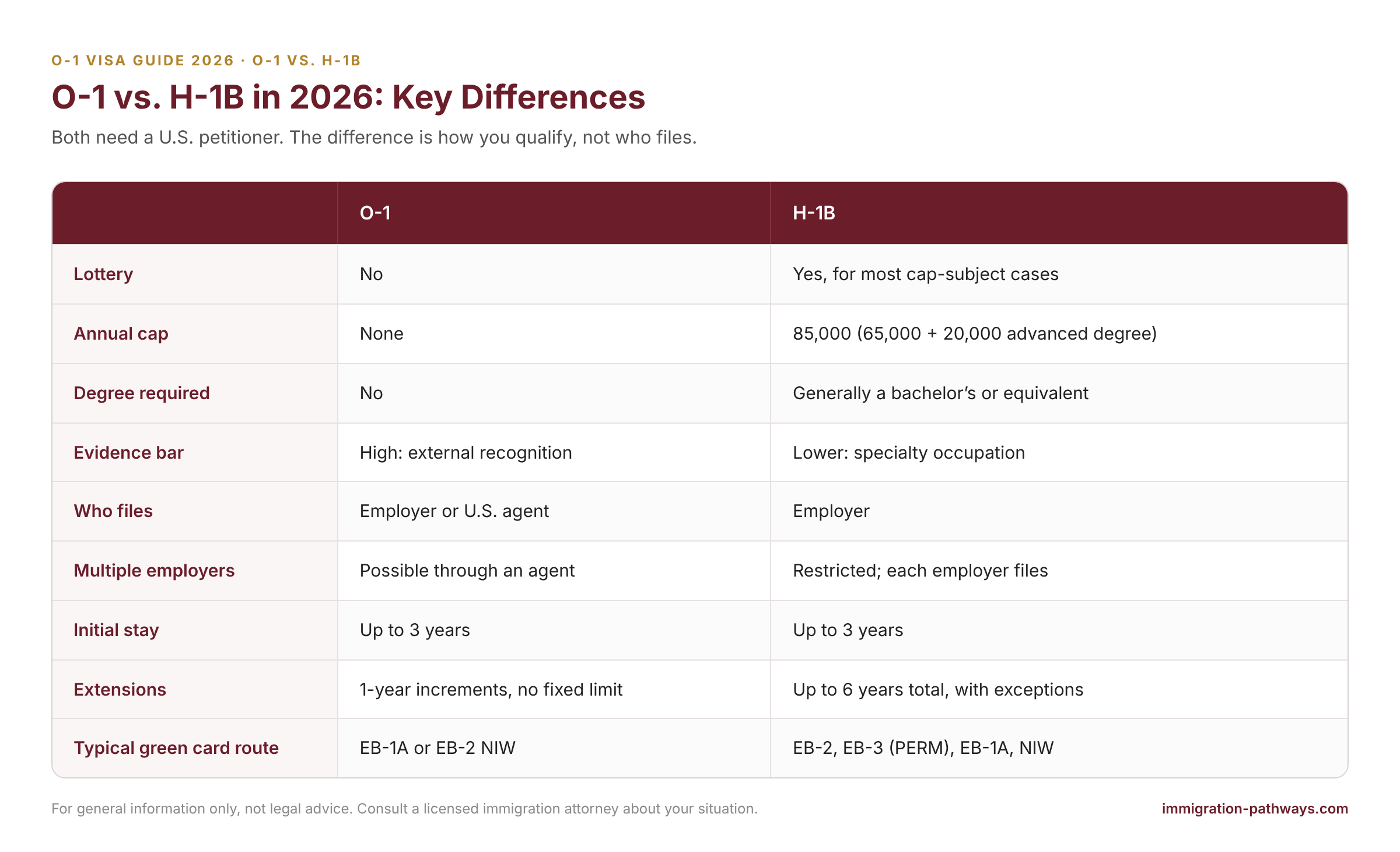
- Lottery: O-1, no. H-1B, yes for most cap-subject cases.
- Annual cap: O-1, none. H-1B, 85,000 per year (65,000 regular plus 20,000 for U.S. advanced degrees).
- Degree required: O-1, no. H-1B, generally a bachelor's degree or equivalent.
- Evidence bar: O-1, high. H-1B, lower.
- Processing: both offer standard or premium processing.
- Who files: O-1, an employer or U.S. agent. H-1B, an employer.
- Multiple employers: O-1, possible through an agent. H-1B, restricted; each employer must file.
- Typical green card route: O-1, EB-1A or EB-2 NIW. H-1B, EB-2, EB-3 or others.
The O-1 is usually the better choice if
- You were not selected in the H-1B lottery and have strong external recognition
- Your field or background makes the H-1B degree requirement hard to meet
- You need flexibility across several employers or engagements
- Your profile is strong enough for the O-1 evidence standard
The H-1B is usually the better choice if
- Your profile lacks the external, independent recognition the O-1 requires
- You prefer a more standardized, predictable process
- Your employer already sponsors H-1B workers routinely
Being on H-1B doesn't stop you from working toward an O-1. Many people keep their H-1B status while building evidence such as publications, judging invitations, press coverage and awards. If you're on H-1B and thinking about the O-1, start collecting documents now rather than waiting for an H-1B problem to force the decision. For the full H-1B picture, see our H-1B Visa 2026 Complete Guide.
How Long Does the O-1 Process Take in 2026?
Before you file
- Evidence review and strategy: 1 to 4 weeks (longer if gaps need filling)
- Gathering documents, letters and supporting material: 2 to 8 weeks
- Drafting the legal brief and preparing Form I-129 with an attorney: 2 to 4 weeks
USCIS processing after filing
- Standard processing: recently about 12 to 15 months for O petitions, and it changes often. CHECK: confirm the current O-1 time on egov.uscis.gov/processing-times (Form I-129, O category) before publishing.
- Premium processing: USCIS acts within 15 business days. That is a decision or an RFE, not a guaranteed approval. An RFE pauses the premium clock.
If you are outside the United States
After the I-129 is approved, you need a visa interview at a U.S. consulate or embassy to get the O-1 visa stamp. Appointment availability varies widely by country; in some places, waits for nonimmigrant visa interviews have run 6 to 18 months. An approved I-129 does not mean you can travel to the U.S. right away. Check appointment availability early.
Realistic total timeline
- In the U.S. in valid status, filing a change of status: you can start O-1 work on the approval date or the requested start date, whichever is later.
- Outside the U.S., in a country with short consular waits: about 3 to 6 months from start to entry with premium processing; longer with standard processing.
- Outside the U.S., in a country with long consular waits: 9 to 18 months or more is possible.
The 60-day grace period
If your O-1 employment ends, federal regulations (8 CFR 214.1(l)(2)) give you up to 60 consecutive days, or until your authorized stay ends if sooner, to find a new petitioner, file to change status, or leave the U.S. USCIS can shorten or eliminate the grace period at its discretion, though that is uncommon. You may not work during the grace period. It starts the day after your employment ends.
What Happens After You File: Step by Step
- Receipt notice: USCIS sends a Form I-797C confirming it received your petition, usually within 2 to 4 weeks.
- Premium processing acknowledgment (if requested): a separate notice confirms the 15-business-day clock has started.
- Possible RFE: USCIS may issue a Request for Evidence at any point, including during premium processing. An RFE is not a denial. You generally have up to 84 days (12 weeks) from the date on the notice to respond, plus 3 days if the notice was mailed. The deadline on your notice controls. A weak RFE response can lead to denial.
- Approval notice (I-797B): if approved, the notice shows your validity period.
- If you are in the U.S. (change of status): you can start O-1 work on the approval date or requested start date. You don't need a visa stamp to work inside the U.S.
- If you are outside the U.S.: take the approval notice to a U.S. consulate for visa stamping before you travel. Bring the original I-797 approval notice, your employment contract or agent agreement, your passport and supporting documents.
- Entry at a U.S. port of entry: your I-94 record, not your visa stamp, sets how long you can stay. Check your I-94 at i94.cbp.dhs.gov after every entry.
How Much Does an O-1 Visa Cost in 2026?
- Form I-129 base filing fee (O-1): $1,055 for employers with 26 or more employees; $530 for small employers (25 or fewer) and nonprofits.
- Asylum Program Fee: $600 for larger employers, $300 for small employers, $0 for nonprofits.
- Premium processing (optional): $2,965 since March 1, 2026 (up from $2,805).
- Attorney fees: about $4,000 to $12,000 or more, depending on complexity.
- Expert letter preparation: varies; some petitioners pay consultants, others manage it themselves.
- Translations (if needed): about $200 to $1,000 or more.
- Visa application fee if you are outside the U.S.: $205 for petition-based visas (O, H, L, P, Q, R). Some consulates have also started collecting the $250 Visa Integrity Fee at visa issuance. CHECK: confirm on travel.state.gov whether the $250 Visa Integrity Fee is being collected for O-1 visas.
- Realistic total: about $5,000 to $18,000 or more, depending on employer size, attorney and whether you need consular processing.
If USCIS issues an RFE, responding typically adds $2,000 to $5,000 or more in attorney fees, plus time. A stronger first petition is cheaper than an RFE response. Check all fees at uscis.gov/g-1055 before filing. For the full breakdown, see O-1 visa cost 2026: complete fee breakdown.
Duration, Extensions, and What "Status" Really Means
- Initial approval: up to 3 years.
- Extensions: in 1-year increments, with no fixed limit on the number. Each one needs a new petition showing continued extraordinary ability. USCIS does not have to approve extensions, and a record that hasn't grown since the first petition may get closer scrutiny.
Visa vs. status
Your O-1 visa stamp (in your passport) and your O-1 status (your legal permission to be in the U.S.) are different things. Your stamp can expire while you are in the U.S. in valid O-1 status; that is normal and does not mean you must leave. Your status is shown on your I-94 record, not your visa stamp. You only need a valid stamp to re-enter after international travel.
Dependents: O-2 and O-3
O-3 is for the spouse and unmarried children under 21 of an O-1 holder. O-3 holders can live and study in the U.S. but cannot work. If your spouse needs to work, they need their own work-authorized status. Raise this with an attorney early if it matters to your plans.
O-2 is for essential support personnel who accompany an O-1 artist or athlete for a specific event or performance and are an integral part of it. O-2 is available for O-1B holders and O-1A athletes, but not for O-1A holders in the sciences, education or business.
The Green Card Path: What the O-1 Sets Up (and What It Doesn't)
The O-1 is a temporary visa and does not, by itself, lead to a green card. What it does:
- Lets you stay in the U.S. and keep building your evidence while a green card case develops
- Shows, in a later green card petition, that USCIS once found you met an extraordinary ability standard
EB-1A (extraordinary ability)
EB-1A uses a very similar evidence framework to O-1A but applies a stricter standard. USCIS is not bound by a prior O-1A approval and has denied EB-1A petitions for O-1A holders based on the same evidence. Don't assume an O-1A approval means EB-1A approval; use your O-1 years to strengthen your record. See our EB-1A 2026 guide.
EB-2 NIW (National Interest Waiver)
NIW is a self-petitioned green card based on showing that your work is in the U.S. national interest. The evidence bar is generally lower than EB-1A. For many O-1 holders, especially in STEM, healthcare and research, NIW is the more suitable route. An approved NIW I-140 locks in a priority date, and if your EB-1A case gets stronger later, you can file EB-1A while NIW holds your place in line. See our EB-2 NIW 2026 guide.
Timing reality
An approved green card petition doesn't mean you get the card right away. The Visa Bulletin decides when you can move forward, based on your country of birth and category. Applicants born in India and China can wait years or even decades in employment-based categories. O-1 extensions can help cover that wait. Tell your attorney about your long-term green card plans from the start. See Visa Bulletin explained.
Cross-chargeability
If you and your spouse were born in different countries and your country has a long backlog, you may be able to use your spouse's country of birth for visa availability, as long as you immigrate together. This is one of the most underused planning tools for people facing long waits.
Common Profile Gaps, and How to Fix Them
- No independent press coverage. The press criterion requires major media; employer PR doesn't count. Fix: pitch named trade publications with story angles about your specific work, not your employer.
- Weak judging record. One review at a minor venue fails the criterion. Fix: seek invitations to review for named journals, serve on conference program committees, and keep proof that each was by invitation.
- Only internal awards. Employer recognition carries little weight. Fix: target external awards with independent selection, national or professional body awards, and competitive fellowships.
- No salary benchmarking. A high number without a comparison is not an argument. Fix: pull current BLS wage data for your role and region and compare it explicitly in the legal brief.
- Letters from managers only. Low independence means low weight. Fix: identify 3 to 5 independent experts with no prior relationship and reach out early, since letters take weeks.
- Contributions without adoption evidence. Claiming "major significance" without proof of impact is the most common failure under this criterion. Fix: document citations, downloads, licensing deals, press coverage of the work itself, or statements from people who use it.
If You Get an RFE or a Denial
RFE (Request for Evidence)
An RFE is not a denial. You generally have up to 84 days (12 weeks) from the issue date to respond, plus 3 days if it was mailed, and 14 more days if you live outside the U.S. Your notice may set a shorter deadline, and the deadline on the notice controls.
Your response must address every concern USCIS raised, not just add more documents. Each issue needs specific evidence and a specific legal argument. A response that doesn't answer the question is effectively no response. Work with an attorney experienced in O-1 RFEs in your field. See our O-1 and EB-1A RFE survival guide.
Denial
A denial is not necessarily final. You can refile a stronger petition or appeal to the Administrative Appeals Office (AAO). AAO appeals involve additional fees and often take 6 to 12 months or more; USCIS doesn't publish O-1-specific AAO processing times, so confirm current expectations with an attorney.
A denial does not automatically affect your current status if you hold valid status on another basis. Talk to an attorney before deciding whether to refile, appeal or pursue a different path.
What the O-1 Does Not Do
- An O-1 approval does not guarantee that extensions will be approved.
- An O-1 approval does not establish EB-1A eligibility or bind USCIS in a later green card case.
- O-1 status does not give your spouse work authorization (O-3 does not allow work).
- An expired O-1 visa stamp does not mean your status has expired.
- The O-1 does not protect you if your petitioner withdraws the petition. A written withdrawal by the employer or agent automatically revokes the approval.
- An approved O-1 petition does not let you travel and re-enter freely. You need a valid visa stamp to return, which requires a consular appointment.