H-1B Stamping Delays in 2026: What Happens If You Travel to India?
H-1B stamping in India is backlogged in 2026. See why appointments are scarce, when travel is risky, how 221(g) works, and what to do if stuck.

Vera Kenahan
October 29, 2026 · 22 min read
Short answer: H-1B stamping in India is severely backlogged in 2026. H-1B renewals no longer qualify for the interview waiver (Dropbox), third-country stamping has ended, and new social media vetting has cut daily interview capacity. If you travel without a valid visa stamp, you may wait months or longer to return. Unless your stamp is still valid, do not travel without a confirmed appointment.
This article reflects conditions reported through October 2026 and is not a guarantee of current consular wait times or policies. Appointment availability and State Department policies can change with little notice. Always check current appointment availability before making travel plans. This is not legal advice.
Start Here: Which Situation Are You In?
- Valid H-1B visa stamp, stable employer, short trip (lower risk): read Should You Travel to India in 2026?
- H-1B stamp expired, renewal needed (high risk): read What Happens If You Travel to India Without a Valid Stamp and The Biggest Risks in 2026.
- First-time stamping after a recent approval (very high risk): read this entire article before booking flights.
- Already in India and cannot get an appointment (critical): read Consulate Wait Times and 221(g) Administrative Processing.
- Laid off while abroad, or at risk of a layoff (critical): read Laid Off While Abroad.
- H-4 dependents traveling separately (high risk): read H-4 Dependents: Separate Risks.
- Planning a trip for a wedding or family emergency: read Should You Travel to India in 2026? first.
The Current Situation in Plain Terms
In early 2026, all five U.S. consulates in India (New Delhi, Mumbai, Chennai, Hyderabad and Kolkata) showed no H-category visa appointments for the rest of the year, with the first open dates reported in May 2027. Since late March 2026, the posts have released H-1B and H-4 slots in small batches that fill within minutes. There is still no reliable, routine availability. CHECK: confirm current H-1B appointment availability in India before publishing.
This is not a temporary blip. It is the result of three overlapping policy changes in late 2025, and their effects are compounding.
What this means in practice: if you travel to India without a valid H-1B visa stamp and need a new one to return to the United States, you may be unable to return for months, possibly a year or longer. People are losing jobs, selling houses, and being separated from spouses and children in the U.S. This is not because they did anything wrong, but because they traveled at the wrong time without fully understanding the risk.
Why Are H-1B Stamping Appointments in India So Hard to Get?
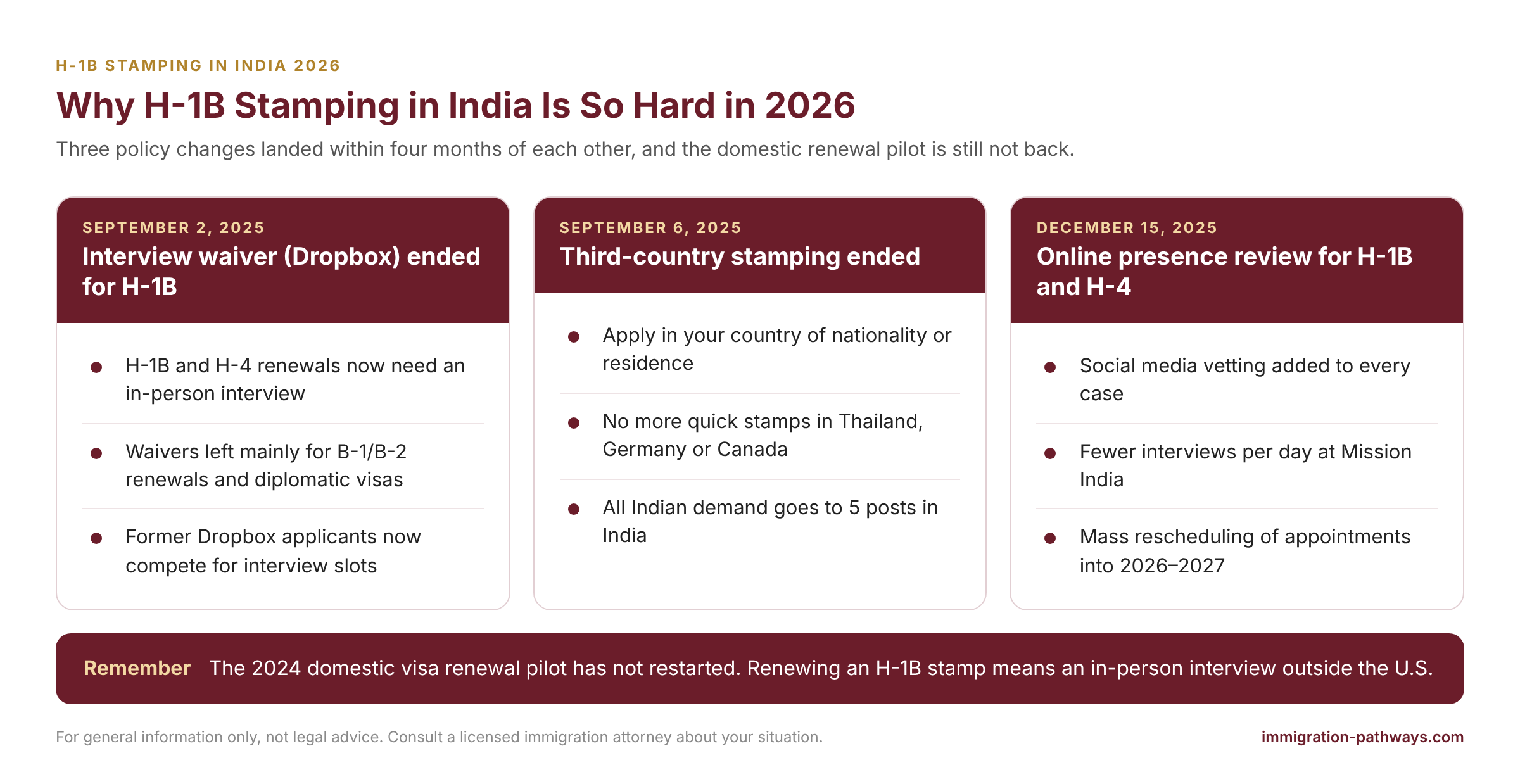
Three separate policy changes in late 2025 created the longest H-1B stamping backlog to date.
Policy change 1: the interview waiver (Dropbox) ended for H-1B
Since September 2, 2025, the State Department has required in-person interviews for almost all nonimmigrant visa applicants. H-1B and H-4 renewals no longer qualify for the interview waiver, often called Dropbox. The waivers that remain cover mainly B-1/B-2 visitor visa renewals (prior visa expired within the last 12 months and issued when the applicant was at least 18), certain H-2A renewals, and diplomatic and official visas. Even then, the consular officer can still require an interview. CHECK: confirm on the U.S. Mission India visa site that no H-1B Dropbox option is currently offered.
Before September 2025, many H-1B renewal applicants could submit documents through Dropbox without an interview. That option is gone. Everyone who used to rely on Dropbox now competes for in-person interview slots, which has flooded the queue.
Policy change 2: third-country stamping ended
Since September 6, 2025, nonimmigrant visa applicants must schedule interviews in their country of nationality or residence. This ended "third-country stamping," where applicants booked appointments in another country to avoid long waits at home. Indian H-1B workers who might once have flown to Thailand, Germany or Canada for a faster stamp can no longer do so. All demand from Indian nationals is now concentrated at the five consulates in India.
Policy change 3: social media vetting added to every interview
The State Department added a mandatory online presence (social media) review for H-1B and H-4 applicants, effective December 15, 2025. Consular posts in India then began rescheduling H-1B and H-4 appointments originally set for December 2025 and later, moving many of them into 2026 and 2027. The extra review has also reduced how many interviews Mission India can handle each day.
The domestic visa renewal pilot is not back either
The State Department's 2024 pilot, which let some H-1B workers renew their visa stamps without leaving the U.S., ran only from January to April 2024 and has not restarted. Members of Congress have urged the State Department to bring it back, but no date has been announced.
I-797 vs. Visa Stamp vs. I-94: The Distinction Most H-1B Workers Miss
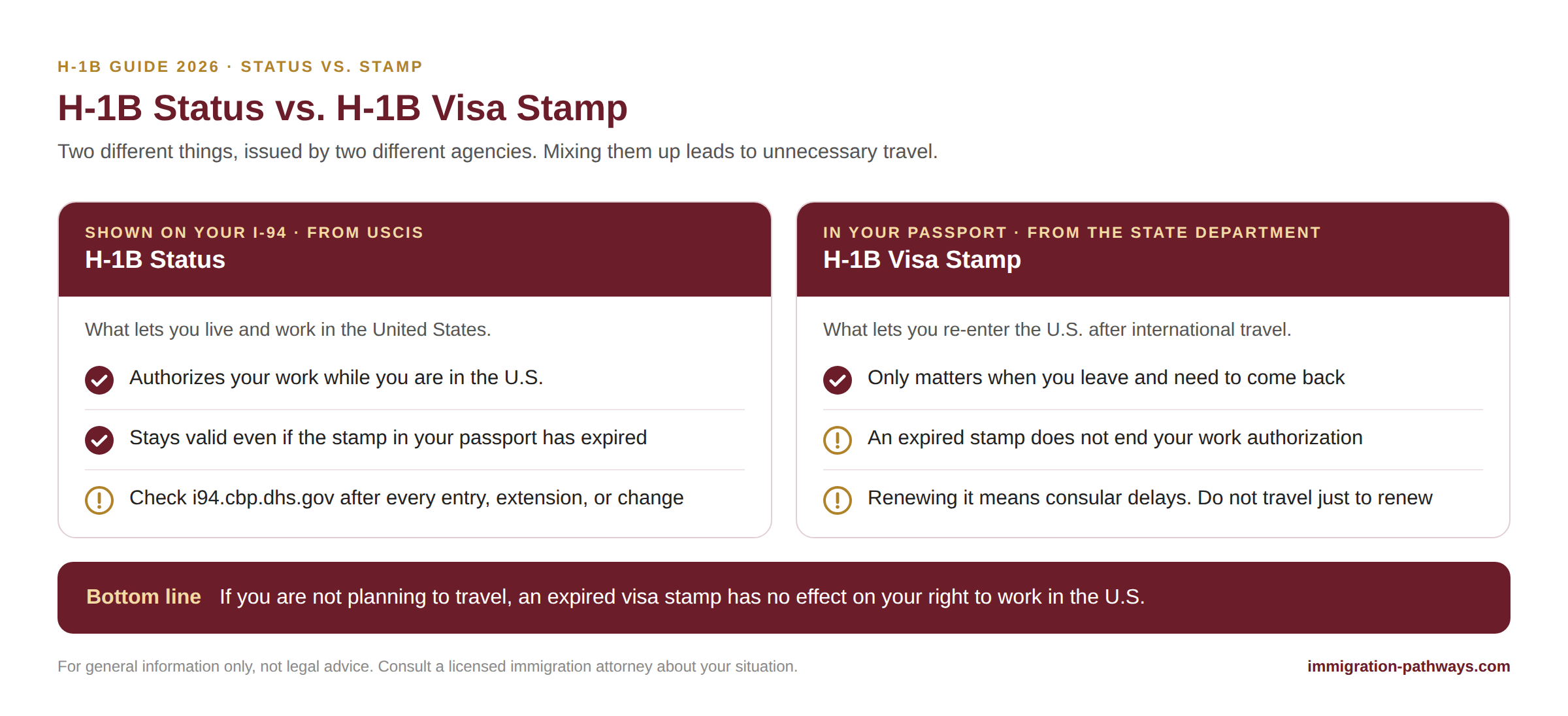
Before going further, this is the single most important concept to understand: H-1B petition approval, the visa stamp and U.S. admission are three separate things.
- I-797 approval notice (H-1B petition): granted by USCIS. It authorizes your U.S. employer to employ you in H-1B status.
- Visa stamp: issued by a U.S. consulate and placed in your passport. It lets you seek entry at a U.S. port of entry.
- I-94 admission record: issued by U.S. Customs and Border Protection (CBP) when you enter. It sets your authorized period of stay in the U.S.
The key implication: if you are in the United States in valid H-1B status and your visa stamp expires, you can keep working legally. An expired stamp does not affect your work authorization while you are inside the U.S. The stamp matters only when you leave and want to come back.
This is the detail many people miss. They leave for what should be a short trip, find out their stamp has expired or that they need a new one for a recently approved petition, and then discover there are no appointments for months. For more on H-1B rules and fees, see the H-1B visa 2026 complete guide.
What Happens If You Travel to India Without a Valid H-1B Stamp
Here is how a realistic trip plays out, step by step.
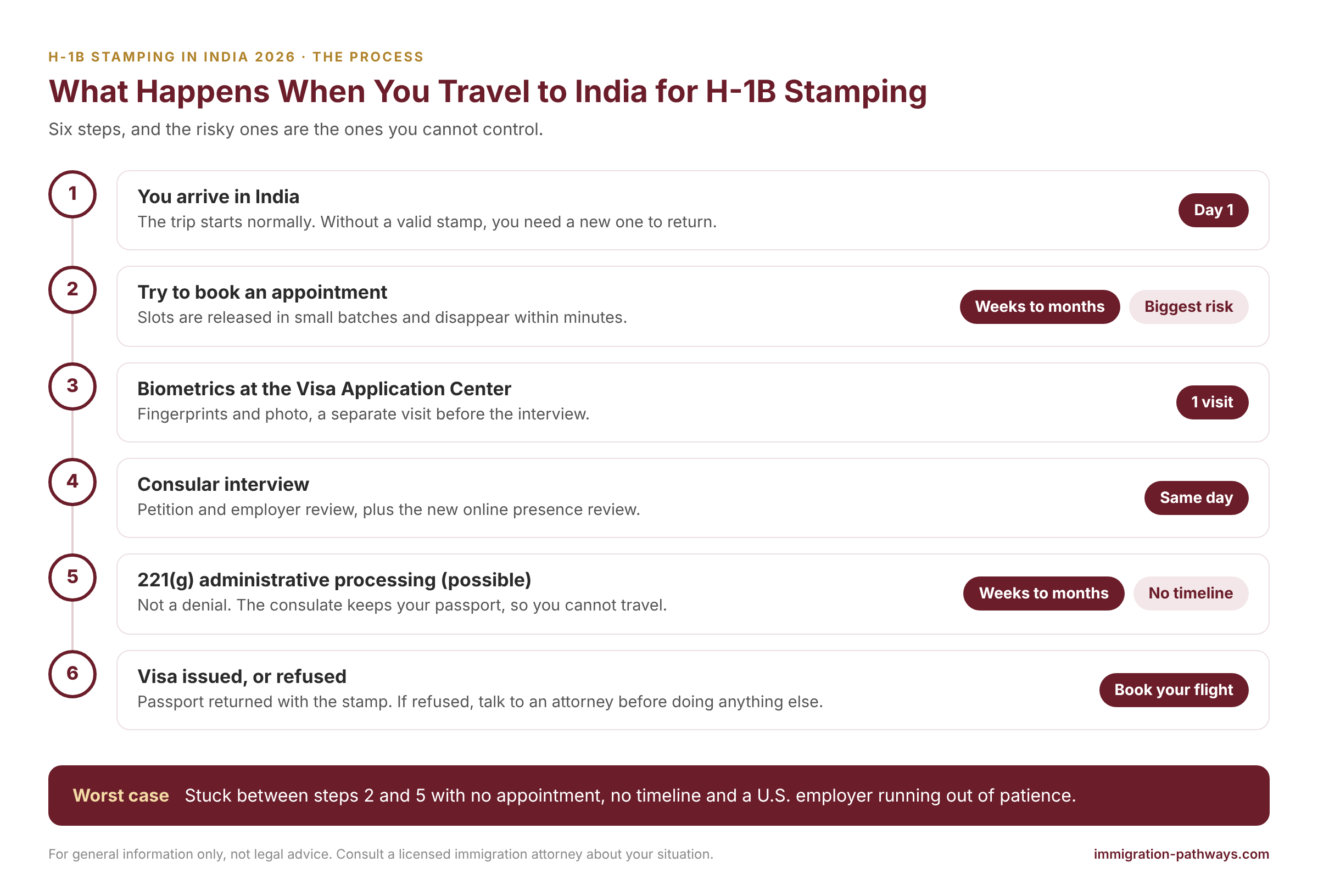
- You arrive in India. The trip starts normally. If your stamp is still valid for your return, you can travel back on it. If you need a new stamp, you need an in-person interview, and that is where the risk begins.
- You try to schedule an appointment. You log into the scheduling system and find little or nothing available. Slots are released in small batches and disappear within minutes.
- Biometrics appointment. Once you get a slot, you first attend a biometrics appointment (fingerprints and photo) at a Visa Application Center (VAC). This is separate from the consular interview.
- Consular interview. The officer reviews your petition and employer documents and now also your online presence. Straightforward renewals usually have short interviews. First-time stamps and complex cases get more scrutiny.
- 221(g) administrative processing (possible). After the interview, you may receive a 221(g) notice. This is not a denial. It means the consulate needs more documents or a security clearance. It can take weeks or months with no guaranteed timeline, and the consulate keeps your passport, so you cannot travel.
- Visa issued, or refused. If approved, your passport comes back with the visa stamp and you can book your flight home. If refused, find out the reason before doing anything else and talk to an attorney right away.
The worst case: you are stuck somewhere between steps 2 and 5, with no appointment, no timeline, and a U.S. employer running out of patience. Thousands of H-1B workers are in this situation right now.
The Biggest Risks in 2026
Risk 1: no appointment available
H-1B workers who traveled to India for what should have been a routine stamping appointment are unable to return to the U.S. because they cannot get an interview date. The wait can stretch for weeks or months.
There is no guaranteed way to expedite a consular appointment for employment-based stamping. U.S. Mission India runs an emergency request process, but approvals are discretionary and are typically reserved for urgent humanitarian or medical situations, not job needs.
Risk 2: administrative processing under 221(g)
Even after you get an appointment and attend the interview, the officer may place your case in administrative processing under INA Section 221(g). That means more review is needed before the visa can be issued.
Common triggers include:
- Employment in technology or national-security-sensitive fields
- Prior visa refusals or immigration violations
- Inconsistencies between the petition and your interview answers
- Social media content that raises concerns during the online presence review
- Complex employer structures
- Certain nationalities or fields subject to mandatory security checks (for example, Visas Mantis or the Technology Alert List)
What 221(g) means in practice: the consulate keeps your passport, so you cannot travel. You will not get a specific timeline. Many cases resolve; some end in denial.
In some long-delayed 221(g) cases, applicants file a federal lawsuit to force a decision (a Writ of Mandamus). It is expensive and uncertain, and should be discussed with an attorney who specializes in consular processing litigation.
Risk 3: being laid off while abroad
This is the highest-risk and most complicated scenario, so it has its own section below.
Laid Off While Abroad: What Happens and What to Do
This is more common in 2026 than most people expect. Workers traveled to India with H-1B petitions that were valid on paper and were laid off while abroad. Under current conditions, their options are limited.
What happens to your status. Your H-1B petition was filed by your employer. When the employer ends your employment, it generally must notify USCIS and withdraw the petition. Once your employment ends, you no longer have a valid H-1B basis to return.
If you are abroad when your job ends, you do not get the 60-day grace period to find a new sponsor, change status or leave. That grace period applies only to people physically in the U.S. in valid status. For the in-U.S. version of this situation, see Laid off on H-1B: the 60-day grace period and your options.
Can another employer sponsor you from India? In theory, yes. In practice, there are several obstacles:
- The new employer must file a new H-1B petition. Premium processing gets a USCIS decision in 15 business days, but that is only the first step.
- You cannot be admitted on the new petition until it is approved and you have a visa stamp for the new employer.
- A new stamp requires an appointment, which is the bottleneck described above.
- A new H-1B petition for a worker outside the U.S. may also trigger the $100,000 payment required since September 21, 2025, depending on the circumstances. See H-1B in 2026: policy changes.
- Some employers are reluctant to hire candidates who are abroad with no clear return date.
Can you return on your old visa stamp if your employer has not yet withdrawn the petition? Some people point to a narrow window before the employer notifies USCIS. This carries serious risk. CBP officers can and do ask about current employment and may contact the employer, and being refused entry can have long-term immigration consequences. Do not try this without legal advice.
What about your spouse and children in the U.S.? H-4 status depends on your H-1B status. If your H-1B status ends, your H-4 dependents must change status, leave the U.S., or find another immigration basis. Consult an attorney immediately if this happens.
Remote work from India: a partial option, not a solution. Some employers allow stranded workers to work remotely from India case by case. It depends on payroll, tax, data security and local labor law, and it creates tax, labor and permanent establishment risks for the employer. It does not solve the re-entry problem, but it can reduce business disruption and buy time if the employer is willing and the legal structure supports it.
Consulate Wait Times: The Current Situation
All five consulates in India have shown little or no routine H-1B availability in 2026. Conditions change week to week, so check current availability before making any decisions.
- Early 2026: New Delhi, Mumbai, Chennai, Hyderabad and Kolkata showed no routine H-1B appointments for the rest of 2026, with the earliest slots reported in May 2027.
- Late March 2026: H-1B and H-4 slots reopened in small batches, first at Chennai and Hyderabad, covering April to June 2026. H-4 slots were fewer than H-1B slots.
- Since spring 2026: all five posts have released slots in small, unscheduled batches that fill within minutes. There is no predictable routine availability.
Expedite requests. U.S. Mission India accepts emergency requests for documented urgent situations, such as life-threatening medical emergencies. If an emergency request is approved, you typically get a short window, about 10 days, to book the earlier appointment. Job urgency alone generally does not qualify. Check the consulate's current criteria, as these policies change.
Third-Country Stamping: What Changed and What Remains
What changed. Since September 2025, applicants must schedule in their country of nationality or residence. This is a standing policy, not a temporary restriction.
Are there exceptions? Applicants from countries with closed or limited consulates, such as parts of the Middle East, have been directed to designated posts elsewhere. Options vary and are not guaranteed. For Indian nationals, there are currently no routine third-country options. If you legally reside in another country (not just as a visitor), that country may count as your country of residence, but this is fact-specific and needs legal advice.
Domestic renewal. The 2024 domestic visa renewal pilot, which let some workers renew stamps without leaving the U.S., has not restarted, and no restart has been confirmed.
Should You Travel to India in 2026?
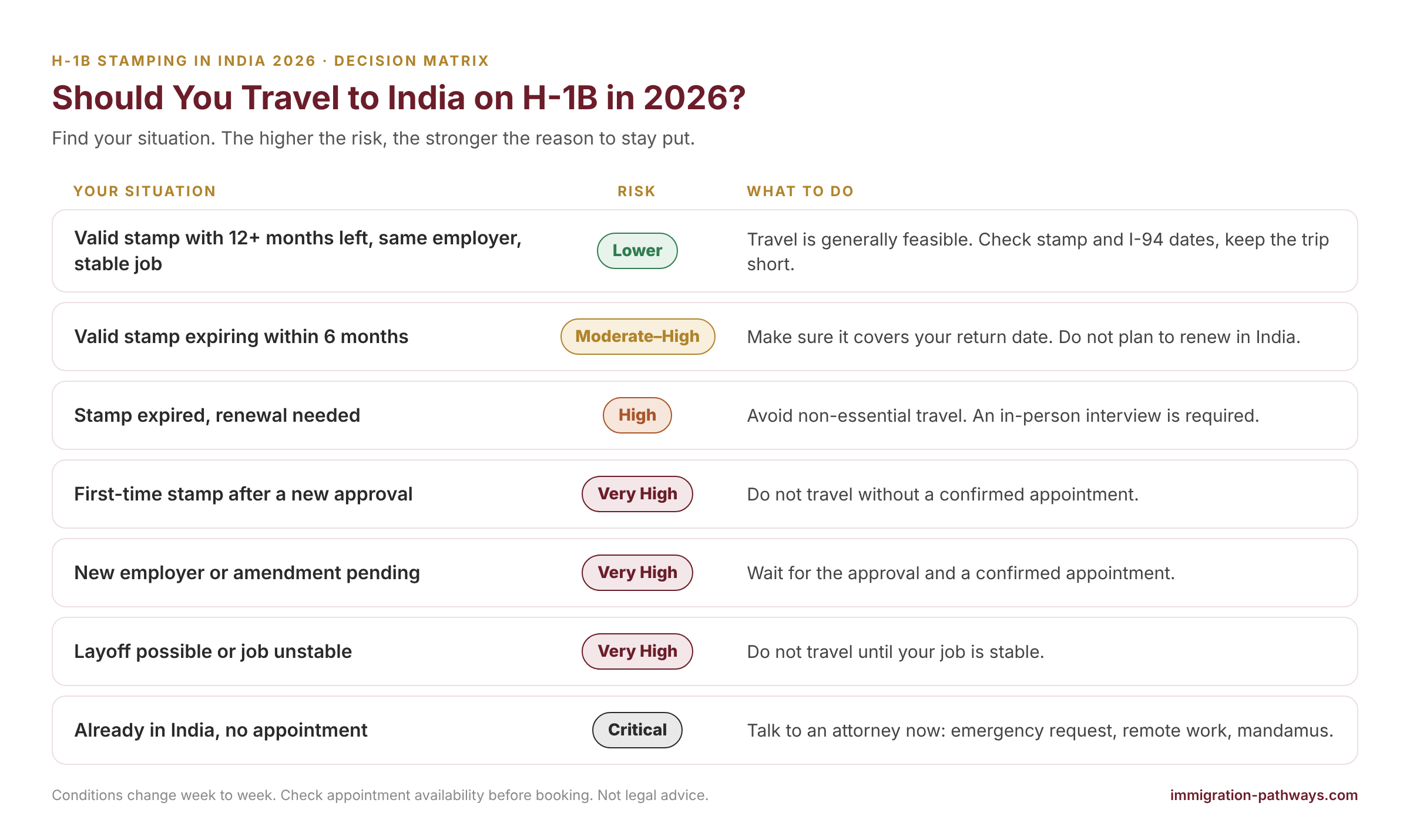
- Valid H-1B stamp with 12+ months left, same employer, stable job (lower risk): travel is generally feasible. Check your stamp and I-94 dates before you leave and keep the trip short.
- Valid stamp expiring within 6 months (moderate to high risk): make sure it is still valid on your return date. Do not plan to renew it in India.
- Stamp expired, renewal needed (high risk): avoid non-essential travel. You will need an in-person interview, and you may not be able to return for months.
- First-time stamping after a new H-1B approval (very high risk): do not travel unless you have a confirmed appointment before you leave.
- New employer, or an amendment pending (very high risk): do not travel. Wait for the approval and a confirmed appointment.
- Layoff possible or job unstable (very high risk): do not travel until your job is stable. Being abroad when a layoff happens sharply limits your options.
- Already in India with no appointment (critical): contact an immigration attorney right away and explore every option: emergency request, remote work, and, in long-delayed cases, mandamus litigation.
Dropbox (Interview Waiver) in 2026: Who Still Qualifies?
Dropbox let eligible applicants renew a visa by submitting documents without an in-person interview. Since September 2, 2025:
- H-1B and H-4 applicants do not qualify. Renewals now require an in-person interview, whether your last stamp expired last month or years ago.
- First-time H-1B stamps have always required an interview.
- The age-based exemptions for applicants under 14 and over 79 were removed, so children and older dependents also need interviews.
- Remaining waivers cover mainly B-1/B-2 renewals within 12 months of expiration, certain H-2A renewals, and diplomatic and official visas, always subject to consular discretion.
What 221(g) Administrative Processing Actually Means
A 221(g) notice after your interview is one of the most stressful outcomes because it gives no clear timeline or resolution date.
What happens:
- You attend your interview and the officer gives you a 221(g) slip.
- The consulate keeps your passport, so you cannot travel.
- The consulate may ask for more documents, or simply say your case needs additional review, sometimes a security advisory opinion.
- There is no guaranteed timeline. Many cases resolve within weeks, some take months, and some end in refusal.
Consulates in India use slips of different colors, and applicants often try to read meaning into the color. Rely on what the slip actually says: whether it asks you for documents, tells you no action is needed while your case is reviewed, or states a refusal.
What you can do during 221(g):
- Respond quickly and completely to any document request.
- Track your case on CEAC (Consular Electronic Application Center).
- If there is no movement after 90 days or more, ask an attorney whether mandamus litigation makes sense.
- Contact your member of Congress. Constituent services offices can sometimes inquire about administrative processing delays.
H-4 Dependents: Separate Risks
H-4 spouses and children go through the same stamping process as the H-1B worker and face the same appointment backlog. Key points for dependents:
- H-4 appointments are usually scheduled together with the H-1B principal, and both are subject to current wait times.
- An H-4 EAD (work permit for eligible H-4 spouses) depends on the principal's valid H-1B status. If the principal's employment ends, the H-4 EAD ends too.
- Children in H-4 status cannot work in the U.S.
- Indian nationals, including H-4 dependents, must complete biometrics and the interview in India.
- Children under 14 now need an in-person interview as well.
Traveling separately. H-4 holders can travel to India without the H-1B principal, but they face the same appointment constraints. If the principal's status changes while the H-4 holder is abroad, it affects their status too, so coordinate travel carefully.
Long-Term Solutions: Reducing Your Dependence on H-1B Travel
As travel risk becomes harder to predict, more H-1B workers are looking at pathways that reduce their dependence on the H-1B system.
O-1 visa
The O-1 is a temporary work visa for people with extraordinary ability in the sciences, business, technology, arts or athletics.
- No lottery and no annual cap
- Extensions in one-year increments, with no hard maximum
- Builds evidence toward an EB-1A green card petition
The caveat: the O-1 still requires consular stamping when you travel, so it does not avoid the appointment backlog. It removes the lottery and the H-1B limits from future visa cycles. See O-1 visa evidence and O-1 visa cost.
EB-1A: extraordinary ability green card
EB-1A lets people at the top of their field self-petition for a green card, without employer sponsorship or PERM labor certification.
- A green card removes the need for a visa stamp entirely: permanent residents re-enter on their green card.
- No employer dependency: changing jobs does not affect it.
- For applicants born outside India and China, EB-1 is current in the November 2026 Visa Bulletin, so approval can lead to a green card relatively quickly.
The caveat: EB-1A has a very high evidence bar. For India-born applicants, the EB-1 Final Action Date is February 1, 2023 in the November 2026 Visa Bulletin, so even an approved I-140 means a multi-year wait. See EB-1A in 2026.
EB-2 NIW: National Interest Waiver
EB-2 NIW lets you self-petition for a green card based on work of national importance, without employer sponsorship or PERM.
- Filing the I-140 sets your priority date, your place in line, right away.
- An approved I-140 generally lets you keep that priority date even if you change employers.
- It reduces your dependence on employer-sponsored PERM.
The caveat: for India-born applicants, the EB-2 Final Action Date is November 1, 2013 in the November 2026 Visa Bulletin, the longest wait in the employment-based system. For Indian nationals, NIW is mainly about securing a priority date and flexibility, not speed. See EB-2 NIW 2026 guide.
Visa Bulletin dates change monthly. Always check the current bulletin at travel.state.gov, and see Visa Bulletin explained for how to read it.
Frequently Asked Questions
Can I travel to India with an approved H-1B but no valid stamp?
You can leave; no one stops you from departing. But you cannot return to the U.S. until you get a valid visa stamp. With current appointment availability, that could take months or longer.
Does my H-1B stamp need to be valid while I'm working in the U.S.?
No. A visa stamp is only needed to enter the U.S. after international travel. An expired stamp does not affect your work authorization while you are in the U.S. on a valid I-94.
What is the difference between my I-797 and my visa stamp?
Your I-797 is the USCIS approval notice. It confirms your employer may employ you in H-1B status. Your visa stamp is issued by a U.S. consulate and lets you seek entry at a U.S. port of entry. They are separate documents with separate purposes.
Can I use automatic visa revalidation to return from India?
No. Automatic visa revalidation lets certain people re-enter with an expired stamp only after trips of 30 days or less to Canada, Mexico or, in some cases, adjacent islands. It does not apply to travel to India.
Can I still use Dropbox to renew my H-1B stamp?
Not under current rules. Since September 2, 2025, H-1B and H-4 renewals require an in-person interview. The remaining interview waivers cover mainly B-1/B-2 renewals and diplomatic visas.
Can I expedite my H-1B stamping appointment?
Consulates consider emergency requests for real emergencies, typically life-threatening medical situations or a death in the family. Job needs alone have generally not been accepted. Check the consulate's current criteria, as they change.
What is 221(g) and how long does it take?
221(g) is a hold after your interview that means more review is needed. The consulate keeps your passport. It can take anywhere from about two weeks to six months or more, with no guarantee. Respond quickly to any document request, track your case on CEAC, and talk to an attorney if there is no movement after 90 days.
Can I work remotely from India while waiting for my stamp?
It depends on your employer and the legal setup. Working from India for a U.S. employer creates tax, labor law and permanent establishment risks for the employer, and some employers allow it case by case. It does not fix your immigration situation; it only manages the work disruption while you wait.
What happens if I'm laid off while in India?
Your H-1B basis ends with your employment. The 60-day grace period applies only to people physically in the U.S., so it does not help you abroad. A new employer can sponsor you, but you will still need a new petition approval and a new stamp, which means waiting for an appointment. Consult an attorney immediately.
Can a new employer sponsor an H-1B for me while I'm in India?
Yes, they can file a new petition. But you still need a valid visa stamp to enter once it is approved, and that requires an appointment. A petition for a worker outside the U.S. may also trigger the $100,000 payment introduced in September 2025, depending on the circumstances.
Can I get stamped in Canada, Mexico or the UAE?
Not under current rules, unless you legally reside there. Since September 2025, applicants must apply in their country of nationality or residence, so Indian nationals must complete biometrics and the interview at one of the five posts in India.
Can I get stamped in a country where I have residency?
If you have legal residency in another country, not just a visitor visa, that country may count as your country of residence. This is fact-specific, so get legal advice; do not assume your residency qualifies.
What happens to my H-4 spouse if I get stuck in India?
H-4 status depends on your H-1B status. If your employment ends, your dependents' status is affected. If you are stuck abroad and your status lapses, talk to an attorney about how your spouse can keep a lawful status in the U.S. independently.
Can my H-4 spouse return to the U.S. without me?
If your spouse has a valid H-4 stamp and your H-1B status is valid, they can generally travel on their own. If your H-1B status is compromised, their H-4 status is affected too. This is highly fact-specific, so get legal advice.
Can I get my passport back during 221(g)?
Generally not without withdrawing your visa application. Some consulates return passports for compelling reasons case by case. Check the consulate's policy and talk to an attorney.
Is the domestic H-1B visa renewal pilot coming back?
Not so far. The pilot ran from January to April 2024 and has not restarted. Members of Congress have pushed for its return, but the State Department has not set a date.
Can I enter the U.S. with my H-1B approval but no stamp?
Generally no. Most applicants need both an approved I-797 and a valid visa stamp to seek entry. The I-797 alone does not allow admission.
Do I need a new stamp if my H-1B petition was extended?
Not while you stay in the U.S.: your work authorization continues under your I-797. If you travel, you need a stamp that is valid when you return. If your current stamp is for the same employer and still valid, you may be able to use it with the new approval notice. Check the stamp and petition dates carefully before you travel.
What documents do I need for the consular interview?
DS-160 confirmation, visa fee receipt, appointment confirmation, valid passport, prior visas, your original I-797 approval notice, an employer support letter, recent pay stubs, tax documents, and anything specific to your case. Bring originals and copies of everything.
Can I bring a lawyer to my consular interview?
No. Attorneys cannot attend consular interviews with clients. Your attorney can prepare you thoroughly, but the interview is between you and the consular officer.
What if I have a prior visa refusal?
You must disclose prior refusals on your DS-160. An undisclosed refusal is a serious credibility problem. A prior refusal does not automatically disqualify you, but it draws scrutiny and can make administrative processing more likely.
What is social media vetting, and what are officers looking for?
Since December 15, 2025, consular officers review H-1B and H-4 applicants' online presence. The specific criteria are not public. Make sure your LinkedIn and other professional profiles match your petition, and avoid content that could look inconsistent with your stated employment.
How long can I stay in India before it causes problems?
There is no fixed limit while your employment continues and your petition remains valid. But long absences can raise questions at the port of entry about whether your employment is still ongoing. Keep proof of continued employment and pay.
What is mandamus litigation?
A mandamus action is a federal lawsuit asking a court to order the government to act on a delayed application. It has been used in some long-delayed 221(g) cases. It is not guaranteed to work, it is expensive, and it usually makes sense only after extended processing with no movement. Talk to an attorney who specializes in consular litigation.
What if the consulate says my case needs a security advisory opinion?
This is a type of administrative processing in which the consulate refers your case to U.S. security agencies. You usually do not need to do anything, and the timeline is unpredictable. Your member of Congress can sometimes inquire on your behalf.
What should I tell my employer if I'm stuck in India?
Be honest and tell them early. Share proof of the appointment situation, such as screenshots of availability or any scheduled dates. Discuss remote work with HR and legal counsel. Employers who are surprised by a long, unexplained absence have less room to help.
Is anyone working to fix this?
NASSCOM, the US-India Business Council and other industry groups have urged Washington to restore a remote or domestic renewal option. As of late 2026, no fix has been announced and no legislation has passed.
What happens if I overstay my I-94?
Staying past your I-94 date creates unlawful presence. More than 180 days of unlawful presence followed by departure can trigger a 3-year bar on returning, and one year or more can trigger a 10-year bar. This applies to people inside the U.S., not to people stuck abroad.
Official Resources
- State Department global visa wait times
- U.S. Embassy and Consulates in India: visas
- DS-160 online nonimmigrant visa application
- CEAC visa status check
- USCIS H-1B information
- I-94 record (CBP)
- USCIS processing times
- Visa Bulletin
All information reflects conditions reported through October 2026. Consular policies, appointment availability and State Department requirements change often and with little notice. Check current conditions with U.S. Mission India and travel.state.gov before making travel decisions. This article is not legal advice.