Why Is USCIS Taking So Long? Understanding Processing Delays in 2026
USCIS has 11M+ pending cases in 2026. See processing times by form, PERM waits, why delays happen, and what to do if your case is stuck.
Vera Kenahan
September 4, 2026 · 20 min read

USCIS is slow in 2026 because of a record backlog of about 11 million pending cases, stricter security vetting, staff shifted toward enforcement, and a fee-funded budget that cannot scale quickly. Green card applications (Form I-485) average about 12.5 months. Employer-sponsored cases also wait about 11 months for PERM at the Department of Labor. Check the USCIS Processing Times tool before you escalate.
This information is provided for informational purposes only and should not be considered legal advice. Processing times, fees and USCIS policy change month to month, sometimes without notice. Unless stated otherwise, figures reflect data available in August to October 2026. Check uscis.gov and travel.state.gov before filing anything, and consult an immigration attorney about your situation.
The Short Answer
USCIS is handling a backlog of about 11.3 to 11.6 million cases. That is unprecedented in the agency's history and more than double the level of ten years ago. Every major form is delayed: adjustment of status (Form I-485) takes about 12.5 months on average, PERM labor certification takes about 11 months at the Department of Labor alone, and some employment-based green cards take several years.
Not every backlog means the same thing, though. Some delays show the system working exactly as designed; others point to real problems that need fixing. This guide explains the difference, what to expect for your form, and what to do if something goes wrong.
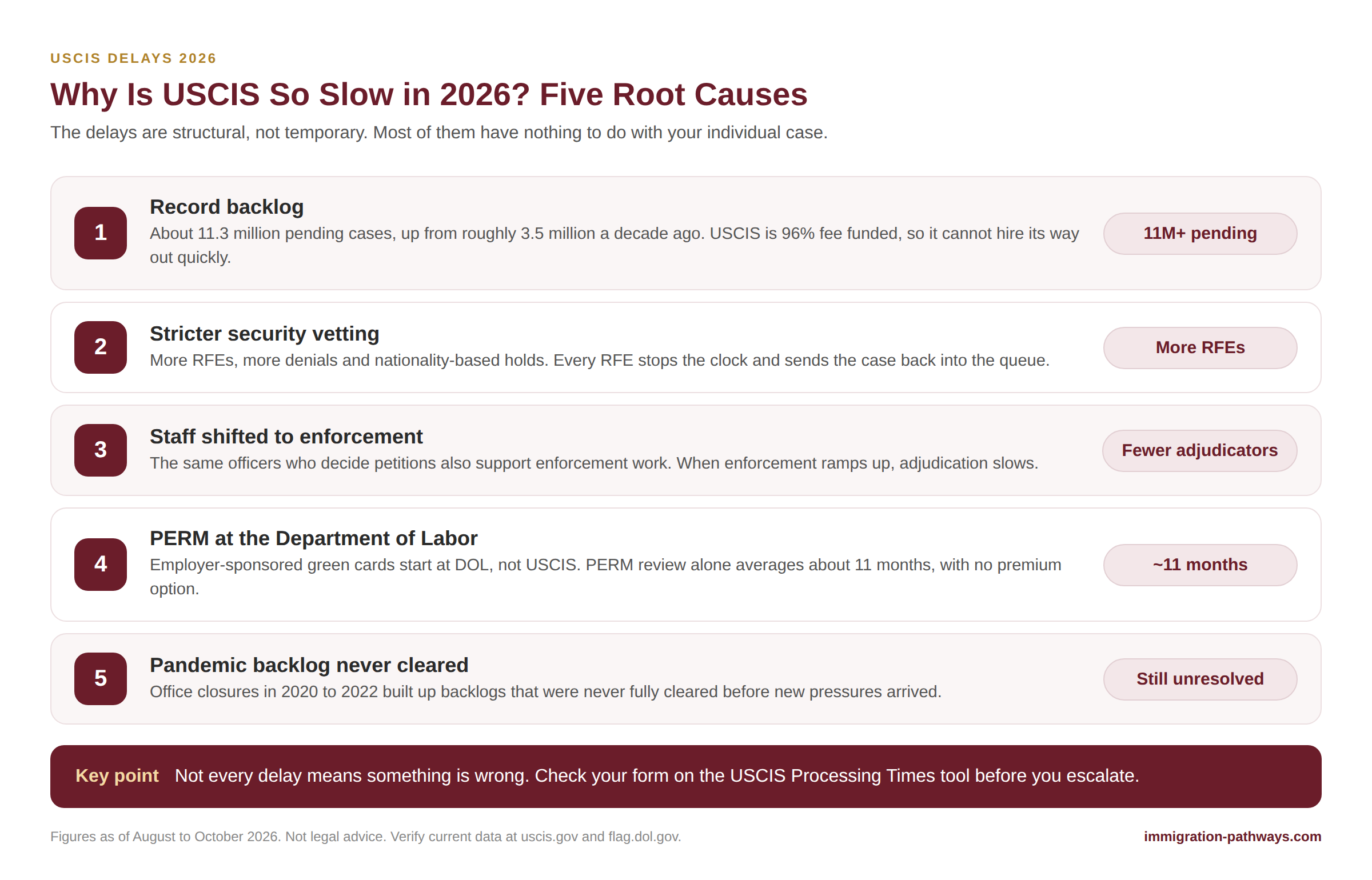
Why Is USCIS So Slow in 2026? The Five Root Causes
1. A record backlog from rising volume and structural underfunding
In the last full fiscal year with available data, USCIS handled around 11 million applications, petitions and requests. Because new filings have outpaced completions in recent quarters, the backlog has grown sharply. According to the American Immigration Council, the backlog stood at about 11.6 million at the end of September 2025 and about 11.3 million at the end of December 2025, and it has since climbed back above 11 million. A decade ago it was about 3.5 million.
That makes this a structural problem, not a temporary one. USCIS is almost entirely fee funded: about 96 percent of its budget comes from filing fees, not congressional appropriations. This creates a loop. To hire more adjudicators, USCIS needs more fee revenue, and more fee revenue comes from processing cases faster. On February 14, 2025, DHS also terminated about 50 USCIS probationary employees as part of a federal workforce reduction, at a time when the agency needed staff most, although the cut was smaller than at other federal agencies that year.
2. Increased security vetting and stricter scrutiny
USCIS has applied more thorough scrutiny to green card and naturalization cases in 2026. The result is more denials, more cases sent back, and longer processing overall.
Officers are also issuing more Requests for Evidence (RFEs). An RFE stops the clock on your case. It adds more than just the time you need to respond: once you submit your documents, the case goes back into the review queue.
The 39-country hold and where it stands. On December 7, 2025, USCIS paused decisions on green card, work authorization, citizenship and asylum cases for nationals of the 39 countries on the travel ban list. A federal court in Rhode Island vacated that hold nationwide on June 5, 2026, finding that the government had not shown it was necessary. That did not end the delays. Members of Congress have reported that USCIS applied broader enhanced vetting in spring 2026 that held decisions for nationals of more than the original 39 countries, and lawmakers have asked USCIS and FBI officials how many cases were affected. In practice, nationals of many countries still faced security-related delays after the hold was vacated.
3. Enforcement priorities drawing resources away from adjudication
USCIS has reassigned significant staff to immigration enforcement operations, which reduces its capacity to decide cases. Applicants with straightforward, uncontested cases wait longer because the officer who could have decided their case is busy elsewhere.
The reason is structural. USCIS officers are not split into separate benefits and enforcement workforces. The same pool of officers decides pending petitions and supports enforcement-related work, such as worksite inspection support, cooperation with removal proceedings and fraud detection. When priorities shift toward enforcement, officers are pulled from that shared pool, and fewer people are left to work through the backlog. That is why benefit processing slows down when enforcement ramps up.
4. PERM: the Department of Labor bottleneck nobody talks about
For employer-sponsored EB-2 and EB-3 green cards, where you cannot self-petition, the process does not start at USCIS at all. It starts at the Department of Labor (DOL), which must first certify the PERM labor certification.
DOL reports an average of 336 days, about 11 months, for PERM decisions issued in August 2026, and as of October 2026 its analysts were reviewing applications filed in January 2026. That is only the DOL review. Add the prevailing wage determination (about 3 to 4 months right now) and the mandatory recruitment period (60 to 180 days), and PERM takes roughly 16 to 22 months end to end. CHECK: confirm the current average on flag.dol.gov/processingtimes before publishing.
If your case is selected for audit, randomly or because of something in the filing, it moves to a separate audit queue and takes longer.
What this means for your green card. If your employer starts PERM now, the I-140 petition will likely not be filed until around 2028. That still assumes no delays at the I-140 stage, in the Visa Bulletin or at the I-485 stage. For the full PERM timeline and audit triggers, see our guide to PERM labor certification processing time.
Planning point. DOL does not offer premium processing for PERM or prevailing wage determinations. That is different from USCIS forms such as the I-140, which do have premium processing.
5. The pandemic backlog was never fully cleared
USCIS closed offices for in-person services and built up backlogs in almost every category during 2020 to 2022. The agency reduced its backlog by around 15 percent in fiscal year 2023, but new filings and new structural pressures have since erased that progress. The pandemic backlog was never fully cleared before the next wave of delays arrived.
How Long Does USCIS Take in 2026? Normal Processing Times by Form
Processing times vary widely by form, visa category, USCIS office and individual circumstances, such as whether you receive an RFE. The ranges below are approximate as of mid-2026, based on government and practitioner sources. They give you a sense of what to expect, not a promise for any individual case.
Use the USCIS Processing Times tool to check your specific form and office. Many service center forms are now listed under "Service Center Operations (SCOPS)".
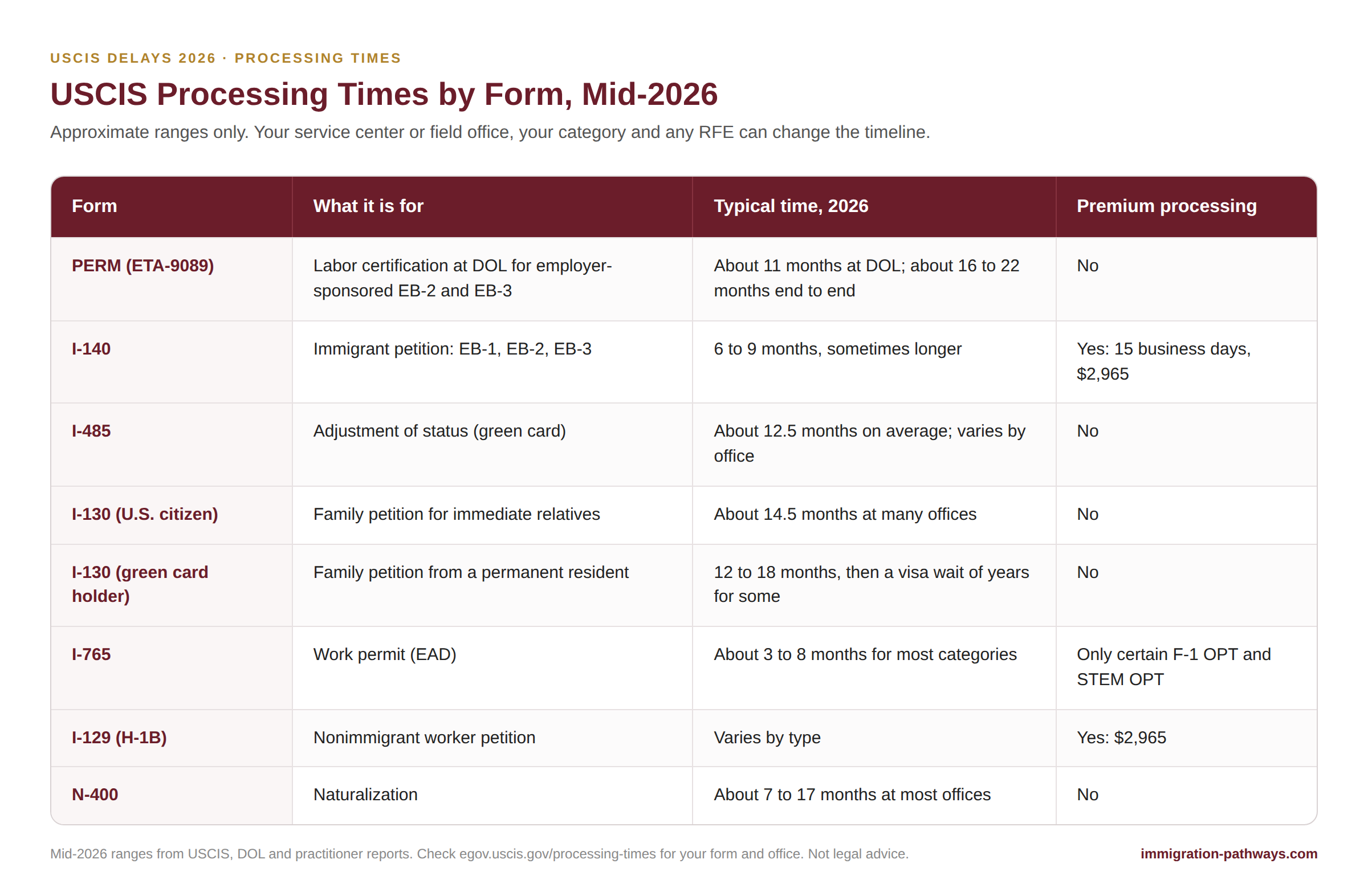
- PERM (Form ETA-9089, DOL, not USCIS): labor certification for employer-sponsored EB-2 and EB-3 green cards. About 11 months for DOL review, about 16 to 22 months end to end. No premium processing.
- I-140: immigrant petition for EB-1, EB-2 and EB-3. About 6 to 9 months standard, sometimes longer depending on the service center. Premium processing: 15 business days for $2,965.
- I-485: adjustment of status (green card). About 12.5 months on average, with wide variation by field office. No premium processing.
- I-130 filed by a U.S. citizen: family petition. About 14.5 months for immediate relatives at many offices, with a wider range by category and service center. No premium processing.
- I-130 filed by a green card holder: family petition from a permanent resident. About 12 to 18 months for the petition; the total wait including visa availability can be years or decades for some categories. No premium processing.
- I-765 (work permit, EAD): about 3 to 8 months for most standard categories; some renewals and categories take longer. Premium processing only for certain F-1 student categories (OPT and STEM OPT). See the October 2025 rule change below.
- I-129 (H-1B): nonimmigrant worker petition. Time varies by petition type. Premium processing available for $2,965.
- N-400 (naturalization): about 7 to 17 months at most offices, with additional pauses reported for some nationalities because of the vetting issues described above. No premium processing.
A note on the I-485 average. The 12.5-month figure is an average across all I-485 applications. Your timeline depends on your field office (based on your address), green card category, whether an interview is required, and other case-specific factors. Employment-based cases, especially those with interview waivers, move differently from family-based cases.
The EAD automatic extension rule changed in late 2025. For years, a timely filed EAD renewal in an eligible category received an automatic extension, first up to 180 days and later up to 540 days. That changed on October 30, 2025. For renewals filed on or after that date, most applicants no longer get any automatic extension just for filing on time, with narrow exceptions such as TPS-based EADs, which follow their own rules. This directly affects I-485 applicants renewing under category (c)(9), historically one of the largest groups relying on this protection. If you filed your I-765 renewal before October 30, 2025, an extension already granted under the old rule still applies on its own terms. If you are filing a renewal now, do not count on an automatic bridge: file as early as your category allows, generally up to 180 days before expiration, and plan for a possible gap between your old EAD's expiration and the new one's approval.
Premium processing fee increase. Premium processing fees went up on March 1, 2026. Filings submitted on or after that date with the old fee are rejected, which delays your case. The premium processing fee for Forms I-129 and I-140 is now $2,965. Check current fees at uscis.gov/forms before filing.
How Long Does an Employment-Based Green Card Take in 2026?
For H-1B workers applying for an EB-2 or EB-3 green card through PERM, by far the most common employment-based route, the 2026 timeline involves three agencies, six stages and several bottlenecks.
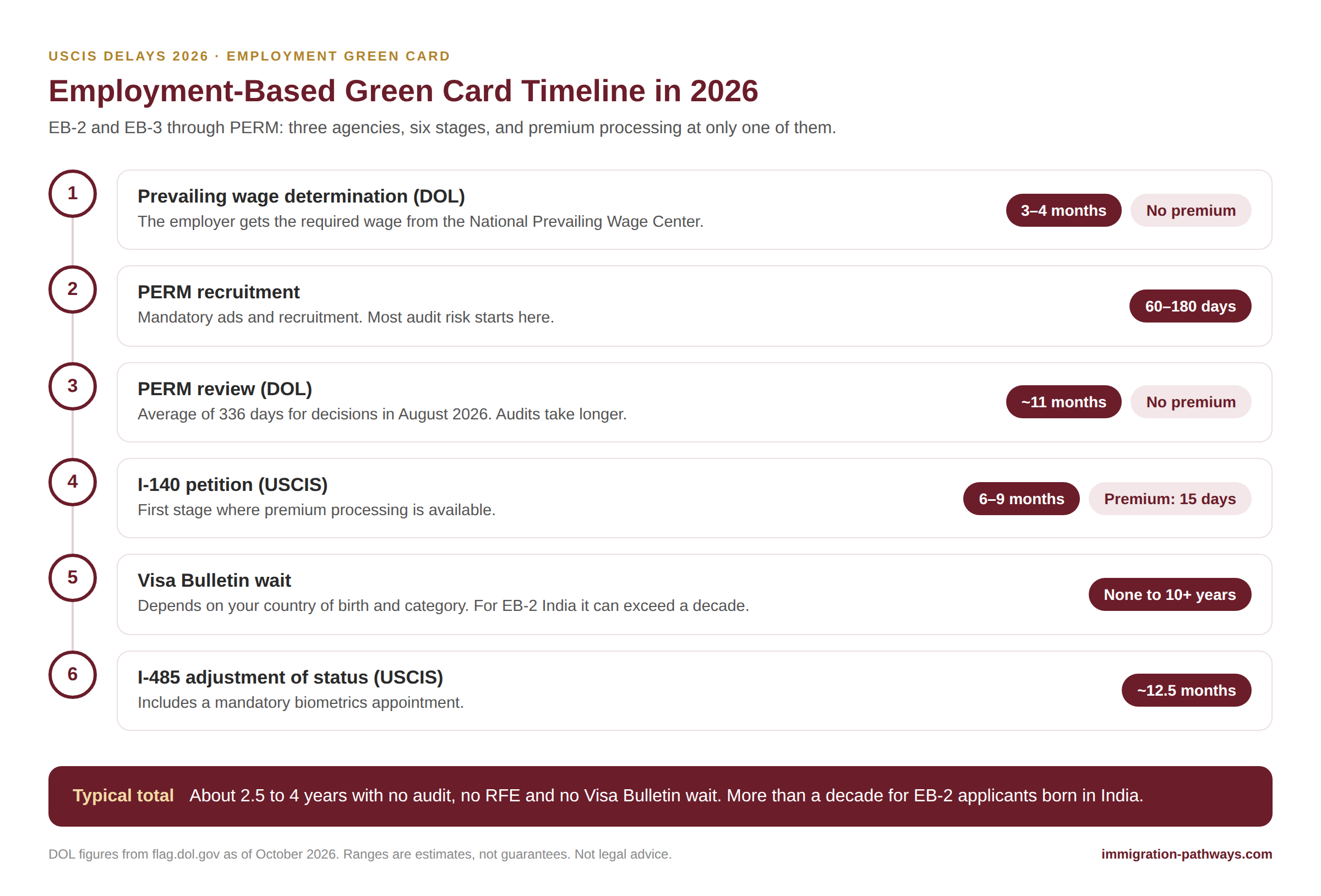
- Prevailing wage determination (DOL): about 3 to 4 months. The employer needs a certified prevailing wage from the National Prevailing Wage Center before starting recruitment. No premium processing.
- PERM recruitment: 60 to 180 days. The employer completes the recruitment steps DOL requires. Timing depends on the employer, and this is where most audit risk comes from.
- PERM review (DOL): about 11 months. DOL reported an average of 336 days for decisions in August 2026. Longer if audited. No premium processing.
- I-140 petition (USCIS): about 6 to 9 months, or 15 business days with premium processing ($2,965). This is the first stage where premium processing is available.
- Visa Bulletin wait: none to more than a decade. After the I-140 is approved, your wait for a visa number depends entirely on your country of birth and preference category. For EB-2 and EB-3 applicants born outside India and China, the wait is usually short or none. EB-2 India was "Unavailable" for the last months of fiscal year 2026 and reopened on October 1, 2026, with a Final Action Date of November 1, 2013 in the October 2026 Visa Bulletin. Only applicants with a priority date before that date can be approved. For someone whose priority date is set today, that points to a wait of well over a decade. That is not a delay in the usual sense; it is a structural limit of the immigration system. CHECK: confirm the EB-2 India date in the latest Visa Bulletin on travel.state.gov. For how to read the chart, see Visa Bulletin explained.
- I-485 adjustment of status (USCIS): about 12.5 months, including a mandatory biometrics appointment.
Realistic total. For EB-2 applicants born in India: more than a decade, depending on how the Visa Bulletin moves. For most other applicants: about 2.5 to 4 years, assuming no audit, no RFE and no Visa Bulletin wait. For strategy across EB-2, EB-3, EB-1A and NIW, see the H-1B to green card roadmap.
Why Is My Case Taking Longer Than Average?
Even within the ranges above, individual cases vary a lot. These are the most common case-specific reasons for delays beyond normal expectations.
- RFEs and NOIDs. An RFE pauses the case and adds both your response time and a second review. A Notice of Intent to Deny (NOID) is more serious: the officer has reached a tentative decision to deny. You generally have about 30 days to respond, but response windows vary by form and situation, and the deadline printed on your notice always controls. If you receive a NOID, contact an immigration attorney right away rather than treating it like an RFE.
- Background checks and security holds. Some cases, especially in technology-sensitive fields, for certain nationalities or with security flags, go into administrative processing with referrals to other agencies. This usually means weeks or months of invisible delay, and generally neither you nor USCIS can speed up the referral. A Tier 2 officer at the USCIS Contact Center can usually tell you whether your case is on hold for a background check.
- Biometrics scheduling. After you file an I-485, USCIS sends a biometrics appointment notice. The case cannot move forward until your biometrics are collected and cleared, and some regions add weeks of scheduling delay.
- Incomplete applications. Missing documents, incorrect payment or inconsistent information between the form and supporting documents lead to rejection or an administrative hold. This is entirely within your control.
- Different workloads between offices. The same form can take very different amounts of time depending on the service center or field office handling it. Field offices especially vary in scheduling and caseload.
- Case transfers. Your case may be transferred to another office, and the transfer may or may not show in your case status. After a transfer, compare your case against the processing times for the receiving office, since that is the benchmark USCIS applies from then on. Your receipt date does not change: the case inquiry date is still calculated from your original receipt date, so a transfer does not restart your clock.
- PERM audits. An audited PERM case moves from the regular analyst queue to the audit queue and usually takes noticeably longer. Common audit triggers include unusual job requirements without documented business necessity, an ownership or family relationship between the employee and the employer, layoffs in the same occupation in the last six months, and job duties that do not fit the occupation code.
What Can You Do If Your USCIS Case Is Delayed? A Checklist
If your case is within the normal processing window
- Keep tracking your status, nothing more. Contacting USCIS early does not help your case and only adds noise.
- Turn on automatic updates in your myUSCIS account so you don't have to check manually every day.
- Keep your address current with the USCIS Change of Address tool. Otherwise RFEs and interview notices go to the wrong place, which can lead to missed deadlines and abandoned cases.
If you are approaching or past the posted processing time
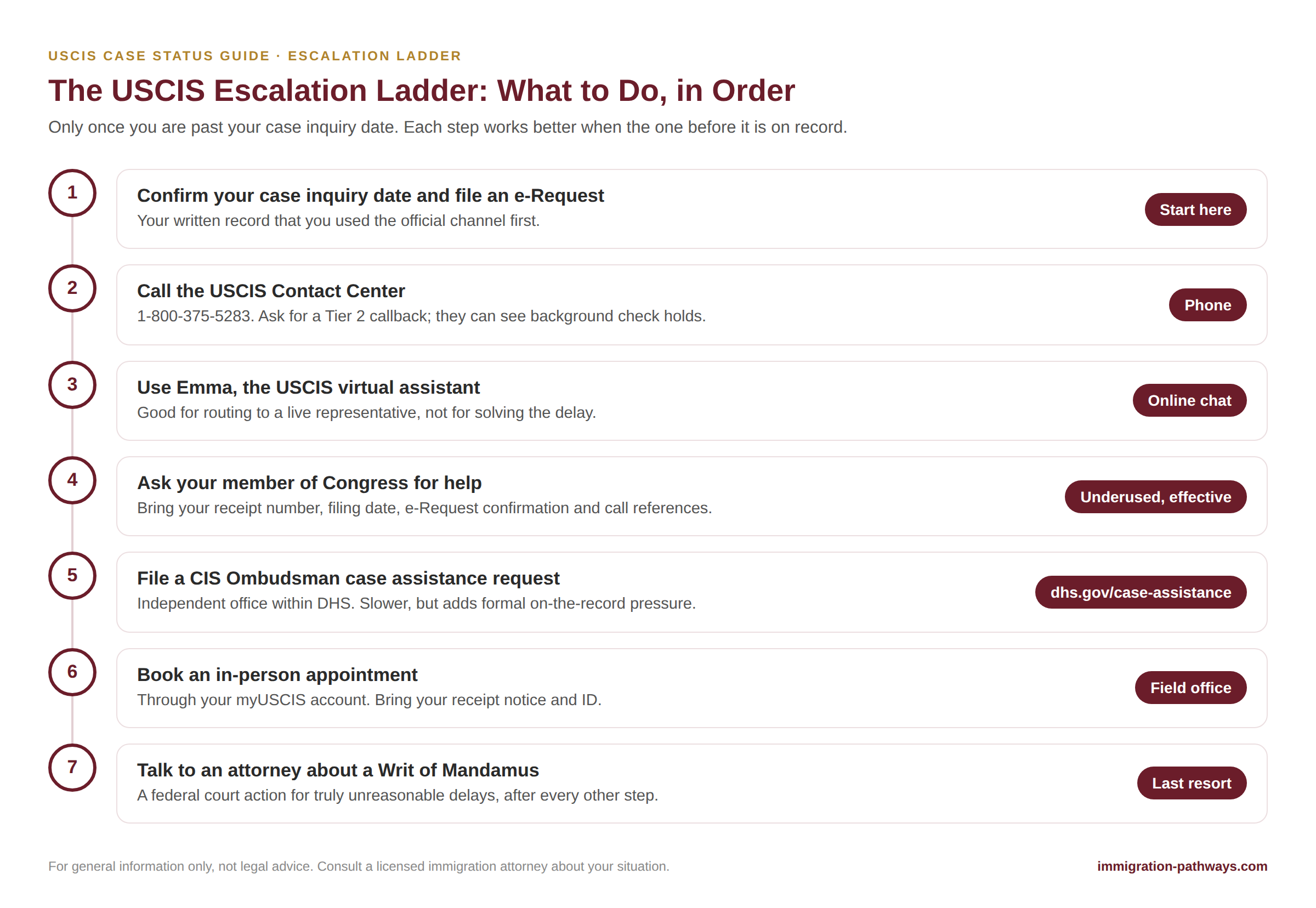
- Find your case inquiry date with the Processing Times tool. Enter your form, office and receipt date to see whether you can submit an inquiry.
- Submit an e-Request at egov.uscis.gov/e-request once you are past your case inquiry date. It creates a record of your inquiry, which you need before escalating further.
- Call the USCIS Contact Center at 1-800-375-5283 if the e-Request does not resolve the issue. Ask for a callback from a Tier 2 officer, who can see more of your case than front-line agents.
If your case is significantly delayed with no movement
- Ask your member of Congress for help. This is one of the most underused options. Congressional offices handle immigration delay inquiries all the time, a formal inquiry gets an official response, and the service is free. Find your representative at house.gov/representatives.
- Request case assistance from the CIS Ombudsman at dhs.gov/case-assistance. The Ombudsman is an independent office within DHS, separate from USCIS, that helps resolve problems such as undue delays. It generally expects you to have tried to resolve the problem with USCIS first; check its current requirements before you submit.
- Book an in-person appointment through USCIS if you think the delay comes from an administrative problem that needs to be sorted out face to face.
- Talk to an immigration attorney about a Writ of Mandamus, a federal court action against USCIS, if your delay is truly unreasonable.
For step-by-step help with a case status that has not changed, see what to do when your USCIS case status hasn't updated.
Can You Ask USCIS to Expedite Your Case?
USCIS reviews expedite requests case by case, at its discretion. Its published criteria include:
- Severe financial loss to a company or person, as long as the need is not caused by the applicant's own failure to file or respond on time
- Emergencies or urgent humanitarian situations
- Nonprofit organizations (as designated by the IRS) whose request furthers U.S. cultural or social interests
- U.S. government interests, such as cases involving public safety, national interest or national security
- Clear USCIS error
Needing to start a new job is not, by itself, a recognized reason to expedite, although severe financial loss caused by the delay can qualify if it is properly documented. Be realistic about how high that bar is. USCIS states that the need for employment authorization alone, without other compelling factors, does not warrant expedited treatment. It wants current, specific, quantified evidence of the loss, such as financial statements, contracts or figures tied directly to the delay, not a general description of hardship. Approval rates for expedite requests, especially those citing financial hardship without that kind of evidence, are commonly reported to be well under 20 percent. File an expedite request when the criteria clearly apply, but do not rely on it to speed up your case. A denied expedite request does not slow down or harm the underlying case; it simply continues in normal order.
Submit expedite requests through the USCIS Contact Center, or through your myUSCIS account if your form type allows it.
PERM cannot be expedited at all. DOL offers no premium processing for PERM or prevailing wage determinations. Build that into your timeline planning.
How to Protect Your Status During a Long Wait
Long delays carry specific risks that can turn the delay itself into a status problem. In each situation below, a wrong guess can be costly: loss of status, an abandoned application or lost work authorization. The right move depends on facts specific to your case, so treat each one as a reason to talk to an attorney, not just something to watch on your calendar.
Your EAD expires while your I-485 is pending
If your EAD is close to expiring and your I-485 is still pending, file Form I-765 for a renewal early. Do not wait for the EAD to expire or assume the renewal will be approved in time. EADs do not renew automatically, and for renewals filed on or after October 30, 2025, most categories no longer get the automatic extension that used to cover the gap. File early and do not assume you are protected in the meantime.
Traveling while your I-485 is pending
Leaving the U.S. while your I-485 is pending, without an approved advance parole document (Form I-131), is treated as abandoning your I-485. File Form I-131 together with your I-485 and avoid international travel until advance parole is approved, unless you hold a valid H or L visa stamp, which may allow you to return under certain conditions. Even then, questions can come up about whether you are re-entering on parole or as an H or L admission, so check with an attorney before you travel after filing the I-485.
A child close to aging out (CSPA)
The Child Status Protection Act (CSPA) can protect a child who turns 21 during a long wait, but it is not automatic and missing the timing has no remedy. The formula subtracts the time your petition was pending (from filing to approval) from your child's age on the date a visa number becomes available. That calculated age, not just the calendar, decides whether your child still counts as a child. It has to be run against your actual filing dates. If a child listed as a derivative on your petition is approaching 21, talk to an immigration attorney before the 21st birthday, while there is still time to act.
Your employer withdraws the I-140
If your employer withdraws the I-140 behind your green card case, what happens depends on timing. Three separate protections can apply.
- Priority date retention. Once an I-140 is approved, you generally keep its priority date for a future I-140 filed by a new employer, even if the original employer later withdraws it. The exceptions are revocation for fraud or willful misrepresentation, revocation or invalidation of the labor certification, or material error by USCIS. This protects your place in line, not a pending I-485.
- The 180-day rule for the petition itself. If the I-140 had been approved for 180 days or more, or your I-485 had been pending for 180 days or more, before the withdrawal, the petition is generally not automatically revoked. It stays valid for purposes such as H-1B extensions beyond six years and I-485 job portability.
- AC21 job portability. Once your I-485 has been pending 180 days or more, you can generally change to a job in the same or a similar occupation without losing your place in the adjustment of status process.
Knowing which of these protections you have is exactly the kind of question to take to an attorney as soon as your job looks uncertain, not after the I-140 has been withdrawn. If you have been laid off, see H-1B layoff: the 60-day grace period and your options.
The H-1B six-year limit while PERM or the I-140 is pending
H-1B status is generally limited to six years. Extensions beyond that are possible, but the type of extension changes as your green card case moves forward.
- One-year extensions (AC21 Section 106(a)): available if your PERM or I-140 was filed at least 365 days before you reach the six-year limit.
- Three-year extensions (AC21 Section 104(c)): available once your I-140 is approved but your priority date is not yet current, so you cannot file the I-485. These can be renewed as long as the I-140 stays approved and no visa number is available. For backlogged categories such as EB-2 India, that can mean years of three-year extensions.
- Once your priority date becomes current: you generally need to file the I-485, or apply for an immigrant visa through consular processing, within one year to keep qualifying for extensions. Extensions then continue in one-year increments until a final decision on your case.
Without a green card case in progress, the six-year limit means a real gap in status. Plan your green card process alongside your H-1B renewals, and confirm with your employer's immigration counsel which extension type applies to you, since it changes as your case moves forward.
Frequently Asked Questions
Why hasn't my USCIS case status changed for months?
The USCIS case status page updates only when specific events happen: biometrics captured, RFE issued, interview scheduled, decision made. Between those events, a case can be in active review for months with nothing visible. Before assuming something is wrong, use the Processing Times tool to find your case inquiry date and confirm whether you are still within the normal range. See also what to do when your case status hasn't updated.
Does premium processing guarantee a faster green card?
No. Premium processing guarantees a decision within 15 business days on the specific petition it is filed with, Form I-129 or I-140. It does not shorten Visa Bulletin waits, I-485 processing or consular processing, and it is not available for PERM at any stage.
Can I do anything to speed up my PERM case?
The most effective step is filing a complete, well-documented PERM application from the start, which lowers the risk of an audit. Once it is filed, there is no way to expedite PERM. DOL processes applications in the order received, there is no premium lane, and filing in a particular month or quarter does not reliably improve timing.
Does an RFE reset the clock on my USCIS case?
In effect, yes. An RFE pauses the case while you respond, and after you respond the case goes back into the review queue. That adds both your response time and a second review. Answer the specific issue the officer raised, completely and directly. Sending more of the same evidence the officer already found insufficient usually leads to a denial.
I have waited past the posted processing time. What are the steps, in order?
Find your case inquiry date with the Processing Times tool, then submit an e-Request, then call the Contact Center, then contact your member of Congress, then request help from the CIS Ombudsman, then talk to an attorney about a Writ of Mandamus. Follow this order; don't do everything at once or skip ahead.
Official Resources
- USCIS Processing Times: current processing times by form and office
- USCIS Case Status Online: check your status with your receipt number
- USCIS e-Request: submit a formal inquiry
- USCIS Contact Center: 1-800-375-5283
- myUSCIS account: set up automatic status alerts
- USCIS Change of Address: keep your address current while any case is pending
- DOL FLAG processing times: PERM and prevailing wage queues
- CIS Ombudsman case assistance
- Find your representative
- Visa Bulletin: check monthly
Final Takeaway
USCIS is slow in 2026 for real, documented, structural reasons: a record backlog of more than 11 million pending cases, reduced staffing, stricter vetting, and enforcement priorities pulling resources away from benefit decisions. For employment-based applicants, the delay starts before USCIS even sees the case: PERM takes roughly 16 to 22 months end to end, and it cannot be expedited.
Two distinctions matter most. First, is your case within its normal processing window, or truly stuck? The Processing Times tool tells you which, and the answer should drive everything you do next. Second, is this a delay you can act on, such as an expiring EAD, an RFE deadline or advance parole before travel, or one you cannot, such as a background check hold, a Visa Bulletin wait or your place in the PERM queue? Knowing which kind of delay you face is the starting point for everything else.
Processing times, fees and USCIS policies change often. Verify current information at uscis.gov and dol.gov before making filing or timing decisions. This article is not legal advice.